
Episode 124 - Mike Chudley
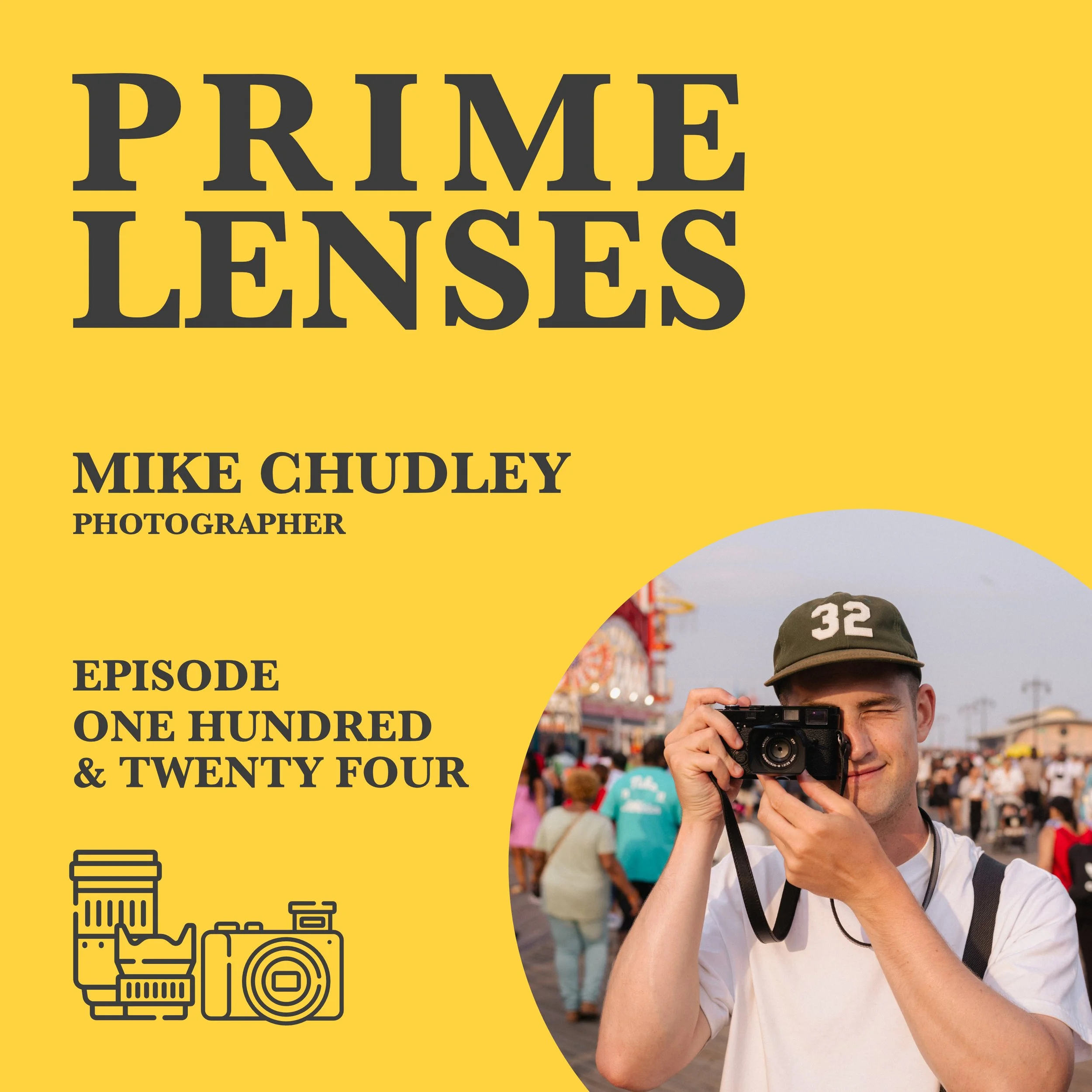


This week I’m joined by Mike Chudley, a Photographer and YouTuber based in the UK. We begin talking about other creators we admire and spoke as he was putting the finishing touches to his video about a trip he made to China.
Support the show on Patreon.
Episode Transcript:
Iain:
Hello, welcome to Prime Lenses. I'm Iain. This week on the show, my guest is Mike Chudley. Mike is a street photographer based in the UK who has also made a name for himself on YouTube and is soon to be publishing his second book. I saw that this was coming out and thought there'd be a great time to jump in and try and have a conversation with him. And we also a couple of friends in common in the form of Dave Herring and Cal Holland, recent guests of the show. So sit back, relax and enjoy this lovely chat with a very thoughtful photographer. Here's Mike.
Mike Chudley:
they did a conversation with Ben did a conversation with Joe Merritt didn't he in his house in London and like that was like an hour and something wasn't it yes and I loved it I thought it was great I thought that was fantastic I love Joel Meyerowitz but it's real because he obviously loves
Iain:
Joel as well right and that's the thing that it comes across that I recorded I recorded an episode with Joel at his house with his wife last summer amazing and sat with with the people who made the film about him and Maggie and we went to I I've sat in that kitchen right and we we recorded there and it gives the episode a different feel and the excitement is clear. And that's why that one works, which I think is a nice segue in. The excitement and the real, the honesty of what's happening, of the interaction is there. So it's not staged. Ben is clearly, as we all are if you meet your heroes, right? That's such a phenomenally exciting thing to happen. And so it just comes through as an honest experience and honest interaction. That's why that works. versus sometimes sticking someone between a couple of plant pots on a soundstage. And it's a bit less, especially if you're having to do two a day for five days and just stack them up. You need to give the host time to go out and touch grass for a bit. Otherwise, if I had to do three of these a day.
Mike Chudley:
I think broadly speaking, people can pick up on how enthusiastic or and authentic uh the conversations are whereas if you're like getting people together intentionally to record something because you know you need to record an interview for the consistency of the show like you're doing it because you're booking it in advance and it's like it's a it's something that has to be done as opposed to something that you really want to do I think the audience can immediately whether it's a podcast or YouTube video know that oh this guy's having fun like this is something this person wants to be doing, regardless if there's four viewers or four million viewers. I think that stands out more than anything when I watch anything or listen to anything.
Iain:
Yeah, no, for sure. And that's been the secret of the show for the three years I've done it, right, is I only talk to people I want to talk to. You know, like, only talk to someone because I think they're cool. That's it, that's good. Yeah, yeah. Well, on the subject of cool, it would be lovely to pick up, I think, in the first instance, because the thing you're working on at the moment which I have found really exciting and enjoyed your kind of build-up is your coastal project that you've started to do so I know you from like our shared acquaintance with Dave Herring he's all right but I'd love to hear about your personal project because a bit like dave lights up when he was talking about his abandoned towns project that he did a couple of years ago you seem to really come alive in those interactions with people like Carol on the boat and the dog and stuff like that. And I'd love to know, that seems to be scratching a different itch for you compared to your street photography. Everyone, I think, listening to this will know you as a street photographer, but that, to me, there's a real difference. Like, you do seem to really come alive in those videos.
Mike Chudley:
Yeah, I think I started doing that because where I live in the UK, I can go 30 minutes west and I end up in the city, which is amazing. And if I go 30 minutes east, I end up at the coast. because the UK is magical like that and you're never that far away from the coastline. And I wanted to try and keep up a consistent routine of taking pictures. But that means that sometimes I can't spend all day in the city because life drags you in other directions. But if I can get out in the morning for an hour or two, then that means I'm at least picking up my camera and pressing the shutter button. So my goal was, if I just head to the coastline, coastlines are beautiful, they're aesthetic, you don't really have to try much. If you're just looking for a sunrise or a sunset, it's nice. it's peaceful so I started going on these walks uh I mean I've lived down south in in Essex because I moved from Lincolnshire just for context I moved like 10 years ago I moved down south to Essex and I've been walking along the coastlines just exploring just because I wanted to get to know the area and I've been doing that for like probably just before covid um and I have a bit of a catalog of photographs from Southend uh Leighton Constantine Canvey Island uh you know Malden just all over the southeast coastline and I made a couple of POVs over the years and I've shared a couple of pictures over the years but not full extent not really giving it much focus just as and when but then I'd say about a year ago I made one vlog from that walk from those morning walks I can't remember I went to when I made the first video and I kind of just said in the video I brain dumped maybe this could be a project to pursue I don't know if I was inspired by a recent conversation with somebody or I watched somebody else talk about starting a project or it was just something that I just realized that actually I could give this some focus, give this some time. And it doesn't, not that I'm half-arsing it, but it doesn't require a full day in London. It doesn't require me to go and do and create the most witty, meaningful, best documentation of human life. Whereas when I go and do street photography, if first and foremost, I'm just enjoying the day out because I think London's the best. But in the back of my mind, I have expectations of and maybe I shouldn't have expectations but I do have a high standard of I want to go and take some good street photographs um and people can always say you know like you enjoy the process I'm one of those people all the time but I can't help but want to progress and actually get results that's like a it's like a human instinct you know like I want to be getting better at this um so with street photography I'm like always battling that okay just enjoy your day whatever comes of it is whatever it doesn't matter but also like it would be cool to get really good at this I've seen the progression of my work over the last 10 years and it's been so fulfilling. But this coastline stuff is just the most peaceful, relaxing. I'm just having a good time. I really am just having a good time. And then when I put it online that maybe I should pursue this project in a few videos, like you just said, I think people have started resonating with that idea a little bit as well. And I was surprised actually that I could make a video about London street photography and it gets received really well, which is fantastic. I'll make a video about walking along the beach in Southend and people equally seem to think it's cool so I'll continue sharing it I was just going to do it for myself and I am doing it for myself but now I know people are following along on that journey I'll continue to document it as well so it's kind of accidental until I realized that maybe it had some legs and here we are I'm probably going on these morning walks at least once a week whether I film it or not but that's where we're at
Iain:
I think the reason it's probably resonating with an audience is for the same reason it probably hit with me was that you're clearly enjoying yourself doing something different. And one of the things I do enjoy your videos because you clearly do read and think and try and put your work into context and you're interested in the wider context of photography for sure. When you made a comment actually in one of those videos about it's and you've mentioned this sort of thing a few times about it's kind of meditative and doing something different. Like it didn't matter that you're trying that lens out, shooting some black and white on a seafront because it was just so calm and so early in the morning. I think that difference is probably part of the power. Is that helping, is doing one then helping you when you shift back to the other?
Mike Chudley:
I was about to say, I think I'm enjoying the coastline stuff and the quieter mornings because of how much I've done London street photography. And I think the chaos and the madness of Oxford Street has taught me, it's like the perfect playground, has taught me that if I can shoot a photograph on Regent Street and spend all day in London hunting for the smallest details, then when I go to the coastline and something is objectively beautiful, I can really play around and have fun with it. And it's the most, it's a very stress-free form of shooting because the portraits I'm taking of people and even the wider environmental landscapes or however you want to describe it, still life of sorts. I'm seeing all of that because of my street photography reps. I'm seeing the details on boats and the way the light reflects through windows purely because I've seen a million different things in London because I feel like street photography just throws everything at you. So then when you decide to go and pursue something separate from it, you've already learned so much. And taking portraits of people like Carol on the boat when she was on that big barge boat. That was so easy to do and approach and take that picture because most of the time I'm in London struggling. So you go to the coastline where it's just super peaceful. It's like, actually, this is way more approachable. This is way more doable. So it's like, in a weird way, street photography is very accessible for the whole world, but you are also throwing yourself in the deep end if you walk around London. It's a somewhat difficult thing to do. So then you go to a beautiful landscape and you realize, ah, I can breathe a little bit here. This is really nice.
Iain:
Things are happening a little bit more slowly rather than stuff coming at you. This is why I think street photographers and wedding photographers are two of the types of photography that I, they're sort of a little bit magic to me because they move at a pace. Because the thing is, you're also, I mean, I know you're zone focusing and things like that, but you're shooting a manual focus rangefinder style camera with a prime lens. And you're still managing to catch the moments like you're over your shoulder. You've got one of your photos, which I would say is a kind of very well-known mic shot, which is the guy in the suits walking towards you. And that guy looks stressed. Yeah.
Mike Chudley:
He's going somewhere. He's got an expression on his face for sure.
Iain:
Yeah, he's either going to a meeting he doesn't want to go to or has just had a meeting he didn't want to go to. He doesn't he does not look happy. But your photos are interesting that way, a bit like Cal's, right, where they raise they ask a question. Not that the entire answer is not in the frame. Is that something that you are always looking for in your street images?
Mike Chudley:
Yeah, thank you for complimenting the image, because that is one of my personal favorites. But I think especially Cal's work, because Cal's a phenomenal street photographer. And I always think that when Cal posts a set on Instagram, or he might show me a picture of sorts, I always think, where and how did you see that person doing that? Because I just spent all day with you. I just walked around with Cal for three hours, and I didn't see that. And then he'll come back at the end of the day and be like, oh, did you see this thing? And I'm like, what? And he'll post whatever photo on Instagram. And I think, is he just the luckiest person? He sees the most random, phenomenal characters. And obviously it isn't luck. He's putting in the work and he's out there a lot and his eyes, he never drops the ball. You know, his eyes are on the move all the time. But I think with my work, I do enjoy the idea that the viewers don't and everyone else doesn't have context to what's going on. And all you have is that 35mm frame. I guess we're just describing a love for documentary photography, generally speaking. Like no matter how objective you are with the pictures you take on the street, there is still some questions left unanswered. And the more obvious something is in frame, but less obvious to why it's in frame, is a nice perspective. And Cal's work is, okay, that's obviously somebody with an interesting tattoo, but then you're left with all the reasons why that person has that tattoo. You don't know why. You'll never meet them. You'll never get an answer for it. And I guess the photograph over my shoulder that we can describe as just a black and white shot of a guy in a suit going to work. It's pretty obvious what you're looking at. It's not an abstract picture. It's just pretty objective. It's just a guy walking down the street. But the expression of the motion and the way the picture's framed leaves you with more questions. Where's he going? Where's he been? What's he thinking? And if a photograph can do that, I think that's really great. Not to just big up my own photograph here, But yeah, Cal's very good at that. Cal will see something interesting and it's okay for something to be objectively interesting, but it does leave you thinking more. And if an image can do that, then you're onto a winner.
Iain:
Oh, for sure. When you were coming up then and finding photography, obviously street photography was the photography that blew your mind. Who were you looking at that first made you think, wow, this is it?
Mike Chudley:
Matt Stewart, without a doubt. Matt Stewart's work in London. I think I just connected with it because it was London and I was walking down the same street. So I was walking down Oxford Street also with, you know, thinking and seeing Matt's pictures in my mind. And then going back and looking at John Merowitz's work in New York was just phenomenal. And Elliot Erwitt's work, he's basically taken a good picture of everything. Yeah, so you start going back and looking at some of the history of it to start getting an understanding of what's possible been done and I think as soon as you first of all see one of Matt Stewart's London pictures you go nah that didn't really happen that's surely not that's not actually what he saw that can't be real and then you go back and realize that people have been doing this forever you know since photography has been a thing almost and your mind that you said is blown by what's possible and then I I remember when I first bought three or four books you know maybe street photography now and a few of the classics um some of the collective work of photographs over the years I then think how is everybody else not seeing this like to me this is like as close to magic as it gets because it is real um and then my fascination just actually exploded after that so definitely matt stewart I think with that one um just because I was in London and I saw I can't remember I think I was in waterstones or something I saw his one of his pictures in like 2019 and I was like whoa this is
Iain:
nuts yeah matt's the real deal um I'm hunting him down as a future guest currently he's we have
Mike Chudley:
friends in common he's such a good character as well his his energy is great he's he's he's always got thoughts and opinions on stuff and he's just a really good personality I did a workshop with matt in in lisbon like three years ago and it's just the best day honestly it was so good yeah
Iain:
the closest I've got to him is we shared a table but it was a screening of a movie so we were like hello how are you there was whispering but yeah so you you're finding the books how long have you been shooting now because it feels like I've been watching you for a few years and you're part of
Mike Chudley:
the furniture already that's good to know I like that is that yes yes it is um I started taking photographs of my friends and myself bmxing and skateboarding when I was so I let I was in year 10 so I was 15 I think um and I'm 29 now so it started off with pretty rubbish skate park pictures but I I have everything to thank for skateboarding and being next because I took 50 000 images over those years doing that I took so many pictures that I took good photos bad photos average photos ugly photos just I made every mistake under the sun without realizing it because I was just doing every day with my friends and then when I left college and started working I moved down south from Lincolnshire to pursue video and photo work because Lincolnshire is very boring and I was like I need to be you know around London I need to meet some people I need to venture out get out get out of my hometown so I moved to Essex um I started pursuing video photo work which I'm thankful to say I still do today um but everything I learned at the skate park applied to real life and the street skating applied to street to street photography and um just being out with a camera throughout my teenage years made that when I was an adult doing it professionally actually if I can photograph somebody jumping down a 10 stair then photographing this portrait on a white background is going to be super easy so um yeah skateboarding and bmx taught me everything got me off the ground if that makes sense yeah do you know good pun and I am you're
Iain:
the third guest in like as many weeks who has told me that like they got their start philip reinhardt and nicholas pettersen who's this weekend as we're recording who's a danish photographer and then you'd like that skate I think there was something magic about the culture around that
Mike Chudley:
art because it was so accessible I was about to say it's it's the skateboarding and bmx culture and this is a bold thing to kind of say but I remember hearing someone else say this But that culture only exists as worldwide and internationally as it does through the medium of photo and video. So in the 80s in California, in the 70s in California, the locals skated home from a surf session. But other than that, nobody knew about it. Now, as soon as it started getting published, as in photographs were taken, videos were made, then the rest of the world saw it. And then you have the likes of Jackass in the early 2000s that really made it into everyone's home. And then like the skateboard culture, Thrasher magazines, Sidewalk magazines, Ride UK for BMX stuff. That is something that you follow. And it only exists because of the content, not to demean it all into content. It's not content as we see it today. But the front cover of a Thrasher magazine was the photographs that I look forward to seeing. And I didn't realize that it was the medium of photography that was doing that. I just wanted to see the front cover of who did the best trick this month. But that wouldn't be possible without pictures. And I just think if taking videos, recording things, documenting life wasn't possible, would the skate and BMX culture be as big as it is right now?
Iain:
Probably not. Yeah, but filming it was always part of it, wasn't it?
Mike Chudley:
Yeah, because if 10 people are at a street session and someone does something crazy down a stair set, only 10 people saw it. And then that's it. Everyone goes home. Okay, cool. Then what? But actually, if someone's there to take a picture, 10,000 people now get to see it because it's the front cover of this week's Sidewalk magazine. So I noticed that as a photographer, as I grew up, that actually photography is everything for everybody else to enjoy. For everybody else to enjoy this, it needs to be documented. And I do think about that when I'm making stuff.
Iain:
When you were making that transition from video and moving more into still, because it sounds like video was maybe the first love or was that just the thing that you could practically do? I'm just curious as to kind of how you make that move from a moving image to a still and how you think about those two different things.
Mike Chudley:
So I definitely started recording everything first at the skate park. And then, especially when I started working, people wanted videos because like having, finding a videographer or someone that can edit was rare then for me, and especially in Lincolnshire. And I did some work in Hall, a rock climbing center slash skate park there. And I was very involved in that sort of scene. I was like the local lad with the camera. And nobody knew anybody that could edit videos. So I just became that kid. So Mike can do that if you want. If you want a little promo doing for your coffee shop, like Mike knows how to do that. It's fine. Yeah. they were all terrible but at least I was trying um and then the photography aspect kicked in when I didn't need to film anything but I was there with the camera and I was like let me play and then I remember there's some local dirt jumps in grimsby if anybody listening has any any sort of relation to that area um gy dirt jumps I remember taking a few pictures there and I was so I didn't realize I was able to do it I remember just snapping away and seeing the picture and be like I think that's good I think that's a I think that's a good picture a 16 year old me just being impressed by whatever I was whatever I was doing and then I realized actually I'm more stoked on the pictures here than whatever video I've made um and I don't know if that's because the video stuff became became more work more like work and the photo stuff was like well well no one's asking me to take this picture but I'm enjoying it so uh could have that could have
Iain:
something to do with it I think one informs the other though doesn't it like that's the nice thing about making things is that you make one thing that feeds back into another thing and then you
Mike Chudley:
know they they're yeah they're sort of I mean like I know the skills are very different but like compositionally and technically they're very similar yes I'm setting up for a nice shot of this person growing over the dirt jump here whether I film it or I get a good picture I'm almost going be doing the same thing yeah um I know that the developing it becomes a little bit different and your eye changes a little bit but setting the camera up as 14 year old mike was just I didn't really know I was setting up I just pointed the camera at the dirt jump so um it was uh I didn't it was like very accessible for me I didn't overthink any of it I was just that kid with the camera and it just meant I was using it all the time yeah well I am a bit more vintage than
Iain:
you are at this point and I will say the nice thing that happens as you get older as you go from being the kid with the camera now I'm the parent with the camera at the event and so the school kind of come and tap you on the shoulder and go could you just come and do yeah and I have to be careful because there are other parents in in the kind of the community around here who are photographers so I get I know I'm like at least third on the list if everyone who does it for reels is busy then I get the email from the head going, can you go and take some photos in the greenhouse? And, you know, and they go, yes.
Mike Chudley:
It's funny, I think, as in like the community that you're in or the school that you're at or the families you're with and hanging around, it's funny because everybody's got a camera, right? But for some reason, I don't know how long this is going to last. Maybe it'll last forever. If you want it done properly, you do ask the person with the camera. But like the photographs of people's phones will also suffice. but um it's just that next step isn't it where someone says actually we we do want this officially uh let me ask someone with an actual camera um yeah I always wonder if that would change well I
Iain:
wonder whether you're touching on something quite interesting there about permission which is something that I think the skate videos in your life and the fact that I grew up around family who used cameras a lot so I didn't feel quite so much like I needed permission to start but sometimes sometimes the fact that someone just turns up holding a camera it's a bit like you know when people walk around wearing a high vis you just thought oh they must have permission
Mike Chudley:
okay yeah especially at an event I mean like if you're at somewhere where people are gathering for something specifically um any protest or any community event or whatever or any march or anything official if you've got a camera there people know what the camera's for so it kind
Iain:
of diffuses that immediately you've talked in the past about actually not feeling the need to ask for permission because you know that your you know your intentions are good yeah do you think that's that's part of the camera also signals to people what what do you mean by that signals what well signals that like I'm making images I'm thoughtfully because if it was just a phone people might go what are you doing waving your phone in my face you're you're bang on with that yeah I think if
Mike Chudley:
you have a camera and you look like you're taking it a little bit more seriously um people assume you have a reason um they don't know that reason but if you add a smile to your face then that reason seems to be okay yeah the camera camera I think in many ways um the smaller and more discreet you are with it the the more off-putting it might be for people as opposed to like you rock up I don't do this but you rock up to an event with a 70 to 200 and a big dslr people go all right cool he's the professional and it's like being that guy with the camera might actually be an easier approach than trying to hide it.
Iain:
Yeah. I did something once where I shot the studio I worked at before had like a 5D with a big lens that they would sometimes use for stuff. And then I shot some, we had some grad students coming in for a year of placement. And I then, I shot that, I used that camera because it was the one we had. And then I also switched to my M. And they, but it was funny, but their assumption was the 5D. It was like, oh, here's the big gun. And I was like, no, you know, It was like that bit in Iron Man 2. It's like it has a big gun, but the M is the big gun, really.
Mike Chudley:
I've had similar experiences where I film all of my stuff on a few Canon R6s Mark II, big RF lenses, and I'll do some stuff for a podcast or some work that I'm being paid for, and I will set up with the Canon stuff, make some videos of whatever is going on, and then I will get portraits with the people I'm working with, but I will pull out the smaller M and I'll maybe shoot a portrait on the summer looks or something. And multiple times people have said, not questioned what I'm doing, but said, why have you changed camera? Like what's wrong with the big camera with the big lens sort of thing? They've kind of hinted at that discussion. And I've gone, this really packs a punch, this little camera. It's very unassuming, but trust me, the portraits will be nice. And people have been surprised after the fact. They've gone, is that portrait from that that laker or they don't know what it is is that from that Leica camera you was talking about I'm like it is yeah and then this is the photograph from the r6 and it's just normal whatever um yeah some people are people are unassuming of it which is funny in a way because it's like 10 times the price it's like there is that what we enjoy shooting on the most
Iain:
right but people don't people don't get it there was a guy once and I was at an airport coming home from a trip and uh I had my camera on the table I was waiting for food and the guy came over and he was like oh how much is that camera and I I always I'm always embarrassed to tell people how
Mike Chudley:
much my m cost no and I bought it used yeah yeah yeah yeah and he was clearly like you know that
Iain:
was his thing he was interested no small talk they just want to know how much your camera is yeah oh god so I so I sort of showed him some pictures and went yeah and it cost you like five grand and he was visibly annoyed he was visibly cross at me it's like okay yeah because I mean and not
Mike Chudley:
that we need to sell like us here but the five grand is not obvious at all it doesn't make any sense does it it actually doesn't make sense even when I explain to my friends that are non-photographers and they're like how much is that that like mp around your neck and I'm like you don't want to know because it is silly and you'll think that I'm silly if I tell you a real answer yes um but if they're good enough friends they just get it and they go yeah yeah all right cool you're obsessed though aren't you I'm like yeah I am yeah but you know it's it relates back to the the the as we're
Iain:
recording upcoming episode with nicholas this danish photographer who uses uh he goes and photographs in ukraine so he photographs on the front line and photographs soldiers and things wow and he uses a q3 and a weirdly a wide lux for the film stuff and I found him through the wide lux because I you know pete mckinnon's talked about this and a few other people like the wide lux is kind of the coolest behind the scenes camera ever invented because it just does this incredible wide nothing quite looks like it even other like x-pans and stuff like that don't look the same
Mike Chudley:
it doesn't look like that does it doesn't look the wide looks looks way different the wide looks
Iain:
that weird swing lens just gives it that weird look and so yeah so yeah he's out there shooting stuff like that but he was even he was like he had to do six trips to ukraine to to pay for his q3 but he says the difference to him in terms of how the images feel that he's making and therefore his practice and therefore it's the tool you want to use and that's the thing that we find hard to describe as photographers if a camera speaks I have listeners who are really, they love the Fujifilm like the X-Pro and the X-100 speaks to them to their very core and if it does then that's what you should use
Mike Chudley:
yeah yeah I can relate to the x100 doing that it's right above my head as we're filming this uh that is I still think it's the most pick like the pickup ability of it I think it's the easiest thing to pick up and just go and shoot with I've never seen a camera like it um I think the the m bodies make me feel more involved just purely because you have to put your finger on the focus on the focus ring so like you have to focus on I'm not using the word focus technically I mean you actually have to focus on what you're doing to use an m-body but with the x100 like you really can switch off and point and shoot and uh the results and nothing to to laugh about either the results on that camera are phenomenal yeah um yeah it's a really really good little camp and I always because everyone sees me shooting with like us all the time and they're like what would you recommend and that's my first answer every single time it's like if you've not used the x100 you should use one because it's I was going to say it's cheap but it's ridiculously priced now because they go up and down because they're in demand but yeah nothing's cheap is it no nowadays but the x100 is a little
Iain:
gem for sure I often point people towards um well there's two recently the deluxe 8 because I think that punches above its weight and is a very versatile camera a friend of mine shout out to class in sweden he's just got one he's getting into photography and it's a really good figure out if you like photography you can be involved you can be as involved or not involved as you like because it's got some of those sort of manual kind of nice bells and whistles which is nice but the other ones
Mike Chudley:
I don't know if you've ever shot with the gr3 or gr4 yeah the no viewfinder makes me not want to use it it makes me feel like I'm holding it's a step away from a phone yes but like if I have I don't know it's not I realize it's a good camera and I've seen pictures of it I realize people can take some astonishing stuff with it because it's so small but I just don't want to pick it up I see it and I think I don't want to hold that it's a really weird isn't it yeah like whereas I mean I've got the no no one's going to see this but I have the canon um power shot v1 yeah but this I'm not using this to take pictures so I don't think about it whereas this is like similar form factor to the gr right um but I don't care about if I want to pick it up or not I'm making videos with it if that makes sense yeah whereas if I'm taking photographs I want to enjoy taking the photograph right I feel like the gr is too um I mean I've literally haven't used it so I can't even say anything bad or good about it I know it's probably an impressive camera but it's just no viewfinder makes it makes me feel like yeah I can't bring it to my eye but what yeah I think
Iain:
the choice is important no it totally is but I but I think that and that's what's lovely about these conversations and it was kind of the catalyst for starting the show in the first place was that I was pretending it was about gear, but the thing is, it's not about the gear. But there is a complicated interplay in photography where we all say the kit doesn't matter. But if you said to us, you know, if I said to you, Mike, I'm going to take your M off you for this photo walk and give you a GR3, you can academically know that you can take some great shots with it and you might learn to enjoy to get something from it. But you'd be so much happier with the thing that you enjoy using. And I think that's what's so interesting about the form is we find a thing that we really enjoy using.
Mike Chudley:
Yeah.
Iain:
And then that changes what we make.
Mike Chudley:
Because I could use the GR and know in my mind I can take the same pictures. That's not the issue. But if I want to take the same pictures, it's a different conversation.
Iain:
Yeah.
Mike Chudley:
Because I'll be less likely to pull it up and raise it in the air to take the picture because it's not interesting me as much. but that gear doesn't matter gear doesn't matter until it does and I think that's the full sentence and then the until it does is different for every person in every situation so the gear shouldn't matter until something happens when it does matter because it's a tool
Iain:
so it's funny like in every other world
Mike Chudley:
people don't say gear I don't hear garden and tree surgeons and I don't hear builders walking around saying gear doesn't matter they just have a tool for a certain job and when that job needs doing they pick up that tool they don't think one is better than the other or they don't think that this brush is worse than this brush they use that brush for that specific job at hand um whereas photographers are like no mine's better than yours and I spent more money that means whereas like the the canon r6 isn't better or worse than the Leica m11 I just pick them up for different reasons yeah yeah yeah so the gear doesn't matter but then if you ask me why
Iain:
I've picked it up it does yeah yeah it's weird isn't it I think we've all got too much time on
Mike Chudley:
our hands the more I talk about it yeah the fact that we've got time to sit here and talk about it
Iain:
is funny yeah I've been shooting on some film recently uh on an r8 on a lycra r8 big honking
Mike Chudley:
SLR. Yeah, wow. I think they look fantastic.
Iain:
So they are. They have a real, is it close by? No, it's not close by. They just have such an amazing feel to them and a heft. They really, really do. And the R lenses, if you ever get the chance to adapt some R glass to your M, I've got a 100 Apo. I sold a 135 and a 90 because I've got this 100 Apo and basically I only ever
Mike Chudley:
want to shoot with that it's incredible that's so cool yeah and actually would make a good case for
Iain:
an ev1 because I have to stick a thing on top to be able to focus it yeah so be able to you know have a viewfinder visiflex and stuff like that do you dabble in the longer focus I mean I know you
Mike Chudley:
kind of as a 35 person really do you dabble yeah 28 and 35 is where I normally go but that's just because I'm shooting on the go and street stuff all the time and I do have this love for when I see a picture and it looks like the photographer was there when they took the picture right I know that sounds so obvious because the photographer has to be there to take the picture but if I look at trying to think who can I make a good comparison actually chris harrison um from down in brighton I'm looking at his book here um the photographs that he took are like quite abstract and leave questions and you're not sure what you're looking at and it's a little bit random but you know it's you know it's something that happened in the street but it shouldn't have happened in the street from his point of view because I think he's using a q2 for a lot of stuff so 28 you can see that you can feel that he was stood there yeah you can feel that his eyes saw that and now I'm looking through his eyes even if you don't know what you're looking at you're like I'm stood where chris was stood um that feeling does not exist if you're shooting 50 and beyond because the the photograph is over there the moment is over there whereas if you're shooting 28 and 35 the moment is there it's right in front of you yeah um now there's there's a line somewhere and it depends on the picture every street photograph and every every environment is different but if I walk around shooting on 28 I feel like the viewers can see my pov yeah um I feel like a picture of something is okay but a picture that makes you feel like why did the photographer take that picture has another layer to it. And not every picture needs to have that layer. But I always think, especially like Gary Winograft, or even Robert, I'm thinking of Americans, the Americans book. You feel like you're with him on this journey through America. You feel like the pictures are... I'm the photographer as I'm flicking through it. You feel like that's Robert Frank.
Iain:
Yes.
Mike Chudley:
Whereas if he was shooting on a 75, it'd feel like the photographs the moments are over in the distance or if shooting on 200mm the photographs, he's not experiencing the moment, he's looking at the moment I feel like that's the difference between a long lens and a wide lens
Iain:
and I think it's really interesting that you've made that conscious decision of like these are the kinds of images I want to make and you're aware of the wider context this is what I think is so great as well about photography is that if somebody likes to make portraits there's like a social account that does this really nicely where a guy wanders up to folks and gets a bit of their life story and makes some portraits of them. And it looks to me like he's using something like an 85 or something like that. But he's connected with a person first and then takes the step back.
Mike Chudley:
I think if I can make up a scenario where I could imagine me feeling the type of way, if we imagine bird photography and we're shooting on a 400mm lens and there's a beautiful portrait of a bird light and it's just blue sky behind this super rare unique bird that not many people on planet earth have seen you go that is an objectively beautiful picture now imagine that picture but the bird is perched on a fence in front of a guy and he's taking it on a 28 now this isn't a nice portrait of a bird anymore this is a photograph of a really rare bird on a fence in front of some dude that to me feels like a more impressive moment than a crisp beautiful photograph of the bird in the sky so objectively the 400 millimeter photograph of the bird is more beautiful more people might print it more people might use it as a banner for something or an advertisement because the bird is so beautiful it's like the front cover of a nat geo documentary but actually like a pretty crappy off-centered wonky horizon photograph of the bird next to some guy on a bench is a better image to me that's a more interesting image because like this guy had to kind of like be quiet and move to the left and take a picture of the bird on the bench next to him like I think that has so much more story to it than a beautiful bird in the sky um and then that's when gear does matter because you need that 21 millimeter lens to get that perspective of the bird next to the photographer hopefully I've described that well enough for for listeners but I always see photographs of some of my friends and other street photographers and it feels like they were there taking the picture because it was on a 28 or a 35 whereas if I look at landscape if I look at wildlife photography specifically I know that some guy has been planted in a field for a mile away from the bird and then I'm just like well yeah the picture's great but if you wait it's just I can't feel anything from it because the it's just visuals if that makes sense I think it does it's kind of you touch on something which is
Iain:
is the image and I say purely but purely documentary or is it also communicating something because as you say the the thing that's about the the animal I know a lot of people who take wildlife photography and if you're shooting something from far away the artificial background separation and compression and all the rest of it gives you that kind of nat geo bbc wildlife kind of yeah and it's stunning right yes which is a stunning incredible absolutely beautiful yeah but it doesn't necessarily do you know I'd yeah like you say the photo of the wider photograph
Mike Chudley:
The wider photograph means that the photographer was next to it.
Iain:
Yes.
Mike Chudley:
That to me is like, there's this another level of excitement that like, there's this super rare bird in the sky. Okay, cool. Now there's a super rare bird on my knee. You're like, what? And even if the photograph's rubbish, technically, the moment is still more exciting. So like a really, really, really, really good street photograph, but you're 100 meters away compared to a pretty bad technical image, but you're two feet away from it. I think the photograph where you're two feet away from it is going to be more impactful.
Iain:
Well, you've got one of your images actually from your portfolio. There's one of like a flock of pigeons doing a bunch of stuff outside a shop, which is quite fun. There's like lots of movement. But actually the one you got, I think it's one of your coastline photos of a woman feeding seagulls and the gull is kind of coming in. It's an example of that. A seagull is not a particularly uncommon bird, like if you want to go and take photos of seagulls. But actually the fact that it's interacting with a person in that way makes it a really interesting picture.
Mike Chudley:
Two foot away from me, the camera and her, means that like I won't have done this intentionally and it was just good timing, but it meant that like I was in the chaos of the birds to get that picture as opposed to being across the other side of the park taking the picture.
Iain:
Yeah. So do you have a kind of ground? because a theme that's emerging is the kind of the presence that you have in the creation of the image, which I think is really interesting. Is that feeding into the wider mission of kind of this collection of images, or do you not quite know what you're going to do with that yet?
Mike Chudley:
No, I'll be honest. I don't, I've not thought deeply enough about where it's going to sit or where it's going. I mean, it'd be great to make a book of sorts or a zine or even if it's just for me personally, because I want to get these pictures off the screen and into my hands. I literally, I went to China in February, because we were talking about before this podcast that I nearly finished the video. And I made a book. Oh, cool. Lovely. From that China video, which obviously, if you're listening, you can't see it. But no one's seen that book. It's just so I have it on my coffee table. And if that's what this coastline project ends up being, then that's cool. But thankfully, I live in this world where people have decided to follow me online. So if other people want a copy, then I just have an audience of people ready to buy, which I'm just super grateful for. So if people are interested in it, then we'll see what happens. But I think I mentioned at the start of this conversation that I'm only doing this because it means that I get to put the reps in and do photography. I'm just doing it out of the pure enjoyment of enjoying an hour's morning walk. Because it's quite literally the best way to start the day. Once I've done that morning, I get back at like nine or 10 and I'm like, great, I can start my day now. I've already done something I truly enjoy and that's go and take pictures. Whatever I decide to do for the rest of the day is, well, I'm satisfied. So I've got nothing to worry about now. Whereas if you're like busy with life and then like the thing that you're actually interested in is on the horizon. Whereas like I get to get up in the morning and go do the thing I love. I can't complain about that, can I? So I'm going to continue doing that and just enjoying the walks. I think that's the way to do it.
Iain:
it's gonna be really interesting as the seasons change around you as you're kind of going to some of these places again I think that'll be really interesting yeah I'd love um I'm waiting for some
Mike Chudley:
snow uh I think I nearly had it in at some point in winter but it wasn't enough and I want to I'd love to see any of these environments because I've never seen I don't know if the beach really can get snow can it if yeah it's going to be odd yeah given the water land mix yeah uh and some portraits. I mean, whoever's out in the deep snow is already a story. So it's easy because it's nice now. It's July as we're recording. The last few months have been lovely. Portraits of people have been pleasant. The sky has been nice, but I am interested in storms. I'm interested in the darker
Iain:
seasons for sure. Yeah. Well, and you've touched on it briefly there with one book, but you have another book on the way as well I do I have it in front of me yeah this uh this is find your focus
Mike Chudley:
a street photography masterclass now I didn't I didn't name that right a pretty pretty bold way of announcing a book um somebody a whole team of people have put this together essentially uh so I can I feel like I can't take credit for much of it because the publishers that make books like this really know what they're doing I wouldn't have been able to something as clean as this but um the the backstory is essentially this this book that's coming out in september uh and october in the uk september in the states the people that made matt stewart's think like a street photographer yeah and craig whitehead's find your frame and also how I make photographs by joe merowitz um there's a few people behind those books that published them and made them and they sent me an email saying would you like to make one and I was like you've got to be kidding me um that I didn't quite believe the email but it was so specific that I was like this can't be fake you know it's one guy was like hey like I was I helped make matt stewart's book would you like to make one as well I was like what's the things of that um and funny enough I don't mind sharing this when when he said we had a call like this we had a we had a 15 minute zoom call and he told me the premise of it and he was like yeah so you know this book here and he held out think like a street photographer by matt stewart and he held out um john merrow is how I make photographs have you seen these books it's like yeah they're they're some of my favorites I love I love them and he was like um well how about we we make one with you and I straight straight up said there's no way I'm in the same league as the two people you've just mentioned why would I why would I have a book on the shelf next to those guys and he was like well honestly like I don't think you are in the same league as those people because they're the best of the best but um it sounds like you have something to say and I was like yeah and he's like so if you've got opinions or thoughts on this I think a lot of people would be interested in also hearing from it so it was a nice in a way he was like no you're not that good I was like thanks thanks for letting me know um but you are obviously online sharing your thoughts a lot and you have a lot of people that listen to what you say so um just being real with you it would make sense that you can share this into a into in book form I was like okay so I'm not expected to produce the work of matt stewart here
Iain:
I think I can go ahead doing this what a wonderful email to get of a like a tuesday I mean this is uh
Mike Chudley:
yes it's 20 chapters I mean how many pages is it I don't know it's 142 pages um and I got to send over all my favorite pictures that I've taken over the years all street photography related there's a couple of coastline bits in there as I've been working on that um and it's I spoke to a wonderful photography writer her name is Rachel and she basically interviewed me for like six months every other week we'd speak on the phone for about an hour um it was like photography therapy we we basically just spoke for an hour over the phone as I was in the car and working I'm doing whatever and she would just ask me to brain dump all my thoughts on street photography. I did that for about six months and then she came back with a more structured, coherent version of everything I said. And then we split it up into chapters and now I have a book apparently.
Iain:
Wow.
Mike Chudley:
Yeah.
Iain:
That sounds like a great exercise for you to have gone through as well because presumably that's really helped everything else you're doing.
Mike Chudley:
Massively. so I'd come off the phone call with Rachel and we'd just been talking about I don't know 28, 35mm lenses or whatever like we just talked about focal lengths just something objective and then I'd immediately be like oh I should make a video about this and then I went ahead and made a video that week about what we were talking about or we were talking about our favourite types of street photographs and then immediately I'm like actually I've got maybe I have got something to say about that I could write an email about this or write a blog or we're talking about gear very briefly in the book and talking about different cameras to use and stuff and then I'm like oh cool I got some points for my next email or video and it actually was very um like a self-fulfilling in a way it kind of worked as I was talking to her and she was writing it all down I ended up with more ideas yeah um so really I'm very grateful to have those conversations it reminds me that if you're talking you should have a group of people to talk to like what we're doing now here I think it's so good both of us to go and think for the rest of the day about these small ideas and concepts and it just it everything feeds everything I think and I walk around the city with one of my good friends taking pictures and I'm like more excited next time to go and shoot because of what we were talking about and what we were discussing and it's um that energy just grows I think in a way so the more I was talking about street photography with rachel when she was helping write the book the more excited I was to go out and do it yeah um and yeah I love
Iain:
that it's so good it is actually something you touch on there that's really important though we don't talk about a lot on the show but as big as when you think about the greats you also there's inevitably people around them like a silly easy example would be the beatles right because there's four of them because they can bounce ideas off each other and you watch if you watch get back the documentary about them making stuff like they are they are feeding each other and bouncing around ideas and you know even when one of them's like making fun of like the other one when they're getting started you know like you kind of need that community around you don't you to kind of
Mike Chudley:
bounce out of yourself you need to um things need to go through a filter or else it just lands objectively so I don't know if you hear a piece of information about photography and you don't know anybody else in the photography world you will just take that piece of information as fact or as objective as possible whereas you take that piece of information and then I discuss it with a fellow street photographer that piece of information grows or gains credibility or you just need third opinions on everything um it gives you a wider perspective street photography is that as a whole like you take a photograph on one street and then you take something completely different on another street and then now you're left with two different like two contrasting scenarios like you just you're infinitely learning from it every time yeah and I think you also need
Iain:
that kind of that person to tell you you're wrong as well as really helpful like yeah sometimes because you get late at night like I'll be looking at something like yeah and the I've got to have this lens for this thing it's like or you could just pick it up and go right and you think that's a silly simple example but you need someone to kind of help bring you back into focus yeah or it does
Mike Chudley:
the opposite and they disagree with what you're saying and their point of the reason they disagreed with it means that actually that is why I decided to do that yeah and then you you lean into even more yeah so if I mean I remember when I made my first book myself um learning to see which is just a collection of my favorite street photographs from over the years um I gave a draft copy to some friends and told them to go through it and be brutally honest so I think it had like 80 90 images in it for the first draft and then I gave it to my friends and they put a cross or a tick on each page if the photo should stay or the photo should go and like half of the photographs got across like my friends were just like nope nope nope nope and then yep yep yep but then on the ones that some of them said no if I agreed with them then it needs to go but there was like two or three where I was like no no this is why I do like it and even they were like oh all right then fair enough so like the even the disagreement made me confirmed my actual my my opinion on it was actually no this photograph does need to stay and because you've said it shouldn't go that's made me think about it more deeply and I am going to stick with my guns um so it's not even about them being right or wrong it's just about the idea floating and if if you want to catch it or not
Iain:
then you at least have the choice yeah I think we need that that extra challenge sometimes just so
Mike Chudley:
that we then really know how we feel yeah exactly that's pretty much it yeah yeah oh nice well mate
Iain:
I have loved getting to sit down with you and talk to you. It's really, really good to kind of bring your perspective. For people listening, if they don't know your work, where can they find a bit more, Mike?
Mike Chudley:
If you just search Mike Chudley, anywhere, I think I should show up. YouTube, I'm uploading every week. And on Instagram, I'm uploading whenever I feel like it. So, yeah. Or just walk around London and you might see me on the streets.
Iain:
Yeah, that'd be good. You and Cal running around, getting photos. Yeah. Little gangsters.
Mike Chudley:
You won't see Cal, though. a mystery because yes I could walk around him for an hour and then he comes back seeing loads of stuff that I'm like where did that come from and he's like just cal knows some secret streets or something where all the cool people are hanging out yeah he's there with his hexar he's you know
Iain:
doing his thing cool well listen mate thank you so much for that I really really enjoyed it
Mike Chudley:
My pleasure.
Iain:
Once again, a massive thank you to Mike for being on the show. A really lovely conversation and do go and watch his video he's made about China that he's now finished editing and released. It's really very good. And I hope he does make that coffee table book into a book for more people to look at. Because it really looked, on the video, it really looked very, very good. Anyway, if you enjoyed that and you're new, don't forget that you can like and subscribe to the show wherever you get your podcasts. So that's Apple Podcasts, Spotify, YouTube Music, Amazon Music and all those lovely places. Please do feel inclined to leave a review and some stars and hit me up. My DMs are open. We are just at the end as you're listening to this of a week of walks that I ran on Patreon with listeners taking photos every day and sharing them and talking to each other and supporting each other. And it was a really wonderful community feeling thing. There's also a merch store. You can join the Patreon. Loads of ways to interact with Prime Lenses and enjoy it. So please do get in touch because that is the best bit. And I love to hear from listeners. Right. Well, I think that'll do. Have an amazing rest of week. Don't go changing. And we'll see you next time. Bye for now.