
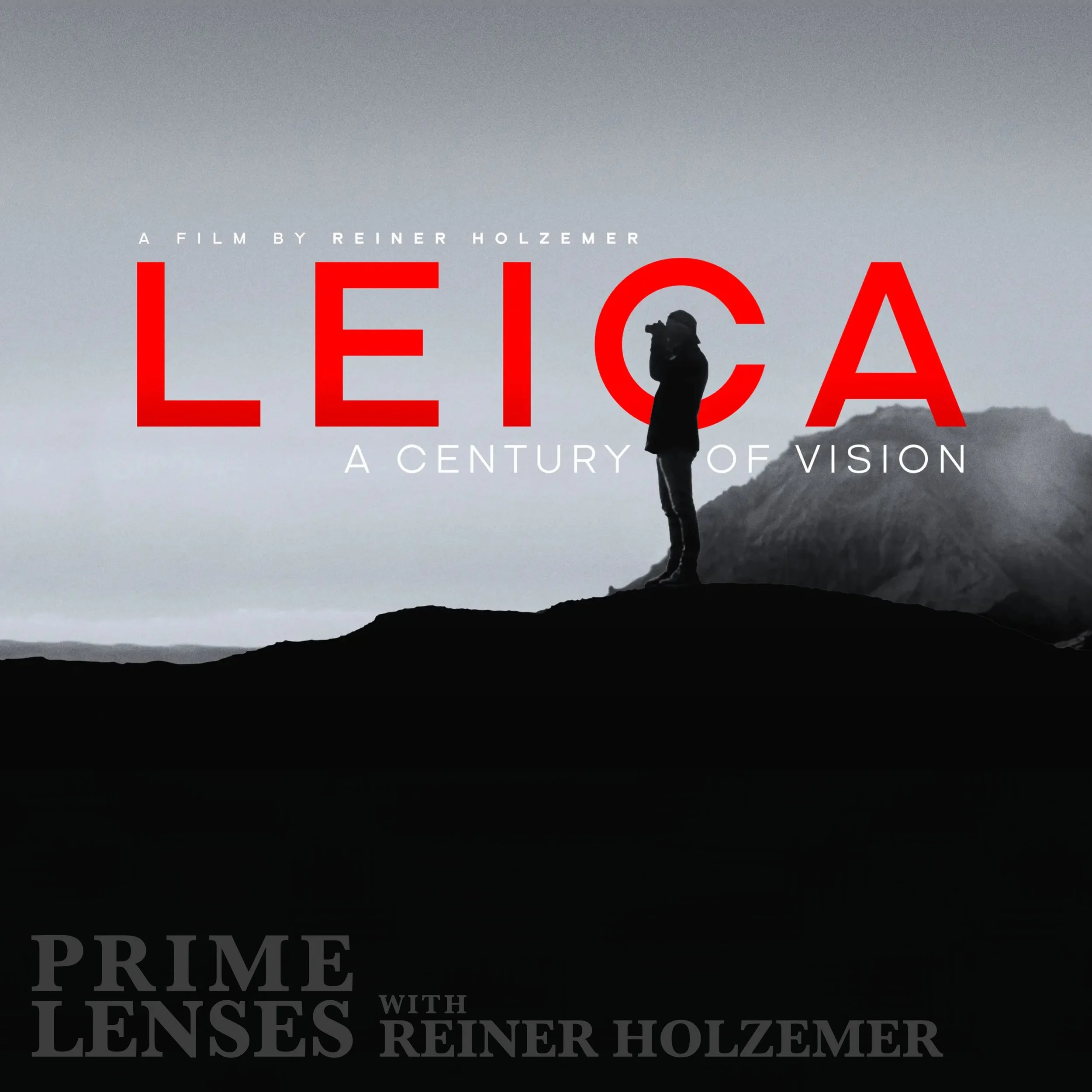


Today, my guest is Reiner Holzemer, the director of Leica A Century of Vision, a documentary made last year to celebrate the 100th anniversary of the production of the first serialised Leica 35 mm camera. The film is not, as you might expect, just a film about Leica the brand, but rather a celebration of photography and recognition of the momentous impact that the invention of 35 mm cameras, the industry that it spawned, and the capability that it gave photographers.
Reiner is fortunate enough to speak with some great photographers in this documentary, previous guests of the show that you may recognise, like Joel Meyerwitz, like Sarah M. Lee, and like Misan Harriman, but also people like Sir Johnny Ive, who worked with Marc Newson to design a one of one M camera, as well as legends in the field like Evelyn Jane Atwood, Ralph Gibson, Steve McCurry, and of course the late great Sebastião Salgado.
I was lucky enough to see the film last year at a screening as part of the 100th anniversary event held in Wetzlar in Germany, and it's fair to say that a room full of people who’d just had dinner and were looking forward to Jamie Cullum coming on stage did not particularly want to watch a movie for 90 minutes. However, within minutes you could hear a pin drop in that room and the early appearance of Salgado on screen in a room filled with people who had known and worked with him was a very big moment that I won't forget.
Leica: A Century of Vision, with Reiner Holzemer
The director on making a documentary about 100 years of 35mm photography, and why it isn’t a film about a brand.
Guest: Reiner Holzemer, director of Leica – A Century of Vision
In this episode
A short, special episode. Reiner Holzemer made Leica – A Century of Vision to mark 100 years since the first series-produced Leica, but it is a celebration of photography far more than it is a brand film. I saw it last year at the centenary screening and the room went quiet within minutes. Reiner tells me how it started with a friend who ran Leica, why he insisted on making it as an independent documentary, and how the photographers came on board once they knew his earlier films. We talk about the Wetzlar archive footage, the books Ragnar Axelsson sent him, how Andy Summers ended up co-writing the score, and the film’s opening in German cinemas on 12 November.
Highlights
Early: Reiner explains how a friendship with Leica’s then CEO led to a meeting with the owning family, and permission to make the film.
Early: He had no interest in a commercial piece. He wanted a homage to 35mm photography, made the way he makes all his documentaries.
About a third in: Why the photographers said yes. Several told him they already knew his earlier films, so he never had to introduce himself.
About a third in: Ragnar Axelsson sent ten of his books straight after their first call. Reiner admits he hadn’t known the work.
Around the middle: The Berlin screening at Kino International, a near-sold-out Sunday morning, and Leica employees who didn’t know how important the company’s invention was.
Around the middle: Asked in Berlin why the film omits Leica’s history during the Third Reich, Reiner says he has no knowledge of it, that it’s an important subject, and that his film focuses on photography.
Two thirds in: Fear of failing as a motivator, with a nod to a Thom Yorke interview, and why Reiner prefers humble perfectionists.
Late: How Andy Summers came to write six or seven pieces for the score, with composer Ben Brunema writing the rest.
Close: The release plan: Germany from 12 November on 100 copies, Austria in December, and the rest hoped for next year.
Chapters (approximate positions, no timestamps in the source)
Start Intro, and a clip from the trailer
~11% How it began: a friend at Leica, and the Kaufmann family
~22% A film about photography, not a brand film
~26% Choosing the photographers, and Ragnar Axelsson’s books
~34% Working independently, and the archive footage
~39% Wetzlar, and what the film adds to the museum
~52% German release and plans for other countries
~56% Did it turn out as planned? Audience reactions
~81% Andy Summers and the score
~97% Release dates and wrap-up
Mentioned in this episode
The film
Leica – A Century of Vision — official page | leica-camera.com
Reiner Holzemer Film — director’s page for the film | reinerholzemer.com
German cinema listing — release 12 November 2026 | city-kinos.de
People in the film
Andy Summers — guitarist, photographer and co-composer of the score | andysummers.com
Ragnar Axelsson (RAX) — Icelandic photographer | rax.is
Sarah M. Lee — Guardian and Observer photographer | sarahmlee.com
Joel Meyerowitz — photographer | joelmeyerowitz.com
Ralph Gibson — photographer and guitar player | ralphgibson.com
Steve McCurry — photographer | stevemccurry.com
Sebastião Salgado (1944–2025) — photographer | contactpressimages.com
Jane Evelyn Atwood — photographer | agencevu.com
Quotes
“I’m only interested in good photography.”
— Reiner Holzemer, Early
“This was done like a real documentary.”
— Reiner Holzemer, About a third in
Mentioned but not linked
• Jony Ive and Marc Newson’s one-of-one Leica camera (intro)
• Greg Williams, and the Leica contact Stefan Keil
• Oscar Barnack and the original Leica I
• Reiner’s earlier portrait films on Henri Cartier-Bresson, René Burri, William Eggleston, Anton Corbijn, Jürgen Teller and August Sander
• The Ernst Leitz Museum and archive in Wetzlar
• Kino International, Berlin
• Composer Ben Brunema
• Reiner’s new fashion documentary, released in Belgium this week
• The earlier Prime Lenses episode with the makers of the Joel and Maggie film
Credits
Host: Iain Farrell. Guest: Reiner Holzemer. Subscribe to Prime Lenses wherever you get podcasts, including Apple Podcasts. Sign up for emails at primelensespodcast.com.
Reiner Holzemer: Leica – A Century of Vision — Transcript
Cleaned transcript. Speaker 1 = Iain, Speaker 6 = Reiner Holzemer. The trailer clip near the start is labelled separately. No timestamps in the source.
Iain
Hey everyone, welcome back to Prime Lenses. I'm Iain. Today my guest is Reiner Holzemer.
Reiner is the director of Leica: A Century of Vision. A documentary made last year to celebrate the 100th anniversary of the production of the first serialized Leica 35mm film camera. The film is not, as you might expect, just a film about the Leica brand. But more of a celebration of photography, and recognition of the momentous impact that the invention of the thirty five millimeter camera had and the industry it spawned, giving photographers a capability that they'd never had before. Reiner is fortunate enough to speak with some great photographers in this doc, previous guests of the show that you may recognise like Joel Meyerowitz, Sarah M. Lee, and Misan Harriman, but also people like Sir Jony Ive, who worked with Marc Newson on the design of a one-of-one Leica camera. As well as legends in the field like Jane Evelyn Atwood, Ralph Gibson, Steve McCurry and of course the great Sebastião Salgado.
I was lucky enough to see the film last year at a screening as part of the hundredth anniversary, and it was fair to say that a room full of people who'd just had dinner and were looking forward to Jamie Cullum coming on stage did not particularly want to watch a ninety minute documentary. However, within minutes you could hear a pin drop in that room, and the early appearance of Salgado on screen in a room filled with people who had known and worked with him was a very big moment that I won't forget You can hear my conversation with Reiner after this clip from the trailer.
Trailer clip
A successful photograph is a picture that you can look on the put on the wall. And at a certain point you realize it's looking at you, you're not looking at it.
You give your audience a first-person experience.
To get the photograph, it takes a lifetime.
Photography. Has never been so powerful as nowadays.
A camera saves my eyes, a camera saved my life I feel like this is more than a job, this is a mission.
Photography for me was a way of life.
It's connection, it's intimacy.
You put that finder to your eye and it's an aerial image. It looks like the world.
Like everything in all art is about balance.
It just becomes an extension of the eye.
There's nothing like it.
Iain
Thank you for joining me on the show, Reiner. I'm I'm really excited to speak to you. Can you tell us a little bit about how the project came about?
Was it something you wanted to make? Did Leica approach you? How does it start?
Reiner Holzemer
How did it start? I have a friend who was the C CEO of Leica at the time when I was thinking about the movie. And uh he was more like a businessman.
He did not know much about the history of photography. Right. I know s some parts of the history of photography because I made fourteen documentaries about various photographers' portraits.
I met Henri Cartier-Bresson in person, René Burri, uh the Magnum photographers, William Eggleston, Anton Corbijn, Jürgen Teller, August Sander. Hadn't met in person, but I made a documentary about him. So so I I really did a lot of work in the photography field.
And Once uh Matthias, the CEO, told me that there will be an anniversary at uh at the Leica Company. Uh uh uh a hundred years ago it was last year nineteen twenty five uh t two thousand twenty-five sorry yeah but it was nineteen twenty-five when the very first uh serial Leica was produced, the Leica I, and this was the invention of the 35 millimeter, the small format in cameras. And I immediately said to to uh to my friend Matthias.
I said we have to make a documentary about that. What what do you think about it? I can try to get TV and sponsors and whatever but you have to give me the the permission And for me it was was f fr from the very first moment it was clear that this is not a commercial piece of work or documentary because of course you can you can say uh like I can hire you and make a nice movie about how brilliant we are, how fantastic we are.
That was not the idea from the very beginning. The idea was to to make this homage to 35 millimeter photography. And that's how it all started.
So so then he he con uh conducted me to the to the uh family, to the Kaufmann family, the the majority owners of Leica, because you need the permission to make such a movie. You cannot just write Leica in a title Yeah. And and and and then get a get in trouble.
So so I had to get them on board and we shared a lot of common ideas about photography and I said I would want to make a movie and It should be more about photography, a little bit about the history of the of the brand. And yeah, they said all yes, and then we uh try to get the money, the budget together and Also that took a while and uh finally worked out well and so we have a movie now about like and the history of photography.
Iain
But I think that that's the key thing as well, is that it is about the history of photography. I think the the fact that it's filled with photographers who prefer Leica cameras actually matters a lot less than you would imagine for a film called Leica: A Century of Vision. And the time you spend at the beginning, I think, you know, detailing what a big deal it was. What Oscar Barnack did, taking cinema film, turning it sideways, putting it in a small body. That I think is the bit that often gets overlooked. Was it hard to I mean that's kind of I suppose if you're making a film about the history of Leica that's an obvious place to start.
But then in terms of talking to the photographers that you do speak to How did you go around making that short list and tracking them down? Because I imagine this had to come together quite quickly.
Reiner Holzemer
Kind of, yeah. I mean but but it was it wasn't so difficult. I I always say first of all they all share the law for Leica, for the camera, for the lenses and so.
And then the other things uh the other thing that that was was was an advantage I mean I I did not make documentaries about photography for about fifteen years. Uh so I was a little bit out of that world. I did not follow young photographers, I did not know who the the guys are who who do the best work and so I was re had to rely a little bit on the advice from Leica.
There was Stefan Keil, uh who's a well he who's who's working for the Leica brand But he's the guy who's connected to the photographers, to the celebrities. And uh I must say honestly first first of all he wanted to sell me a lot of celebrities who photographed. But I always said No, I'm only interested in good photography.
If a celebrity does good photography, then we can think about it. But not only because it's a celebrity, because It should be really about the essence of what photography is and what photographers are doing, how they do their work, how they approach a subject or how they go to war, what the philosophy and all the ideas behind behind our so what played a little bit in my favor was I was not aware of that. Uh because very often I give you an example like Ragnar Axelsson.
I I I must admit I feel ashamed. I did not know his work before I uh had a zoom or a telephone call with him. So then he immediately sent me like ten of his most beautiful books from from Iceland and and uh uh Greenland and I felt so ashamed that I was not aware of of that but probably the days when I made those movies I had an overdose maybe in photography.
So that I really had to had to cut off and you maybe you know the problem when you are into that world it's almost like an addiction you buy one foot of hook you buy the next one the next one the next one and you look into it once and then it's in the shelf and you never look or maybe ten years later you you're you know, pick it out again. But that was also a good concept. So what happened was uh Ragnar sent me all those books and I said, Oh my this is so fantastic.
So I wanted to give something back and I said to him Uh shall I send you some links to my movies? Do you want to see my movies? Because I want to introduce myself.
And they said that's not necessary. I know all of your movies and they are all brilliant. Oh wow.
Cool. And that is and that was a that was a such an honor for me and such a surprise. And it did not happen only once.
Greg Williams was the same each time when I had a first contact Zoom call or Teams call. Uh then I said, shall I introduce myself? And they all said, no, it's not necessary.
We know all with all the work that you did about photography and we feel very honored to be part of that. And I think that was was key also for the for for them taking bar part in that documentary. Because if it would have been Leica to approach them, then it becomes more a commercial idea.
Then it's about money. Are you an ambassador? How do you sponsor me All that stuff.
So this was done like a real documentary. It's the same as I do all my documentaries. Very independent.
I make all the decisions. Of course I It was depending on some advice from Leica also. And I got all the historical footage from them which was fantastic and I love those old images.
The the sixteen millimeter I I really love it, the factory, where you see the images of the factory. And it's such it's all has has such a value and it's also Yeah, beautiful. I cannot say find another word for it.
Iain
No, it really is. I mean it's stuff that you won't see uh you know, short of going to Wetzlar where they have that fantastic museum. I was there a couple of weeks ago and short of visiting again and seeing that stuff, there's really no other way. To see that material other than other than in the film. When you're talking about writing it and producing it all yourself, you know, it's a very small team that put the film together. Did you go into it with an idea of of what you wanted to say or the kind of the route through it that you wanted, or did that very much come together as people signed on and said yes
Reiner Holzemer
Behind my it's it's it's both ways. So of course we have a concept the the the basic concept was okay we have an historical moment an invention and what did this invention do to photography? And then first of all you think do you are you looking for art historians are you looking for do you need somebody like an expert on uh art hist history or photography history to talk about it.
But I thought I I th I liked it much more when it's all coming from inside the photography world. Okay, so we have two people from Leica who talk about the invention, the more or less the owners. But mainly you have a guy like Andy Summers who was the police guitar player, but he's a passionate Leica photographer and he he has shows no solo shows with uh playing guitar and showing his photography slides in the moving in the background or screened in the in the in the background And I love it when Andy talks about the history of photography and what the achievement of Barnack was because they are the ones who benefit from that.
And what I really realize now, because I at the moment I'm on a cinema tour, promotion tour for the movie in Germany And we had the start yesterday in Berlin and it was fantastic. We had the b one of the biggest, most beautiful cinemas, uh Kino International, Cinema International. Uh uh it's a it's a gigantic uh cinema and uh and it was almost sold out there were maybe twenty seats left on a Sunday morning eleven o'clock And they're all I I thought m I'm not sure who's really going to be interested in in that movie.
And but we also had a screening I'm today where you where you we where we have this call in Wetzlar, the city where the Leica uh manufacturing place uh is in the museum, the center of Leica if you want to say so But we had a screening in a regular cinema here which opened three days ago, and they were very happy, of course, to show that that movie And of course there were also a few people from who worked for Leica in the audience. And we had a Q&A after the after the uh screening of the of the movie and you cannot believe how many people who still w who even work there who are familiar with the camera with the technology and everything are not aware of the history of and and and how important this development that Leica did was for the for the history of photography And once they realize this, they feel actually very, very proud. So you get comments, oh I didn't know that we were so important.
And that's that's that's very beautiful to hear
Iain
So the plan now is you're doing the tour around Germany. Obviously the film opens officially next week, doesn't it?
Reiner Holzemer
N November twelfth it will be and it's also amazing so we have a cinema distributor who is also our uh world sales representative for the movie. So he also would like to sell it to the UK, to America, to all the countries. We are in close contact with Spain.
It will already be uh in cinemas in Austria, probably Switzerland. Uh uh uh Asia, uh Japan, because there's also a big Leica and photography uh community there. And um and in Germany it will start on November twelfth.
And the crazy thing is he will start with 100 copies of the movie, which is for a documentary incredibly big, uh a big number. So I'm very happy about that
Iain
Yeah, no, I I am too, and I'm really hoping it comes to the UK soon 'cause I want to to shout about it. I've talked to filmmakers before, the um the couple that made the film with Joel and Maggie. Uh my awaiting um yes uh wonderful people yes brilliant and I had them on the show and and that's how I got to speak to joel and maggie as well When when you look back on the film now, is it kind of different the outcome different to what you thought?
So when I spoke to them the thing I took away from the film in a way was that it was Maggie's film actually in some ways more than you would is you would imagine going into it, a Joel Meyerowitz film About you know, it's probably more Joel than Maggie. But the the thing that makes that film interesting is that actually it's more Maggie's film as she, you know, later in their life their relationship is rebalancing a little bit. I'm curious with your film, you you kind of shook your head as you as I was asking the question, but did it kind of come out as you expected?
If you'd written down on day one what you imagined it to be, was it kind of what you imagined by the end?
Reiner Holzemer
Yes, I would no uh uh a hundred percent because if from the very beginning it's it's you can do two different kind of movies about this subject. You can make like an like a portrait of the company with its ups and downs and the maybe also the good and bad sides during National Socialism. So for example, yesterday in Berlin a woman asked me uh I I did on uh uh uh very honestly not know about it.
She's talked about there were some some how do you say that some uh uh prison workers in the third uh reich working for Leica. Why did you not include this aspect in the movie? And I said I think if this is true, I I I have no knowledge about it uh haven't read anything about it.
I think it's of course w a very important uh subject to talk about or maybe to put it in a movie. But my mo movie is focusing on photography how photography has changed changed and what uh uh yeah what what motivates what what are the ideas that photographer s uh uh have in the back of their heads when they work with the small 35 millimeter format. And this is also the response that I get and that makes me very happy And it for example, Steve McCurry said very beautiful things on Instagram about the movie and and Sarah M. Lee, the the guardian photographer, she's You cannot believe how proud she is to be in that movie.
Not only because she wants to put her face into the world. She's more shy. She thinks no, she's not a good Talka but she she she's a person who is really familiar with the history of photography.
I think she even st uh uh did uh art history uh uh at your university or so and she said there's no movie and that's not only uh that uh uh yeah how do you say focuses or emphasizes really the the focus of what photography is about for people who work with it in a in a very profound way, in a very thoughtful and honest way, and do it as a profession. And this is a response that makes me of course very, very, very happy. And yeah, and I hope this is also what the audience will take away from that movie.
So of course sometimes you think it would have been nice to shoot this guy also doing this project. We do you think we should have had a few more women maybe in the in the documentary. But we shot some more but that then it didn't work out.
We could not follow the project anymore. So you know it's all practical reasons that you have in the end. But I'm very, very happy.
And uh you won't believe it, but Meanwhile we had three screen screenings in Germany, two screenings in in California because the movie came out at its world premiere at a film festival there And I watched it all the time from beginning to the And I mean b the thing is also the the movie is it has been finished a little bit earlier. You you saw it already last year And meanwhile, I did another one on a fashion theme that comes out in Belgium this week in cinemas. So and then you th you you're a little bit more free to to judge your own work because then you you come from the fashion world now. Six months or whatever working on that intensely that that project. So you come back to the to this movie and you can see look at it with fresh eyes. And I love the music.
The music is composed by Andy Summers and and a a a very talented younger uh uh uh film composer from LA, Ben Brunema. It's the best score I ever ever had. I don't know.
It's just b uh the also the way the movie is edited, the rhythm. I I really love it. Uh yes it's uh it it it's not always like this.
I'm very critical. And but most of the people who take their w work s very serious are very critical about They see all the mistakes. I I read an interview with Thom Yorke recently and he he I mean I he's more my the the head or singer of my uh most favorite band radio in the world And he says he often when he goes on stage stage, uh he th he's afraid he will fail.
And that's the biggest motivation for good work, in my opinion. People who think I'm the best, I'm the proudest, I know you know, we know politicians also in the world who are like that. And we and and and I prefer the ones who who ourself uh perfectionists want to achieve the best result but in a in a decent, humble uh way and also with with Yeah, with a fear of of failing and that's a very good motivation.
So I'm not always proud of my moves, but this one I I I say it very honestly, I I s I like to watch it very, very much And that's also the r response I get from the audiences. Y yesterday was more an elder Berlin was a young audience, yesterday was more more uh an older audience But the reaction is always the same. People are touched, there are moments are also full of emotion.
Uh I I think But you there's also laughter, so it's the b the perfect mix that I need for a good uh documentary. It's it's human stories, people who you can can meet and afterwards think maybe you you learned a little bit more about the professional photography but also about the person who who who you just saw on the screen, how he suffers in certain moments and
Iain
Yeah. Yeah, it's wonderful. And I will embarrass Sarah on the mic and say she's a total badass and should have far more confidence she's wonderful. Um
Reiner Holzemer
Love her work.
Iain
She's really good. Lots of previous guests of the show in in the film. You mentioned there the score is fantastic and you mentioned Andy had contributed to music. Was that something that came about really organically? I was gonna ask about that because he's obviously he's a big deal and for him I I I imagine you didn't go into that conversation like, you know Do you want to do us a jingle, Andy?
Reiner Holzemer
No, no, I I mean I didn't know him in person before we met in Los Angeles. And so then uh first we were shooting in his studio in Venice Beach where he uh put on a uh uh uh a screen and showed his slides in the background, and then he was improvising on on the guitar. And I mean, I loved the way he played guitar in police and in in solo shows and everything.
And then he he's a he ma he's a master with the g guitar, of course. And I loved that that style of music. So then we Uh that was it for the first day we were shooting, then we uh arranged a meeting the the following day because you know sometimes it happens spontaneously, you don't know In in the beginning people often say, oh I have only limited time, two hours, and then we have to have to finish.
Uh whatever. So but then he liked the conversation, he felt comfortable, he thought this makes more sense than maybe than he expected. So so I said it would be great to see you photographing, uh to walking around doing st street photography.
He said, Yeah, I often go to the the to the center of of Los Angeles where I lives and um uh and take some street photographs and then asked yeah can we do that tomorrow together and and he said yes of course we can do that So and on the way back we sat for one and and a half hours in the car together. It was a long way back to his house. And then I said, D have you ever done uh movie scores?
I I was I I didn't know. Uh and he said, yes, yes, yes, a couple of movies and so on. Oh I said, uh yeah, maybe it's an idea that you could do a score also for this, for this one, or work on that one.
And then he immediately said, Oh, I would feel very, very honored because he loves and admires photography. He's a big admirer from La Ralph Gibson, who is also in the movie Yeah, Ralph Gibson admires Andy Summers for his guitar playing and because Ralph Gibson is not only a photographer, so he's also a guitar player. So that's a n very nice story in its own on its own.
So and then he said, Yeah, yeah, yeah, but uh you have to I can connect you to my agent. All those people they have agents, so it's not so not always not so easy. And then Uh and then they sent me some scores that and he did for other movies.
Uh but to be honest that was very different from what we have now. And I could not imagine that kind of music that he did for those fiction movies. For my movie.
I thought it it it would have to be a little bit different. And then you also have to talk about money, so what do you get? And then the agent is trying to get as much money as possible.
And then I said so okay, let's make a deal like this. But we were all always positive. I and I understand their point of view of course too because the agent cannot say, okay, you get a big star for nothing because we he also has to protect his value and that the the the work is paid in a in a proper way.
So uh so we found an arrangement and I also thought I cannot do the whole score only with electric guitar and uh that was the main focus uh uh that we wanted. So it was a perfect mix in the end. And he contributed like six, seven pieces and Ben did all the rest, you the the of the score, the strings, the pianos, the electric pianos, all that stuff.
But I really love it. And did not It already a few people after screenings came came to me and said, will this be available on whatever Spotify or so? And we are thinking about it on at least to honestly to release it on on a Spotify list.
Iain
Good. Well I'll keep an eye out for that and if it does release let me know and I can put it out in newsletter and let the listeners know as well. Reiner, thank you so much for taking the time to talk to us. We're excited about the film. It's it's in German cinemas from the twelfth
Reiner Holzemer
Yes, 12th of November, 100 cinemas to start with with, and then it's in uh uh December, it's in Austria. That's for sure. The rest will come next year probably. And we hope to get it all over the world, of course.
Iain
Yeah, fingers crossed. Well if it comes to the UK, I am I'm getting a Blu-ray or a DVD or whatever I can get my hands on. It was great.
Reiner Holzemer
Thank you, Iain. Thank you for having this uh beautiful talk with you