Episode 132 - Geoff Ang
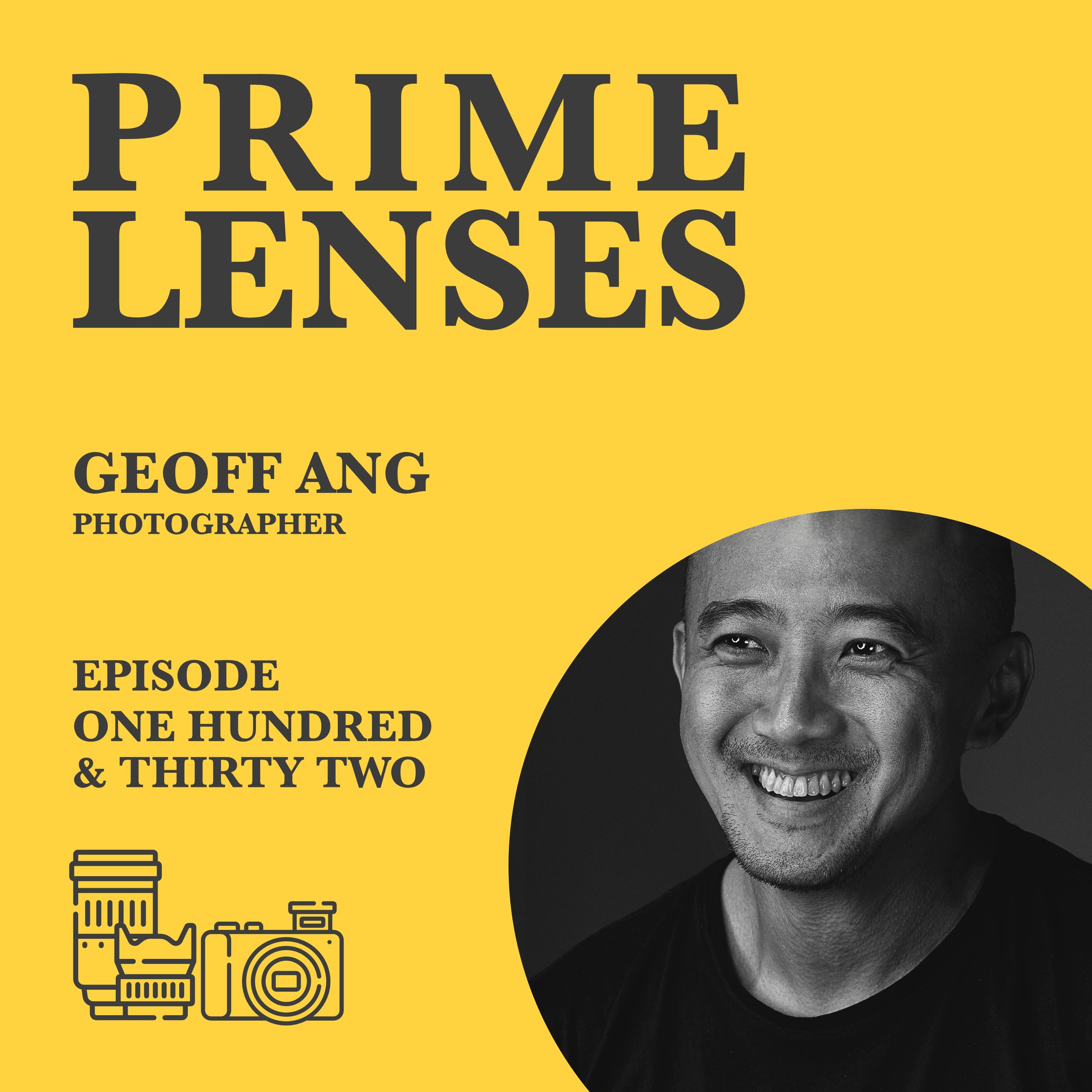


This week on the show I’m joined by Geoff Ang, a photographer based on Singapore who has spent over 35 years making incredible work with models products and brands from all over the world. You’ll hear me say to Geoff at the end of our chat that I feel like this conversation is an education, so everyone take your seats, open your textbooks to page 22 and let’s get started. Welcome to Geoff School.
Mentioned in this episode
People
Helmut Newton — fashion photographer Geoff cites as having briefly worked in the Singapore press before his career took off · Wikipedia
Steve Jobs — referenced as an example of the "human factor" books Geoff reads about how people become exceptional · Wikipedia
Books and reading
Inside the Mind of a Photographer by Geoff Ang — his book distilling 20 years of workshop material into a guide to the psychological and business side of commercial photography · insidethemindofaphotographer.com
Tools and products
Phase One digital backs — the medium format system Geoff bought into in the late '90s and still shoots today · phaseone.com
Sinar 4x5 cameras — the large-format studio camera system he used for high-resolution transparencies · Wikipedia
Dicomed — the dedicated digital retouching system used before Photoshop matured · Wikipedia
Leica SL3 — his current mirrorless body; Geoff has been a Leica ambassador since the first SL · leica-camera.com
Fujifilm GFX — his second current system, chosen for faster autofocus at high resolution than his Phase One · fujifilm-x.com
Apple Vision Pro — discussed as a new, if "selfish," way of viewing photography · apple.com
Sony Alpha 7R VI — mentioned by Iain as a recent loaner, notable for combining high resolution with strong video specs · Sony product page
Godox — budget lighting-stand brand Geoff cites as part of the barrier-to-entry drop after 2010 · godox.com
Companies and institutions
GeoffStudio — Geoff Ang's studio and portfolio site · geoffang.com
Profoto — lighting brand Geoff has been a longtime workshop ambassador for · profoto.com
Leica Gallery Singapore — hosted his recent exhibition to launch his book · leica-camera.com
Support the show on Patreon.
Episode Transcript:
Geoff Ang
And I always say this very simply. If I was a wildlife photographer and I'm shooting birds, right? And I would want to understand everything about that bird, when it migrates, when it sleeps, when it eats and so on and so forth. You know, so the thing is, I'm shooting humans. So I want to learn everything about what a human does, you know, body language, micro expressions.
You know, facial muscles, EQ, IQ, and all the different cues, right? Because I think it makes me that much more sensitive as a human being when I interact with my models, when I interact with my clients, when I interact with my crew. These are all very, very important aspects to being a leader on set.
Iain
This week on the show, I'm joined by Geoff Ang, a photographer based in Singapore who spent over 35 years making incredible work with models, products and brands from all over the world. You'll hear me say to Geoff at the end of this conversation that this has felt like an education. So, with that said, everyone take your seats and open your textbooks to page 22. I'm Ian, you're listening to Prime Lenses, and welcome to Geoff's School. That bell's for me, not for you.
Geoff Ang
I never studied. I started working when I was 11. And not being able to do well in school, you know, prompted me to, you know, pick up a skill and be damn good at it, I guess, right?
I'm lucky enough to have a father that had a small production house that helped with, you know, me having access to the equipment and learning from his staff and so on and so forth. So I was growing up literally in his production house. It gave me access to a medium format camera, Bowen studio lighting in those days. And I was just figuring things out on my own. Through my early teenage years, And I started figuring out that, hey, you know what? Photography is something I want to be good at as opposed to being a graphic designer or a sound engineer or whatnot. Those were the different skill sets he has in his productive houses. So I picked photography of all of them. For a very simple reason, I'm able to not sit behind a desk. I can get out. I can do things with my hands and shoot beautiful people.
So that was the drive for me. That being said, I mean, photography in Singapore, photography in Asia predominantly, I think. If you look at in the early days, I guess, you know, commercial photography was a very different beast compared to today or even 10 years ago, right?
In those days, very, very few people could do what commercial guys could do. Right? It takes a whole lot of skill, a whole lot of, you know, financial commitment to be able to be even contending in the commercial realm. Because a medium format camera, a large format camera, film, studio were all extremely expensive in those days. Right? And you won't have much access to learning photography unless you were assisting for a photographer or mentoring, being mentored by someone. There was no YouTube. There was no, you know, classes for photography in those days. You know what I mean? It was far and few. So that's at least my perception. Of what, you know, I mean, photography has so many different genres and tenets and, you know, there's obviously the reportage, the journalistic world and so on and so forth. If you even check history, I think, who was it? There was a really famous photographer, Helmut Newton, I think. Helmut Newton actually did a stint, I believe, in the Singapore press. As a journalist before he became Helmut Nielsen. Wow. So cool. So yeah. So something like that. You know what I mean? Yeah. Photography for me and I believe for different people came from different places. But for me, I was being groomed at a very young age literally to be a photographer. And I gave myself that pressure of being an Asian kid, right? In Singapore especially, you know, education is everything. You know, paper qualification, university degrees, everything. Without any of that, you won't go far. Literally, you won't go far. So my dad took a risk knowing that I know I'm no good at school. He pulled me out of school and said, you know what? You can't study? Fine. Be good at something. Be fucking good at something. Literally.
So that's what I did. I decided that photography is going to be my thing. At 14, I pushed myself to say, this is it. Photography is going to be my skill set and I'm going to be really good at it. At 16, I did my first professional job. Literally, I did at 16. The client even said to me, I mean, the creative director actually said to me, Do not tell the client you're 16. Say you're 19 or 20. You know, when I was shooting. And it was for a Wilson tennis record catalog. So I was, you know, I literally spent my every waking hour in the studio experimenting, replicating. You know, in those days, how I learned photography was literally by copying, replicating what I see. Because I didn't have avenues of learning from anyone other than my dad who was the so-called photographer in the company. He was pretty decent, average, but nothing great. But still, he had a lot of technical knowledge. And so what I did was I literally looked at magazines and books or whatsoever and I found pictures of actual campaigns. Like for example, in those days, there was this absolute vodka, you know, that was a very iconic image of the bottle with a white glow behind. That was like, you know, the advertising image of the day. And I knew that my dad had a bottle somewhere on the shelf. I took that very same bottle and I copied it exactly right down to every single detail, every highlight, every shadow, the circumference of the glow behind. You know, I went to that kind of detail and I copied. That shot and reverse engineered everything in the studio. And when I did that, psychologically, it gave me quite a boost because now I know I am personally at 16 or 15 as good as that guy who was engaged by some big agency to shoot hundreds of thousands of dollars for that one campaign, for example. So that really, really taught me how to learn and to be good at what I do because I literally learn by making mistakes. I literally learn by moving things myself and discovering things myself. You know, I remembered one time where I was trying to solve the lighting reference that I saw and I couldn't quite get it right in the reflection. I tried a white reflector, I tried a black reflector and at some point I just put a green light on it. A grey board instead of a white or black typically. And it worked. And I was like, wow, you know, I was blown away. You know, that reflectors doesn't have to be white or black. It could be grey, it could be pink, it could be green. And so that kind of learning really gave me that confidence, you know, as a teenager that I have some sense of a talent because I'm figuring things out myself.
If you think about the young photographers of today, they see something on YouTube. Some self-professed lighting expert, for example. And he is going around teaching you lighting. And a lot of them consume photography and their learnings in this manner.
They don't really put it to practice by actually doing it with their hands. They watch it and go, yes, I know how to do that now. Right? So I think that kind of learning experience doesn't really make you any better. You're just brushing things on the surface. Right? But when you're doing things, every move, every angle of a degree of a reflector, a degree of a light makes all the difference.
When it comes to photography, when it comes to lighting, when it comes to angles, exposure, there are so many variables, right? And you're doing it with your own hands. You're moving things in real time. You are experiencing it as it comes. The learnings are so much deeper. Do I make sense? You absolutely do. You have to do it. And I think what you're highlighting, the reason I love this so much, I've got two boys.
Iain
And one seems kind of like a bit academic and sort of sits down and reads a lot and learns a lot and the other one will do that too but is a craft person is whittling wood the whole time and carving and making stuff he's learning to knit and he's doing and what you're describing for yourself gives me joy because if I can be as brave as your dad was and say look just find the thing you're good at and support them in doing that then hopefully at some point in the future he's having a conversation like this where he's like I found the thing and my parents gave me the space. Because you're absolutely right. We, in, I think, we, as a Western culture, and then we kind of exported this to the rest of the world, this notion that you have to go to university and you have to do this. And I think there was a 20, 30 year period there where it was assumed that was the only way to do anything. And I do, it's funny, when we worked in, when I worked in Malaysia, we would go to universities to meet people who were studying game design and art and things like that. And my boss at the time, He's from Asian parents and he would stand up in front of all these people and he's now like co-CEO of the studio but he would stand up and he would say I know I'm from a background like yours I know how hard it was for you just to get here just to convince your parents that this is a real job and you know it's as valid a line of work as a doctor a lawyer because your parents just want what's best for you exactly what you're identifying is we've never it's never been easier to try and learn something you've got to do it you've then got to get put your shoes on and go and try it and try it out precisely precisely totally is that where some of your manifesto stuff came from as well because one of the things I love about your approach is that front and center on the website is a manifesto to your approach there you go yeah I mean you know i've always been a very psychological photographer as much as I believe in being
Geoff Ang
But I think to be at an elite level, you have to conduct yourself with a lot of soft skills and a lot of psychology. And I use a lot of that. I read a lot of books about the human factor. And I read a lot of books about business, about how Steve Jobs became Steve Jobs, how Elon became Elon, you know what I mean? And how did superhumans become overachievers? And, you know, are now, you know, changing the world. I love that human element. And I truly believe that as photographers, you know, whatever you do, even if you're still a photographer and you've got nothing to talk to in front of the camera, right, you still are dealing with clients. You still need to be able to speak a certain way, carry yourself a certain way, bite the client, to convince them what you're doing is right, and so on and so forth.
You are in many ways a salesman while you're shooting. Because while you're shooting, you're convincing through the imagery that's coming out on the screen or the back of your camera that this is the shot and you are selling that shot. You are telling them, you know why we should have her hold the cup with the right hand instead of the left hand? And then you explain it out, right? That, to me, is so important to At least, I'm speaking from a very commercial photographer perspective. You know, because half the time, I truly believe clients don't know what they want until they see it or until you tell them what to see. Right? And then I'll go, yeah, you know, why is the right hand? Because behind there's a tree and this tree, the trunk is leaning towards the left and then your logo is on the right and dah, dah, dah, dah, dah. And then you see the weight of the picture and then they go, ah, And before you know it, it's sold. And you can say it's a wrap. So it's literally things like that that really, really interest me. I spend a lot of time discovering about how to make people feel. Because I think there's a deep human factor to photography, especially in my genre when I deal with people.
And I always say this very simply. If I was a wildlife photographer and I'm shooting birds, right? And I would want to understand everything about that bird, when it migrates, when it sleeps, when it eats and so on and so forth. You know, so the thing is, I'm shooting humans. So I want to learn everything about what a human does, you know, body language, micro expressions, You know, facial muscles, EQ, IQ, and all the different cues, right? Because I think it makes me that much more sensitive as a human being when I interact with my models, when I interact with my clients, when I interact with my crew. These are all very, very important aspects to being a leader on set. To manage all this, to come together and to align people and to manage egos and to manage all the sensitive aspects of things. Everybody has a voice. Everybody wants to say something. The junior client wants to impress his boss. When the junior says something, I don't just diss him off. I would say, oh, that's a very good idea. Let me try it. You know what I mean? Because who knows? At some point, this junior guy might become the senior guy and he might hire me in the near future and so on and so forth.
So it's all these little things that I try to be sensitive about. Perhaps in my younger days, I was young, I was a top photographer, I was egoistic, I would just brush off some junior guy and say, nah, forget it, and I walk away. But now as I get older and as I become a father, I mature a lot.
I see things very differently. There's a deeper sense of sensitivity and fragility and empathy in me as I progress. So back to your question about my manifesto, for example.
I read a lot of business books about businesses. And one of the advice from some of these business gurus is to, you know, have a manifesto so that you know and you are aware of your brands or your company's message and, you know, mission statement and whatnot. And I figured that, you know, as much as I'm in the arts and I'm not, you know, a corporate company, you know, it doesn't mean that I can't have a manifesto, you know what I mean? So, and I also figured out that I should put all the values that I hold very dearly to me, that I really want every client to kind of hold me accountable because I put it out there in the world. A very simple thing and one of the lines in my manifesto says that I am always early and never late. Right? That holds me to being always on time or at least always early. You know, to be on for a meeting, to be on set, to be anything or even to go for an interview. To interview an assistant who is junior to me, right? He should bloody wait for me, for example, right? But no, I am there early to meet an assistant who wants to be interviewed by me, for example, or an intern or whatsoever. So that's the extent of my values that I hold very dear. And I put it out there, you can call me out if I'm late, you can call me out if I don't meet any of my values. And I think it really, really changes the way I think and the way I conduct myself in every situation. Because, you know, I'm on a call with a client, I am in a meeting physically in a room with a client, I'm on set with a client or, you know, with anybody. You know, the minute I'm with anybody, be it a client, be it a talent and me being the supplier to a client and so on and so forth.
Iain
I love this. This is so good. Thank you.
Because you're identifying something that people, I think, who, when we often look at traditional work like art and photography, we forget that there's a business to it. We forget that pressing the button is kind of the last part, right? There's all the preparation of course, but there's also making sure you have the right help and support and the right things are there because there's a Denzel Washington quote that I love that I suspect you will as well, which is that you create the environment in which you work. And that is within your control to make the atmosphere on set the way it needs to be, to make the image, you know, to work with the models. Because sometimes you're talking about studio work a lot there, but also looking at your portfolio, it's a lot of stuff with athletes out in the world. Where there's things you want them to do and you don't know how well that person slept how hard they've been training did they have an event recently do they you know have they had a fight with their partner all of that sort of stuff and you've got to kind of yeah go right i'm going to photograph you from above or i'm going to do this or we're going to we're going to get wet let's go and that's I love that you're kind of going into this detail of like all the work that happens beforehand because I think sometimes when people are buying stuff they don't understand and presumably having people on set you've always shot digitally I
Geoff Ang
Oh, right. Okay. Oh, yeah. I've seen the rise of digital. I was a film photographer. I mean, I'm 52 now. I've been shooting since I was 14. That's like 1984. Right? Digital only came to light in the late 90s. Right? So I've been shooting like, you know, 10 over years of film. I used to process E6 film.
I shot 4x5, I shot 8x10 film, transparencies. So, you know, I really had that deep, deep understanding and discipline of film. Being able to then have that foresight in the early 90s and in the late 90s, literally at the turn of 1999, I saw that digital was rising. The very first digital back that Phase One had, which was called the Lightfield, It was like a six or four megapixel digital bag. I saw the foresight. I was pitching for a big shoot for a TV station in Singapore to shoot the celebrities. And at that time, my portfolio was, you know, a whole mashup of interior product, food and industrial and some people. And my attempt at fashion. But I've always wanted to do fashion. I've always wanted to do, you know, shoot beautiful people, right? So I went there with my portfolio of random stuff. But I came with a very big bag of ideas and references and how I wanted to shoot their celebrities. And to sweeten the deal, I said, hey, look, If you give me this job, I will buy this digital camera. Right? And this digital camera would allow us to see things as we shoot and we will be fully digital. You know, and our actors will be able to perform in a certain way where they can see stuff and I could retouch stuff and create colors in those days. Because prior to digital cameras, we and I was part of it. I used to shoot ad campaigns. On film and we would scan transparencies be it 4x5 be it you know 120mm transparencies we would scan them and each scan would cost easily $200 which is about $150 US right in those days you would have to drum scan it it was a very slow process and retouching was on a system called Dicomed which was a dedicated you know retouching system, right? There was, and Photoshop was still like, you know, in version 1.0 or 2.0 in those days. So, there was very specialized people doing very specialized retouching.
And it was a very slow process, digital retouching in those days, and very, very expensive. So this digital system that was, it costed at that time, it was about 40 grand SGD, which was about 35 US, right? And I said, if I get this job, I'm going to buy and use the money from the job and pretty much the entire amount and buy this digital back, right? And then of course, I'll need a Hasselblad or a Mamiya to adapt it on behind, right? So, I was literally the first guy in Singapore. According to Phase One, Southeast Asia, I was the first that bought this system. And ever since those days until today, I've had quite a close relationship with Phase One over the years. Maybe less so in the last couple of years, but a fair amount of my career, I've been working with them very closely. They've been supporting me.
We've been doing workshops around the world with them and so on and so forth. But that being said, with digital photography, it actually gave me that upper hand over all my seniors at that time. I literally leapfrogged. My trajectory was not just a gradual, it was a rocket. You know, in a span of three to six months, I literally became the most sought-after photographer in Singapore. Because I could do things no one could do. Colors, you know, effects. And retouching that no one could do. So I learned Photoshop myself. And, you know, it was literally that. I just embraced it and I became everybody wanted to work with me. Right. So fast forward to today, it's a bit like what's happening with AI, right? You know, some young chat or lady would take on AI and then, you know, the introductory is going to be very different. You know, it's, it's, it's, It's history repeating itself, right? Yeah, so that's how I think digital has evolved over the years. It's amazing. First of all, you do not look in your 50s, sir. You're maturing very well. I kind of, I mean, I'm joking. Well, I turned 50 in like three years, so I've got a few years yet, but I'm like, I hope I age this well. This is great. I won't.
Iain
I'm Scottish, which means that you put me in the sun, I immediately turn pink. So it's, you know, I just, we don't have, we don't have the aging well genes. The best I can hope is just get a lot of sleep and stay hydrated. It's all I can do. But you mentioned that like the speed is the key, isn't it? Like the iteration cycles and being able to show people. And the reason I was curious when you were talking about having folks on set, some photographers I talk to find that quite a hard thing, having people there looking at the images the whole time.
Geoff Ang
But it sounds like very early on you went, this is the thing because it is about connection. And if I can show the subject or if I can show the client and just you just sounds like you love just bringing people into your process. Of course. I mean, before digital, we would shoot big campaigns and we would literally freeze the set, right? Rush that couple of rows of film to the lab for one hour processing, have a more We look at every frame. Of course, there's a fair amount of trust. I would say, yeah, I got it. But clients in those days would say, no, let's be really sure we got it. Right? So we freeze the set, wait for transparency to get back. Yep, we got it. It's a wrap. Right? So things were a lot slower in those days. It was really cool because you would have coffee, you would get to know people on set, you wait for the transparency to come back. Right? So that was amazing. But then, as how the human race, we always want things to be better, to be faster, to be da-da-da. And digital came and then suddenly everything became really, really fast. And so, yeah, it was a big risk, but yeah, I lucked out, I guess.
Iain
No, you did. Right place, right time, my friend. I think everyone feels like sometimes in their career, they were in the right place. And then gradually as we get older, there was some aspect of the past that was better.
So maybe more coffees, more sitting around and sort of really getting to know people. I am curious as to, you've mentioned a lot about studio work. I know you do a lot of stuff on location as well. Do you have a preference to how you work? Because as cameras have gotten smaller and higher quality, you know, I shoot with an M11, incredibly small, incredibly high quality for its size and weight. It's unreal. Is that, is that, was that something you've explored as well? It sounds like you explore things that enable new things.
Geoff Ang
I've always been geeky. I've always been an early adopter with anything. As you can see, you asked me about my earphones. I've got the latest earphones. I'm a sucker for these things, right? When the Apple Vision Pro came out, I was running to the store to get it, you know? Yeah, I love adopting new technology. I love playing with new hardware, but I've always been as nimble as I can when it comes to cameras. And lenses, right? I've always pitted them as, yeah, I mean, it's great to have good cameras, that's for sure, you know, but again, it's just like, you know, you giving me a pen, you know, I may not be able to write a book, you know, better than a writer, right? But you give me the shittiest camera, I could potentially shoot a pretty good picture, you know what I mean?
So, and I've always truly believed that. Of course, there are preferences. You know, over the years, I've used all kinds of cameras. I was, my first camera was the Canon AE-1 and then I had the Canon F1 and then I progressed into Nikon, the D850 or 8 something. And then, you know, over the years, it was then Sony. Of course, Phase One, I had my Mamiya 6-7, 645.
I had the Hasselblad 503. Then at some point, obviously optics was important for me. Cameras wasn't so important.
The optics was important. I had the Sinar 4x5 cameras as well to do really big, high-resolution 4x5 transparencies. So the Sinar was the epitome of the studio camera, right?
So in those days, I had them all. And then I slowly progressed deeply into the Phase One ecosystem. I had the P 645 camera that they had with Mamiya. And then obviously the XF, which is the current body, which is amazing in its own way. You can't beat a Phase One. When it comes to quality, the sensor, the colour science, you know, 150 megapixel, trichromatic, wow, you know, it's, you know, the tonal range, you're getting, what, 16 stops, right, you know, of recovery, that's insane, you know, I always joke you could just shoot everything wide-angle and crop everything up later, because even if you crop 20%, it's still like, you know, it's still a decent, you know, small camera, you know what I mean, so that being said over the years and then now I'm more settled down. I have still my Phase One. I have a Fuji as well, the GFX. Primarily because that's mirrorless and I'm able to then, you know, be able to work at 100 megapixel but yet still be able to focus faster than the Phase One, right? The Phase One honestly doesn't do, you know, it doesn't focus well fast enough for the kind of things I do. So the GFX kind of fills that void. And then I'm on the SL3 on the Leica. I've got a whole range of lenses with the SL. I've always been a Leica user like yourself. I've had the M's, I have the Q's, I had the first SL. I've been their ambassador for many, many years now. So over the years and recently when the SL3 came along, you know, they put me in again. I was the first SL1 ambassador. So yeah, over the years, I've, you know, gone, you know, and I think I'm at a sweet spot right now. I'm super happy with my SL3, super happy with the GFX. Yeah, yeah. It's just evolution. Yeah, of course, it never ends. There's always something better, cheaper, whatever, whatever. But yeah, for now.
Iain
Yeah. I tried the SL3P recently, like a loaned me one for a week. Right. It's a weapon, right? It's an amazing camera. And it's so much more than I need for anything that I'm doing. But if you're photographing sports or if you're photographing sort of any moving subjects, like the stuff you do with athletes, I imagine, you know, must be great for that. Because again, you can, it's so high resolution. You can go fairly wide. You've got latitude. And it does video as well. It's crazy. You'll remember the days when I went to a Sony event recently for the A7R6 and they were running through all the photography features and then someone else came up to talk about the video features and I was just watching thinking even 10 years ago that would have been a different camera. They'd have just put all of that in a separate thing and now it's all just consolidated down into this one body.
And actually, moving images is an interesting way onto something I wanted to ask you. When you mentioned the Vision Pro, that's got huge potential for viewing photography in a different way. Because you can view images like videos and stills, and they can look like they're on a big screen in front of you, or you can be in an immersive space. Do you have a preferred way of experiencing your images? Because you remember when there were transparencies and then film and prints and actual analog prints. But digital is fast, and you can go so big.
Geoff Ang
Has your preference for that changed over time? No, it's always been still, you know, I'm still very traditional. I love seeing them on my screens. I've got huge BenQ color calibrated photographer's monitor. The Apple Vision is a very selfish device, right? You see it and no one else can see what you're seeing, you know? It's nice, but I think, you know, I would, I would, I still want to have a proper monitor that's properly color calibrated.
You know, I like matte screens better than a gloss screen. Primarily because they translate, you know, better when it gets printed because it's matte. You know, you don't see the gloss of the RGB on a printed form, right?
You know, so I'm still old school like that.
Iain
Do you still get a lot of your work turned up in print?
Geoff Ang
Because for me, that would be the thrill, would be seeing something printed in a magazine. That's, I think, when I would feel like a commercial photographer. Right. I mean, these days, far and few, I'll be honest. The printed media is definitely something. Occasionally, I see my work on the side of a building, on a billboard or whatnot, but that's about the extent of it. Occasionally, in a backlit, in a train station, or something, you know, but yeah, far and few in magazines, far and few in newspapers anymore.
Although I recently wrote a book called Inside the Mind of a Photographer, that's something that was very dear to me because, you know, I was living in Bali for a very good amount of years during COVID. And, you know, I lived the life in a very semi-retired way. So I had a lot of time on my hands. And I used to do a lot of workshops, you know, for Profoto. I've been the ambassador for many, many years. So they fly me around. I did for Phase One and for Leica and whatnot. So I've done a lot of workshops and talks and seminars. And I've just, this deck, right? This keynote presentation that I've put together since, what, the early 2000s and I've been putting all my teachings and, you know, whatever is in my mind that I speak of at all these events, right? And over the years, every year, every few months, every other week, I learn something, I read something and I improve the, you know, this presentation and I'll talk about it in a few months about my new learnings and so on and I have been polishing this for a good 20 years right so I've been thinking you know what I should and people have also said that you know the teachings that I put out I should put it in a book of you know in in some way so I decided to distill the entire presentation deck into a book literally called Inside the Mind of a Photographer.
It is not a technical book. It's a book that teaches you the softer side of things on how to optimize yourself as a thinking photographer. Right? How you speak to clients, how you develop new ideas, all this very novel way of doing things. And all these are little things that I have learned over the years, even how I how I speak and how I carry myself. And I always say, even when I'm on set, I'm actually on stage. Right? I am performing. Because if you think about it, the clients are behind me, the talents in front of me, everybody's seeing me perform, you know, and I'm literally like a conductor, right? I'm moving my hands, you know, a light goes up higher, I'm moving my hands, you know, the chin goes down lower, you know, I am conducting. So, so I always, you know, to performance.
And I perfect this performance, literally. Every time I'm on set, I know somebody's watching. Always, somebody's watching me.
So I play it up. I jazz it up. I make it feel performative.
Because it is, you know, the way you do things, if you think about it, I've shot this same lighting perhaps, I know, in a similar fashion, in a similar vein, 50 times in my career. I can literally do this in an hour with one eye and one hand tied behind my back, right? But the client paid a good amount of money to have me here on set. I've got to play it up. I've got to make it look like, you know, yeah, you know, Geoff's the guy, you know, he's, you know, he's working so hard.
He's such a perfectionist. Yes, I am, but I'm also in many ways performing to it. So that they feel they're getting their worth from me. And it's what I've always taught my crew as well. As much as you are working behind the scenes, I'm watching you. And the clients are watching how we work as a production. Because then everybody, feels taken care of on set. I always tell my crew, my production, my producer who works with me, David, we run it like Disneyland, I always say, right? In Disneyland, magic happens, you know? At every hour, suddenly there's somebody coming out with drums and, you know, Mickey Mouse is dancing and not that we have that, but, you know, we will have cakes on set, we will have, you know, at a random time and we will have new coffee breaks and, you know, we'll...
It's run like a six-star hotel, you know, where we are taking care of service. It's not just, you know, serving the image, but we are serving the client as well, right? Because it's experiential. In many ways, clients walk away from mindset never really in many ways seeing the final image because there's so much retouching to be done. So what do they walk away with? They literally walk away with the feeling of how they feel. The food they had, the service they had, from even my assistant walking up to them and say, hey, you know, would you like another cup of coffee? Right? I see that your cup's empty. You know, simple things like that, I think is important. It's important for anyone to feel when they are on my set. Right? And I always say this as well. Take for example, you want to fly to London, right now, most airlines would get you there. In fact, every airline would get you there. Why do you choose one airline over the other? Experience, yeah. Yeah, it's the journey, right? You will get to your destination, but how you get there? The seat, whether is it comfortable, the service, the food, the entertainment while you're in the plane, right? These little things, you know, comes into play. So why would I pay $500 more for that airline over the other airlines at $500 cheaper, but will both get me to London, for example? You know what I mean? So literally, that's how I think.
Iain
I love that little clip. That's so good. And I think it's the importance of thinking really broadly and thinking about the experience that everyone's going through. You talk about it on your website and in some of the stuff I've read that you've done before, right? It's the journey as much as it is. Is the destination and the final image. Do you think that part of this kind of holistic view comes from you having grown up around business and a studio and you just were exposed to it very early on? It sounds like that was actually a really good training. Yep, totally. I think my dad, I thank him for that. He really put me through a very strong regime of just having very thick skin.
Geoff Ang
Right. Because, you know, he's a typical Chinese father, right? He would scream at me. He would be fairly abusive. You know, in today's context, you know, child care would be coming. You know, child services would be coming for him, you know. But in those days, it was just how it was, you know. And I think that made me really resilient. And it made me understand that if I can't take what my father is dishing out, What some stranger who is some CEO or some big time global creative director who is abusive towards me, I won't be able to handle it, for example, right? So he has taught me to be that version of myself that's very resilient, very thick skin, able to take a fair amount of abuse, so to speak, and get the job done, for example, right?
Because in my career, I can tell you, I've met all kinds of people. I've met abusive agents of celebrities, you know, who would be seriously abusive to me, creative directors who have such big egos. And I just suck it up. I smile, you know. Because another one of my mantras is this. If you want to tell somebody to F off or you want to be a diva, go do Don't take people's money. If you are a commercial photographer, you are taking people's money. They have every right to tell you that they want the product to be bigger and so on and so forth because it's their product and they're trying to sell something. Who am I to be all artsy-fartsy and say, you know what? No, the product has to be that size. If you want to do that, don't take money. Do art. You know what I'm saying?
So I've really come to terms with that side of me. When I was younger, I was that guy. I was like, no, the product will not be bigger because this is how I do it, right? That's my younger self speaking. But as I grew older, yes, I gave in, but I gave in with that understanding that, hey, you know what? This is me making a very good living, right? And I want to be very, very good at it. And if I compare myself with my peers, You know, rewind back 10-15 years ago, we were all top photographers. They have all, a good amount of them have all fizzled and I don't know what they are doing today. But I'm fortunate enough to still have a very decent career at my age in a very young industry. Because you think about it, creatives are always your 20 and 30-something. Right? They, even today, they will probably be resistant to work.
Working with Uncle Geoff. Right? Because Uncle Geoff will come with his big team and, you know, his sense of confidence and, yeah, I've done this before. I know what I'm doing kind of thing. Whereas the young kids, they want to experiment. They want to play. They want to work with their mates who are 20, 30 something and get crazy and do stupid stuff. Whereas I come in and get the shit done fast and well. Right? So, you know, that's my struggle. I'm struggling with that over the last 5, 10 years.
You know, trying to stay relevant, trying to stay young, you know, trying to create work that still looks on par with the younger photographers who are killing it these days. Right? So that's a struggle that I think many photographers who, from my era, who were the top photographers, I mean, in the best of times, my day rate was 30 to 50 grand a day. That was my day rate. Up alone without anything else, right? Not inclusive of usage, right? It's not inclusive of equipment and production. It's just me, you know? I'm pulling in 30, 50 grand. So, and find me a profession where you are making that kind of money and over the years, it just drops and drops and drops and drops and drops, right? In the 2000s, literally, that was what I was making and I was, A two-day shoot, I was making in excess of 60 to 100 grand. And I can be doing three, four, five campaigns a month. I was making bank, literally. And then you fast-forward to 2010. 2010 was literally the shift. The shift of when photography literally just went like nuts, right? You think about it, right? Let me break it down for you. 2010 was when social media was rising, right? Instagram came and we had the iPad, we had the iPhone and then we had the Canon 5Ds coming up, the DSLRs coming up, right? And then China brands are coming in with $20 reflectors. Before that, the foldable reflectors were from Lesto, that will cost hundreds of dollars. Right? And then the China reflectors were 20 bucks. Right? And then you can, you know, China C stands, China stands, you know, before there was only Matthews, for example. Yeah. Now you can get a Godox C stand for a hundred bucks, for example. Right? And so on and so forth. So the barrier of entry became really low and everybody started wanting to be photographers. And then not only can you be a photographer, you can see self-publish.
Right? And then everybody started flooding the market. And then it became just this big, amazing scene for clients to go, okay, you know what?
I can choose who I want now. If you don't want it, there will be another person behind you queuing up. And there's hundreds down the line.
And there will be literally somebody who will do it for free. And there will be somebody who will literally pay to do it on top of that. That's the extent of the aggressiveness of these young, you know, upstart photographers coming into the industry because it's so vibrant. And there were softwares that would have presets and LUTs and, you know, and colors. And before, to do amazing color, you need to have good color sense. Now you can just browse a certain color until something clicks and you go, yep, that's the one.
You know what I mean? So photography became so democratized. Everybody's a photographer. Everybody as a phone is a photographer. You know? To the point where me, the professional, is less needed, right? Okay? So perhaps in the earlier days of the, you know, the revolution, I was still, you know, the big ones, the big jobs, they still need someone like me. You know? But now it has came to today as we stand, you know, we have came to the point where the young generation have, you know, they are learning so much, they are doing so much that, you know, they are seriously doing really good work. And I'm honestly at my age exhausted just seeing how good they are. Yeah. Right? Because they are doing very, very experimental stuff with blurring and one flash and everything that it just went, whoa, that's the aesthetic, right? Okay. And another thing I want to break down for you, you think about it.
You know, as of today, there is this whole one-flash aesthetic, right? This hard flash, this one-flash, or maybe you rewind back a few years, there was still that one-flash aesthetic, but not as prevalent as it is today, okay? You think about it, right? When someone picks up a camera, what do they do? They will say, I'm a daylight photographer because they don't know how to use lights. They don't know how to shoot flash. In daylight and I'm a daylight photographer. And then after a while they go, you know what, I need to level up. I will buy one light. So that's what they do. They buy one light and they start shooting that one light look. So what happens is this particular photographer version of this photographer who came from daylight then bought that one light, there are millions of them in the world. Millions of them having the Same journey. Buying a camera, shooting daylight, buying that one light. And they all are on the same timeline. And you know what they're doing? They are flooding social media with that aesthetic. In the hordes, in the millions. And when they flood that aesthetic, clients will go, wow, that's a cool aesthetic. I want that look. Because that's what all the young kids are doing. And then before you know it, that's the look of today.
Shutter Drag, Blurring Background and whatnot. You know what I mean? So, and then here I am, Mr. Big Time commercial photographer coming on set with a truck of 20 lights, right? And then I light the set with 20 lights and whatnot. And then I show it to a young producer and the young producer literally, this literally happened last year. When I moved back to Singapore last year, I started to try to get my I put myself back into the Singapore scene after moving back from Bali. And I met some young producers and I showed them my portfolio. And they went, wow, Geoff, you're so good. You know, your work is so polished with so much cinematic. It looks like AI. They literally said to me, it looks like AI. I was shocked. My jaw dropped. I didn't know how to reply. I didn't know how to feel. I didn't know if I was to be angry. To be sad or to laugh. I didn't know how to react to it, honestly. And that just shows me how the youngsters are seeing things, right? They literally said, my 20 light setup look like AI. Okay, so I said, fine. Show me in my entire portfolio what would be something you think would work today and you can sell, right? With one light. At least they knew what they wanted. So they flipped with one light and I just think to myself, that was the most, the least set up shot, one of the least set up shot in my portfolio. It literally took none of my experience and none of my creativity and whatever that I have to execute that shot. It was so nothing, but it was something for them.
So that kind of sums up the state of how things are. So that brings to how I see things today, as we stand today. September 2026. How do I see my work and how should I evolve? Do I simplify my approach so that I can be part of what everybody is doing? Should I use more AI?
I am quite stubborn about it. I refuse. As much as I dabble in AI, when Photoshop introduced Gen AI, when it was in beta three, four years ago, I was fiddling around with it. I was impressed. I literally shot something and said, add rocks, right? In that one, in that two words, Photoshop added rocks into the shot. Match the lighting, match the blurring, match the perspective. And I went, okay, we are screwed. This was three, four years ago. I literally said, we are screwed. Because in that simple move of typing two words, I got rid of my retoucher, I got rid of my maybe CGI guy, if I want to add rocks, right? And my art department. The art department who would then have to carry those rocks into the studio, to place it in the background. I got rid of two different departments. They were out of a job straight away. So that just puts so much perspective. And today, I think I'm starting to get out of a job. Because you don't need a photographer today in many respects. I mean, there will be. But in a lot of things, yeah. So I am trying to to figure myself as well in that space. But I'm resistant to it.
Iain
Well, I will say as someone also of a similar vintage with some gray hairs, making an audio-only product in a visual-video-obsessed world, all I can say to you is my belief is that people, these mediums don't go away. There's just a moment where stuff happens. I have a similar reaction to you to the kind of post-American apparel resurgence of the single light flash photography. I've spoken about it for on the show. I don't like it very much and it's getting overused. Some of my favorite magazines, magazines like Monocle adopted it a couple of years ago as their kind of house style. And I just don't think it really works, especially when you're photographing just normal people. Like when you're photographing a civilian who doesn't normally have a flash, the last time they encountered a flash on a camera was their parents. With a Polaroid. And so they just don't know what to do with themselves. And when someone comes in and they're expecting more gear to arrive, they're expecting a proper, you know, because that's what they've had in the past. So I think that the tastes will change over time. And I think where you're well placed is that you do have the knowledge. You're not there going, I'm a daylight photographer and hoping for the best. You have the skills in your toolkit to do it properly when the time requires.
Some of your automotive photography, the motorbikes, that BMW K, I had a K-series BMW, so I saw that photo. I was like, oh my God, that's incredible. But you're not shooting that with one light in a meaningful way. You're not creating iconic automotive photography and fashion photography with one light. Not really. Not stuff that people will look at in the future. So I think you're well-placed. That's why I'm optimistic. And I have friends who create stuff using AI where they've photographed a model.
And then they augment the image. And as you were saying earlier a bit, they're making art rather than making commercially. They're not making commercial photography with it. And I think that's where we'll probably land is all of these capabilities. You know, like, you know this from shooting with M's. You get back from a shoot with an M and there's dirt on the sensor because you were swapping lenses. Those things love to get dirty. So having one click that removes dust is a net positive for the world. Of course.
Geoff Ang
The good comes with the bad, but I think you're well-placed because you've got the skills, you've done the time, and it sounds like you'll take the client. It depends. I'll be honest. I'm in my 50s, right? AI will be a bubble. It has suddenly become a bit of a dirty word in many circles. End of day, it is novel. It's a novelty. Everybody just wants to play with their new shiny toy, right?
So they're playing with it. As they play, it does its rounds and whatnot. To me, it's a matter of when does this bubble break and when do everybody go, you know what, let's get back on set. Let's get back to moving things with our hands. As opposed to tightening on a keyboard and prompting an entire image campaign out of words, out of thin air. So when does that bubble burst? Will be, if it's going to be six months from now, two years from now, three years from now, I still have a career. If it breaks in five to ten years, I'm going to be reaching my 60s. You know what I mean? Then I start to become, okay, that's really grandfather Geoff as opposed to uncle Geoff.
Uncle Geoff. Right? Exactly.
So, yeah, there will always be the youngness of, you know, I mean, I'm very cynical. Right now but that's just how it is right so end of day i'm just hoping that it bursts soon and I could get back and have my final burst you know literally yes you know because I I I still love what I do I still love what I do I just I just had a big exhibition you know at the leica gallery in singapore to launch my book and I enjoyed the entire process you know of creating art right and yes I I use AI to speed up my retouching or, you know, to get rid of certain things. And it is definitely, it does help, right? But other than that, I think, you know, it is important to obviously embrace new things. I'm still fiddling around with it. I'm still experimenting. But, you know, in baby steps for me, I guess. I guess I'm at a certain age where, you know, I'm like, you know what,
Iain
The young ones, you know, have fun, right? Yeah. No, I love it. I love it. And I think it's the right attitude. It's a good thought to kind of close out on because we've got to be open to these things. They're here. And yeah, I think your attitude is correct. And thank you for taking us to Geoff's school today. I feel fully educated, you know, by this conversation. It's wonderful. Thank you. Thank you. Thank you for having me. For people listening who might not know your work and should definitely go and look at
Geoff Ang
Your portfolio is beautiful. Where can they find a bit more Geoff Ang? Literally jeffang.com. And find me at jeffang on Instagram as well. So these are the two places I post. I don't honestly update my website as much as I used to because now clients don't really visit websites. They do occasionally, but they would more often than not ask for a deck from me. And I would curate a very targeted that is closer to what they want. If Coca-Cola comes, they don't want to see a car. They want to see people drinking, you know, for example, and so on and so forth. So I will curate my portfolio accordingly. So a website is just, you know, something there. But more current stuff would be my IG on Instagram. Geoff, thank you so much. I've had a brilliant hour chatting to you. It's been wonderful. It's flown by. Thank you. Thank you, Afshir. And, you know, There are so much to talk about, but I truly enjoy sharing. I've always been one for not withholding education. I love sharing. I love spreading because I think if I had someone, not to sound egoistic, like me or someone who actually goes out there and shares as much as they can,
Iain
You know, learn a lot faster, you know, but be careful where you learn things though. There are a lot of false prophets out there as well. Today. Oh, ain't that the truth? Ain't that the truth? Yes. There you go. Congratulations. You are now all graduates of Geoff School and be careful whose advice you take. And I say that before saying, I hope you enjoyed the episode and time with Geoff and if you did please do feel inclined to leave a review let me know what you thought of it my DMs are open and I say this every week but it's great because then people come and chat to me it's lovely to hear from all of you and get feedback and suggestions for future guests some future episodes incidentally with people like James Popsis came about because people contacted me so do reach out and say hello you can follow the show wherever you get podcasts So Apple Podcasts, Spotify, YouTube Music, all those places. There is a website. There is a merch store. There is a Patreon. You can hang out and talk to other members there. It's a barrel of fun. And if you are in Scotland or in the Highlands at all, I'm hosting a walk this year with Photo, the photo sharing app. We did one last year in Inverness. We're doing it again this year. That's on the 26th of September. So there we go. Well, have a wonderful rest of week, whatever it is you're doing. I'll see you back here next week.