
Episode 131 - Graham Niven
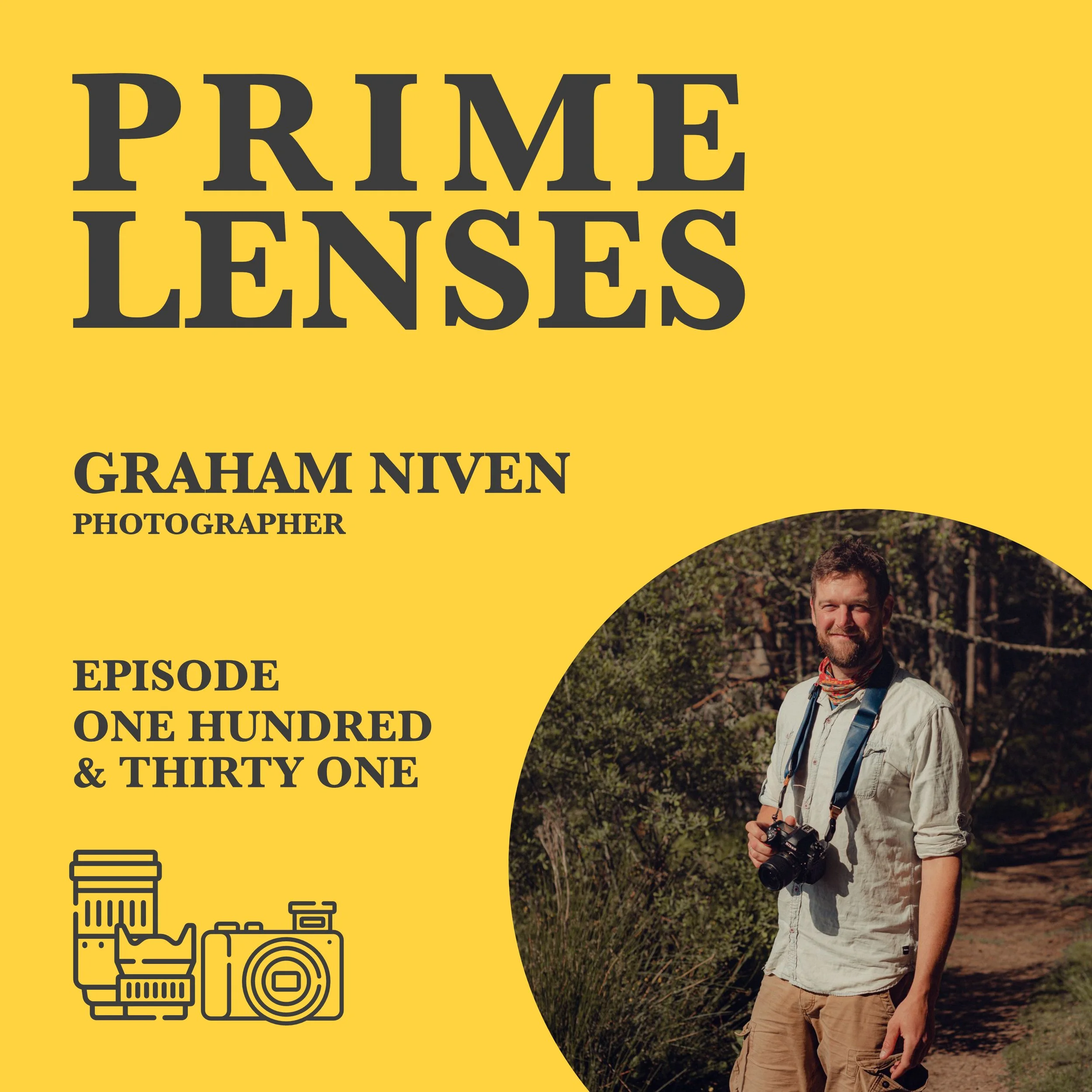


I love to record on location and usually that means getting up very early in the morning and going a long way so I have been plotting for a while to chat to Graham Niven, an award winning landscape photographer who lives in the same village as me. A big personality, he’s well over six foot tall, he’s a fantastic photographer whose work have loved since before the podcast. We decided to take a stroll around a local loch to talk about how he got his start, how he thinks about sharing his work and what he’s using these days as the pressure on photographers to do everything, all the time, increases. We begin with a choice …
Support the show on Patreon.
Episode Transcript:
Graham Niven
Left or right?
Iain Farrell
Left!
Graham Niven
Really?
Iain Farrell
Right!
Graham Niven
I feel like you get more reward on this side.
Iain Farrell
Oh do you?
Graham Niven
Yeah this is lovely but I feel like you arrive if you come this way. And then you kind of put your loch on the right hand side.
Iain Farrell
Oh nice. Well you see I'm with the kind of the woodland whisperer in a lot of ways. Thank you for saying yes in the first instance. That was a while ago wasn't it? Well you know it's a 20 year project I'm not going anywhere this is how I get people. There's some people that are like we can't do it right now and I'm like I'm cool I'll see you in 10 years.
Graham Niven
Oh yeah, it's quite nice that you're nearby so it wasn't like I could escape anywhere because I see you most days at drop-off.
Iain Farrell
Yeah. One of the things I wanted to kind of ask you about because I love people's photography superhero origin stories. So I kind of wanted to cover a little bit of what started you with a camera. It sounded like the humanitarian work was more the draw initially or you know, traveling and seeing people and helping people was maybe more the draw than initially the photography. But I'm curious as to what came first to chicken on the egg.
Graham Niven
Yeah, so, the beginning. I think way even before I got into humanitarian work, cameras were kind of around during my childhood. My granddad was a real tech nerd. He was an engineer, and when he retired, he had this amazing house full of knickknacks and tools, and this is in the late 80s, 90s. One of those garages that I can still smell today, just amazing things that I really and he was really into photography and videography and cameras and he was always filming us and photographing us and it's just a sort of a memory that's hanging in there um so that was definitely an influence um and my dad did a bit of photography and traveled a lot as well and I think a lot of those stories kind of set me off on a plan to as soon as I left school to go and see as much as I could before kind of getting back into education um So I went off to South America about six or seven months after leaving school and spent six months there in the Andes and I was able to get hold of a camera before I left at OM1, Olympus OM1. Yeah. This was about nine, did I have two thousands? So even then that camera was what, 30 years old? Yeah. And I was just like, I was amazed by this thing which had three controls, four controls. Yeah.
And I think that was a really nice way to start photography. Getting hold of the real basics of light and composition. And there's not much that can go wrong. There's nothing to break. So yeah, I took that with me and quickly realised I wasn't much of a writer. I tried to take a sort of daily diary or a blog. But I just didn't keep up with it. And I found the easiest way to document stuff or to capture things was with a camera.
And that was amazing, you know, like being up in the Andes in just the most incredible landscapes and beautiful people and a real feast for the eyes and for the camera. And I kind of really enjoyed and I kind of miss the finding film or developing film. I haven't done it for many years and I'm not going to pretend I'm like, you know, going to become a Lightroom hero again. Or sorry, Darkroom hero even.
Yeah, yeah. But I did, yeah, you know what, I don't even remember that feeling of taking a spool of film to somewhere to get it developed. And then when the day came, I'd almost like sprint there. Yeah. To find out what was on the roll. Sometimes it was absolute guff. But yeah, so that's when I got my first camera. And then I came back, went to uni in Glasgow, and I kind of lost the photography for a few years. I think I just got distracted by, you know, life.
And everything else you do at that age. Yeah, yeah. And I was taking photos here and there, but I think I got my first digital camera maybe about five years later.
And I was working there as a tour guide after I left university. I studied geography. I worked as a tour guide for a few years, and then when I was traveling around Scotland, I was using the camera more in a more sort of landscape sense, but taking photos of people out in the landscape.
And then I went on to study in Sweden to do humanitarian response. And then was always traveling for 10 years or so with that work. And I was doing some photography when I was back. I was kind of moonlighting doing some jobs. But it's quite an encompassing job. You know, it took over your life essentially. I was traveling a lot. Yeah. Quite an intense time. It was really exciting.
And very rewarding and had some amazing experiences. But camera work was always kind of, it was along with me, but it was never my primary role for being there, obviously. But yeah, I amassed a lot of photos over those years. And then I think it was about 2016 or so, I started organising them and putting them into a website and began to kind of have a. Taking photos would be looking back and and organizing work that I had already produced yeah and I became a bit more conscious yeah
Iain Farrell
It's busy 10 years because you've been also like the way you say it is like I just kind of like fell into the thing but you've fallen if you have fallen into it you fall into being like a multi-award winning really widely recognized who makes just happens to make stunning images you know like was that the goal when you were putting that portfolio together, you were like, right, now I turn, now it's game time.
Graham Niven
No, no. I mean, that was a nice aside. It's a funny thing with contests and I think I wasn't even aware of that world and I thought, well, I've got all these nice images. It'd be nice to just put them in mix and see... We frog there. Oh, yeah. Yeah, just... I wasn't really connected to other photographers. Right. And that sort of community.
And so didn't know what was going on out there. So it was quite nice even to just see other people's imagery. And to see yours next to other people's creations and their visions. And it was really inspiring to sort of see what's out there. Yeah. Because as you've said, I think before in the podcast, it's quite a, I'm not solitary, but you can quite often find yourself. I do certainly. And it's quite an insular thing. Yeah.
It's very much a one-person job. Yeah. And I find this, your podcast, has really opened up horizons for me in terms of hearing other people saying that and talking about how their experience has always been a personal one, but they realise that they're sharing a lot of ideas and feelings of other people who almost sometimes purposefully will do things by themselves because in a creative sense, certainly in nature photography or landscape photography, I quite like to be out by myself.
Yeah. Because I'm always, otherwise, slowing somebody else down. Never... Well, I learned quite quickly, like going for hikes or bike rides with pals, they just got really like, oh, Nev's taking a photo again. Same with my family, I've got a lot of photos of the backs of them. Yes, totally. As they walk and look very picturesque in the woods. It's never their front, it's always behind. Yeah. I learned that lesson quite quickly. People were always like, oh, it's like taking a dog.
For a walk, you know a dog does ten times the distance as the walker. The photographer's always like whew, sipping off to lots of different places. I was never beelining for the summit.
Right, yeah. I was always like, if I get there, great. Yeah.
But I'll see what I see along the way.
Iain Farrell
Yeah. Well we have one of your, I assume it was a fairly early morning photo of the Buachaille, which is, it looks like it's high up and sort of on another mountain or a ridge or something nearby.
Graham Niven
And I see a lot of your stuff where you're camped out as well and things like that so that presumably means there's a fair bit of preparation and planning has to go into something like at least to know kind of where the sun's going to be and things like that. There's a lot to think about when you're doing stuff like that in terms of I'm a fair weather camper I won't go out and there's no point in going to the top of the mountain if you know it's going to be p.m. of rain and stuff so I do you know look a lot at like sunset sunrise angles moon phases I'm fascinated over the weather. I've got far too many apps on the phone. I mean, we live in such a time where it's crazy that you can almost tell specifically where the sun's going to rise over a hill, etc. I don't try to get too bogged down in it, but have a little look. And then there's certain places where I'll amass a list of things I'd like to do and things I'd like to see. And if the opportunities allow, the stars align, then carry a very heavy bag up a hill.
That's when I discovered poles as well. Ah yeah. Takes a lot out of the knees. And yeah I just I do love the experience though of sort of solitary camping on top of a hill. Yeah. The first time you do it I mean I'd done it a lot when we were traveling and stuff. But it's quite a therapeutic you know experience just to you don't you have a terrible night's sleep usually. If you're trying to do some astro as well then you're up every or so setting up cameras etc and but the first few times I did I just loved it you know and sometimes you come away with images that are just amazing and sometimes just nothing at all but um you never lose from the experience you know right yeah um and there's a few classics you know like the book all the one you're mentioning uh is a view that's you know very well recognized and um but I think for a for a time before social media These kind of images were pretty unique.
Yeah. Because there weren't a lot of people, and this is not that I count myself, in that group. I mean people like Colin Prior and folks who were doing it in the 90s, whose images we all saw and were like, "Wow!"
Like, I don't think you really appreciate how much graft goes into being at the top of the mountain at 4am. Yeah. And set up with your camera and surrounded by images and all these little things.
But yeah, I just, I do that maybe, I don't know, try and do it at least two times a year. Yeah. Maybe a couple of times in winter and summer. And it's magic, yeah. There's a few, I've got like a mental list of images in mountains I'd like to climb. And sometimes I've done them before and you'd like to go visit them in different seasons and very specific scenes. There was one a couple of years ago up in Liathach.
In Torridon. And I'd been up quite a number of times. It's quite a sort of well-known scene of Liathach from Beinn Alligin. And it just looks so alpine. The shape of the mountain is incredible. But this vision of it, it's just almost like a Toblerone peak. And you've got the Cuillins in the background. You can see the sea, the horizon. And there was a big Atlantic snowfall. So not very often we get cold air coming off the Atlantic. It's usually quite moist and warm.
There was a huge amount of snow falling and I had hoped to... basically from the peaks to the beach. So everything was white. I thought, oh great, I can capture that scene, like full white. But of course, it had fallen on quite warm ground, so it was really hard terrain. And I got to the car park pretty early and thought, well, the avalanche risks were saying that you shouldn't go into Corrie's. of a certain aspect. So I was trying to avoid the quarries and I thought I'll go up the ridge. And I managed to find someone else's footsteps who'd gone up before me which I thought was pretty amazing. But I was obviously a lot heavier than they were. So even though I could use their footsteps it was really hard going. And what normally takes like an hour to get up took me about two and a half or three hours. Wow! Just I was up to my armpits in snow at times falling into rivers and stuff. Yeah. And then I got up there and I was so I took a few images, some of which were lovely, but not really ones that I was like, oh, but only when I got down, I was kind of looking at them thinking, oh, you know, didn't get what I was looking for. But still an amazing thing. And I think when you share like even an image of something like that, you know, you don't often get the narrative of the effort that's gone into it in the background. Yeah. But it's, yeah, you don't have to come away with a prize. No. You can come away with a lesson as well.
Iain Farrell
Well, it's something that comes up a lot, like my mate Gadget and a few other people who've been on the show talk about getting your reps in. And sometimes there is, sometimes there is a bit of, you know, that goes into the movie version of your life. That's the training montage. Yeah, absolutely. And I think I'm not much of a, I don't go full beans on social media. I have a kind of love-hate relationship with it. Yeah. And as much as I kind of respect the people who film themselves,
Graham Niven
Doing everything. You know, like plant the camera, walk past the camera, go back, get the camera, do a drone shot of you walking, you know, a slow footstep. Yeah. And then here's me taking the phone, here's me taking the sentence. And, you know, that's, I find some of them really interesting to watch, but it's just, I just couldn't be hooked with all that nonsense, you know? I'm tired enough just carrying my 25 kilo pack up the hill. Yeah. So it's, yeah, you kind of have to almost,
Iain Farrell
Give the experience through the image through a astile image or a series of images yeah um my days are yet to become a youtube star of filming myself youtube sensation it's a bit like when people say why don't you film the podcast I'm like have a word like it's it's it's it's a lot of effort getting you know to do in person to do the audio not to mention most of the time it would just be two people on a webcam that's true I'm not sure that's worth watching like you know we're very we're we're denying the audience because we're extremely handsome men but it's not it's not a guarantee every week you know um so yeah so it's I I can completely relate to that and it's also about building something sustainable yes once you once you give them something they're gonna want more well and you are that's the big that's the the bad again it's one of the things I think with any creative pursuit if you're doing something and especially if it's new to you and you start to get that people start to go oh that's good yeah and you're getting that
Graham Niven
That kind of anonymous...it's not really actually...it's junk food feedback, you know? It's not actually good for you or doing you any good, but it sort of feels good in the moment because some random has found it and if you get, you know, that can distract you and then suddenly you feel like, "Oh, I've got to do this," rather than making the thing that you actually want to make or... Yeah. Yeah, I suppose, I mean, some images or some content works better than others, but is...are you doing it for them or for you or for...?
Iain Farrell
Yeah. Yeah. Yeah. The algorithm doesn't like pauses. Don't put pauses in. Well, what am I doing? Stop sounding like me at a certain point or you. Same with your images. If everything, if you had to shoot everything suddenly on film because film was popular, well, maybe I don't want it. Maybe I find it too much of a pain. It's like when everyone was talking about, well, I don't know what truth there was in it, but you've got to do reels. You've got to do videos. You've got to do videos. You've got to do reels of you taking photos.
Graham Niven
Or photos of you taking reels or... Yeah, kind of lost the... I find that sometimes you just... It's like throwing a glass of water into a swimming pool and saying, look at that! And it's gone within seconds. Yeah. So I don't know. I just... I quite a long time ago stopped... Not that I'm immune to dopamine. Sure. Stopped really caring too much about feedback or growth or whatever else.
Yeah. In that world, at least. Yeah. I much prefer talking to someone who said, oh, I saw that image and it was fantastic and looks for a story behind it. And that is much more of a giving process in terms of learning, etc. And that's what I really love about, I think the first time we met was when you came to my gallery. I was just thinking, yeah. Two or three years ago. And just talking about the images on the wall. It's really nice.
Iain Farrell
Like the gallery is a very small space and it's a tiny village, doesn't have a lot of footfall but we don't really have a systemized opening and closing etc. But even just having folk in and chatting about images, yeah, gives you a lot. I remember the one I really love which I came in very confidently you may recall. Yes, we're gonna buy this photo, it's the black and white one of the cliff which did you shoot that from a boat? Yes. Yeah. Whereabouts is that again? St Kilda. Yes.
Graham Niven
Which is a pretty magical place for all sorts of reasons but visually it's almost otherworldly. You know you go to some places and you're like it's not real. It is real. It can't be real. It's real.
And the reality of it sitting there in front of you almost your mind kind of struggles to comprehend the you know these cliffs that just come I'm not sure I think there's 600 metres high Borare or thereabouts and it just looks like the bones of the earth. or shooting out through the Atlantic Ocean. So yes, that was the boat. My greatest happiness from that photo was I managed to get a straight horizon whilst the boat was... And the frame was... What's the froggy? The frame was very full, so there wasn't much space for error in terms of shooting it wider than I could. And I wasn't thinking about, you know, in those scenarios, you're really just very reactionary.
Trying to get something straight and well exposed and everything else. And so sometimes images like that just come out and you're like, oh, wow, amazing. I wasn't pre-planning it or foreseeing it. It just kind of came out of the catalogue and I thought, wow, that is the one. And there was a few from that trip, but I quite like ones as well where you don't especially look at it in black and white, but then as soon as you see it in a,
Iain Farrell
Later on and you find ways of editing or reproducing it and black and white sometimes just really complements an image. So you let that kind of come to you because I sometimes set the camera to black and white almost like I'm putting film in it and I've got this old you know that old Leica the film one with the digital back on it that one that I've just picked up because it only shoots colour I sort of treat that like it's got a roll of Kodak in it because it kind of looks a bit Kodak-y. Yeah. And then my other, my M, if I'm taking that out as well, I'll set that to black and white and then I've kind of got one of each. Interesting. I'll even set it to JPEG sometimes because I'm a tourist. Yeah, yeah. And I'm like baking it in. I'm just like, let's just enjoy this and learn a bit of craft. Yeah. I sometimes fear losing out, so I always just shoot in colour.
Graham Niven
And only seldomly do I like actually specifically think about producing a black and white image. Yeah. For it, there's a, there is a specific conditions like if you've got kind of high contrast snow and a blue sky, always, I always feel it works nicely. Um, there was a, which quite often we get in Cairngorm Plateau. Yeah. Um, and there was a time a few, well, two or three minutes ago, I can't remember, that'll blur into one.
Really, really cold day. It must have been... No, this is... I think this was the first cold winter because it was a really, really deep cold winter. It was about -18 when I left the house. Wow. And did a hike up over the plateau. And just... I was shooting in colour but I almost knew I was going to process it into black and white. I bumped into the reindeer herd and then when I came up over Coire an Sneachda there, the wind was whipping up the snow, soft snow, just making these like billowed clouds.
Over the cornice. That's one of my favourite scenarios for black and white. And also, not that I shoot people a lot, but sometimes you can get some real emotion in someone. And the monochrome just takes a little bit of the skin blockiness out. Everyone looks better in black and white. Especially in low light, I find. Low light colour can just be a bit of a coin toss as to whether everyone just looks a bit
Iain Farrell
I spoke this week with Jocelyn Bain Hogg down in London and he shot Gangsters. He did two books, one was called The Firm, one was called The Family. And I asked him about the choice to shoot in black and white. And he was like, well, part of it was he was skint and could process it himself in his bathroom darkroom. But the other part of it was, as he put it, it's like ham-faced gangsters in London didn't look amazing in colour under like a ring flag.
In a nightclub. So black and white was the obvious choice because then you're not distracted. Yeah. Because, you know, like if you're using a flash and stuff, and I think that look has... It's funny, it's come back in the last few years, it's sort of very post-American apparel. Everyone's shooting with a flash again. But I'm not sure I'm entirely here for it all the time. I think it sort of... Especially if you use it on civilians. If you use it on models, I think they know what to do with it. But if you're just... I've seen magazines, My favourite example of this is Monocle who adopted it as their standard for photographing, you know, here's the ambassador of wherever to wherever. And they just look awkward. Because you've just, in a fairly dimly lit room, you've just blasted them with a flash. They've been caught doing something. Yeah, they do look, yeah. And they're just standing next to a chair. And they just look a bit shocked. I don't recall the last time I used the flash, actually. I just always find it like, it's just a bit like someone's been shot with a water pistol, you know?
Graham Niven
I don't particularly love the results but I do I can see where it could work for people but yeah I have once or twice carried it in my bag but never used it yeah I think if you're Martin Parr you got away with it yes yeah some people make it work oh actually a lot of macro folk well that's the thing yeah it does very well for there I got a macro lens recently and I had that's the only fact that's the only time I've used it last year so and it is amazing what you can one of those little hoods yeah And I just that's a kind of more of a sort of fascination hobby. I wonder what that face looks like. Really close. Sometimes it's beautiful. Sometimes it is terrifying. Yeah. My wife has a bit of a fear of spiders. And I photographed just a nonchalant house spider. And oh my god. It was just one of the most, I mean, who needs science fiction when you've got things like that? I mean, it's beautiful.
In a sense. It's amazing. You can see the hairs and thousands of eyes. So I quite often, the last couple of days actually I've had it with me, we were collecting birch seed. Not far from here, just up on the hillside. There's a very small window to collect birch seed and that's going to be used to spread in the fire site. Anyway, we found loads of cool little bugs on the birch leaves on day one. I was like, right, I'm bringing my macro lens tomorrow.
I'm getting some interesting shots of some crazy looking bugs. Nice. Yeah. Yeah. I do love We Beasties. Hi. I'm a big fan. It's a world that we're not like you know really aware of until we are able to see in their sort of scale. Yeah. Which is crazy. Yeah. So you're all Nikon stuff all the time. Are you? Apart from drone staffing. Oh yeah. And I don't have, I'm not sponsored. I have no allegiance whatsoever.
I basically flipped a coin when I bought my first DSLR which was I think a D70 many moons ago. I think I picked one up and it felt better in my hand. I had big hoofs and it fitted better in my hand basically. And I remember speaking to a guy probably in Jessops or wherever it was back in the day. Other shops are available.
Yeah, he was like, look, they're much of a muchness. Nikon, Panasonic, Canon, whatever. And then since then, it's just kind of like, pick a side. That's your side. Yeah. But I did go through a big kind of process. So then I was like Nikon, I went, got a few different bodies and lenses over the years. And like, I'm not a tech guy. I really much see it as a tool. And I will look into like the capabilities of certain things I'm going to buy, but I don't have any kind of emotional feeling about it. Or massive interest. Other than what does it do. Yeah, it's a job to be done. Yes. So I had a, I got like a match funding business growth grant thing a few years ago. And it was an opportunity to like, basically, I was looking to do a bit more video work. And so I basically did an overhaul of all my gear. And so I was like, right.
This is amazing. I have a blank canvas of an opportunity to go down Sony or Panasonic or Canon or Nikon. And I spent so much time going around in circles, deliberating over little things that really didn't matter. And then I was just like, I spent so much time thinking about this and I just went, I'll just go Nikon again. And I don't know whether it was a good decision or a bad decision, but it just feels very natural in a way that I knew where the controls were.
So I don't know whether I've missed out or not, but for me it's very much just a tool. It doesn't, you know, whether it takes 30 seconds or 30 photos per second or 35, I couldn't care less. That said, like it is, you know, they're such amazing tools these days. I think we take for granted just, you know, how incredible they are and what they can do. And even from little things like just even a long exposure, I mean, I can explain to somebody what the camera sees for something like a star shot or an aurora or you know taking all light over 30 seconds or whatever it is and you know the common discussion is well I saw the aurora it didn't look like that and and so the camera gives us opportunity to see things slightly differently um but then I think like when I talking to people in photography workshops you really just break it down to the really basic stuff around light and composition and shadows and highlights and etc. And I think people quite carried away with this tool which is really complicated. Whereas most of the enjoyment just comes from framing something and capturing it. So yeah, for me it's very much a tool. And I do appreciate the kind of tech geek side of it as well.
In a sort of, you know, it's an amazing thing. My granddad was definitely a tech geek. So there's a lot in that and, you know, it can open up amazing possibilities of, you know, what this tool can allow you to do and allow you to see. I just get lost in it. My mind doesn't comprehend a lot of it. Well, we do. And I think that's the other reason that conversations like this are good with people doing the job because,
Iain Farrell
When those of us who are tourists, who really enjoy it, get sucked in by the marketing that tells you you must be a pro and you must have the latest body so that you can do 30 frames a second blackout free. And I always come back to what does it enable? But tell me about what it enables and then we'll go from there because that I think is what's interesting. So when I was, Sony invited me to a thing earlier this year and they had models on trampolines.
It was like the fastest thing, hardest thing to shoot. Like I wanted to show you what this thing now allows me to do that I couldn't do before. And then his assistant was there whilst they were capturing images, cutting out these people on a trampoline and making these amazing collages. Like, and you can start to put work together very, very quickly and iterate very fast. And so that's, that's great. Now you're showing me it's worth something. Yeah. And it's worth doing rather than, you know, quite often just like newer is better. Yeah. It's like, is it though? I don't know.
Graham Niven
Like, the way you talked about your OM1, the fact that you just had immediate access to everything, you can learn your fundamentals, and that can be really satisfying too. Absolutely. Yeah, I think it might have been you seeing it on a podcast once, but the camera you have is the most, you know, technically wizard-specific thing you're ever going to have. You know, it's the best camera you've ever had. Yeah, yeah, yeah. The newest camera you have is the best camera you've ever had. I mean, in terms of capability, etc. I don't know.
I feel like we've kind of reached a plateau of, well, capability, but also of need. I don't know how many photos you need to take in a second. Well, yeah. Obviously, you know, if you're shooting birds and wildlife and sports, et cetera, then there's a need for it. But it's like with a lot of things. I mean, there we go on to some type of AI. I was like, do we need AI? Would it be really okay without it? Probably. Yeah. Of course, there will be really useful applications for it.
Yes. Do they outweigh the impact of it?
Iain Farrell
I heard a great thing last week about that where they were saying about, you know, they've just put out papers where they're showing that ChatGPT and Claude and things can solve mathematical problems that we haven't solved before. And they were like, that's great, because they're probably looking for a new area of business that would take advantage of the product and start buying it. except and it's the classic modern technology thing of sort of misunderstanding the market you're moving into they've shown that they can solve all these math problems maybe the maths research world will start investing in these tools you talk to people who do math research and they go there's not really funding for math research it's sort of me in a blackboard like there's not there's no if they're looking for businesses that can spend money they are definitely in the wrong place and they may have just ruined you know things that would attract people to Yeah, Oh, not someone else, something else. Yeah. But also something else to do something that's only a facsimile of something that already existed. Right. It sort of stops that creative kind of spark happening between people. Like, a friend of mine years ago worked at Apple. Uh-huh. And he thinks that he is accidentally the reason that the old iMacs and Power Macs knew what colour they were. Because when you bought one, if you bought the blue one, the desktop wallpaper and theme and everything was set to And he thinks that came about because he asked someone whether they could. He didn't say that should be a feature and you should do it. But he asked the question and then people went away and sort of thought about it for a bit and then actually there was a way to do it and then it shipped. It's those sorts of happy accidents. Yeah. And they're all over the place. Yeah. And that's all part of growth, isn't it? Learning by making mistakes. Well, yeah. And also the point of working with people. Aye. Right? What's the point of...
Graham Niven
You work with a printer and they have a really cool idea for helping you frame your stuff and printing it and stuff or you just show things to people and you know you've got to we've got to have those little it makes it satisfying yeah otherwise it's just you're just on your own the whole time doing it staring into the void and I think that's like going back to sort of working in a solitary sense as well it's it's very therapeutic and I get a lot from it but equally it does uh yeah feel nice to share stuff as well and get feedback and ideas and all sorts. Especially, yeah, things like printing, like I just have a, I sort of settled in a way of doing things, mostly just to sort of streamline it and simplify it. But, yeah, it's good to get a wee kick in the bum down again or, you know, knock sideways and see what else there is. Yeah. Do you enjoy the printing, like some people talk about the printing is when it's finished or, you know, do you feel that, I do, yeah I do. I do love, I've got a printer at home, it prints up to A2 size, and I think when we moved up to the Highlands, I used to live at Edinburgh and you know I had loads of great printers nearby that I would go to, and I had, you know, cost wise it made more sense more than a flat, than a space, etc. When we moved up here, it just, it was going to be tricky because everything had to be posted out and It just seemed to make sense to try and do something from home. And I do, yeah, I love the process. It's like, you know, I guess similarly to seeing your images either from when they come back developed or you see them on the screen, but the process of them coming out of the printer and seeing how the colours come out and how the scene is framed. It, yeah, really kind of, and then you're putting it on a wall and you're not just seeing it once in the palm of your hand, right?
The main thing is the scale of it but also the regularity of which you see it and it almost becomes like part of the furniture but then occasionally you stop and look at it and you notice it and you think about it which is a much more different process than you know staring at the phone which is the other way we do it these days which is you know it's not how things were intended I don't think. No. I also think we have a problem with the quality of the screens we're looking at because they are so high quality. I know.
Iain Farrell
And they do make everything look better. You know, like, I think it's part of why the Digicam thing has come back around. Like, shooting with a 21-year-old 10 megapixel camera again recently. The images are pretty good, and I do like them. And they print nicely. But you look at them on a phone, they look spectacular. I know. In a way that is unearned, really. Backlit and... Yeah. What's the... HDR. Really high DPI. Yeah, HDR to death. Yeah. Yeah. I think that's why a lot of people,
Graham Niven
I mean phones are pretty amazing for photography and convenient etc but when people take a photo and the HDR happens almost instantaneously and you're looking to go wow that is pretty much better than real life yeah happy with that yeah whereas you know taking a raw image you're you know playing about with highlights and shadows and stuff and I'm trying to be careful not to overdo it to match that expectation of yeah what people want to see in the palm of their hand yeah But yeah, I think printing and putting them on the wall in the gallery and selling images, which then people have in their home, but I think it's all part of that process of discussing the image, the experience, the place. I find it hard to choose what to print. Right. Because, you know, the age-old thing for photographers is, you know, part of the process of taking the photograph. It's full of emotion, it's full of memory, it's full of, you know, visceral things like even like smell and animals that you saw etc whereas a print is a sense of you know a 2d representation um so trying to depends what I want to do with it if I want to print it for my own sort of gratification then I don't really care but if it's something you know I I think trying to print stuff that you know people or hope people will connect with that's the tricky bit yeah um I mean to be frank sometimes I I struggle to print stuff that I think will sell. So we've got a small gallery space and I'm like right I need to be really specific with what I'm going to print and frame because you know it's expensive and if it's not the one that people want then it sits on the wall for a long time. So that process I find tricky. Sometimes the ones that you love are not the ones that everyone else loves. So there's a balance to be found there. And I found you know there are images that sell lots of. Namely Places normally where people have a memory or they've been on holiday. So we're here in the Cairngorms and there's obviously lots of scenes that people will recognise, like the mountains or the bothies or the trees or the forests, but perhaps not the way the light hit a mushroom on a cold Tuesday morning in November, you know? Which is the one that you're like, oh, that was great. Yeah. So it's a bit of a process and a learning process and, you know, there's certain images, for instance, like Ryvoan Bothy sparks, which was completely unplanned and was one of those really sort of go home and look at images and wow moments. I was kind of seeing it on the back of the cameras I was taking them but and that was like six years ago and it's by far in a long way of my biggest selling print. Yeah. So I'm trying to do a new one of those. Yeah. Yeah. Add a couple to the repertoire. Yeah. You've got the The Kilda Cliffs, which is, I think, presumably, I would have thought that one's quite a popular one. Or is it too stark? I think it's just a wee bit alien to people. They don't know about it's in Kilda. Or people do, but yeah, it does get a lot of recognition. I mean, I say that as I confidently walked in and said, yes, we'll have that one. And then texted you and Alice says, no, we're having a different one. Yeah, that's right. I'll get one for your special room, probably. I think I just need to get it. I'm going to redo my office.
Iain Farrell
And then I think I'm allowed that one room. I think I'm allowed that one to have anything in there. You've got to have your, your, whatever, your posters up. Yeah, my own little bat cave. I'm sure that's, that's allowed. My own posters up. I had a guy on one of my teams once who, when we were redoing bits of the office, was like, yeah, I'm going to put up a poster. And he's like, and I want to put up a poster of Cameron Diaz. And I was like, no. And he went, no, it'll be a tasteful one.
I was like no sorry man we're an engineering team doing a load of stuff I just know this isn't a garage in the 70s they don't have a Pirelli calendar in there no no they didn't it was uh I was and I was really unpopular for about a day and a half he was in the right half um but he's probably a manager now and probably understands where I was coming from yeah that's funny we're talking about your back catalogue there though do you go back over it much and kind of I've been talking to a bunch of older photographers recently and they're at a different stage where actually they're not out and about as much they are and so they're doing a bit more combing back through and in their case often finding negatives and re-scanning them and the scanning technologies come on a long way as well so the images maybe look cleaner or they're seeing something in them that they didn't see do you go back much over your archive? Almost to the point where I feel like I'm going insane
Graham Niven
I can be sat there and just be like what am I doing? This is the 18th time I've been around this. You know, especially with Lightroom as it is now, I have tried to structure it in the years basically. But sometimes like, for instance, sometimes for personal projects, but if a client's looking for specific images of something, and the Cairngorms are wider Scotland, I will try and and I'll be like, you know, if something doesn't quite work, I'll go deeper and deeper. And then I find an image and I get sidetracked and I want to re-edit something. But I don't like to fall into the trap of always having to create new stuff. Especially, I was chatting with a friend the other day about submitting images for contests. And quite a lot of them, they have to be taken within the last year or the last five years.
But some of them are just taken in any time frame. And I like that because, you know, the photograph doesn't really go out of date. No. It may be less sharp or whatever else. But, you know, there's no... You can't take a better quality photo now than you did 20 years ago. Yeah. Because it's not judged on the DPI. Yes. That said, I did take a lot of shit photos back in the day. And I wish I had taken them better of amazing scenes. Yeah.
I remember I studied in Sweden to do humanitarian response and part of that was to work in an NGO for I think it was eight months I lived in Honduras in Central America and that was when I bought my first sort of big DSLR I didn't really know what I was doing with it and I switched it I used the in-camera controls to make things look funky right and this is pretty social media you know this is just for me I was like oh that looks cool I was shooting in JPEG and all these scenes are amazing but the colours look like they're taking in some sort of mad disco and I can't do anything with them. So there's little, that's all, and that's learning isn't it? Learning in a way which I couldn't go back and spend eight months there. There are some images that I'd like to try and, I don't know, save from my former self. But yeah, it'd be interesting as well, a friend of mine, He just bought an OM1 and I was like, "Oh my god, I used to have it." I still got an OM1 somewhere. So we were chatting about it and they made me go and dig it out and there's a spool of film in it. He's only got like 12 photos left. Oh wow. I wonder what's... I don't remember last time I took a photo with it. But then I was thinking about, you know, could I get all the old negatives and I think you have a negative processor. I do. Yeah, yeah. I used to... Yeah, well it'll just go on the end of whatever lens
Iain Farrell
In fact, you've got a macro lens. Yeah. What is it, like 100 or something? 105, yeah. Yeah, so that'll be perfect. And it's a little tubey contraption, and you screw that onto the end of your lens like a filter. And then, because you've got fancy autofocus, so it'll even just work. Whereas I have to spend time working out whether I've got it in focus or whether I got the image out of it. I've had negatives where I've spent ages, and I'm like, why won't this one be in focus?
And then I realized it's because I didn't nail focus when I took it or my dad didn't in the 70s and it's not like you have to use the the bit at the edge that says Kodak or whatever is what I use as my focus reference and then yeah but yeah you're very welcome to borrow it's very easy setup that could be a that could be a rabbit hole that I go deep into yeah it's good though if you've got if you've got a good modern camera you can scan your own negatives effectively at like you know 60 megapixels or whatever it's perfect yeah um that would be there's another
Graham Niven
Project on the horizon. Yeah. But I don't, yeah, to go back to your question, I, I, um, yeah, I think like probably you find this too, but you can go into little spells of having your camera every single day and just like feeling, you know, a deep sense of creativity. And then you can go into several weeks or months where I just don't pick up the camera. Um, depends when, when it is, whether I'm doing it, if I'm doing it commercially for work, if I'm really busy with work stuff, um, then I sometimes, things lose the personal creativity. Yeah. But yeah, you just kind of ebb and flow with it. Yeah. But I don't ever feel like a constant need to... I take a lot more photos than I show, as everyone does. And probably 99.9% of them never see the light of day. Yeah. So I feel like there's never a need for more photos. Yeah. More like capturing things as they happen. Yeah. And I'm... I very much have a mixture of approaches, whether they are very purposeful, I want to capture an autumn scene with the sun setting in this location and shining on this tree and that, you know, watch out, Froggy. Hey Froggy. And that, yeah, it takes a bit of planning, but then I'd say that's maybe 5% of, or maybe a bit more, but most of the images I produce are like, I put my camera in my, I can go on a bike ride. Right. Or something like that. So they're kind of incidental. Yeah. I mean, I might, you know, I know where I'm going and I'll probably see a nice scene here. If I'm going for an even bike ride, then I'll, you know, the light will be nice, etc. Yeah. I always, I'm learning. Sometimes I'm like, oh, I can't be bothered to take the camera, but then if I don't take it, something amazing will happen. Yeah. But if I do take it, I'll sweat more and feel this heavy pack on my back. Yeah.
Iain Farrell
But it's always better to have and not need them to need and not have as they say. Yeah I think so and I think if you've this is why I try and up until recently I've tried to keep myself honest with only the one as well because then it's really easy and you're just like right I'm just going to pick up that one because and the other one to some extent is an antique so it's a bit of a high days and holidays thing where like like today where it's a bit drizzly and a bit grey I'm not going to bring out the 21 year old camera they only made 2000 of it's probably a
Graham Niven
I applaud your approach because you're kind of like you one of your hands is basically a camera yeah you're uh I think it'll escape you oh no well it's because there's a guy I really love talking with a guy called James Popsys who lives over Wales where yeah um he's going to be on the show excellent um and he talks about the importance of having it like he has a bag sometimes with him that he can fit like a water bottle in and
Iain Farrell
Maybe a spare battery or something like that but that crucially his camera doesn't fit in it when he's got those other things because his camera won't make any pictures when it's in the bag and that's a really good kind of because whether or not I come back time and time again to this iteration cycles and repetition and so I will press the shutter a few times and get warmed up and do whatever and then I'll feel good in the moment I might get back later and decide actually I didn't have anything but I was practicing something there's something that I'm more ready for
Graham Niven
Just by virtue of, you know, and I'm not, again, it's a bit like I don't train and exercise to be an Olympic athlete, but I do move around and that's good and it means, you know, like when you lose your balance or whatever, you go, oh, training is good for something and I think it's the same with making things. Yeah, definitely. I guess it depends on your mood of moment. For me it does at least, but then if, yeah, if you don't have it and something changes then you're at a loss and you can use your phone.
Iain Farrell
Well yeah, there's the mornings when we're very lucky as well because we let the school run in the village living in the woods. You know this, it's gorgeous. So the mornings when I go, oh it looks a bit grey, I won't bother having the camera on my neck, are the mornings when suddenly the sun comes out. So you just, you have to have those experiences to learn from. Yeah, we're approaching that, well maybe we're holidaying it, there's been a couple of mornings where it's like really misty down in the village but you know it's only 100 metres high and you wait like half an hour and there's like a sort of 10 minute period
Graham Niven
Where the mist lifts and the sun hits and you're like, that's the frantic time. Yes. But sometimes you're on a bus or something.
Iain Farrell
Well, yeah, sometimes you're driving. Sometimes you're coming back from the airport and you pull over anyway. Like, I've done that before.
Graham Niven
Quite often, I was driving to football the night. We'd play a little sort of five-a-side game in Aviemore. And there was a really black sky behind the Cairngorms. And the sun was just coming out between a gap.
Iain Farrell
And you know those times, that was one of those times, I was like, "God damn it, that was my camera!" And it was just magical times. And I suppose that does give you some worth in having something on you all the time. Usually when you go to Tesco or something. Would you ever grab something kind of pocketable, like a GR or something like that? Because that's the kind of happy medium, isn't it, of glove box camera.
Graham Niven
I did think about trying to get something like that and prioritise another lens instead but I do think that there's value and yeah just now you could have a little Panasonic Sony number which they look amazing. I saw a friend of mine recently said he's off to a trip maybe a bikepacking trip and he wants a small camera that he can put in his little camera bag snack thingy-ma-jiggy and I said so I just I thought of these cameras and I did look into them and they're, you know, a decent one second hand is like 500-600 quid and they've got like 28-300 zoom and for me, like, especially if you're traveling, having that versatility in the zoom is kind of a big deal, but yeah, they look amazing, but he showed me it.
Iain Farrell
He went and bought one and he showed me it and I just thought I was going to drop it. I felt like I was holding someone's new baby. It was so shiny and small and my hands are so big and clumsy. I was like, take it back before I drop it. So I'd need to get some sort of grip or something. And then before you know it, you've made it bigger and heavier. A friend of mine was talking to this week, she's filming behind the scenes for a photo project she's doing and she's doing it on her phone because the phone's good enough quality for the video.
Graham Niven
And so she was like, I'll get a small rig, and before you know it, you've turned your phone into like a big slab. Yeah, but I think phones for video is pretty amazing, actually. Yeah. In terms of what, you know, lots of people, content creators, or whatever you want to call them, I suppose a lot of that stuff is done on phones or even these tiny Osmo cameras, which look annoyingly convenient. Just wanting my bag right now. Is there? Yeah.
All my video is in Osmo Pocket. I managed to find a very cheap one on eBay. Wow. And it's great. Yeah, they do look insane. Especially for traveling and whatnot. When I was thinking about lenses actually, and not being a tech-specific approach, the lens that I found, or the lens that I always reached for, was like a really big clunky 28 to 300 right I think that's what I got for my uh when I went to honduras um and it just like you know you're sitting on a bus and you see something but it's a few hundred meters away you cannot get there yeah you can use this big clunky zoom and you don't always get the sharpest image or what have you but I just found that everything lens just too convenient and I just yeah that's that is my and I have the the modern day version of that is now a 28-400. Wow. Which is just bonkers. It's only, it goes to F8, it's a bit clumsy and you've really got to be quite careful if you're fully zoomed in in terms of keeping a sharp image. But yeah, if I'm just going for a bike ride, I just stick that on the front and it kind of captures everything. Yeah, there's nothing you can't do. Yeah, but low light and stuff is a bit of a problem. But, you know, rather than carry a platter of lenses with you. Well, I was going to say, you were tripod Only for necessity. Like if I need to do a long exposure. But say if you're up a hill and the light hits for a minute or two, I'm sometimes occasionally will be looking at a scene and ready to press the shutter, but mostly I'll be just running around like a blue ash fly. Just like, "Oh, this is happening! Oh, look behind you!" So yes and no. I always carry one, which annoys me because I'm not really yeah I think that the folk who sit and wait for a scene to happen I kind of appreciate that approach but just I'm not that patient I'm not much of a bracketer or multiple exposures I tend to be a one image yeah kind of a guy you know like I'm not I'm not saying there's anything wrong with doing dual exposures or capturing foreground and background stuff. I've tried it a few times. I'm definitely not somebody who would, you know, I think it's what they call a bearing witness essentially. Yes. That said, you know, the camera can show you things that your eyes didn't see in a long exposure. I certainly wouldn't go down the path of, you know, everything seems so available. Like, would you like a sunny sky in this photo?
Or a cloudy one. Yeah. That just, that shit really gets my goat. Yeah. Which is fine, you know, people, if they enjoy that, then fine, but don't put it out there as something that happened. Yes. Because that didn't happen. Yeah. And I think as somebody who, and there's lots of people who will spend a lot of time, trial and error and lots of failures to get magic conditions or to, you know, walk for several hours or days to capture a scene. Yeah.
To just create it on a desk at home. Yeah. And that, I think, you know, it's very easy to see for, you know, for people who are used to it, but a lot of the images you see online with, like, you know, vortex cloud and a familiar scene which looks very unfamiliar, like somewhere like the Cuillins where people will transplant the sky in. Yeah. Which just looks ridiculous. You might as well just chuck in a dragon for a measure, you know? Yeah. That's just kind of fantasy. If you like science fiction,
Iain Farrell
Great. Yeah. I suppose as long as they declare it as such. Yeah. You know, this isn't a real moment in time. Yeah. I made it up. Yeah. I don't know whether that's where there's the line blur between photography and I don't know, what would you call that? Well, it's a bit like, it's imagined, it's a bit, it's closer to painting. Yeah. Or poetry in a bunch of ways. When I studied art history when I was at school and one of the things was that art painters and artists were very dismissive, some of them, of photography early on, because they were like, why would you just capture exactly what's there? What's the point? And they would also say, we can't leave it alone. And then we're proven correct when people in dark rooms start flutting around to kind of raise shadows. And again, I think it's that thing of sometimes there's a myth associated with things like shooting on film. They're like, oh, I just get what I get. It's like, well, no one ever just got what they got. You know, there were shortcomings of the medium that people always He's trying to overcome. And like the James Dean photo in front of the Flatiron building in New York, if you see the contact sheet versus the final print, the contact sheet they've exposed for some highlights in a way that like he's really in shadow but then the final image is incredible and striking. Or the Muhammad Ali fist photo where the guy got the photos of him training and just got his knuckles in the skin. They've still done things to accentuate and bring out the detail.
Graham Niven
That's there in the negative. So this idea that real photographers were never just putting their images into snappy snaps and getting what they got. And so why would digital be the same? Why would it be the same? You're absolutely right. I think I feel like there's maybe a line, for me personally anyway, that's my only perspective, but there's a line in my own approach which I don't feel comfortable going over. Unless I was to be like, this is a... I took the foreground and then I...
Iain Farrell
I took this beautiful sunny sky from Madeira and I put them together and here I have this image. And it's called Madeira and Culin. Yes exactly. Well you know we've done two laps. I know knackered. That's pretty good. That's pretty good. I was gonna say I should let you get on with your day but for people listening if they don't know your work and they want to pick up a print or something. You could come to the gallery here in Scotland. We live in a village called Nethy Bridge in the Cairngorms. It's beautiful
Graham Niven
We're very lucky if you're in this part of the world. Look up Niven Photography and come and say hello or drop me an email or however else you want to get in touch. Yeah. But in person's nice. Yes, in person is nice. Hiya, morning. Just getting busy now. Thanks. We've timed this very well. Hi. Yeah. Well, thanks, mate. I really enjoyed that. No worries. It was good to chat, man.
Iain Farrell
How long was that then? That's like an hour. Holy moly. Yeah, I know we did it. Will I take one? We'll do another one? Yeah, we'll do two more. A huge thank you to Graham for coming on that walk with me and for braving the midges and the mist. We were going to sit down by the water and have a chat, but what happened, Graham went back to his car to get something, and I said, I'll just stay here. I think it's not too midgy. I think it'll be alright. And he went, oh, I don't know. And yeah, sure enough, within about 30 seconds, I was starting to be swarmed by the, I don't know how they find us. Like they look so small. Do they have eyes? Can they smell me? Don't think I smell that bad. Anyway, it was a beautiful morning and a wonderful walk. And I hope that you enjoyed it as much as we did. If you did and you're new, don't forget you can like and subscribe to the show wherever you get your podcasts at Apple Podcasts, Spotify, YouTube Music, and to leave a review and to tell your friends. The best way to help the show grow if you like it is to tell a friend. There is a website, there is a merch store, there is social media and I reply to messages and DMs so please do hit me up and say hello because that is the best bit. Right, well I think that'll do. Have an amazing week whatever it is you're doing and we'll see you same time next time. Bye for now.