
Episode 135 - James Popsys
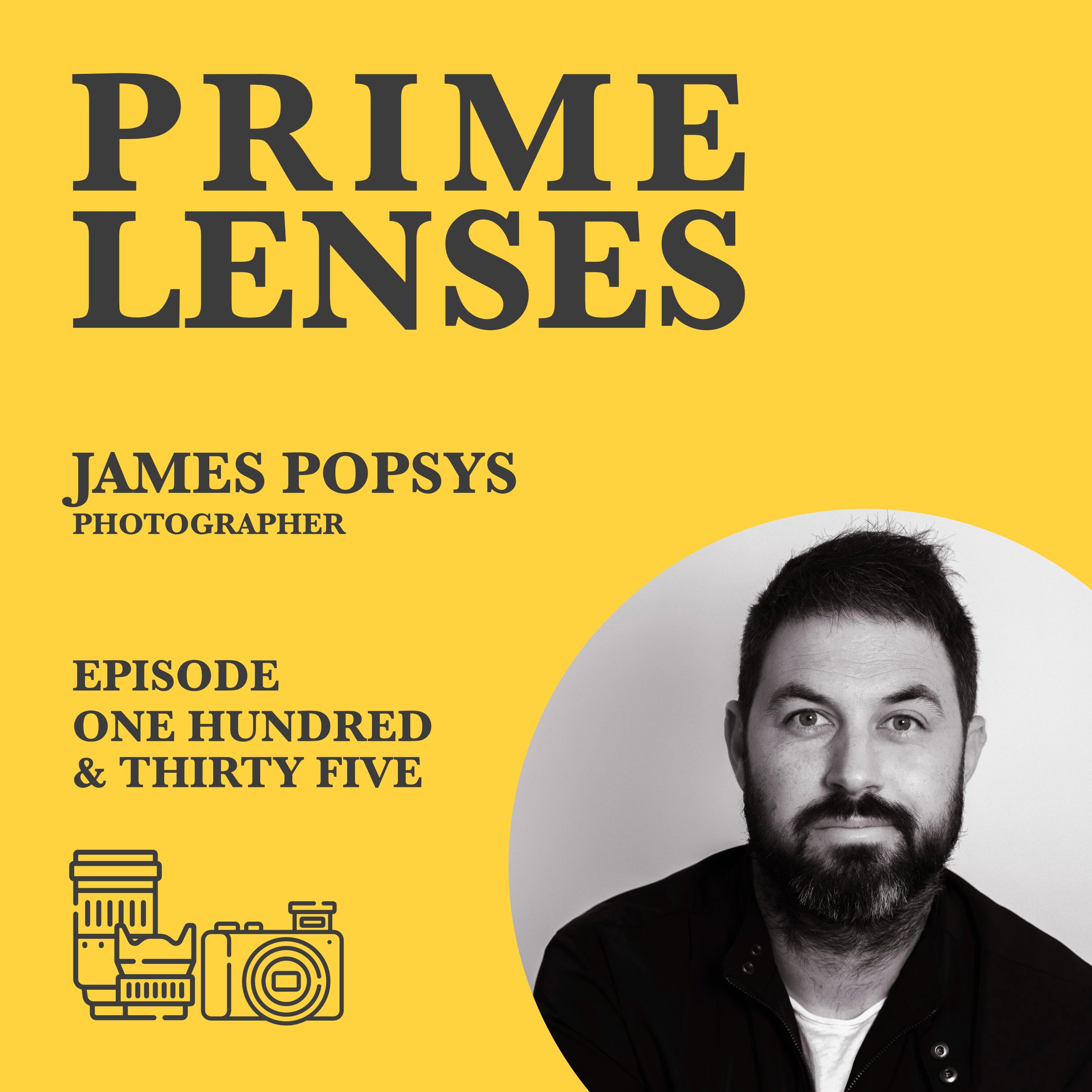


135. James Popsys
What if the goal isn't to make photography easy - what if the difficulty is the whole point?
Guest: James Popsys. Photographer, YouTuber and author based in Snowdonia, North Wales · jamespopsys.com · YouTube and Instagram: search "James Popsys" (P-O-P-S-Y-S)
In this episode
James has been on my list of dream guests for ages, so I was thrilled to finally sit down with him. We start, as these things do, with lawnmowers and film scanners, before getting into the real story: a marketing job in London, weekend photo walks, a conceptual composite of the London Eye as a bicycle wheel, and a move to Sydney that somehow led to a YouTube channel he started almost by accident in New Zealand. James talks about guarding his own individuality by deliberately not watching other photographers' videos, connecting the dots backwards to find the worldview running through his work, and what it took to commit thousands of prints to paper for his book Human Nature. We get into his one-lens, one-body philosophy, why he thinks difficulty is a feature of photography rather than a bug, and why he'd still rather be surprised by an ordinary place than get the photo 3,000 other people already have. He's off to East Greenland in a few days to experiment with a more hybrid, video-forward workflow, and this conversation is a lovely primer for anyone who wants to know how he got there.
Highlights
[Opening] Film scanners, darkroom chemistry, and a cold open about finding surprise in unremarkable places
[Opening] A very serious digression into battery-powered lawnmowers
[First third] The London Eye as a bicycle wheel, and the Sydney-to-YouTube origin story
[First third] "You can't connect the dots going forward" - finding the worldview that was there all along
[Middle] Making Human Nature: watching the zeroes stack up on a 15-metre printer
[Middle] The horses-through-the-window print, and why James is a "one body, one lens" traveller
[Middle] A Leica SL3's peeling grip, and 21-year-old Leica R8 and R9 bodies that still work
[Second half] Guarding individuality by not watching other people's videos
[Second half] AI, disclosure scandals, and why nobody's asking for more of it
[Late] Street photography, Britt Bradley's Gen-AI-vs-wet-plate test, and heading to East Greenland
Chapters
Positions are approximate. The transcript has no timestamps.
Opening Cold open: finding surprise in unremarkable places
Opening Film scanning setups and darkroom chemistry
Opening Kit Young's 400-roll film habit
Opening North Wales weather and the lawnmower tangent
First third James's origin story: London, Sydney, and an accidental YouTube channel
First third Connecting the dots backwards to find a worldview
First third Guarding individuality; avoiding other photographers' and podcasters' work
First third Human Nature: starting the book, and the RISD-style question of what comes after book one
Middle Printing day: watching thousands of pounds turn into ink
Middle The horses-through-the-window print and limited-run prints
Middle A 140kg Canon PRO-2600 printer in the house
Middle Exhibitions, introversion, and whether James should "try anything once"
Middle Why a photo feels finished when it's printed
Second half The New York school-bus photo, 40mm, and shooting at "imperfect" times of day
Second half Not doing YouTube gurning thumbnails
Second half Dabbling in filmmaking and switching to DaVinci Resolve
Second half One body, one lens, and heading to East Greenland with Jeroen Van Nieuwenhove
Second half Gear rules, a Leica SL3's peeling grip, and the Leica R8/R9
Late AI disclosure scandals and the Ricoh promotional-material controversy
Late Britt Bradley's Gen-AI vs wet-plate test
Late Running a business to sustain people, not to maximise returns
Close Where to find James, and lawnmowers revisited
Mentioned in this episode
People
Thomas Heaton - landscape photographer and one of the first photography YouTubers James watched early on · YouTube · [First third]
Joe Allam - travel and street photographer and YouTuber James cites as an early influence · joeallam.co.uk · [First third]
Nigel Danson - landscape photographer and friend who reassured James his printer inks would last for years · nigeldanson.com · [Middle]
Ed Smith - photographer local to me, mentioned for his exhibition work · [Second half]
Josh Edgoose - London street photographer known for finding humour in the everyday, featured in a video with Sean Tucker that stuck with me · Fujifilm profile · [Second half]
Sean Tucker - photographer and YouTuber who filmed the Josh Edgoose video I mentioned · [Second half]
Jack Lodge - former guest and South Coast photographer known for returning to the same spot across every season · [Second half]
Cal Henderson - former guest whose film street photography I mentioned · [Second half]
Britt Bradley (Nitrate Fox) - former guest and wet-plate collodion artist who posted a Gen-AI-vs-real comparison that fooled me completely · Lens Culture profile · [Late]
Kit Young - former guest, film photographer who buys film in 400-roll packs and views his work exclusively as prints · [Opening]
Jeroen Van Nieuwenhove - landscape photographer and workshop leader James is running an East Greenland trip with · jvn.photo · [Second half]
Books
Human Nature by James Popsys - his first photo book, self-published in 2024, exploring the relationship between man-made structures and nature · [First third]
Tools and products
Valoi Easy120 - the film scanning rig Iain is using and James is considering · Valoi · [Opening]
Ilford XP2 Super - the black-and-white film James shoots that develops in a standard colour C-41 process · Ilford · [Opening]
Kodak Portra - the colour film Iain is buying more of · [Opening]
Canon imagePROGRAF PRO-2600 - James's 140kg, 24-inch-wide print studio-in-a-house · Canon · [Middle]
Leica SL3 - the camera James used briefly before its grip started peeling · Leica · [Middle]
Leica R8 / R9 - Iain's 21-year-old film SLRs, one fitted with a 10-megapixel digital back · [Middle]
Panasonic Lumix GX1 - a small Micro Four Thirds camera James recently rediscovered with an added viewfinder · [Second half]
DJI Osmo Pocket - the compact camera both James and Iain use for lightweight, all-in-one shooting · DJI · [Second half]
Peak Design sling - the camera bag both James and Iain independently landed on · Peak Design · [Second half]
DaVinci Resolve - the video editor James switched to after leaving Adobe's subscription model · Blackmagic Design · [Second half]
Ricoh GR - the viewfinder-less compact camera at the centre of a promotional-material AI controversy · Ricoh · [Late]
Places and events
Ammassalik / Tasiilaq, East Greenland - where James is headed days after this recording, to experiment with a hybrid stills-and-video workflow · jvn.photo workshop listing · [Second half]
New Zealand - where James shot his first, unplanned videos before starting his YouTube channel · [First third]
Chinatown, London - setting for the Josh Jackson/Josh Edgoose street photography video James remembered · [Second half]
Quotes
I found most joy in getting something that I think is really interesting in a place that isn't particularly interesting.
James Popsys, [Opening]
The idea of one day can quite easily slip away, can't it?
James Popsys, [Second half]
What if we just ran the business to sustain the people that work there and that's it, and we didn't worry about maximising returns?
Iain Farrell, [Late]
Mentioned but not linked
"The name of the car is a little bit." [Close] - the transcript's final line is garbled and I couldn't reconstruct it. Please check the audio.
Rico / Ricoh promotional-material story [Late] - James says he "heard" about this but didn't know the details; I couldn't independently verify which campaign is meant.
The Hasselblad competition "coke bottle" story [Late] - referenced in passing; I couldn't confirm the specific competition or year.
GoPro disclosure controversy [Late] - mentioned without a name attached, so I couldn't research or link it.
Credits
Hosted and produced by Iain Farrell.
Subscribe: Apple Podcasts · Spotify · Patreon
Transcript
Prime Lenses – Episode 135 – James Popsys (cleaned transcript)
James Popsys
Like I said, I don't spend a huge amount of time on Instagram, but there was a time probably 10 years ago now where it was all about the kind of the honeypot bangers basically. And it was everybody discovering be it a beach in Iceland, be it a spot in the Dolomites on top of a mountain. And don't get me wrong, I've explored those places too, but I found most joy in getting something that I think is really interesting. In a place that isn't particularly interesting. I think that it's really hard sometimes to get that delta if you go somewhere that's already spectacular. Because ultimately you might get a spectacular photo, but guess what?
3,000 other people have got it too. So finding kind of a surprise in an environment is one of my favourite things to do with a camera or attempt to do with a camera. How are you?
Iain Farrell
Really good, thank you. It's been a lovely morning. I've got some... I've been running around with the camera already today.
Nice, fresh roll of film loaded into my R8. And I've got my... You won't be able to see it behind... That blurry thing behind me is me trying to make a difference. Make my film scanning setup better and gradually just accepting that what I need to buy is just a machine that you put negatives into.
James Popsys
Yeah I've got one of these what are they called Valoi Easy 120 or whatever it's called and I also just bought the adapter for 35 because I'm dabbling with 35 as well and it's such a pain. Yeah I think I'm in agreeance. I think I quite like the idea of doing it myself. I sort of think if you're going to shoot film and you're going to go through this kind of tangible process, you want to be part of that rather than just having a load of tiffs land in your inbox. But at the same time, it's a bit of a faff.
Iain Farrell
So I've been looking because, so here's the thing. It's lovely when you just jump straight in. But like the XP2 that I'm shooting is a black and white film that you can develop using a color C41 process, right?
So I liked the idea of getting the simplified color kits and then being able to develop black and white and or color but it also turns out that this black and white film develops pretty well just using a standard black and white developer as well thanks very much and so actually it's like some of these films the more you get into it the more you start to realize like you can develop it with like Heinz soup like there's just you can just put it in coffee grounds like a bath event like if you've got time and you can just leave it it's weird and they're like yeah you need a fix or you don't if you just rinse it for three days. And it's like, well, what? What are we doing with all these chemicals, you know?
And it's just, there's so much weird lore surrounds it. I'm a member of a darkroom. There's a darkroom up in Inverness.
There's a darkroom I can go and use and they've got all the chemicals and stuff pre-mixed and ready to go. So I can just book time, go in and use it. But then, which is great. Community darkroom is really good.
But then the more I talk to friends who've developed film for a long time, then they start to say things like, well, but you don't know how long that's been sitting around and it goes off or it doesn't go off or maybe and it's just this oh god like like you say yeah rabbit hole I've I've lived a very sheltered life as far as film goes but I feel like I'm stood kind of very much on the edge of the rabbit hole which feels more like a precipice at the minute I mean I've yeah I'm basically I'm still very much uh okay people seem to use Portra so I'll buy some
James Popsys
Oh, is that the price? Is it? Oh, my goodness. Okay, I'll buy a little bit of Portra. And then, yeah, I feel like I very quickly, you can end up down the hole, which is quite exciting.
Iain Farrell
Yeah,
James Popsys
Fun.
Iain Farrell
Yeah, it definitely is. I was talking to a guy, I don't know his work, Kit Young was on the show recently. And no, he or he makes beautiful, like otherworldly looking film photos, some of them up in Scotland, some on.
And he was talking on the episode about buying film, and he buys it in such large quantities. So he doesn't think about what it costs per roll he's like he just buys it in packs of like you know 400 rolls because he will go he told this story but he will go he went to america he went to new york for five days I think for his honeymoon and went to B&H and said that like 80 rolls of film please and they said oh eight and he went no 80 and like he just he got and he got through all of it like he just bang bang bang just shoots it I think I worked it out like assuming an eight hour day he was shooting like a roll every hour and a half or something crazy. It was just like, what are you doing?
James Popsys
Nuts.
Iain Farrell
Dedication. It's a lot of money. It is a lot of money, but you know, he's committed for sure. He does the whole thing. And he only ever views his work on analog, like he's made a contact sheet or he's made a blown up. He never sees his stuff scanned and then printed digitally.
He only ever sees it done. So he is spending his hours just in the dark with the radio on. Just doing the thing.
So hat off to him. You have been on my list of people I'd love to talk to for ages. So I'm very excited to sit down and chat to you about all things like colour and photographic and things like that.
But how is North Wales today? It looks like the light in the room looks like it might actually be quite lovely today.
James Popsys
It is. It is. And I'm absolutely delighted because I, this weekend just gone, I scarified my lawn.
I went through a whole process. It was really suffering after the drought. So I went through the whole process. I spent hours on my lawn.
And then ever since, we've had bright sunny days and rainy evenings. So the lawn gods are shining down on me at the moment. And yeah, it's nice and bright and sunny.
I should be out shooting really, but you can't have it all, can you?
Iain Farrell
No.
James Popsys
Sometimes it's a real curse. I think to myself it's amazing to have lots of time dedicated to photography but it's also a tale as old as time that people who do this for a living say you don't actually spend that much time shooting by the time you sorted emails and whatever else all the stuff that everyone in any job has to do you know you kind of your time spent shooting is is pretty minimal but yeah long way of saying it's lovely here today How about in Scotland?
Iain Farrell
It's beautiful. I've got sun coming through and I will say it's the gift of where I live is that we don't because they cleared the plot of land the house is on for like the house and then the rest of it is just trees and woodland. And so I don't really have lawn.
I have like moss and stuff. And so I don't like we do have a little electric mower but I just sort of point it at it a couple of times a year and just sort of go and it takes like half an hour. And also pro tip for anyone listening as we start in a very kind of middle-aged man gardening kind of place.
James Popsys
Yeah, this is a lawn podcast, right?
Iain Farrell
Yeah, it is. Yeah, yeah. Get a battery-operated lawnmower because then it only works for as long as you actually want to mow the lawn. So the battery I have that lasts like 20 minutes, I don't often want to do more than 20 minutes at a time anyway. So having the ability to go, well, I'm done now, just breaks it up and then come back later.
James Popsys
That's a nice pro tip. My mother-in-law has got an electric mower that has headlights, and I've never been able to work out really. I mean, that's a niche. I'm not mowing in the dark very often. Yeah.
Iain Farrell
No, it's weird. They've added it to vacuums now as well. Some of them have a little light on the front. Very strange.
I don't need to see that I've missed a bit. Just let me live in bliss. Let me live in ignorance.
James Popsys
Let me tell myself I've done the job.
Iain Farrell
Exactly. Maybe sometimes you can't see that you're out of focus. And that's okay. I was down at 1.4. I was shooting for vibes.
James Popsys
Yeah, quite. Oh, yes. That's what we're supposed to be talking about, isn't it? Photography. Yeah.
Iain Farrell
I was bringing it back around. Like slowly. Yeah, nice.
James Popsys
I noticed.
Iain Farrell
Thanks. I'm a pro. But yeah, you feel like you have been part of the photo furniture for a little while now.
And I think like a lot of people who have made, I guess, made a name for themselves on YouTube, but I'm assuming YouTube came after the existing career in photography. I always like to kind of get a sense of people's superhero photography origin story. You've done so much that we've seen, but where did it begin for you in photography?
And what made you then go, I'm going to point a camera at myself and talk to it like it's a person and do that every week?
James Popsys
Yeah, it was a strange one for me. So I did have a, I had a very brief career in commercial photography before YouTube took off really. So I long, long, long story short, I was working in London in a marketing office job, a job that I really liked, but my weekends would be spent going around shooting in London.
And it got to a point where I thought I'd really love to give this a go professionally. And I was doing kind of, I was trying to think of an example, I was trying to think of conceptual kind of, how do I describe it? So for instance, the London Eye, which hopefully most listeners will know, I swapped it out for a bicycle wheel in Photoshop and that's the kind of thing I would do and eventually, slowly, that kind of attracted the interest of some clients And I made the switch to going full-time with that. And at the same time, I had watched people like Thomas Heaton, who hadn't long started his channel, people like Joe Allam.
And I thought, that's a really good idea in terms of doing some marketing and drumming up some interest in what it is that you do for your business. And so I thought I'd give it a go. We were no longer in London at that point. We had moved to Sydney for for just under a couple of years.
Before we came home from Sydney we wanted to go and spend some time in New Zealand which we'd done previously. And I'd started making some videos in New Zealand had no idea what I was doing but when we got back it seemed like a natural kind of thing to continue. And luckily for me my wife my now wife was applying for doctorates and there was like a lead time of nine months between her applying and her starting somewhere.
So we had this period where we knew we were going to be staying with parents, kind of back home, kind of mid-20s at this point on Easy Street. And so I had a free hit, basically. I was super lucky.
I had some savings, but obviously living at home, having that option really, really helped me out because it gave me a runway where I could say, okay, I've got this best part of a year to try and make this a thing. And so I was taking on more clients, but at the same time, I was getting a little bit of traction with YouTube. I mean, it's always the same with YouTube. The first hundred subscribers take months and months and months, and then slowly it kind of gets a bit quicker.
And YouTube and commercial stuff, they were taking off at basically the same time, and I sort of thought, which one of these do I enjoy more? And I much more enjoyed the freedom of being able to go and shoot what I wanted and make videos about what I wanted. So it was very much right place, right time.
It was very much at the start of photography YouTube, with the exception of a few people, like I'd mentioned. And so I kind of felt like the audience was just sort of growing or realizing that there was some photography content online. And there weren't that many people doing it. So it was just, yeah, I was very much right place, right time.
There was nothing special about what I was doing or what I am doing. I just got really lucky, basically. And I have been sliding down on the seat of my pants ever since.
Is that a metaphor? Maybe it is. Who knows?
Still a bit early in the morning. But yeah, that's a very condensed version of what happened.
Iain Farrell
I like it. I like sliding by the seat of your pants. And I think it's to your eternal credit that you say, well, I'm not really doing or haven't done anything particularly special.
I think you do stand out to me as a different type of voice and a different type of presenter of stuff because you're not trying to be the next PetaPixel and review cameras for a living and things like that. I think what I've always enjoyed about your stuff is that you come at it from a perspective of there's an objective beyond the thing. For you, you're interested in colour, you're interested in how people and the natural world coexist, you have a perspective and a point of view.
And I was curious, was that something that arrived very early on for you in your photographic practice? Like you've obviously like, if you're compositing stuff and you're mixing in things into the real world, you're thinking about how things connect together and how they look and things like that. But is the grander view, the grander worldview, did that kind of like arrive the more you were doing this? Or have you had kind of a fairly fixed, you know, that's been something It's just interested you forever.
Everywhere I go, Alice makes fun of me because I like photographing sheep. If there's a sheep somewhere, I'll stop and take a little picture of the sheep and she makes fun of me. Even if there's a statue of a sheep. I don't know why. I think my dad used to do a lot of it and I've just rubbed off on me.
But was this a worldview that you're now sharing?
James Popsys
I think it's always been there, but it was one of those things. Was it Steve Jobs that said you can't connect the dots going forward, but you can go backwards. So you can sort of look back and say, oh yeah, I was really interested in that. I just didn't. It wasn't until I had these years and years of photos, this evidence, and you kind of look back and think, oh yeah, I've always liked that. This isn't a new thing that I've just happened across. I've just realized that I like it.
So it was a lot like that, really. And it's nice to hear. Thank you very much for those kind words.
I think one thing I do work really hard on is trying to guard any sort of individuality that I might have by trying not to take on too many other forms of inspiration. So I've got lots of, luckily one of the benefits of being in this space for years and years is that you gradually make friends, photography friends or people that have got YouTube channels and other people that make photography videos. And I would love to watch all the videos and the stuff that my friends make, but I know that it would more often than not, give me lots of inspiration and would eventually lead to me wanting to make stuff like other people are making.
And so I try to not let that happen and try and make sure that it's whatever I make is coming from my interests rather than kind of imported stuff, which is a pain sometimes. As I say, I'd love to watch more stuff that other people are making, but I kind of, I work really hard on not doing that just to make sure that I'm making what it is that I'm making. I want to make.
Iain Farrell
Yeah, I try and do the same with podcasts. I sympathize. Like, Leica launched a podcast.
People are like, have you heard it? It's like, I know it's there, but I avoid it. I let listeners tell me what they're talking about and then just figure it out from there.
James Popsys
A lot of the time, it's very much to my detriment because I'll have conversations with people about photography and they'll be listing kind of photography greats a lot of the time in any given genre. And I'll have absolutely no idea. I've got stacks of books that I love to look at. Don't get me wrong, I know about plenty of work, but I've not delved into, again, rabbit holes in the way that I would like to, purely because of that.
Iain Farrell
It is funny because I feel like books feel safe somehow. If you've got an Alex Webb or a recent one I've talked about a lot on the show is the Dune photo behind the scenes. I mean,
James Popsys
Do it. It's a chance to be a fine thing. Yeah.
Iain Farrell
Possibly a good jumping off point onto the book. Because you made a book in, you started it, what, around 2020?
James Popsys
Yeah, I guess so. Yeah. Yeah.
I'm trying to think what the oldest photos in there would be. Yeah. It wasn't over a particularly long time span.
Human Nature was basically, I published it in 24. And it was, it was photos right up until then. But going back to basically the point where I connected the dots.
So when I realized that this kind of relationship between man-made stuff and nature was really what I was kind of drawn to. And yeah, it was a really nice project. It's one of those kind of, it's a strange thing putting together a book, or it's certainly your first book, because your inclination is to make it kind of as wide as possible. And then you kind of think after that, okay, do you just do that again?
Iain Farrell
Do you do like a volume two of here's the next five years of stuff in the same vein it's just so nice to look at something tangible but there is something in the age of kind of everything being on screens something so nice about book and I would be proud looking at my own stuff in a book yeah I'll bet I mean it was a it reading reading what you've written about it and then seeing the videos and stuff like that it does feel like you experienced every emotion going through that process and putting that thing together. And I can never decide when I talk to people about books. I've said this before, but whenever I talk to someone about a book, I'm always amused by the surprise on the person's face as to how hard it was. There was just so much to it. And do you think that would make it easier or harder for you to do book two?
James Popsys
Probably a bit easier. I mean, the biggest, the thing that I really struggled with was committing to an order of essentially thousands and thousands. And going to see it printed.
The printer that I used came highly recommended from several trusted sources. And knowing that for the second time around and using them again, I know I'm in safe hands. But even so, when you go and watch day one of the printing and you stood in front of this thing, I can't even think what the printer was called, but it's like a 15 meter long printer and they're throwing ink at it.
And yeah, you're seeing the zeros stack up. That was a very part of the process. Because unlike basically anything online, you know, it's not once you've committed to print, that's it.
So that was really terrifying. And I think it's always the case that there are, you know, in hindsight, there would be things that you change. But I think again, for kind of future books, I think it's just helpful knowing that that's the case.
You can expect that it's not going to be perfect. There will definitely be things in hindsight that you'd want to change. But yeah, I think the first one, I imagine, he says, would always be hardest.
Yeah. Maybe not. We'll see.
There'll be some terrible calamity.
Iain Farrell
When we see you having an actual crisis on YouTube,
James Popsys
Just point the camera at yourself. Yeah.
Iain Farrell
Please do. On that, because you've done some fun experiments with print as well. You've gone through periods where you've made certain prints available for a very limited time and experimented with the form there, which I always thought was really fun to do.
The one that stood out to me was one of the horses through the window, which I always thought was an amazing shot. Love that photo. It's so good. Thank you.
Do you think about it a lot? Because you seem very creative in the... You're not just about presets.
In terms of product and in terms of thinking about, making something a way that people can engage with what you do. You seem quite creative in that way. Are you kind of naturally a product guy?
James Popsys
Yeah, I think so. I mean, I can't lie. I'm an incredibly disorganized person trying my best to be organized.
And it hasn't helped having two kids. And I know you'll know the, I mean, thank God it's September. I mean, the summer, I've got a five-year-old and a one-year-old and this summer was my first experience of, I think, what summer holidays are, really.
The good and the bad. So I'm kind of pleased that it's September. But yeah, I'm incredibly disorganized and I also think of myself as quite a creative person.
I kind of like to find interesting solutions to problems and test them. But I don't necessarily have all the time to kind of delve into those experiments that I'd like to. And what that often results in is kind of piecemeal experiments that never quite get concluded.
But I do think there's something interesting about, yeah, offering prints for a set amount of time. I mean, the reality is that that tends to work quite well for my schedule as well. Because, you know, if I have two prints available for a few weeks, I can typically wait until they're closed. So long as I've told people that have ordered one beforehand that that's what I'm going to do. I can print them all in one go, pack them all in one go, and it's not this ongoing, you know, not that it's a problem to have ongoing orders. I mean, heaven forbid, poor me.
But it kind of, it makes the process a bit neater. But I'm still kind of, I'm still trying to work out the best way to do prints. I love making prints, but the kind of, the process often takes It takes lots and lots of time and it's not the optimizing that process I have found to be tricky.
So I'm still trying to get to grips with the best way to do that. But I kind of like I do like the So I went through a period of offering I think it was two prints a month and I would change them every month roughly and I kind of liked that that forced me to confront what I was willing to sell as prints what I thought was good enough to be sold as prints. It forced me to chase photos a bit more than sometimes I do.
So I think I might go back to that. I mean, I'm sat next to my, I forget what it's called, a Canon PRO-2600, I think it is. It's 140 kilos.
I remember that because we're on the top floor of my house. So it's sat, but I mean, it's an industrial printer for all intents purposes. And it's sat in a little, in my house.
It's not, I don't think it's designed to be there. I had to chop off the end of my desk to get it in, but, uh, I very much enjoy using it. So, yeah, when I'm organized enough, I shall get back to, uh, kind of a structure for, for offering prints.
I think.
Iain Farrell
Just put the pro graph behind me slightly to shame. Like, I thought I had a big printer, like a little a three plus, but compared to yours, yours is like the big, What, A1 or something?
James Popsys
It's a big broad thing, isn't it? Yeah, it can print 24 inches wide.
Iain Farrell
Whoa.
James Popsys
I mean, it's amazing. It's the best thing I've ever spent money on. That said, I had to, when I first went through the introductory inks that you get with every printer, it came time to replace them. And that bill hurt.
That bill really hurt. But it's a good machine. And a friend, Nigel Danson, I don't know if you've had Nigel Danson on, that he, I have it on good authority from him that that batch of inks will last many years.
So we'll see.
Iain Farrell
Well, fingers crossed. I mean, long may the orders come in, right? Yeah, quite.
James Popsys
Yeah.
Iain Farrell
As long as the orders come in to meet it. On the subject of having stock, I do sympathize. Behind me are a bunch of umbrellas and cups. And so, you know, like the Prime Lenses merch does exist, but the global addressable market for a Prime Lenses umbrella hopefully isn't more than I have. I will say that.
James Popsys
Well, good problems to have, perhaps.
Iain Farrell
Exactly, exactly, yeah, yeah. On the subject of printing then, one thing I like to talk to people about, because you've mentioned you really enjoy printing. I think some folks I speak to print more than others.
There is a general consensus a lot of the time that printing an image is kind of when it's done. Like, they feel like that's the end point that they're aiming for all the time or the bit that's most satisfying to them. Do you aspire to exhibit a lot of work or have things up like previous recent guests, like Ed Smith, a local guy to me who's done projects locally, have done loads of exhibitions and done a really good job of getting their work out there. Is that something that you're interested in? Because I'm not sure whether you straddle the line of you want to go educator, YouTube-y, or whether you want to go photography, present your work in a more traditional way.
James Popsys
Yeah, the truth is I don't know. I feel a bit conflicted about teaching going forward, mostly because of AI, to be honest. You know everything is just plagiarized these days and you sort of think what's the point you know you can it feels kind of um it's a lovely feeling putting a video out um talking about stuff you've learned in the hope that it'll help other people and getting feedback from that the reality is that more and more that information just gets scraped and taken and and you know there's no there's no credit there there's no there's less and less reason to do that basically.
So I feel conflicted about that. I get a real kick like a lot of people do from other people seeing my work. I always shy away from the idea of things like exhibitions.
Mostly I think because I'm quite kind of naturally introverted. I like sharing my work and I like getting feedback from my work. But when you post stuff online there's a distance there.
I see, if I look on my YouTube analytics, for example, I see that people are watching and I think, oh, that's fantastic. But I don't actually see a crowd of people, which I'd find overwhelming. So the idea of having some sort of opening night for an exhibition or something, I don't know.
But perhaps it's something I should do. I do think you should try anything once. So maybe I should.
Iain Farrell
Yeah. James pops this live. Let's go. I'm excited.
James Popsys
Tumbleweed. Get on the stage.
Iain Farrell
Yeah. Like it could be like those things where you just need to, I've done this in a previous life when I tried stand up. Right. And if it's recorded, the room's dark.
You've just got to make sound like there's loads of people there. You've just got to keep, you know, just all week one of YouTube. You just make the video like you're talking to an audience of thousands.
James Popsys
Yeah.
Iain Farrell
And it's like five people, but that's just how it goes. Yeah, yeah, yeah, definitely.
James Popsys
There is definitely something about, I definitely agree with the idea that a photo is finished when it's printed. And I can't really put my finger on why that is. I think a lot of it, for me at least, is because I take photos pretty much exclusively outdoors.
And when you do that, you're confronted with the elements, you know, be it wind, weather, whatever it is. And so it's a very visceral experience often, being out in the world taking photos. And so to then look at the end result purely on a screen, I don't know, you miss all of that. And there is something about a physical item that kind of does bring it more to life.
Yeah, I don't exactly know what the mechanics of that are, but I definitely agree with the idea that But yeah, printing work is a really nice conclusion to whatever it is you've made.
Iain Farrell
Because you've travelled a lot for your stuff as well. You've been to the Arctic Circle and Iceland, I think. One of my favourite photos of yours, I think it might be one of your favourites as well, I don't know. The buses in New York with the kind of snowy scene in the foreground. So you've got the yellow school buses and then the city behind in the background.
I really love that kind of, I don't know, just the juxtaposition. There's something very, very pleasing about that composition. I can't describe it mathematically other than I just look at that and go, oh yeah, I really love that kind of combination of things.
It feels like you've landed on a real style and a real look and feel for your stuff. If you're out in the world, wherever it is, do you now kind of... It's akin to when the first mirrorless ones came through for me where you would get that thing where you would half-press the shutter and suddenly see in the viewfinder a very close approximation of what you were actually going to It was sort of the first time I really learned to shoot manually consistently because you could see it very quickly. So that loop really closed.
Do you just see the world in those colours now and in that kind of slightly you have a slight haze I think to your work as well. Is that like just how you see everything?
James Popsys
I think so. I mean in some ways I'm unfortunate that the way that I like to shoot is naturally how I see the world I mean I make no secret of my love of 40 millimeters for example for exactly that reason you know I love seeing photos that that look how I would have kind of happened across them if it wasn't me taking them so I basically shoot everything at head high I as I say I shoot at 40 millimeters I tend to try and shoot at all times of day because that's normally how I experience the world I don't I'm not lucky enough to only go outdoors in beautiful golden hour you know I'm out all times a day so that kind of informs how I shoot and and so how I how I photograph is how I would naturally happen across the world anyway and yeah I'd go back to printing I think that New York photo that you mentioned is a good example of another thing that I try and do which is to shoot scenes that aren't quite perfect and I don't try and perfect them in post either you know that if there are stones on the floor where I don't quite like them, I won't clone them out. And when you're printing, if you're printing on kind of textured heavy matte paper, that kind of brings a level of imperfection to the photos as well that I really like. I kind of, yeah, I don't, I don't know if I achieved this, but I'm very conscious of at least attempting to have a viewer of my photo not recognize immediately that what they're looking at is a photo. In the way that they would if somebody had shot with a 10-stop filter or if somebody had shot with a 600mm lens. I quite like the idea of somebody seeing something and not recognising that what they're looking at is a still. I don't know that I achieve it, but that's the goal.
Iain Farrell
Well, it definitely looks like your image as well. I will say your photos just have a look. If I'm scrolling through YouTube, quite often YouTube goes on when I'm cooking dinner or something like that. And if I'm... Your thumbnails always stand out as well as being yours.
And I've always appreciated that you're not doing the YouTube gurning face thumbnail. You're not playing the game.
James Popsys
I've been through that.
Iain Farrell
I've done that too. So I've... To your credit and everyone's, I've forgotten that.
Nowadays, you've done something so consistent for so long. And I think landed on balance. I'm the audio person.
I like making radio. And that will have an audience size that it has. But they're the loveliest audience in the world. And so I will just stick to listeners more than viewers, I think. If I do video, you do for a different reason.
But would you ever dabble, because you're a stills person, would you dabble more in kind of you messed around with filmmaking early on? Is that something that attracts you? Or are you kind of very, I'm 40 mil stills till I die?
James Popsys
No, it is. It is something that attracts me. I think as I've kind of, I mean, again, I suppose making a conscious effort not to look at too many other people's work, even though I want to.
Another benefit of that is that you naturally kind of end up with perhaps a more individual style because you're not in any way, even subconsciously, at the mercy. Of trends, basically. As much as I would be if I spent two hours a day on Instagram.
I am starting to dabble a bit more in, I mean, I wouldn't call it filmmaking, but I definitely found when I have been on YouTube and I've kind of explored verticals outside of photography, I've really appreciated channels that have made a very conscious effort to make the footage look beautiful in a way that I've not really I thought about up until the past couple of months even. I switched. This is boring, but I got sick and tired of Adobe's subscription model.
And I've not left LAR room yet, but I'm consciously thinking about it. So I moved over to DaVinci, and that's kind of opened up a whole new world to me, which I'm finding interesting. So yeah, we'll see.
I always struggle to do more than one thing at once. And so naturally when you're making videos about photography and you're out trying to do two things at once, that's not something that my brain really enjoys. But it's something I'm going to try and dabble with a bit more. In a couple of days' time, I'm going to East Greenland, one of my favourite parts of East Greenland.
I've only been there once, a settlement called Tasiilaq. And I'm excited to get back there and I'm going to try and dabble with with the idea of a more kind of hybrid workflow. We'll see how we go. I might come back with nothing.
Iain Farrell
But you've got to give yourself to the experimentation, right? I think that's it's better to try it and then come back with nothing. Yeah,
James Popsys
Absolutely. And to be honest, it's I'm running a workshop with my friend Jeroen. So it's kind of in terms of my what I come back with. It's basically a free hit because I'm not there for my own stuff, basically.
But yeah, that's a long way of answering the question. Yeah, I'm getting more and more interested in the idea of motion.
Iain Farrell
Yeah, no, I like it. So when you're out there, are you a good, easy, light kit traveler person? Or are you the person who like five hours before you're leaving is still packing and unpacking and deciding what goes in the mag?
James Popsys
No, I used to be that. I used to be that. And then I realized, ultimately, how many shots I was missing because I had a giant Shimoda 50 litre whatever it might have been on the ground thinking oh do I need the do I need the 70 to 200 here or should I and lo and behold the world's unfolding in front of me and I'm missing it all yeah so these days I um yeah I'm very light I take a small kind of four litre sling where the wherever possible I I love the DJI little pocket cameras I think they're fantastic what they do that can fit a sling.
And then aside from that, I've got a couple of batteries and I've got my one camera and one lens. And that's definitely my preference for how I work these days. Yeah, I give myself less options.
Iain Farrell
Yeah, I think we have the same sling. I think the Peak Design, I have like the six liter version of that, but it's kind of the best camera bag ever made. And every time I try something else, I'm like just frustrated that it's not that one.
You know, I've got a Billingham that Leica sent me and I've got a couple of, you know, a couple of, you know, of different types of bags. And like camera cubes are great and you can fit all sorts of stuff in your bag. And it's like, it's fun to kind of Tetris Jenga your way into kind of having kit in a bag. But you're absolutely right. They're like fundamentally when it's in your bag.
And this is a phrase of yours I've borrowed a lot of times on the show. If it's in your bag, it's not making pictures. So actually having the smaller bag that just keeps it out and then go is like the right, I think the right mindset. And you do right with your one, I think one body.
Are you running around with a Sony still or are you Leica, SL-ing these days.
James Popsys
No, so I had a Leica SL3 for a few months, and I loved it, but it started peeling apart. The grip on it started peeling apart. So I was offered an exchange, but I thought, oh, that's just going to happen again.
And I kind of looked it up, and there were a number of people saying that it had happened to them as well. Maybe I needed a tough reporter. Who knows?
Iain Farrell
Yeah, I think the Kevlar would go fuzzy. I look at those reporters and I just think replacing a leatherette with fabric just feels like it will if you get if you use it a lot just feels like it will go bobbly like a woolly jumper or something like I'm not yeah I'm not convinced I am running around at the minute with I've got an R8 and an R9 which are 21 years old now but they're still yeah they're still going they still work and listeners will be sick of hearing this now, but every guest has never heard it. But I don't know if it'll fire without a lens.
No, it won't. But it's got a clunk. But yeah, it won't fire without a lens because it's leaving the shutter open for like 50 seconds while it doesn't exposure. That's light meters.
But yeah, it's got a cracking little shutter sound to it and it's a hefty chunk. And it's got a little 10 megapixel back on it. So I can take the back off and shoot film or I can leave that on. And shoot 10 megapixels. And it speaks to something you've spoken about a few times. There are images I've made with that, with the 100mm lens, like of my nephew the other weekend when they came to visit.
And they're just stunning. The quality is just incredible. And you just realize how it's just all lenses.
That's actually, I think, increasingly, I'm like, that might be all that matters. Just the quality of that glass, because it's just stunning to use.
James Popsys
Yeah, I'm kind of in a bit of a strange place with gear at the moment in that I've kind of I love camera equipment. I love experimenting with it. I think it I think ultimately gear does matter because it's all that's between you and a picture.
And if you're I suppose what am I trying to say? I think it has a real impact on on how you feel about what you're making, how you feel in yourself while you're making. It, I think that all matters.
And at the same time, I look at modern cameras and cameras have been solved. You know, I don't need to watch any camera review of any new version of a camera these days because I know what's going to be said. You know, it's got a few more megapixels, it's got a tiny bit more dynamic range, and it's got a feature that nobody really cares about, be it OpenGate or 8K or whatever.
And so I sort of, I've I've got a couple of Sony cameras that I will never need to replace because they've got everything I need and more and then I do quite like every now and then going down a bit of a rabbit hole and looking for something a bit more kind of eclectic and something that stirs the senses more than a modern camera. On my desk at the minute I've got a camera that I just absolutely love, a little Lumix GX1. And a couple of months back I bought a viewfinder for it and it's just completely changed the camera.
And it's not particularly bright But yeah, it's funny how Every now and then I get a real Pang of wanting to go back to something That felt experimental, you know I think that's another reason I've really enjoyed using The DJI pocket cameras Because quite recently It's a product type That was developed basically out of thin air And I do feel like manufacturers Have gotten kind of set in their ways and aren't willing to experiment with, I suppose, what we would call kind of conventional cameras now, which I think is a shame. So going back to stuff that's a bit more wacky and a bit more outside the box, I really quite like.
Iain Farrell
No, I'm the same. And it's funny, the expression on your face, the little smile on your face and the way your eyes lit up a little bit talking about that little Lumix is why I started doing this. Because it was my own experience of myself and meeting other camera friends.
It was like there is something, you know, like it's silly things, but like my M is just, I love using that thing. And it just speaks to me. And that combined with the 35 that I use all the time, the 35 Zeiss that I love to shoot, it just speaks to my soul. And I mess around with this R9 and I mess around with film and I love it. And then I use the M for like half an hour and I'm like, what am I even doing?
Because it just works. And I just know how it works. And it's a combination of things. It's obviously, you know, the quality of the tool and whatever. But I think it's mostly time in the saddle, which I think is the other thing I appreciate about your general approach to kind of beating us over the head with, it doesn't matter what you use. Look, you can get the same results with just about anything.
It's the fact that you have to give yourself enough time to get familiar with it and get on with it. Yes. And because I find it's a bit like getting into a different car, you know, if you hire a car on holiday and you're just like, well, I don't, where is this?
And why is there no button for that? And it's just, it's familiarity. And then by the end of the trip, you're fine.
And I feel like if more of us did that with kit and weren't constantly bombarded with people on YouTube going, this is a Hasselblad. You should have one of these like, well, or not like apologies. Well, no, but yeah, but I think you've been really clear eyed about it.
We were like, they sent me this thing. I've had it for a while. And I think that's again, what I like about your stuff.
At least you're honest about it. Some YouTubers in the last week have gotten to terribly hot water by not fully disclosing their connections with companies. On the GoPro end of things, it was rather than anything else.
Oh,
James Popsys
Okay.
Iain Farrell
Something is not a sponsored ad. If it then turns out later that you have an 8.2% investment in the company or whatever it was, like that's a bit different.
James Popsys
Oh, I see.
Iain Farrell
That's a different thing. And so you'll, you will get.
James Popsys
That's never going to end well. No,
Iain Farrell
No, no, no. And they've sort of post-rationalized it. A bit like Steve Jobs. They've joined up the dots in the background and gone, oh, well, actually, it was because of this. And I didn't want people investing.
And it's like, no, I think you've just screwed up. And it's okay to just stick your hand up and just go, I screwed up. That's fine too.
No one will judge you for that.
James Popsys
I've sort of learned not too long ago really it's kind of the penny has dropped that I think it's more than okay to enjoy cameras and see the value in different cameras and like photography I just I think what makes sense for me at least is to try and have a bit of distance between those two things and to try and treat them almost as separate hobbies you know it's two things can be true It is the case that to some extent it doesn't really matter what you use. All cameras are all attempting to do broadly the same thing. And at the same time, their operation is different and that can have an effect on how you feel about the process.
That makes sense. And so it's okay to enjoy using different stuff and recognize that for the end result, technically it doesn't matter, but creatively, It can matter a huge deal. Yeah.
Iain Farrell
Which I think is really lovely because we talk ourselves around in knots. And that's it. Like that conversation, I think everyone listening to this will have had with themselves at some point. And I think you just have to go, what do I feel like picking up today?
The heart wants what the heart wants. Until very recently, I had this one camera rule that I was like, the M is the camera and that's it. And that helped keep me honest.
And that was probably on some level influenced by your general, you know, like I'm sticking to this and this one lens and this one focal length. I think it spoke to me. I was like, yes, that seems like a jolly good idea.
But this R9 has broken that slightly because just for reasons I can't explain, I love picking the thing up. Right. But thankfully, it's 21 years old and they don't have a great reputation for reliability.
So that problem will potentially solve itself at some point.
James Popsys
But in general. As you say, the heart wants what it wants. Yeah.
Iain Farrell
And if it helps you make things, and most of us are tourists, we're not doing this for our job. We are, you know, we don't have a, I would have different feelings. If I had to go and turn up on a set and I've got access to Jack White or Ronaldo for half an hour, if that, then yeah, I want to make sure I've got two of everything in the bag and nothing can go wrong.
And I've done 17 test shots beforehand and, and, and. But generally speaking, most of us are just going to a place that we'll probably go to again at some point. And it's on our doorstep.
And I think that's the other thing about your images. Like you photograph where you live so much. Can get so much mileage out of that.
Do you have a general way of... Because people must reach out to you all the time for advice and guidance, things like that. I tend to tell people to start where they are, especially family members. I'm a member of my family that people come to if they want to buy a camera and they're not sure how to practice or where to practice.
I'm assuming your guidance is similar. It's like start where you are and start with what you can get to easily.
James Popsys
Yeah, I'd say so. I think the most... Not the most common. Probably one of the most common. Questions I get is, how do you, what would you recommend for somebody like me who can't travel? You know, I've only got my hometown and it's quite simple. I mean, interest is all relative and, and somebody who lives on the opposite side of the world to you will find where you live incredibly interesting.
And luckily we live in a time where you can spread your work far and wide and people, theoretically at least on the other side of the planet can see what your hometown looks like. I think luckily, like I said, I don't spend a huge amount of time on Instagram, but there was a time probably 10 years ago now where it was all about the kind of the honeypot bangers basically. And it was everybody discovering, be it a beach in Iceland, be it a spot in the Dolomites on top of a mountain.
And don't get me wrong, I've explored those places. Places too. But I found most joy in getting something that I think is really interesting in a place that isn't particularly interesting.
I think that it's really hard sometimes to get that delta if you go somewhere that's already spectacular. Because ultimately you might get a spectacular photo, but guess what? 3,000 other people have got it too.
So finding kind of a surprise in an is one of my favourite things to do with a camera or attempt to do with a camera. So yeah, I think sometimes what you might perceive as a boring place or somewhere that you photographed a lot or somewhere that you think nobody's got any interest in, I think that can be to your benefit depending on how you think about things. The images might not be obvious, you might not get something as soon as you step out of the car, but
Iain Farrell
You know the deeper you look I think potentially the more special the thing you might find and maybe not but this wouldn't be fun if it came with guarantees would it you know no absolutely I feel like you need a year of going back to like the same sorts of places like this is where a commute is good like if you go to an office every day when I used to go to an office every day or a few times a week just seeing the seasons change and seeing different things that's when you kind of recognize and start to notice stuff and you need that time. I remember years ago seeing a video of Josh Edgoose in London, street photographer, going around and him, I think it was with Sean Tucker, but he was going around taking him around and there was that bit of London where Chinatown is and as they're walking along he sort of points at a doorway with a mop and bucket and he's like someone's going to come out of that door in about 10 minutes and it's just, it's lapsed to start with and then you start to see the light change. There's a bit where I live the town over from us that I drive along all the time in the evenings taking the kids to and from like swim classes and martial art things that they do and all sorts and the sun coming through that group of trees and it's just it's kind of natural Scottish woodland just on a slope and the way the light comes through it's like something out of a Ghibli movie it's amazing and I keep meaning it's a it's a kind of a fairly fast narrow road so I can't just pull over every time when I've got especially got the The Kids In The Car, whatever. And you know this family life, so you're on your way to or from something.
There's no in-between. But I need to remember to get there because it's been three years already and I haven't actually yet stopped and gone and got that shot. And I keep saying to Alice, well, we're going to live here for another 20 years. But if I'm not careful, it will be 20 years before I actually go and stop.
Or with all the heavy winds, like we've had it where the trees come down. So it's like you need the time to kind of experience things in different states. And then you can go and capture stuff.
And that, I think, also makes it feel like a body of work in a funny way. Even if you're not publishing it or not doing something with it. Keep little folders.
James Popsys
Yeah, the idea of one day can quite easily slip away, can't it? It reminds me of there are lots of photographers who will consciously make an effort to go back to the exact same spot in all the different seasons. Like my friend Jack Lodge does that brilliantly.
He's down on the South Coast. And he's got some amazing examples of he's been back to exactly the same spot in each of the seasons and he'll stick them together and the results are stunning. But yeah, the idea of happening across the extraordinary within the ordinary is, I mean, by definition, you need to spend an awful lot of time not getting anything in the ordinary in order to earn something extraordinary.
So it's the name of the game, isn't it, ultimately?
Iain Farrell
Yeah, it really is. Jack's lovely, former guest of the show.
James Popsys
Yeah, I'd love to spend some time with him. His work is incredible. It's one chap I do know. His work is amazing, yeah.
Iain Farrell
Is it when you do kind of look at stuff, is it the contemporary folks like him that you're kind of maybe more interested in? Or are you kind of playing it safe and going for, you know, your Ansel Adamses and, you know, the big, heavy hitters.
James Popsys
No, it's a mix of everything. I think the past year or two, when I've sat down to look at the people's work, more often than not, I'm definitely drawn to street photographers, if I had to put a label on it, purely because that is what I'm most, I'm often most impressed by. The act of being able to capture things that only last literally a split second. The anticipation that some of these people kind of have honed is just something to behold. It's incredible. So I'd say I'm most drawn to that. I mean, obviously, I kind of, living in Wales, I have spent a huge amount of time kind of in the mountains and I'm definitely partial to a nice sunset landscape, don't get me wrong, but I'm definitely most impressed by, what people accomplish in busy places.
Busy, ordinary places. Yeah.
Iain Farrell
Cal Henderson was on recently. His street photos blow my tiny mind. The stuff that he catches and on film as well with just to make it that little bit extra hard for himself.
James Popsys
Yeah. It's just stunning. I mean, it's a shooting exclusively on film is a great way to kind of show your receipts, isn't it? Yeah. As a street photographer, particularly in an age where people, are highly skeptical of kind of mesmerizing photos.
Iain Farrell
Yeah.
James Popsys
But yeah, very, very impressive.
Iain Farrell
Justifiably so, actually. Another former guest, Britt Bradley, she's Nitrate Fox online and does a lot of glass plate photography. She posted something yesterday, which was a can you tell the difference thing between Gen.ai, an actual wet plate of a still life kind of scene that she set up with some flowers. And a digital shot that she then adjusted afterwards to look like a wet plate picture and posted all three. And I was completely off. I mean, there was one that was a bit wonky in its composition that I assumed was the Gen AI thing because I was like, I'll bet Gen AI is a bit crap at arranging a photo.
Actually, completely wrong. The two crisp, well-organized ones, one was Gen and one Gen AI and one was her Canon DSLR. And I was like, right, I should give up at this point. There's no point trying to guess anymore unless... If someone doesn't label it, it's going to be really hard to tell.
You can't just look at the fingers anymore on a person. Yeah, it's bonkers, isn't it? Yeah, completely mad.
I don't know where it goes, really. It used to look really nice and fake. Did you see Ricoh use some generative AI on their promotional material?
James Popsys
I did hear that. I don't know the details, but I did hear that. That blows my mind.
Iain Farrell
I don't know. It was such an easy tell. I can't imagine.
No, exactly. But it was such an easy tell because the person was holding the camera up like this to their eye as if it had a viewfinder, which of course GR doesn't have. So it's like, it's so obvious.
But it's one of those situations where, like you say, the meeting aspect of that, that's just someone who doesn't have time. That's someone who's been told to do the impossible and just get it done. I've worked in agencies where you give an account exec an unreasonable task and you don't brief them properly and then what you get back is shit.
And this was really polished. Version of that because they can achieve a higher quality of output for that same small amount of input now but yeah it was very bad and it was up for too long they deserve the kicking they got for that really well it's the same as the um was it a few months back that um Hasselblad competition where one of the uh the winners that was it that coke bottle yeah yeah it was very clearly yeah it's bonkers I think photography as I said the difficulty of photography I think
James Popsys
Is a feature, not a bug. I don't think it would be worthwhile if it was easy. And I don't understand the draw of attempting to make it easy.
Other than trying to earn recognition that you don't deserve. I suppose I do understand that. But yeah, I don't worry as much about photography going forward as other people seem to. I mean, don't get me wrong. Product photography for instance um but I think another benefit of youtube to be honest is is that you can show your process you can very clearly show that what you're doing is real um and I I'm not not interested in the slightest in anything that that isn't real either doing or viewing um I think I'm in the majority in that so yeah yeah I'm not as worried as I'm not as worried as lots of other people seem to be at the minute I think it's connection to people the thing that reassures
Iain Farrell
Is that they hate it with such a passion so quickly and so instantly. And it could be, it's a funny thing because you could see the two things side by side, like with Brit's example yesterday, perfectly serviceable social media post quality. Like I haven't blown it up and seen it on a big screen.
But ultimately the thing that gives me the ick is not the composition or the actual end state. It's just knowing that someone wasn't involved in the process. And that just makes me sound.
I'd much rather have something that there was a person involved in the process. That's the bit that I dislike. So I think you're right.
The thing we should be hopeful and reassured by is that people, the audience seem to seek it out. Nobody's looking at AI slop and going, that's really good. I really want more of that.
No,
James Popsys
It's right. Yeah, I agree. I think these things have a way of working themselves out.
I mean it's a weird example but we there's a Marks and Spencers not far from where we live and their cafe is like a it's just a shell of what it could be basically you you go an order just on a screen as you would a McDonald's and the demographic where we live is is skews pretty old so a lot of people are they're going to Marks and Spencers and just doing shopping on their own and maybe they want to go for a coffee like the what they would give probably for an with someone just ordering their drink. Surely the company would make their money back tenfold just by having someone that people can talk to rather than a screen to order. I don't know.
I think these things have a way of working themselves out, but perhaps I'm too optimistic and naive.
Iain Farrell
Yeah, I think the lesson that needs to get through to the world is like, what if we just ran the business to sustain the people that work there and that's it? And we didn't worry about maximizing returns. That just seems so boring. That's a crazy idea.
I know. I know. It's mad, but it's like, just what if? Just what if we did something because we want it to exist?
Like my old boss at the video game studio I used to work at used to say that. He would go like, I don't even care if we make a profit as long as everyone's got a job at the end of the year. I was like, that just should be a thing we do more of. Can we normalize that, please? That sounds great.
James Popsys
Yeah. I mean, I see lots of benefits in Captain But shareholders do ruin lots of stuff.
Iain Farrell
Yes. Yes. No, the idea, we've got it all skewed.
But anyway, at the risk of delving down into a rabbit hole where we'll violently agree with each other. Should we go back to lawnmower? I think the lawnmowers is good. Before we do too much more lawnmowering, I think I should say, like, this has been wonderful.
I've loved talking to you for the show. And I've always wanted to chat to you. So I'm very, very happy I get to tick you off today.
For people listening who maybe don't know James, where can they find a bit more James?
James Popsys
Yeah, so I have a YouTube channel. I mean, if you've got this far, you've probably realised. You can search James Popsys, which is P-O-P-S-Y-S on YouTube to find me there.
I've got an Instagram account, again, just my name. And I've got a website, again, just my name. So yeah, feel free to check out my work. Thank you very much.
Iain Farrell
Yeah, very easy to find. Well, thank you, James. I've loved it.
James Popsys
Likewise, Iain. Thank you. Great to chat.