Episode 134 - Daria Zlobinski
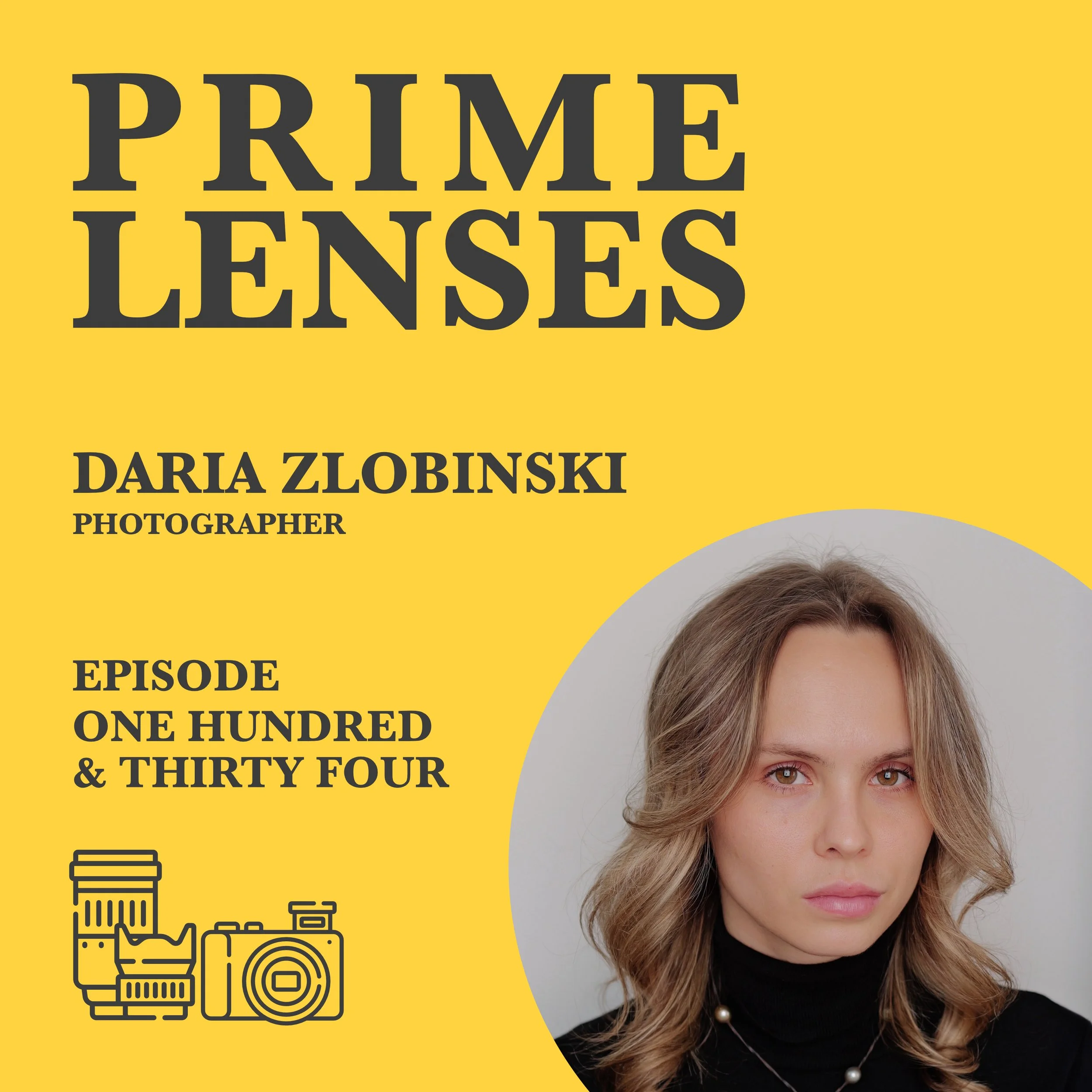


134. Daria Zlobinski
What do you do when the best trip of your life makes every photo after it feel smaller?
Guest: Daria Zlobinski. London-based photographer, macro and nature obsessive, never without a Leica · Instagram: @dariazlb (main) and @d.zlobinski (photography)
In this episode
Daria messaged me a while back to say she was burned out and worried she was falling out of love with photography, and would I like to talk about it. That sounded like exactly the right kind of Prime Lenses conversation. We start at the beginning: windsurfing holidays, her dad's cameras, a Tumblr surf blog, and a RISD summer workshop where everyone else photographed people and she found a plant house. Then the harder part: how an Antarctica trip set a bar she isn't sure she can reach again, what Instagram rewards versus what she actually loves, and the small, silly challenges that got her shooting again, from an iPhone walk in Regent's Park to Sunday mornings at a farmer's market. Along the way: a Leica Q3 that got rained on, a salt-crusted Canon 5D Mark II with a black strip across the sensor, the sound of a Leica R9 shutter, and a pop-up show she'd love to hold in the Barbican Conservatory before it closes. And yes, we carried on talking after I said we'd finished.
Chapters
Positions are approximate. The transcript has no timestamps.
Opening Cold open: the iPhone challenge
Opening Intro and why Daria is here
First third Windsurfing, her dad's cameras, Tumblr, and a Canon 60D
First third RISD workshop, the plant house, Henry Horenstein
First third London, consent, and carrying a Leica everywhere
First third Travelling as a different version of yourself
Middle Q3 vs D-Lux 8 in Iceland
Middle My kitchen, a Spider-Man web made of wool, and Day One
Middle 200,000 photos, iCloud panic, and stock photography
Middle Prints, books, and making something just for you
Middle Slop reels, likes, and doing it for yourself
Middle Postcards, cyanotypes, and slow mail
Second half Burnout, comparison, and the self-criticism cycle
Second half Photo walks, small challenges, and Sunday farmer's markets
Second half Scotland trip talk, spontaneity, and projects that assemble themselves
Second half Photographers who shaped her, and Dolly Parton
Second half The pop-up dream and the Barbican Conservatory
Late The 5D Mark II story
Late The R9 and its shutter, favourite cameras, retro lenses, and Osmo Pocket video
Close Where to find Daria, and the customary extra ten minutes
- Episode Sponsorship -
BestPodcasts.co.uk is a free podcast player that works in your browser on any device. You can listen to episodes from your favourite hosts. You do not need an account, an app, or to download anything to listen to the best free podcasts.
Mentioned in this episode
People
Henry Horenstein - photographer, RISD professor, and author of Animalia, the book that clicked for Daria · Wikipedia · [First third]
Stephen K. Schuster - New York photographer behind City Kids, a years-long project photographing teenagers · Tribeca Citizen on the exhibition · [Middle, second half]
Mike Chudley - photographer and YouTuber who made a book just for himself after his China trip · Episode 124 · [Middle]
Anthony Prince Leslie (AP) - photographer and filmmaker I'd spoken to the day before · Episode 133 · [Middle]
Books and reading
Animalia by Henry Horenstein - close, abstract photographs of animals taken out of context (Pond Press, 2008) · UMass Dartmouth exhibition page · [First third]
City Kids by Stephen K. Schuster - the self-published book of the project (2025) · Le Grand J · [Second half]
Tools and products
Leica Q3 - the full-frame compact Daria carries and that got rained on in Iceland · Leica · [Middle]
Leica D-Lux 8 - the small zoom compact that became her Iceland camera · Leica press release · [Middle]
Canon EOS 5D Mark II - her dad's well-travelled camera, used in Antarctica and Iceland · Canon USA launch release · [Late]
Leica R9 with Digital-Modul-R - a film SLR turned 10-megapixel digital camera, my recent madness · DPReview on the announcement · [Late]
DJI Osmo Pocket 3 - what I use for all my video · Launch coverage · [Late]
Day One - the journal app I use for its "On This Day" memories · dayoneapp.com · [Middle]
Foto - the photo-sharing app behind the global Foto Walks · fotoapp.co · [Second half]
Companies and institutions
RISD (Rhode Island School of Design) - where Daria took her first academic photography workshop · RISD Photography · [First third]
Places and events
Barbican Conservatory - Daria's dream place to show her work; it closes at the end of 2026 for a multi-year restoration · Barbican · The Guardian on the plant cutting giveaway · [Second half]
Foto Walks - the worldwide day of free photo walks; I host the Inverness one · Walks info · My chat with Michael Howard of Foto · [Second half]
Week of Walks - my own week of listener photo walks in July · Day one · [Second half]
Park Hyatt Tokyo - the Lost in Translation hotel, reopened after a 19-month renovation · TravelMole · [Second half]
Quotes
It's okay to stand out from other people.
Daria Zlobinski, [First third]
It has 3 million views. And for the past couple of months, it just garnered me like 300 followers or whatever.
Daria Zlobinski, [Middle]
If I make a plan, 99% it won't work out. So that's why I'm very spontaneous.
Daria Zlobinski, [Second half]
Mentioned but not linked
Daria's Instagram accounts [Close] - @dariazlb (main) and @d.zlobinski (photography). Spoken in the episode; I couldn't verify the profile URLs by search, so add the links by hand.
Brett Henriksen [First third] - Daria's RISD professor who introduced her to Horenstein; the spelling is unconfirmed.
"Lucas" [Middle] - former guest who has worked with scientists drilling ice cores; surname not given.
"Richard" [Middle] - former guest, Dutch, based in New York, who sends postcards through a small Patreon; surname not given.
"Torsten" [Late] - someone I talked to about the R9 with digital back; surname not given.
"Philip Reinhardt" [Late] - former guest who shot the Winter Olympics with a borrowed R9 and digital back; the spelling needs checking.
"The Carrier Print Club" [Middle] - my print club starting next month; the name in the transcript looks garbled.
"LSA" [First third] - the group Daria reached out to for event photography; possibly LSE.
"Kodak channel" [Middle] - the Antarctic spot Daria says she left a piece of her heart; possibly the Lemaire Channel.
Grandma's old "IXUS" camera [Late] - a 7-megapixel compact; probably a Canon IXUS.
Credits
Hosted and produced by Iain Farrell.
Subscribe: Apple Podcasts · Spotify · Patreon
Transcript:
Daria Zlobinski
So I started off with doing a little iPhone challenge because we always have an iPhone on us. We sometimes forget, especially photographers, that it's a really powerful tool. Like you don't need to carry anything crazy.
You still can take amazing photos. So it's just like, okay, I'm going to go on a walk for an hour in Regent's Park. And let me just play with composition.
I'm going to focus today on the rule of thirds. Next day, it's a little bit of a different challenge. And so slowly kind of making myself comfortable. With a few mediums I've kind of neglected, especially the iPhone. So it was nice to kind of relearn some of the tips and tricks.
Iain Farrell
Daria Zlobinski and I have been chatting on Instagram for ages. As we mentioned in this episode of the podcast, we've kind of been ships in the night at various events and kind of missed each other and not quite sat down. But recently she messaged me to talk about some burnout she'd been feeling and was worried that she'd been falling out of love with photography and actually said, I'd love to come onto the show. And talk about that and some of my creative process and all that good stuff. So that sounded like it would be an excellent Prime Lenses episode and would be stuff that I thought you'd all be interested in hearing about. This is also classic Prime Lenses as you'll hear at the end.
I say we've basically finished and we're wrapping up and then of course we talk for another few minutes. Maybe not as long as we used to in the old days but for the old heads out there it's a little bit of a return to form. Right here's my conversation with Daria.
I've wanted to talk to you for ages I've been really excited to sit down and chat to you because we've talked a lot online I think I've missed you at events in the past or we've been ships in the night but I am curious because you also wanted to to talk a bit specifically about kind of creativity and how kind of you can sustain it and how hard that can be to sustain sometimes and I think you've got some really good feelings and like you kind of want to get out of it and you can't get out of it and you can't get out of it and you can't into the world. But I'd love to start where I often start with what gets you photographing in the first place and why photography?
Daria Zlobinski
I always love this question because you kind of have to reflect back. So my first brushes with photography came from my dad and he's kind of like a hobby photographer but specifically for nature and water sports. So we're a family of very passionate windsurfers.
So that means, you know, for windsurfing, you need to follow the wind. And it's always in like these beautiful destinations. So my dad has always like taken these beautiful shots of waves of nature, some geckos roaming around.
And then once I kind of reached high school or middle school, I got my first camera. It was a Canon EOS 60D. And so that was my first like physical camera holding it and figuring out like wow like this is mine I get to take photos the world is my oyster and so I started kind of that was back in like the tumblr era so tumblr was kind of popping off and so I was just like oh this is perfect um I ran a surf blog given like where I was traveling at that time which I would allot to hawaii and I was just capturing you know the sun the Sunrise, the Sunset, all the surfers in the lineup on like Honolulu Bay. And I just fell in love with it because it's just like you got to capture a moment from nature.
You get you never know what you're going to get. And it's all about the conditions and figuring out what the right shot is. And so that was kind of my first brushes, then posting it on Tumblr, gaining a little bit of traction.
And then Instagram came in and it was just kind of like that pivotal moment where you just get to share photos with the world. And that really, I feel like, changed photography for what it is now. And then I was in high school, so that was around 2015-16, I think.
And I got signed up for RISD, for RISD photography classes. And that, I think, is where everything really, truly took off. I've taken a few courses here and there, but this was a summer workshop dedicated to film photography.
And this was the time like I actually ended up kind of getting academic training for it. So it was a group of around 10 or 15 people. And what I remember was everyone wanted to do portraiture.
That was kind of, you know, everyone was just like, oh, I have a camera, people to model. And I kind of always felt a little bit uncomfortable by that. I don't know if it was just me. I was just like, oh, there's me and my plants.
But everyone is taking photos of other people. Like, is something wrong here? And then I was just like, you know what? It's okay. It's okay.
It's okay to stand out from other people. In RISD, there was an amazing plant conservatory at Brown, and I fell in love. It was just this beautiful glass house with, like, the most insane tropical plants that were, you know, kept in such good condition.
So I spent most of my time in, like, this plant lab. And I think that's kind of where I found my style. The Professor Brett Henriksen, like big thanks to him because he kind of created the foundations of who I am today and introduced me to one of my favorite photographers, Henry Horenstein.
I loved his book Animalia where he took different photos of animals, but you couldn't really tell because it'd be maybe a tentacle or maybe the kneecaps of an elephant. So it made you stop and think And that to me really stood out Because usually you see a photograph and like Okay, that's a person That's an object But here you really had to take the object Or living organism out of its usual context And just think like Oh, I'm looking at veins here of a leg And you're just like, wow This is part of an animal And so I kind of took it to my own interpretation where I love anything macro like raindrops, leaf veins, anything. And so at that time, I had a fantastic macro lens. I can't remember what it was, but I would just focus in and create these compositions where especially if you're if you're doing film photography, usually it's black and white.
So contrast really was kind of important here. And with like different levels of contrast, you just create a completely different image. And so that was just like, everyone was like, oh, what are you doing?
And I was like, exactly, exactly. This is what I want. I want that reaction of like, what is this? Because that makes you stop.
That gets your attention. And I've kind of developed everything out from there.
Iain Farrell
I love that you were never afraid to be different. I think that's very important. One of my favorite photos of all time is the picture of Muhammad Ali.
And it's his fist. And what I love about that picture is that, you know it's him but you're not it's not a it's it's the silhouette of him in the background the out of focus it's what you see is the knuckles and like the work and the skin and just the way that like he's used his hands and I love that right from the get-go like doing an audio podcast in a visual first world you were like no I'm sticking to this and I'm doing this and there's that has that guided you then is there a like a long-term mission or is it is it just always to be following your, you know, your inner voice. You know, is that the mission?
Daria Zlobinski
It's, it's a mix of both. So since I'm based in London now, and I just finished grad school, so that was like the perfect opportunity to get comfortable. I've always been a little bit uncomfortable with shooting people because again, living in London, you have to get permission.
You know, there's different like, not laws, but more of like, I don't know. You have to ask for consent. And it's because I know a lot of people don't really, you know, don't want to be in the show or something.
So here it was really interesting for me to challenge myself and work with shooting people or more of like traditional like spaces. And so I kind of went out of my comfort zone and like reached out to LSA and she's like, oh, like, there's a few events going on. Do you guys need a photographer?
And so that was a little bit new to me. So there was like a few speaker events. And I was just there in the background doing my thing.
I was just like, oh, wow, this is interesting to see if I can truly capture how candid these moments are. And overall, just living in London really changed my perception and path on photography because there's so many things going on in London. And so I kind of have this little motto where I don't go anywhere outside of my house without my Leica.
And so for the past two years that I've been here, almost every single day, I've carried my camera on my neck. And so that was just like, oh, okay, whenever there's an opportunity, I'm going to snap a photo. And that was so fun, because I ended up having so many people talk to me just because I'm wearing my camera.
Like, oh, what do you do? And I'm like, I'm a photographer. And so that kind of brought me out of my comfort zone.
And kind of I ended up doing this fantastic photo shoot at the Venice Carnival for this couple. That was staying in our hotel and they're complaining like oh we don't know any photographers we want to get some good photos of us in the costumes and I'm like well I'm here you're in luck so why not and they ended up loving the photos it was so cool and that was just probably my first time I actually felt comfortable like hey here's here's some photos of you
Iain Farrell
For me yeah do you think being away when you're if you're at a festival or something like that I find when I'm traveling, especially if I'm going somewhere, you can almost be a bit different. You can take on a slightly different personality. You know when you're a kid and you're on summer holidays, the kids you meet at the holiday camp don't know that you're a massive nerd who loves Star Trek and Doctor Who, in my case. And so you can be cool for a week. So do you think that that first experience, it helped being somewhere else and just slightly outside of, you could play that character and try it on?
Daria Zlobinski
Definitely, definitely. Definitely, definitely. Traveling for me is part of the fun of photography.
I love being out in nature. And anytime there's a nature trip, for example, Antarctica, Iceland, Faroe Islands, I don't know, anywhere, Kenya. I'm like, yes, yes, it is. I am going to get some amazing photos of the nature, the landscape, of just kind of create what I'm seeing and kind of translate it in a different way for wherever the photos are going. Social media or wherever so that's very very fascinating yeah which Leica are you running around with most of the time is it a q um so the q3 is somewhere and that's what I'm mixing right now between the q3 and the D-Lux oh yeah I got it for my partner but I ended up kind of taking it back for myself because it's so light and nimble like yeah I did that once with a motorbike I I convinced alice to buy uh a Hornet
Iain Farrell
Which was the same as my first big bike that I'd ever had and I had sold and missed it and I was like hey it'd be the perfect size for you and then I think I definitely rode it more than she did and we had it until earlier this year so yeah it's I can I can relate to kind of convincing someone like now is a great time for you to buy this thing that I also love and it's honestly I was a little bit skeptical of the D-Lux I don't know because I know it was kind of more compact
Daria Zlobinski
Than the traditional Leica. But it's such a fun and nimble tool that I recently did another trip to Iceland and I took three cameras with me. I took the 5D Mark II, the Q3 and the D-Lux. And shockingly enough, actually, wait, you know, I'm going to ask you this question. Which camera do you think I reached out the most, like used the most during this trip out of these three?
Iain Farrell
So having been to Iceland and it's like the landscape, it's like being on the moon, right? Like just if you've never been to Iceland, like, you know, look at pictures of it because where I live in Scotland is probably the closest in parts of Scotland, you know, like the west coast of Scotland is kind of like similar in some ways.
Daria Zlobinski
Oh, beautiful.
Iain Farrell
But Iceland is just an entire place of just massive open landscape. So in my head, I would go for something like the queue because you've got a wide lens and you've also got the macro thing. So you can go wide, you can go close, that lens kind of is a do-it-all, it's weather sealed because sometimes the weather sucks. So that would have been, if I'm Detective Iain-ing this with my detective hat on, that's what I would have guessed.
Daria Zlobinski
Surprisingly, it'd be the Q, not the Q, sorry, the D-Lux 8. Again, since it's super nimble, I ended up getting a last minute waterproof sleeve for the Q3 and I ended up, it was raining and I wasn't for a couple days. And so the conditions weren't great.
And we were out shooting this one waterfall on the south side. And my Q3 got flooded with rain to the point there was a little bit of condensation in it. And I was just like, oh, no, no, no, not now.
I was a little bit bummed for the trip. But the D-Lux was so small where you could just pull it out, snap a photo, put it back in and it was just so quick and reactive because you didn't have to like fiddle around with the Canon lens you know because I was working with the telephoto so obviously you know you kind of have to lug it around and then that situation with the Q3 really kind of shocked my world and so I ended up taking some of my favorite photos on the D-Lux which honestly I was so surprised and really didn't think it would be my go-to camera for this trip but in certain moments it just like fired off what right when I was like I needed to. So that was a really nice discovery.
Iain Farrell
It is good to kind of be forced to change sometimes. And to like this morning, I was living a very glamorous life. I was upstairs getting dressed, came downstairs.
My eight year old son. Now I've recently got them into Spider-Man because I love Spider-Man. I grew up and we watched Spider-Verse the other day.
I will send you a picture after this conversation, Daria. The kitchen that I came downstairs to. Has multiple threads of coloured wool stretched between furniture and chairs and the door handle.
And it's just he's created a massive web. Alice is away this week in Vienna for work and I sent a picture of it to her and she just went, it's like seeing the inside of his mind. There's just all these coloured strands all over the place and he was just doing it. And so our kitchen is just covered in wool at the moment and I've promised I'll leave it until he comes home from school and then we'll, will figure out how to dismantle it.
But he's just gone off and done the thing. And so it's one of those situations where I put a 28 on because I don't normally shoot with a 28 because I wanted to get it as wide as possible. And now I'm rocking my little, you know, my 28 on my M and I'm like, maybe I'll just do that because the Elmer is amazing.
But it's like, I'll leave that on for the day. And then I'm outside my comfort zone and I'm doing something different because normally I'm a 35 girly.
Daria Zlobinski
That's so cool though, especially like seeing the inner workings of the mind and having the ability to capture it also. And I feel like you're going to be looking back at this in a couple of years and it'll just be such a fond memory.
Iain Farrell
Well, it's on that topic. I'm going to write about this soon. But like there's, I use a diary app on my phone. I've talked about a couple of times on the show called Day One, but there's like a journal app on the iPhone now and all sorts.
And basically I throw pictures into it all the time. So like little notes or screenshots and things like that. And then what you can do as you're building that sort of thing up, you can, if you have a minute during the day, absentmindedly or waiting for a kettle to boil or whatever, I can go into the app and I can look at what happened on this day in history.
And then I can send those pictures to Alice or send them to friends. If we, you know, if we did something years ago today, you know, this day, seven years ago was my son's first day, my eldest's first day at school. And there's these cute little pictures of him as like a little guy with his grandparents and stuff.
And so it's a really fun way because I think when we're, and I think as we probably come around to one of the things we want to talk about, about like creative flow and burnout and things, it's a way of keeping me invested in picking this thing up because I know how I feel when I get to see these things years later. So exactly what you're talking about, a year from now, two years from now, I will see those pictures of the kitchen and remember that we spoke today and it will just, it's, It's because we make so many pictures. What do you do with them all?
What do you do with yours?
Daria Zlobinski
Oh my god. Every couple of years I have this problem. So I have 8 terabytes of iCloud.
And I'm about to max it out. And it's stressing me out because I have this terrible habit of importing things to my phone. I just tend to edit.
My computer is kind of broken right now. So I've started editing everything on my phone. It's to the point where... Wait, let me see.
I have... How many photos? I have over 200,000 photos right now.
It's so bad.
Iain Farrell
That's not... Yeah, that's a cry for help.
Daria Zlobinski
So I'm, like, offloading to a storage, like, device and everything. But it's really stressful. And so I'm looking through, like, photos right now. And I'm like, oh, I have, like, flowers. You know some other like miscellaneous stuff like what am I doing so half of it I don't know if this is kind of really accepted or not I don't know I know that some people have a few things to say about it um but you know how you always have like b-roll photos or photos you just take and you just don't know what to do with them and so I kind of ended up going a little bit into stock photography with that which kind of actually ended up I actually ended up learning quite a lot also about myself with that because it's just like these photos are sitting around not really doing anything they're in my camera well they're nice but I can't really post them on my instagram or social media so I'm just like you know why not maybe someone will use it and it's interesting that you know there's a side of like stock photography where like your photos are just kind of passively making income there and then on the other hand there's also the good photos that you you know you have to sit and mull over and be like okay this is this is the good thing stuff this is going to go on social media. So it's always kind of a battle of like, what's good, what is truly worth putting out there, or what can kind of be put into like this other pile of things. I don't like the word pile.
I'll think.
Iain Farrell
Collection.
Daria Zlobinski
Collection, yeah, yeah, yeah. Collection of things. But yeah.
Iain Farrell
Yeah. It is a tricky thing to wrestle with. One of the things I like, I was curious with you as well is, do you have like an end point in mind for an image?
Like, is there a plan at some point for you? A book or an exhibition or things like that? Or do you treat this more like some of the commercial photographers I speak to are very much, you know, they like printing, but their focus is on the people they're doing the work for, they're making the images for. So they don't necessarily have an attachment. Like AP, who I spoke to yesterday, likes seeing his stuff in print, but it's not, it wasn't, like, it was great for him to see some pictures in Vogue, but he wasn't, like, that wasn't the end point, right? He wasn't like, And now I see it in print and it's only meaningful.
I've spoken to other photographers where they're like, the image kind of doesn't mean anything until it's printed.
Daria Zlobinski
Oh, that's so interesting. So I, for me, it's more about like the end work and who can see my work and kind of eventually my goal is to have this published and be seen by the wider world, especially my Antarctica series. Oh my God, that was an amazing trip. That I'm very grateful for. And that's kind of where I was just like, okay, I really, really want to put my work out there because I think it deserves to be seen. Antarctica is kind of almost like a mystical place where not that many people really think about it.
And every time I mention, I'm actually kind of, I'm wearing a hoodie. I don't know if you can see it. I took this pic in Antarctica.
Iain Farrell
It says on the back of your hoodie, yeah.
Daria Zlobinski
Yeah, yeah. So it's just kind of like a little self-promo.
Iain Farrell
Nice.
Daria Zlobinski
And it stirs up such interesting conversations. And so, again, no one really knows about it. It's such an important place, especially given, like, climate change and everything going on.
And to be able to see these icebergs just carved out by nature and time and realizing, like, wow, you know, we're just humans. We're doing our own little thing. But then nature and, like, Earth is really creating all the necessary things for life.
And so to me, I was just like, this is beauty. This is just like a sculpture in time. And I had the opportunity to capture that and, you know, kind of open people's eyes to that, you know, there's something out there outside of like the urban jungle, you know, outside of the concrete jungle.
And so I've received some really positive feedback from it. And people are just like, wow, this is so cool. Especially like one of my shots is of the bubbles trapped in ice, which I think is so fascinating because it's literally history of being trapped in this fragment of ice that's like more than 15,000 years old.
You don't know what's in there. I don't know what's in there, but that's crazy that something was frozen in there and it's floating around and it's now it's 2026.
Iain Farrell
Yeah, it's been there ever since. A former guest of the show, Lucas, has been out with scientists and they drill columns of ice to then do research on the columns and stuff like that. It's incredible. And he was saying he's running around at like minus 50 or something crazy underground for days and days at a time with big gear. So yeah, it is kind of mind bending, isn't it? So you can look at rock or you can look at ice and things and like the history of the planet is just written in front of you like baseball scores.
Daria Zlobinski
If you ever have a chance, you have to go. And honestly, this trip kind of inspired me. I'm working slowly on it. My computer is currently being repaired.
But I really want to do a coffee table book with all of my photography. But the problem with that is how do you organize and section it off? Because again, I tried going by certain groups like macro photography, specifically. Like nature then going into a little bit of travel then it's like do you go by country do you go by the subject how do you organize this and so this kind of became a little bit of a big mess which I need to figure out so I don't know if you maybe have some advice um unfortunately for you I'm a tourist so I consume a lot of this stuff and I get to talk to all of you but the the picture making is all your problem not like I'm really sorry I have no
Iain Farrell
Answers for you. I have only ideas for projects myself. But I think what you're talking about, Mike Chudley, I will share one thing that might be useful to you.
Mike Chudley was on recently and he went to China, which was a bit of a once-in-a-lifetime trip for him. It was amazing. He'd always wanted to go, made some incredible images.
And when he was on the show, he talked about making a book that was really just for him. So he's made the book, he's done the layout, he's written stuff, he's chosen his images. That lives at his house.
And he doesn't know whether he'll ever do anything more with it or whether he would look to turn that into an exhibit or something like that. He just knows that he enjoyed making the book and that he's happy. And I think that's a really powerful thing for us all to know as well, is that sometimes you can make something just for you.
And I think, again, it's funny, you've come up through this kind of social media period in our history, starting with Tumblr and then the madness of Instagram. And I think there's an increasing pressure on us all to feel like we have to, you know, if I'm not getting a bajillion views like a Kardashian, then I'm not doing it right. And I think there's a, that's the danger though, isn't it? And actually, if you're making meaningful work and you're getting good feedback and you can sustain yourself as a creative person, however you do it, then who cares?
Like let yourself enjoy it and make the things. Because you'll work it out, right? Like, and sometimes you'll be over 130 episodes into a podcast before you figure some of it out. And just maybe it's a personal example.
But yeah, I think that's important. It's like you can take a step back because you've got all this material now you could do stuff with.
Daria Zlobinski
That is true. But social media is so interesting because it really, I think it changed the way a lot of photographers kind of do and show off their work. I found myself every so I run my own Instagram and then I have a photography Instagram and I noticed I've had this photography Instagram for more than a decade now and I noticed myself falling into like this social media trap where you know as a photographer you have an expectation of like putting out certain content that garners the most amount of engagement but then on the other hand you kind of just want to post things for yourself and it's always this decision of like Do I do it for me?
For social media? And then especially now with Instagram, it's all about reels. It's always all about reels. And it's so frustrating because my most liked and viral piece on my photography Insta is a really random reel that has nothing to do with photography.
And it has 3 million views. And for the past couple of months, it just garnered me like 300 followers or whatever. And I'm like, this, this, This is so frustrating because I would call it slop.
Iain Farrell
Yep. Yep. Yep.
Daria Zlobinski
And then like meanwhile my work that I love like some of my favorite images they get x amount of likes not no saves no shares and I'm like oh okay just remember it's all in your head they don't know they don't know that this this means so much to you.
Iain Farrell
Yeah I think that that's why we just have to do it for us like we just have to do the things that we want to do and make the things that we want to make and they can with an audience. And I think the thing to bear in mind is like, even if something is small and only gets liked by, I don't know, 20, 30 people, 100 people, whatever it is, if you got all those people in a room, you'd feel pretty good. Like all those people going, hey, you meant it. Like if you did a little, a small gallery opening or something like that, that would still feel amazing.
And I think that's where the scale and magnitude of these things is just nuts. And you just have to not think about it because you can't, contextualize it, you know, and that for me, at least, I, you know, I try not to look at the stats. I just try to make something good.
And then the thing that sustains me is getting feedback a bit like you probably do. I get lots of messages from listeners, new and old, pinging me stuff. And then sometimes they send me things through the post and it's lovely.
And so it's just, oh yeah, no, it happens. Occasionally I get little pictures and stuff. Yeah, yeah, yeah. I've had pictures.
I've had little postcards. I got some, I got some little cyanotypes this week from someone.
Daria Zlobinski
Oh my god, do you have a separate collection for everything? Yeah,
Iain Farrell
Well I have them on a little shelf. Because some of the folks have had on do little, this is why I love the resurgence of little printed newslettery type things as well, where little postcard clubs. People do that and they send you a picture and there's a little letter and stuff. I had one where a former guest of the show, Richard, lives in New York, he's Dutch, but he sends out little picture postcards periodically to people. He has a little Patreon you can subscribe and then he'll send you something and he sends them to me and as a joke he put on the letter Sir Iain right my postman then was like I didn't realize you were a sir and he thought it really was I had to go no no no no it's just richard being funny because I'm I've got a voice I've got an accent that's a qualification it's definitely not that I'm a sir but it was funny he sort of he read it and thought it was but yeah it's really oh that's so cool oh my god that's giving me a few different ideas there we go because yeah I I know like the last two years
Daria Zlobinski
Or so everyone is kind of doing like a little mail club or something like that or slow mail as some people call it and I think that's so great because you know we're all so used to seeing photos especially again with social media always on a digital screen and like when was the last time most of us actually held like an actual photograph and like physically you know held it felt the texture actually observe things like the fine grain and everything yeah so that's you know there you go you heard it here first
Iain Farrell
The Carrier Print Club starts next month. So that might be a good way on to. You and I were talking on Messenger a little bit back and forth about burnout and feeling of it. Do you feel like it's this moment right now that's contributed to that? Like there's just the always on nature of the world?
Daria Zlobinski
I guess. So I've always thought of like my photography as kind of a cyclical thing. So I mentioned that in high school I picked up photography.
I was really into it and then there was a period of my life where I just kind of stopped I guess it was maybe like the first years of uni or something like that and then I actually ended up just recently the last five years getting back into photography and throughout these five years again like I've been feeling like these highs and lows and for me probably there are two things so one the Antarctica trip was just so amazing so many incredible photos where looking back I'm like oh I don't know if I can produce the same type of quality of work I'm chasing not only the emotions that I got from taking these photos especially like in the Kodak channel or the what what'll see where I think I fell in love I think I left a piece of my heart there um and so you're just like wow like I want to get I want to feel these emotions I want to get photos like that but then you're just kind of you know in a city environment or somewhere else where you're like uh I don't have like the drive the creativity like in the moment to produce something like that um and then on the other hand there's also social media which kind of really contribute in my personal opinion contributes to that is that it's always at least with myself I'm always looking at my work and being okay it has to be really good work that I have to put out because it can't be I don't know I'm very self-critical or it's It has to be in focus, done in a specific way where I feel some sort of emotion coming out of me. And when I can't, I don't really post that much. Everything is really in my camera roll, which is terrible.
I really need to share my work because it deserves to be seen. And so this cycle of self-criticism and kind of thinking, what does social media want? And figuring kind of out, do I balance it with my desires?
Or do I balance it with, again, social media. So that kind of creates a little bit of a vicious cycle of just, is it worth posting? How is it going to be perceived?
Iain Farrell
It sounds like you've been feeling pressure from... Definitely pressure.
Daria Zlobinski
Yeah. And again, the pressure, because again, you see these amazing photographers put out their work and you're like, wow, they're posting these amazing content. How can I compare myself to them? Which obviously that's the first, Mistake is comparing myself to them.
Obviously, it's good to kind of see where you're at. But, you know, I am my own person. And so with that, your podcast, actually, you did like a little daily walk series.
And then I actually I feel like we actually ended up connecting over, I believe the photos app. No?
Iain Farrell
Yeah. Yeah.
Daria Zlobinski
And I remember you were hosting photo walks, which honestly, like I regret not signing up for them or I actually wanted to host one of them but I wasn't in London at that time and photo walks in general are kind of amazing tools and ways to get out of like this slump in a way because it just forces you to like okay like maybe focus on taking photos of red objects you know like okay this is breaking you out of this usual cycle of like oh I only take photos of nature I only take photos of people So it makes you really think outside the box. And especially these couple of months have been a little bit difficult for me. And I kind of got myself out of this funk by creating these little challenges for me.
So I haven't touched my Q3 in maybe four months now, except for like last month. And I was just like, ah, okay. So I started off with doing a little iPhone challenge because we always have an iPhone. On us. And so we sometimes forget, especially photographers, that it's a really powerful tool. Like you don't need to carry anything crazy.
You still can take amazing photos. So it's just like, okay, I'm going to go on a walk for an hour in Regent's Park. And let me just play with composition.
I'm going to focus today on the rule of thirds. So when I did the walk, looked at some of the photos, I'm like, oh, wow. Okay.
Next day, it's a little bit of a different challenge. And so slowly kind of making myself comfortable with a few mediums I haven't kind of I've kind of neglected especially the iPhone so it was nice to kind of relearn some of the tips and tricks but then now I started carrying the D-Lux because it fits into a woman's purse which is amazing so I always have it out now I carry it with me all the time it's just sometimes the Q3 is a little heavy on the neck yeah so I'll also say especially London I'm a little paranoid about you know someone But that's been fun. And for me, Sundays are very special because where I'm based, we have a fantastic farmer's market.
And I noticed looking back at my camera roll that Sundays are my photo days. Since it's a farmer's market, that means fresh produce, fresh flowers, lots of interesting people. You never know the conditions.
And so that kind of became my little passion project. In a way where I'm like, oh, let's see how I can challenge myself at this farmer's market. Not only to take photos of, you know, fresh garlic or just like these, all the different produce and stuff.
And so slowly I've kind of developed a few little different things coming out of it, which I'll be posting a little bit later about. But that's been nice. For me, it was always just like challenge yourself and think outside the box. Like my motto is always think outside the box because, That's where all the beauty happens.
That's the beauty of our minds. And you get to see it transform in photos.
Iain Farrell
I'm really glad that a little silly photo project kind of was the kind of thing that you're using to kind of help yourself pick stuff back up and not feel that pressure. Because I think, yeah, on the low days, we do feel like, what's the point? Every photo has been made.
Why am I bothering to do this? And you sometimes need something to kind of lift. Lift yourself out a little bit.
You should do that. Photo Walks are coming back. I'm hosting one in September.
So if you have a look on their website, there will be one in London, I'm sure. Is that a third one? Second.
Second one. And I'm hosting one up in Inverness. Oh,
Daria Zlobinski
That's amazing. You can also be on a plane. You're so lucky you live up there.
Iain Farrell
So beautiful. It's amazing. I can't complain.
It's really, really good. It does mean I make a lot of photos of trees. But when the light and the trees are beautiful, then why not?
You know? Trees never say no as well. I don't get... The tree doesn't need to sign a waiver.
Daria Zlobinski
No, no, no.
Iain Farrell
So you do a lot of travel, though. You've been... And it sounds like you grew up traveling and seeing the world in a really cool way. I love the windsurfing. Are there other projects in your mind that you like, I really want to get this off the ground?
Daria Zlobinski
Honestly, I... Because I haven't... I'm very grateful to have the background in traveling. And the opportunities to travel. So I have kind of just settled down for like the last couple of months and I am yearning to get back out in nature. I think I might be actually planning potentially a Scotland trip.
Iain Farrell
Yes,
Daria Zlobinski
I can help you out with that.
Iain Farrell
If you need advice.
Daria Zlobinski
Maybe a little car camping, who knows.
Iain Farrell
Yeah.
Daria Zlobinski
So I honestly, I just want to get back out into nature and go to landscapes where there's just no human impact. At all, which I think is so rare in this day and age. And in general, I just seek to capture, like, usually, okay, so if one goes traveling, there's, like, a typical set of, like, tourist photos one, like, most people take, and I seek to kind of just not do that.
My goal is to reinterpret cultures and different places from a different vantage point that one wouldn't usually think about. And so I'm yearning for like the opportunity to just see what kind of happens in the moment. Because again, all of this is in the moment. You can't really, you can plan.
But the beauty is in what you can control, you know, in the moment, you never know what may happen. And so I'm just waiting for those moments. I'm always carrying my camera with me for that moment that, oh, I need to take a photo of that, that, that.
Yes. So I'm waiting for that. I'm waiting for that.
Iain Farrell
So there's no kind of project like in the back of your mind where you're like, I want to photograph butterflies.
Daria Zlobinski
Oh, you're giving me ideas. Generally, I'm very open minded because I feel like if I well, that's a tendency with me. If I make a plan, 99% it won't work out. So that's why I'm just kind of I'm very spontaneous. And so when I feel something is right, that's kind of where it comes. And then I look back and then kind of It's a backwards way of doing things but then I compile a project out of whatever materials I've gathered so it's kind of a little bit of thinking on my feet and having the creativity at the end of like, oh, okay so I guess that's a project on XYZ
Iain Farrell
Yeah, very nice, good Look, the podcast I just start so I sympathize with the desire to be spontaneous and keep a bit of energy in it I think that's really good So when you were studying photography then and you were kind of starting to fall in love with the medium who were they showing you that you were looking at and because obviously there's your eye and there's what you were making that you enjoyed but were they showing you other photographers that you were starting to kind of latch on to and that have stayed maybe inspirations to you oof um of course there's like the every there's a set of photographers that most people know and it's really like taught in the classes especially like and some
Daria Zlobinski
And so forth but to me and especially like with portraiture and every day there's so many different and prominent talented people out there that it's really hard to kind of select and so if anything I noticed it's more of like the students themselves ended up having someone they really idealized and looked up to and so they kind of channeled that especially I noticed Like some of the students that were focused on portraiture, they really admired certain fashion photographers. And I really commend them for that because they're trying to emulate their style and, you know, kind of put on their own flair on it. But for me, again, my professor Brett Henriksen at that time, he... I can't believe it just like this moment kind of opened the doors for who I am today.
He just brought out a book and it was Henry Horenstein and I was just like oh that's that's interesting I've never heard I've never heard of him before and like the cover image really just stole my attention and I saw most people were just kind of again going back to the famous photographers on portraiture and so forth and like documentary photographers and then here I am just like flipping through this book and just being completely mesmerized by the photos And I was just something internally clicked for me. And I was trying to find other photographers with similar work. And I was just like, oh, I finally feel understood with like the way I see the world.
And that for me just was like the moment it all clicked in my head.
Iain Farrell
He was, was he Texas and horses and that sort of stuff? Yes, yes,
Daria Zlobinski
Yes. It was interesting also seeing his other work specifically more documentary-based and focusing on people, which was interesting that, wow, you really can kind of have different styles here. But for some reason, Animalia really was just like, this is me.
Iain Farrell
I've got a feeling, I just pulled him up while we're talking, I've got a feeling he may have photographed Dolly Parton, which seems like a good time to be talking about him. Definitely. Long may we miss Dolly Parton. She was kind of amazing.
Daria Zlobinski
Crazy how things just... Yeah.
Iain Farrell
I saw the news about her and I was like, has anyone checked in on Dick Van Dyke? I was just very worried for a moment there. I was like, we can't lose another one.
Like, Tim Curry and Dolly Parton within days of each other. Like, just can we pause? I don't want another 2020 moment where we keep losing legends.
So what's next then? What's the plan? Like, obviously, get the laptop fixed and for the love of God, sort out your iCloud.
But what you mentioned your itching to kind of get out there and start traveling.
Daria Zlobinski
That and then also I am thinking I am looking right now at my two very large printed photographs from Antarctica. I do have a little project in mind where I just want to maybe rent out a space in London for like a day or two on a weekend like a pop up and just kind of display my photos. Because I've tried submitting to contests, I've tried submitting to galleries, and also that's kind of going back to the topic of burnout. It's just like always, you know, to get a little bit of a spotlight on yourself, you have to put yourself out there, and it's just like all these submissions, always, you know, sending emails and all of that where it gets tiring because there's so many fantastic photographers, like why you specifically have to, you know, want to be featured or whatever. And then that's also kind of like the thing the exhausting part is just like doing doing all of that repeatedly and kind of sometimes not getting the result you want so I was thinking you know what maybe I could take things into my own hands and just if I do enough like promotion and so forth and spread the word yeah um I think it'd be fun to just do a little pop-up and display some of my favorite photographs and just have people pop in explore maybe maybe they'll find something new maybe they'll fall in love you never know well there's a proud tradition of it you know the
Iain Farrell
The photographers in the 60s and 70s in the US who were trying to promote photography as a valid art form when it wasn't always viewed as one were just banding together and putting on exhibitions of their own work and just showing it off like forcibly getting their work out there. There's a friend of the show a guy called Stephen K. Schuster who lives in New York. He's done some really amazing work. He was in his late teens early 20s photographing kids running around New York.
And he did a set called City Kids. And he just put on an exhibition last year. He's been working on this thing for like 20 years.
And it's so cool. The work is fantastic. And yeah, sometimes you've just got to throw it out into the world and just by whatever means necessary.
So yeah, if you don't know his work, go and look that up. He's been on the show as well. It's great.
But I think that's an example of like, yeah, just make a thing happen. Where would you put it? Where's your dream London location?
Daria Zlobinski
The Barbican Conservatory. I know they're closing. But that's like one of... I still haven't been there. That's crazy. I still haven't been there. I know they're closing.
But it's like my dream location. I know it sounds totally crazy. Maybe one day. I don't know. Somehow.
Maybe I'll make my own little Barbican Conservatory. But it's just like such a beautiful place. And I feel like the fact that the buildings are all intertwined with plants and everything. I feel like that's such a cool setting where it really means... Like literal, you know, that like connecting back to age. And so I think it'd be so cool to just like have my photos there, but also kind of engulfed by plants. I don't know. I don't know. There's something about it that's just like, mm.
Iain Farrell
Yeah. Barbican is such a cool building. Like it just harkens back to like a strange time in British architectural history when we were, we thought everyone would live in flats and how would, you know, how we would, we would build these massive high rises.
London would almost become Megacity 1 from Judge Dredd. They were almost proving that out as a concept. It's wild.
I didn't know they were closing it.
Daria Zlobinski
Yeah, they're closing it supposedly at the end of this year because they're doing some restoration work. They're even giving away plant cuttings, which is really cool. You can take a little piece of Barbican Conservatory with you.
Iain Farrell
Oh, nice. That's very cool. Yeah, I'm glad they're looking after it. That's important. There are certain places that are just important I read, this must be like a year and a half ago, the Park Hyatt in Tokyo closed for like 18 months so they could do a renovation and restore of that place, you know, like, that's the hotel from Lost in Translation and so you're just like, yeah, that should sustain, that should persevere, like, you should, you know, that should be looked after and preserved It's important, you know
Daria Zlobinski
Yeah, definitely, definitely
Iain Farrell
So one thing you touched on earlier, which we haven't really talked about, was just you mentioned a 5D Mark II, which seems like a choice in terms of like, I'm curious because it's not a newer camera anymore, but it's a really good camera. And whenever, sometimes friends of mine ask me like, what's the best deal in photography? And I'm like, well, if you don't mind something larger, but want quality, the 5D, all those lenses, are amazing.
Loads of really good glass for it. It's really good image quality. Because you've got access to a Q3, you've got access to a D-Lux.
I'm really interested in what makes you also pick up the 5D.
Daria Zlobinski
So the 5D has a very funny story. It's my dad's camera that he had for over a decade. If you look at the state of the 5D, it's really concerning.
I have to jam, just bang on the camera to get the battery out. The on button is permanently on. You have to bang the battery door open for it to turn off.
So I always have four battery packs on me because you never know. And so that was the camera I used in Antarctica because that was the moment. And I urgently needed something where I can like put on a telephoto lens.
And so my dad had his camera, the telephoto lens. And I was just like, you know what? He just gave it to me during the trip.
And so this camera has been kind of in my family for a really long time. And I was honored to get to use it during Antarctica. And it was just like this massive thing has like salt crust on it, rust, you know, you can see it's very well used.
And then like, After the Antarctica trip, my dad's just like, oh, you know what? I have whatever the newest Canon model is. And I'm like, you know what? I think it's fun to take this really staple piece.
Because, you know, you yourself know 5D Mark II is very, very, very important in the camera world. And so I was just like, you know, that will be fun to play around. I got a few lenses laying around, another telephoto lens.
And so I was just like, I call it a beater camera because it's just like, It's lived through so much. There's dents. There's everything. It really shows that this camera was really loved and well used. And so I ended up taking it to Iceland also.
And while it is experiencing issues, half of my sensor shows up. Half of the image, I think it's probably something to do with the image sensor, has a little black strip on it. So I have to crop my images.
But I think that's part of the fun for it. And the fact that this camera has survived 10 plus years, it's in my care, which like, I'm not the most gentle person. You know, I love to use my cameras and show like signs of use.
You can't really see it on this one. And so that to me was why I kind of ended up staying with a 5D Mark II because no matter the circumstances, it's always there. It works.
It gives you these amazing images. And so what, why? Obviously it's fun to play around with everything else but I was just like I'm gonna ride this until the end until it just no longer works. Just put it through the max use.
And it's been fun because everyone's just like I don't even have a proper like strap. It's a piece of cord from a boat that still smells like Antarctica so bad. But it's always just like oh like what is this camera?
Is this like vintage? I'm like someone actually said that. Is this a vintage camera?
Iain Farrell
I suppose but not really to some extent yeah yeah it's like oh what's the story here and I'm like oh well it's been to all seven corners of the earth from every place here but it's just like a nice little moment of like oh it's been everywhere you never know can just snap a shot and it'll be good I love it and I love that it's got a little bit of digital wear and tear that's like having a light leak in a film camera or something like that You've just got this thing that you know you work around I will talk about it because I've I've recently picked up on the kind of slightly vintage camera front an R9 Leica but with the digital back on it Yeah so it makes it into it takes this film camera from being a film camera into being a 10 megapixel digital camera
Daria Zlobinski
Have you posted any photos from it?
Iain Farrell
Yeah a few but There's a lot. I'll send you some afterwards because a lot of them have been of the boys. I'll just double check.
Have I posted any? Probably not tons thinking about it, but I'm kind of working on a little video about it because I love it. It's insane.
Like the image quality from a 10 megapixel sensor, but with those incredible R lenses, their manual focus SLR lenses. And also, I will play you. Listeners will be sick of this because I keep playing it.
But wait till you hear the shutter.
Daria Zlobinski
Oh my god, I heard it on your previous podcast.
Iain Farrell
Yes.
Daria Zlobinski
It's good, isn't it? That is such a beautiful.
Iain Farrell
Yeah.
Daria Zlobinski
That's amazing. That's so sexy.
Iain Farrell
Very silly camera. That was what my friend Ali said. I sent it to her and she immediately replied. She went, not to be inappropriate. That's the hottest shutter sound I've ever heard.
Daria Zlobinski
How did you come about it?
Iain Farrell
So I know about the R9 with the digital back from talking to Torsten and others. And I had a guy called Philip Reinhardt on the show earlier this year. He's done a lot of stuff for Leica. He shot the Winter Olympics using one of those.
He sort of borrowed one. And this one came up. It was like being sold by a guy 30 miles from where I live.
And so I just I sort of in a moment of madness grabbed it because I thought I'll buy it. And then I'll make a video about it or some episodes and stuff and then I'll sell it. And the problem is I love it.
So they're normally very, very expensive. So I kind of I'm going to have to kind of sell some things and justify keep it. But I've had my one camera rule forever because it keeps me keeps things simple.
You know, having having just the M and just swapping lenses on that keeps life really easy and it keeps me focused on making stuff rather than do I have the right gear. But I have to admit it's lovely. And the other week I went away.
We had a we had a day visiting my in-laws. And my brother and sister-in-law came with their little boy and we took the boys and it was really lovely and I basically shot with the M set to black and white and the R9 was in color because that's kind of it's got that lovely Kodak-y CCD kind of look and it was really fun having the two cameras and just treating one like it's got color film loaded and one like it's got black and white and it was it was a glorious day it was brilliant so I'll send you some pictures afterwards you can have a look but because we tend not to put the boys on the internet like They'll choose how much they want to be online when the time comes. But yeah, it's really, I'm really enjoying using it.
It's great.
Daria Zlobinski
What's your favorite camera at the moment?
Iain Farrell
Oh, it's still the M. Like,
Daria Zlobinski
Shoot with.
Iain Farrell
It's still the M. I mean, the M's just unreasonably good, right? Like, it's like your Q or like anything else. It's just so small and portable and has really good battery life.
And the images are stunning. And the glass is great. My favorite 35, which I'm going to make a thing about, is just a stunner.
So yeah, it's still the M. It'll be the M forever. But the R9 is a bit special.
Daria Zlobinski
That's exciting. That's also interesting. I love just asking everyone what your favorite camera is because everyone has such different preferences, especially for your goals and needs and everything. I have to look into something new.
Iain Farrell
Yeah, yeah, yeah. Well, you know, you're in London. You're near, you're near.
Daria Zlobinski
There's a camera. There's like two camera stores within walking distance. It's so dangerous. Oh my God.
Iain Farrell
That's the other thing. It's easy for me to say that, you know, don't buy too many cameras when I live in the woods, right? Like there's nowhere.
I can't just nip around to B&H or something. So yeah. Well, this has been lovely.
It's been really nice to sit down with you for an hour and sort of chat and catch up. For people listening, if they don't know what to do, If you don't know your work and want to see some of it, where can they find you?
Daria Zlobinski
Ooh, okay. So I am based on Instagram. So Daria ZLB, D-A-R-I-A dot ZLB is my main... Sorry, there's like a helicopter now.
Iain Farrell
Okay, we'll let the helicopter pass and then you can carry on.
Daria Zlobinski
The life of living in a metropolis. I can hear the Bakerloo line underneath me and helicopters.
Iain Farrell
We'll make some of this stuff go away. Don't worry about it. It's all good.
What I will do whilst we're waiting for the noise to go, here's a link. It should pop up on your screen. See if you can tap that.
Or I can actually send it to you on Instagram.
Daria Zlobinski
Oh, I see it. There you go.
Iain Farrell
I'll send it to you for afterwards as well.
Daria Zlobinski
Oh, wow.
Iain Farrell
So those are made with the DMR. And the thing is, the colours are delicious. Lens for that camera that is slightly hazy.
And so on film, that makes your film, it's made my black and white film really hazy in a way that I didn't like. But on the digital sensor, it's giving things a look that I would have to work quite hard to recreate in post-processing. Sort of a bit vintage, but there's still sharpness.
The colors are glorious. So yeah, well worth old lenses combined with new, slightly more modern technology.
Daria Zlobinski
I was actually wondering I actually wanted to ask you this question so I you probably get ads for like lenses and like whatever random photography equipment what do you think about because I'm being pushed a lot of like ads about like all these like crazy lenses with like light flares and all of that like what's what's your opinion of that because I'm kind of like on the fence like I feel like you can the beauty of photography is you can create these effects yourself I don't know I'm like curious to what your thoughts are on that.
Iain Farrell
I think that this kind of like the retro lenses like the put a toy camera lens on your camera and things like that and I've nearly kind of pushed the button a few times but I think it's a bit like digicams the reason the R9 works for me is and I've tried low resolution older cameras and they just annoy me because they're not good enough because they're they don't resolve enough detail and I think the reason I've landed with the R series as a film camera and also as a digital camera is down to the quality of the camera. Of the lenses. There is a certain bar below which I don't want to go.
And I appreciate that people like the single flash post-American apparel sort of thing that's kind of fashionable again at the moment. And I think sometimes it can work and sometimes it doesn't. But fundamentally, I appreciate that aesthetic and I appreciate what people are going for with a lower quality thing. But I've got my grandma's old XS camera over in the corner that's like 7 megapixels.
And I've tried making pictures with all these things and I find them just a bit frustratingly poor rather than of a vibe. And so I think that's where and again I'm very lucky to have the M because you can set that to JPEG only if you want to kind of recreate an older look. But there's a quality, there's enough clarity in the lens that that's where I want to go to.
It's not modern super sharp like a phone but it's but there's detail there and there's a character and a texture and an enough richness and that's what I found with the r as well it's actually the lenses it's not the sensor it's not the it's it's the fact that those lenses are some of the greatest lenses ever designed and that then makes it work that's you know you could blow those pictures up and they look great so for me something like a retro pie lens or something like that I think I would find frustrating fairly quickly because it's not I love doing it in camera I love using a lens for the qualities of the lens but I don't I don't want to kind of sacrifice some of the quality that you could have and that means I don't have to shoot raw all the time like I shot some stuff that overexposed the other week by accident but actually the overexposed images were really cool like they they have a brightness to them and like you know there's a it's quite fun so it's good to kind of experiment and things but I can do that with whatever got. And I think that it just comes down to if spending 50 bucks or whatever on one of those funny little lenses breaks you out and you experiment and you try something, then great. But I don't think it works for me. And I actually think some of it as well as video.
A lens like that can be quite fun for video on a digital camera because it creates a bit of a camcorder-y look. But I'm a stills person. All the video I do is on an Osmo Pocket. Because I don't care. Well, and this isn't. This is on my webcam, right? But all the stuff I've done on YouTube, it's just this guy.
It's just an Osmo Pocket 3.
Daria Zlobinski
How do you like it?
Iain Farrell
It's great. It does the job. I think the color is a little bit oversaturated and maybe a bit too high contrast.
Daria Zlobinski
Do you do M-Log or D-Log? No,
Iain Farrell
I don't shoot Log. I just shoot it in a video and I pull it in 4K, pull it into DaVinci and off I go. I try not to mess with it because, again, I'm the audio guy and any video stuff I'm making, I'm making for a specific purpose really to try and guide people back to the show.
Daria Zlobinski
Interesting. Wow. Because I've been trying to go into video a little bit and I noticed like my problem is my shaky hands, especially with the Q3, my hands, you can notice a micro shake and like I don't like using the stabilizer and all of that like in post-production. I feel like it really kind of ruins the quality and all And so I have the Osmo Nano, but like something's still not it there. So maybe the pocket, the one you have.
Iain Farrell
But anyway, I digress. You were, before we were interrupted briefly, you were telling people where we can find more of you.
Daria Zlobinski
Yeah. So I am on Instagram and you can find my main Instagram at DariaZLB, D-A-R-I-A dot Z-L-B. And then my photography Instagram, which I promise I will post more photos, I will dig them out of my camera roll, is at d.zlobinski. So that's d.zlobinski. So it's my last name. It's complicated, but that's part of the fun.
Iain Farrell
Yes. Well, we'll have links to that in the show notes as well, just in time. But yeah, brilliant!
Look at that, we did it! There we go. Thank you so much for being on.
It's been lovely to have chatting.
Daria Zlobinski
Thank you for having me on! This is so cool! I love it!
Iain Farrell
The best episodes are the ones that feel like just a chat, and that feels like just a lovely chat, so I think it'll be really good.
Daria Zlobinski
Cool, amazing.