
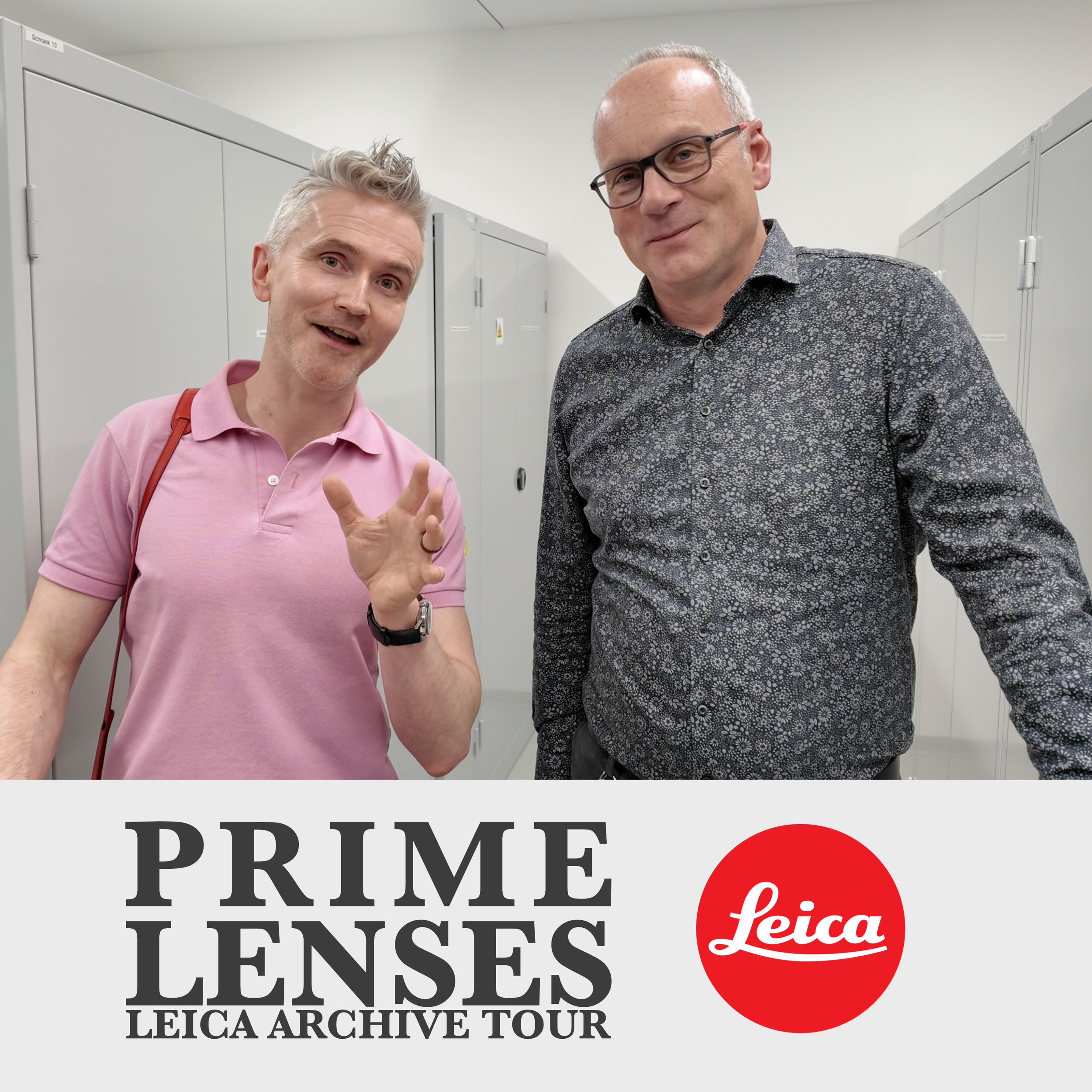


Midweek Special. Step Into Our Memory
A tour of the Leica Archive, from Barnack’s signature to the one-off camera Jony Ive designed.
Guest: Tim Pullmann — looks after the Leica Archive at Leitz Park in Wetzlar.
In this episode
On a recent trip to Wetzlar, Tim Pullmann took me through a side door at the Leica museum and into the archive, the place where the company keeps what it has made, drawn, printed and nearly thrown away.
This one is a walk rather than an interview, and you hear the rooms as we go. The paper archive first: a 1923 technical drawing of the 0-Series signed off in pencil by Oskar Barnack, a hand-glazed ceramic Leica that exists exactly once, and a hundred-year-old bound magazine that may hold one of the first Leica adverts. Then the camera archive: original Barnack negatives that still print beautifully, a golden M4, a Paul Smith edition, and the prototype of the Leica M for (RED) that Jony Ive and Marc Newson designed.
Tim also explains how a building’s keyholder became head of the archive, and why Leica came close to ending the M system in the 1970s.
Highlights
No timestamps in the source transcript, so these are positioned by where they fall in the episode.
• Opening — The message written on the floor outside the paper archive, and a very large R8 left over from Photokina
• Early — How Tim became head of the archive: he was the person responsible for the building, and someone said “here is the key”
• First third — A 1923 drawing of the 0-Series camera, 190 parts, approved in pencil by Oskar Barnack himself
• First third — The handmade ceramic Leica I, and why it was never put into production
• Midpoint — Original Barnack negatives, more than 100 years old, and Tim’s case for printing your photographs
• Midpoint — The prototype Leica M for (RED), and which parts were made at Apple
• Final third — The Paul Smith story: spotting him in the Selfridges window and introducing himself
• Close — Why Leica nearly stopped the M system, and how Leitz Canada saved it with the M4-2
Chapters
Positional only, pending a timestamped version.
• Opening — Iain’s introduction to the campus, the archive and what’s in it
• Opening — Outside the paper archive: the R8, the Super XXL M6 and how the archive grew
• Early — Tim’s route into the job, the team, and how colleagues send things in
• First third — The paper archive: the 0-Series drawing, the ceramic Leica, the Leica Society International gifts
• Midpoint — Ludwig Leitz, R8 design sketches, Deutsche Fotowoche and the signature wall
• Midpoint — The camera archive: Barnack’s negatives and employee card, the Ur-Leica story
• Final third — Cupboard 11: the Leica M for (RED) prototype
• Final third — Paul Smith, the Leica X, and the golden R3 and M4
• Close — The M4, the M5 and the future of the archive; Iain’s thank-yous
Mentioned in this episode
People
• Tim Pullmann — the guest; leads archive tours at Leitz Park · https://www.macfilos.com/2021/10/11/opening-of-the-ernst-leitz-museum-in-wetzlar
• Oskar Barnack — Leica’s inventor; his original negatives and signed drawing are in the archive · https://gmpphoto.blogspot.com/2024/03/leica-nullserie-leica-1-technical.html
• Jony Ive and Marc Newson — designers of the Leica M for (RED)
• Paul Smith — fashion designer, creator of two Leica special editions
• Peter Karbe — Leica’s chief optical designer · https://wiki.l-camera-forum.com/leica-wiki.en/index.php/Current_designers_of_Leica_products:
• Manfred Meinzer — industrial designer of the Leica R8 · https://wiki.l-camera-forum.com/leica-wiki.en/index.php/Current_designers_of_Leica_products:
• Mathieu Bitton — photographer, whose signature is on the hotel wall, and a guest on the show (Episode 82)
Cameras and objects
• Leica M for (RED) — the one-off M designed by Ive and Newson, auctioned for charity in 2013 · https://leica-camera.com/en-AE/Company/Press-Centre/Press-Releases/2013/Press-Release-2013-12-25_Leica_M_for_-RED
• Leica X2 Edition Paul Smith — the first Paul Smith camera, limited to 1,500, with the light bulb on the flash · https://www.photographyblog.com/news/leica_x2_edition_paul_smith
• Leica CL Edition Paul Smith — the second collaboration · https://www.popphoto.com/story/gear/leica-limited-edition-paul-smith-camera
• 0-Series and the Ur-Leica — pre-production cameras and Barnack’s first prototype · https://gmpphoto.blogspot.com/2024/03/leica-nullserie-leica-1-technical.html
Companies and institutions
• Leica Society International — held its autumn meeting at Leitz Park and toured the archive · https://leicasocietyinternational.org/blog/a-visit-to-the-leica-archives-during-the-lsi-wetzlar-2023-conference
Places
• Leitz Park and the Ernst Leitz Museum, Wetzlar — Leica’s headquarters campus, museum, shop and hotel · https://www.macfilos.com/2021/10/11/opening-of-the-ernst-leitz-museum-in-wetzlar
Quotes
We want to find new stories about Leica and tell people about the heritage and what happened in the past and what we did.
— Tim
But if it’s printed and stored in a good condition, I’m sure you can have a look on it in 100 years.
— Tim
“No Leica quality, so please no mass production.” It’s a ceramic model, it couldn’t be precise as a milled mechanic.
— Tim
Mentioned but not linked
• Ken Takayama’s ceramic Leica I — name and the “Four-Earn slides” wording are garbled in the transcript
• The Leica trailer on YouTube — Iain’s short film of the archive; add the link
• Joel Meyerowitz, “A Question of Colour” — the book on the shelf; title and author unconfirmed
• Stefan Daniel — archive colleague; couldn’t confirm a page
• “Dr. Kaufmann” — presumably Andreas Kaufmann, Leica’s chairman
• “Dr. Kluck” — Leitz decision-maker on the M4-2; spelling unconfirmed
• Von Südowicz — former Leitz spokesman; spelling unconfirmed
• Focomat enlargers (IIc and V35) — used in the archive’s new darkroom
• Deutsche Fotowoche, 1925 — bound volume with a possible early Leica advert
• A Leica documentary featuring Sebastião Salgado — Leica: A Century of Vision
Credits
Hosted by Iain Farrell. Guest: Tim Pullmann. With thanks to Oliver and the team at Leitz Park. Subscribe and find every episode at https://primelensespodcast.com
Prime Lenses – Midweek Special – Tim Pullmann, The Leica Archive – Transcript
Iain: Hi everyone, welcome back to Prime Lenses, I’m Iain. This week a very special midweek episode, bringing you my conversation with Tim Pullmann from the Leica Archive. Tim was gracious enough to show me around on a recent trip to Germany and let me have a look at some samples, prototypes, relics that live in the archive preserved for posterity.
I was interested to go and see this place because Leica, I think unlike a lot of companies, really understands its heritage and its and has devoted time and space to keeping that heritage and past alive, as well as continuing to go through it to try and find artefacts and interesting new stories to tell. So, a little bit of context before we get started. Leica’s Archive is in Wetzlar in Germany at their headquarters.
They have a large campus just outside the town that houses their production and repair facilities, as well as a museum, a shop, naturally, and a hotel that you can stay in if you’re visiting. There’s also a wonderful cafe staffed by just the nicest people you’ll ever meet, and I love going there for a coffee and a cake. When I met Tim and Oliver on the day, they led me through a side door at the museum and up to the archive.
If you visit the public areas of the museum, you can actually see the paper archive through a large window on the first floor. If you’re being shown around like I was, what you’ll find is a small office shared by Tim and his colleagues, and then two main areas. These require keycard access and are decorated by lots of signs saying that you shouldn’t be there unaccompanied and that you definitely shouldn’t have camera equipment with you.
Luckily, I had permission. The archive is split broadly down the middle into two parts. I opted to go into the paper archive first, which is filled with books, magazines, blueprints, old photographs and marketing memorabilia like posters, as well as giant replica calendars from show stands, pamphlets, booklets, all that kind of stuff.
Then there’s the main camera archive. This is a room filled with hardware like special editions and prototypes, all stored in locked cabinets, and both rooms are temperature controlled and very uniformly lit. They’re filled with large cabinets and moving library shelves, the sort that you see sometimes on shows like Slow Horses.
I’ve made a short trailer on YouTube showing some of the things that I was shown, so after this, if you’re craving more, you can go and seek that out. So we begin with Tim outside the paper archive and a very special message, which is written on the floor.
Tim: If you’ve seen this here, step into our memory. Welcome to the Leica archive.
Iain: Oh, thank you. With a suitable grandiose echo as well, which is quite nice. Thank you. Whoa, that is a very large R8.
Tim: Yeah, welcome to the Leica archive. This is our, we say, paper archive. So everything you find here, most of the things are on paper like books, magazines, technical drawings and so on. Or some bulky things like the R8 or here the Super XXL M6. Oh wow, I didn’t even see the M6.
Iain: Wow.
Tim: This was one of the highlights in the 90s at the Photokina booth for Leica. And the R8 was for the marketing and introduction in the mid of the 90s. This camera traveled around Europe. And it was at every big Leica store.
Iain: It’s pretty good. Yeah, I like that. I love the R8 and the R9. Fantastic cameras.
Tim: Yeah.
Iain: How much do you have? Because you said this is just the paper archive. Yeah. So this massive room, it’s great because it’s got a little bit of echo. You can hear how large it is with these large moving trolleys. How much do you have in here?
Tim: I can’t say it exactly.
Iain: No.
Tim: It’s not counted. Nothing is digitalized until now. Right. But it’s all better sorted out because Most of the things we have here were during the time we were in Solms, the 30 years, most of the things were in the attic of the building.
So nobody knew exactly what we have. And now we sorted it step by step. We sorted it out.
Iain: So how long have you been doing this as the head of the archive?
Tim: This was more or less a coincidence. I was responsible for this building where the archive is in. When the building was started and to the end I came in for the rest work and then I was eight years responsible for this building and during this time with a colleague and she had to stop working for the archive due to her health and at that time there was no idea to hire a new person for the archive and somebody said or asked “Who is responsible for the building?” And it feels like there’s a finger on me and then “Here is the key, please take care of the archive.” But today we are a small team and we work together.
My main job is in the German sales department, but I’m responsible especially for the cameras and lenses and so we work together and we sort out, especially our colleagues from the picture archive, they sort out the pictures we have. In our archive and step by step, we try not only to keep the archive and the things, so we try to sort out and find new stories about Leica. So maybe you know the book from 100 Leica stories from the anniversary.
Many, many times the people who made the book were here in the archive and together with them we found a lot of stories about Leica and this is the idea behind the archive. We want to We want to find new stories about Leica and tell people about the heritage and what happened in the past and what we did. This is why we show the archive.
It’s not for the public but we are going with groups in to in and when you’re here in the museum you have a small window here over there and you can have yourself a look into the archive and get a feeling what we’re having in. There’s an interactive display and you see here in the in the shelves, historic things, and get some explanations. So everybody can, I would say, smell the archive.
Iain: Yeah, yeah, and get a sense of it. That’s so cool. So you’re kind of mixing up a little bit of what’s on display just to keep things so that when people come again and visit the museum, they see different things each other. Yeah, from time to time we change.
Tim: Yeah,
Iain: Oh wow. That’s very, very cool. And the things that you’ve got in here as well, are you working quite closely with other teams within Leica to make sure that things, you know, as things are in production, I think so, you’ve got old stuff, obviously, and there was things that got thrown in the loft. But now that you’re here, and now that the company knows that there’s this ongoing thing, do the teams think of you or do you have to kind of go out and see? No, many of the teams think of us. Yeah, because when they,
Tim: When they clean up the offices, they say, oh, I found here this and this and this, a brochure, would you like to have for the archive? So yes, we say, come in, we’re throwing away, could, can we later? But first we have to check maybe we keep it here in the archive.
And this is also with cameras and lenses so when a new product is launched the development department says okay we have here some prototypes and we bring them here to the archive and keep them here. This was not always so. In former times many things were thrown away.
Yeah.
Iain: Hard to think of what might have been. What could have stayed. You were mentioning there finding new stories. One of those, I think I saw the picture outside of Oscar Barnack’s dog that was fairly recently-ish, you know, in the last few years was found. Have you found anything recently that you thought was really special and exciting?
Tim: So for me, sometimes when I open a box in the camera archive, sometimes I see products or lenses, yeah, oh, I didn’t know that we did this. I was there with Dr. Kaufmann one day in the archive and I said to him, “Hey, Dr. Kaufmann, this is new in the archive. This is a Focomat for mass production of pictures from the 50s.” And he said, “Oh, I didn’t know that we ever produced something like that.” So this was quite new for him and for me as well. So this is sometimes funny stories.
Iain: The really old stuff will have stood out. If you open a box and find a first generation camera or something. But there will be a bit in the middle, I guess, where it’s fuzzy.
There’s not as many books written about it. Because you keep people a long time. People tend to stay at like a long time. So presumably you’ve got quite a lot of institutional knowledge as well from some of the colleagues that you still have.
Tim: Yes. Especially for one source for me when I have questions is Stefan Daniel or Peter Karbe. They have a lot of knowledge from the 70s on, what happens there in the company.
But also from, you know, sometimes we have here collectors as guests. They know much more than me. And I learned a lot from them.
Iain: Or maybe you know,
Tim: We helped to when the red dot photo book was published new. We were here in the archive and checked the information and so on. And so on and so on and so on. Yeah,
Iain: Yeah. Do you sometimes have to go outside to private collections to fill in gaps? No,
Tim: We do not that actively. Okay. We do not buy actively. We have no budget for this.
Right. But if people ask, do you, we have something here. I want to donate it to the archive.
And we say yes. Normally we say yes.
Iain: Yeah.
Tim: But most, the most people asking, okay, I found a projector here in the attic. From my grandfather or from my father. And then they say, "Might this be something for the archive or the museum?" And then we have to say, "Sorry, it’s a mass product.
There’s not a huge collector market and we have all the products here." It’s more a personal thing for the people that say, "Okay, it has a value." But we think younger people see a product with Leitz or Leica on it and as they say, "Hey, Leitz, Leica, high quality must be something valuable, what I have here in my hands." And then they say, "Maybe I ask Leica before I throw it away." That’s amazing.
Iain: So the archive sounds like it’s divided broadly into two parts. There’s kind of physical product and then there’s paper. Paper is magazines, books? Magazines,
Tim: Books, technical drawings.
Iain: I can show you one special here. Oh, that’d be amazing. Yeah,
Tim: These are copies from drawings we have in here. And I have here one very interesting drawing.
Iain: Wow.
Tim: This is a drawing from 1923 and it’s a cut through the so-called 0-Series, the pre-production series cameras. And you see here all the parts have a number, so 190 parts necessary to produced the camera and what it’s interesting that it’s from 1923. Mr. Schaefer won work there in the office and did this drawing.
But more interesting is this here handwriting with the pencil. The drawing is officially approved by Oskar Barnack. This is his signature.
Iain: Wow that’s so cool.
Tim: The master himself has approved
Iain: It’s a very special day, because this morning, although I visited Leitz Park three times, this morning was the first time I went and stood on the spot where the first photo was taken in Wetzlar.
Tim: There’s the photo.
Iain: Wow, amazing. The birth of an entire industry. So cool. You have the best job, Tim.
Tim: Yeah, when I have time to go to the archive. We have a lot of marketing stuff, materials and so on here. And I have one thing which is really my favorite.
Because it’s unique. And I’ll explain you why it’s unique. With a twinkle in the eye.
But here’s a wooden box. And here’s written on Leica 1 Model A. Four-Earn slides by Ken Takayama, 1985. He was a big fan and friend of the brand and he made this model of a Leica 1, so the first serial camera, in ceramic.
Iain: What Tim’s showing me is a handmade clay replica of an original Leica camera, complete with 50mm Elmar lens that can be pulled out. It’s handmade and hand glazed and is beautiful because of it, but obviously quite rough and ready and natural. Around the edges. It’s a truly unique piece and would be really, really lovely on a shelf somewhere. Sadly, it lives in a box safely in the archive.
Tim: And you can’t do anything with it, Iain. No. It’s an artifact. No picture. But one is possible.
Iain: Oh, wow.
Tim: You have a collapsible lens. Amazing. And that’s the reason why this camera only exists one time on this planet.
Iain: Yeah.
Tim: “No Leica quality, so please no mass production.” It’s a ceramic model, it couldn’t be precise as a milled mechanic.
Iain: But I love it.
Tim: It’s so many nice details.
Iain: Oh, how wonderful.
Tim: And with his own box, wonderful.
Iain: Such lovely stuff. Spades for breaking ground around us as well. And marketing. Oh, those Converse are cool, aren’t they? Yeah,
Tim: You know there’s the Leica Society International.
Iain: Yes.
Tim: And they held here two years ago their autumn meeting.
Iain: Right.
Tim: And yeah, for sure we went with groups of them here through the archive. And at the end this was a way to say thank you.
Iain: Very nice.
Tim: And you see here a portrait of Ludwig Leitz. Ludwig Leitz was responsible for many years for product design and development. He is the founder of Leica design.
You can recognize a Leica product in the mass. There are always some details that say this is Leica or this must be Leica. He started this.
Yeah.
Iain: Amazing. I love also the pictures of the R8 here, these technical, these concept sketches. Right.
Tim: When Leica was divided in three parts and Leica camera was worked on his own as a company, the design office was closed. So we worked together with external designers and Mr. Meinzer designed the R8. And he also designed 20 years later the first Leica mirrorless camera, the SL1.
Iain: Yeah. That’s a great camera.
Tim: Or like SL type 601. So this was the first name. And this is a photo of the groundbreaking.
Iain: I sent a friend a photograph today. He lives in Canada and they just replied going, does the building look like film canisters on purpose? And I was like, well, yes, actually.
Funny story. But yeah. Oh, wow.
Tim: And here we have very old magazines, more than 100 years old. German and there was a special interest magazine today you would say it for photographers, photographic industry, for dealers and so on and this the name was Deutsche Fotowoche German Photo Week.
Iain: Right.
Tim: And you see here all the issues in one book, binded in one book. Oh wow. From 1925 and we found this advertisement in this and this might be we say it’s not 100% sure but we say might be This might be one of the first commercial advertisements for the Leica camera.
Iain: Wow, that’s so cool and wonderful to have it bound, that someone collected that together and bound that. It’s funny to think, even before it was an official department within the organization, people were recognizing the importance of certain things. Yeah, very, very cool.
I do love the giant R8. My friend John gives me a hard time for loving the R8 and R9. He is wrong. Incredible cameras, never want you to try one. But it will make him laugh. I’ve seen that.
Oh, it’s a Polaroid book. That’s good. Yeah. Yeah.
Tim: These are books with photographers from all over the world, not only Leica photographers. Yeah. And this collection is not actively managed. So books coming in by coincidence or we found something. But we do not buy actively books.
Iain: No. I imagine people send a lot of stuff to people and then it’s like I don’t need this or it just ends up here. You’re in danger of becoming a person everybody gives stuff to you that they don’t want.
Tim: That’s the reason why we say okay yeah please come and later we have sometimes we have to decide okay we don’t need it really. So this is it’s like in the private house you have one day you have to decide I keep it or I put it away.
Iain: And who are the signatures? You’ve got a lot of visiting photographers?
Tim: This was when the hotel was opened. So everybody of the opening party had the chance to give a signature. And some years ago they said, “Okay, we will remove it now and we want to throw it away.”
And we said, “No, we don’t do that. We will keep it here in the archive.” Here is a photographer, Mathieu Bitton. Yes, Mathieu is on there.
Here is Mr. Von Südowicz, the former spokesman from Leitz for many, many years.
Iain: Very cool. And I will say there’s a copy of A Question of Colour, which is my favourite, Joel Meyerowitz. Well, where to next, sir?
Tim: Let’s have a look into the camera archive. And this is my colleague Anton. Hello Anton. Anton is responsible for the darkroom. Oh wow,
Iain: Yes.
Tim: Since one year we have a darkroom, right? Yeah. Yeah.
Cool. And yeah, he’s really a specialist in printing black and white. And we do this all on historic old Focomat IIc, Focomat V35.
Yeah,
Iain: Okay.
Tim: With the old lenses. Yeah.
Iain: Very cool.
Tim: And it works perfect.
Iain: All right. Thanks. See you.
Tim: Yeah.
Iain: Okay, here we go.
Tim: This is the room for the collectors.
Iain: Yeah, this is probably what people think of, I guess, when they think of an archive. Yeah.
Tim: Yeah, but Leica is producing cameras and lenses for taking photos. Yeah, this is only one part of our heritage. It’s also great photography or other things as we’ve seen in the paper archive. So yeah, we want to keep the photographic culture here in the archive, so to say.
Iain: Yeah, yeah.
Tim: And this room is nearly everything on historic products which we own or prototypes. In this room is not the so-called Ur-Leica, so the prototype of Oscar Barnack. It’s too valuable, it’s safe in the bank. Yes,
Iain: Yes. That makes sense. Is the one that’s in the museum on display, is that an original or is that a copy? No, it’s a copy. Yeah, that makes sense.
Otherwise someone could crash through. It’s like being in a room out of a spy movie, you know, like this is the room that people break into to steal secrets, you know?
Tim: Just a second.
Iain: As Tim disappears down the corridor.
Tim: This is one of the so-called Ur-Leica. This is how the camera looked like.
Iain: It’s funny to see one looking new, actually, because you sort of assume that it was born with the paint rubbed off, but of course it wasn’t. Wow.
Tim: And you see here, we still have original negatives from Oskar Barnack. Of the pre-production camera from Oscar Barnack and included was there a DVD, you see it here in this picture here, a DVD with films from Oscar Barnack because Oscar Barnack was a filmer and also included was a picture with a print from one of his negatives made with the Ur-Leica and there was this catalog and people could choose which picture they want. And you can have a look here at this guy here.
And now I show you the original negative. It’s here. So, and when I show this to our visitors, I always tell them, digital photography is fun.
It’s cool. You have so many possibilities. It’s great.
But what will happen with our data in 100 years? We don’t know this already. We don’t know it.
But if it’s printed and stored in a good condition, I’m sure you can have a look on it in 100 years.
Iain: Yes.
Tim: And this is here, this negative is more than 100 years old. And you still can get a picture out of it. Or this is here the other motif. This is also in Wetzlar, the “Eselstreppchen”.
Iain: Yep.
Tim: Yeah.
Iain: They’re so clear. I think that’s the thing that’s surprising. I think for anyone listening as well who doesn’t shoot film very often or has never gone back to old negatives is just if they’re still as you say if they’re kept correctly and that’s over 100 years old how clean the image actually is stunning isn’t it really wow and this was only the the cinema film it was not the film made for for still pictures what sensitivity to light would a film like that I don’t know it no it’s low though isn’t it I mean it was also it was it wasn’t constant at the beginning yeah yeah So clever to take that leap and imagine taking that film.
Tim: And today we have this electronic card that shows that he works for Leica. In former times we had this card. This is the employee card of Oscar Barnack. And the reason, unfortunately, was after 25 years he died and the reason he died.
Iain: Yeah. Oh, wow.
Tim: Gosh. But it’s the original one. Yes.
Iain: I guess that’s the original database, isn’t it? Yeah. Yeah. The original database of employees. Gosh.
Tim: I know that you want to see one special camera.
Iain: I would.
Tim: Because in the history of Leica, we sometimes work together with famous designers and it will show you two cameras from two designers.
Iain: Oh, cool. Yeah. Yeah. Yeah. Nice.
Tim: And come with me here to the... Okay. This is cupboard number 11.
Iain: Oh.
Tim: So this is the... The prototype was the last prototype of a camera which was then produced only one time. It’s the Leica M for (RED).
One of one. And this camera was designed by the former Apple designers Jony Ive and Marc Newson. This camera was produced for charity proposals for the organization (RED).
1.5 million US dollar or something like that.
Iain: Yes. It’s quite a stretch. It’s a crazy thought as well, but the design and the customization is incredible.
Tim: Wrong lens. Oops. But what you see here is nearly the final design.
Iain: No way. I would love to.
Tim: Well,
Iain: This is a bit of a moment. Oh, it’s stunning, isn’t it? Just what an incredible thing.
It’s funny how it has that M-DNA, but it’s also very Ive and very Newson. Was it based off of the M240 or something? M240.
And how many prototypes would you have gone through in terms of manufacturing? One.
Tim: This is the prototype of the housing, but it’s still polished. Not so many things were made.
Iain: That spins. That’s the hood, isn’t it? Integrated hood.
Tim: Some of the parts were produced at Apple. They have more experience here with aluminium.
Iain: They’d know all the radiuses and stuff. Little things on the side for a strap. Wow, thank you so much. That’s amazing.
Never thought I would ever get anywhere near that. I hope whoever bought it has used it a little bit. Like wherever that camera ended up in the world, you know, you kind of hope it gets used for something.
I’m in that one. There is this one. Yeah.
Tim: Okay. Just pack it away.
Iain: You’ll get in trouble from the head of the archive if you don’t tidy up properly. Every day for my kids when I travel I do a little newsletter for them called the Daily Daddy. Except when I’m in Germany when, because I’ve been before and it’s Daddy in Deutschland. And tomorrow’s edition will feature this camera and they will have no idea why that matters.
Tim: And I would like to show you another camera. It’s when I was on a vacation this year in England and I was in London. Oh yeah. And I passed by the Selfridges.
Yes. Yes. And there in the window of Selfridges said one man who also designed two cameras for Leica.
Paul Smith. It was really a coincidence. I want to show you one camera.
I bought a book from him and got a signature and had a chat with him and I said: “Hey, I’m Tim from Leica. I’m working here for the archive and I have two cameras you’ve made with us.” He said: “Yes, I remember.” And had a darkroom and so on and he said okay in memory to my father I will do that project together with Leica. Oh wonderful. Make such a camera and this is here this was the first edition the Leica X.
Iain: Yes oh I love those.
Tim: You see here this is funny here for the flash.
Iain: That’s my favorite detail on that camera the way the little the little light bulb drawn on the flash.
Tim: And also here, this is number one of 1500. So this is what we keep also in the archive, things like that. - Right,
Iain: Lovely.
Tim: Typical Paul Smith.
Iain: The Paul Smith colors are superb, he’s wonderful. He’s on my list. I would love to get him on the show because he’s loved photography his entire life. And this is like a proper presentation setup as well.
Tim: And I couldn’t believe it that he sat there and my wife said, “Hey, this is Paul Smith.” Oh, okay.
Iain: He did, he kind of joked that he was moving his office. He took all sorts of artifacts, a bit like this in a way. He kind of built a little shrine to his career in the window of Selfridges. Brilliant timing.
Tim: Yeah. Sometimes, yeah. So I’m happy that I have this camera here and now I met him in person.
Iain: He seems like a lovely fellow. He’s on my list. I will get him one day. If I can get Tim in the archive, I can get Paul Smith. Rumour has it there was a golden R made at some point.
Tim: Yeah, there was a golden R. - Oh, right. - Yeah. When I did my apprenticeship in a photo store.
Iain: Yeah.
Tim: This was always, this was very important for the boss. Okay, the golden light has to be in the window.
Iain: Okay.
Tim: Because we are like a dealer. The camera was never sold.
Iain: Right. Ah, okay.
Tim: This is for example, the golden R3.
Iain: Oh, look at that. M4. It’s tricking you.
Tim: It’s the wrong box. Ah, no, it’s a box. You could choose Leica R3.
Oh, I see. It was M3. Yes.
But I also have a golden Leica R3 or the golden M4 too.
Iain: And that’s a fully working... Yeah. Brilliant.
How cool is that? The M4 is a little special. My friends really like the action on it, the sound of the shutter.
Beautiful. And that’s gold. It’s not just plated.
Tim: It’s not massive gold, but it’s gold plated.
Iain: Very cool. Beautiful. Summilux lens as well.
Tim: And the M4 is also a special camera because Leica was thinking about to stop the M system at the beginning of the 70s because the M5 was not so successful. And then Leitz Canada said: “Okay, to stop the production of the M is not a good idea because we produce so many lenses for the M system.” So there was a decision made by Dr. Kluck, Walter Kluck, and he said: “No, no, we will bring the M production to Canada and produce the M camera again.” And then they started to reproduce the M4 as an M4-2 with some optimations and so on. Helped to survive the M system.
Iain: Yeah,
Tim: I’m glad. And then 1988 the M6 came. - Yeah.
Iain: I have to say I have a soft spot for the M5. I think it’s an amazing camera. And I wasn’t alone. Last year when they showed the film that had Salgado at the beginning saying his favorite camera was M5.
Tim: Yeah.
Iain: It was lovely. I did a little punch the air because it’s been, I’m waiting for that film to come out so that lots of Leica people will then go, Of course the M5 was marvelous. It’s been very quiet on M5 Hill.
Tim: If you speak to technicians here, some of them say the M5 was technical-wise the best analog M camera ever made. Yes. But I think there are a lot of different opinions about this product. Yes.
Iain: I think it looked... You see, I love things that kind of are a big swing from a design perspective, and the M5 was a big swing. This is an amazing archive, and thank you so much for letting me see these things. It’s incredible. Is the goal now for you and Anton and others to continue this as a kind of, this will be a forever project for the company?
Tim: Yeah. So I think this will be a project for me until the end of my working life. Yeah. Maybe after that, maybe when I retire in 12 years, they ask me, would you like to take care of the archive?
Yeah. So we all together, Anton and Christine, especially in the picture archive and me and here together with Stefan Daniel, We want to sort out what we really have and more in a strategic way. What you see here is now, we moved from Solms to Wetzlar and then here in the new building after some years.
So what we see in the boxes is not 100 completely correct together. So it could be that it’s an R lens together with an M lens and so on. We want to reorganize the archive so that we find things faster and get a much better overview of what we have. We have an overview, but we want to go more into detail.
So this is a working progress.
Iain: I love it. I love the idea of you being a Leica Fellow after you leave. Brilliant. Well, Tim, thank you so much. It’s been an absolute joy.
Tim: You’re welcome. It was a pleasure.
Iain: Once again, a very big thank you to Tim for showing me around, to Oliver and and really this was a bit of a dream come true episode. I never thought I’d get that close to the archive. I never ever in my wildest dreams thought that I would get near to that Jony Ive Marc Newson Leica M. What a ridiculous experience.
And a massive, massive thank you to the taxi driver in Wetzlar who returned my DJI Osmo Pocket to the Leica headquarters after it fell out of my pocket in a cab. I was enjoying myself too much talking to the team at reception and shoved it in a pocket and ran out the door. I need to learn a lesson on this and I will say it out loud for anyone listening.
If you’re filming something on location or recording something, for the love of all things, before you leave that place and pack all your stuff up, copy the material somewhere. Lesson learned for next time. Anyway, if you enjoyed that and you’re new, don’t forget you can like and subscribe to the show wherever you get podcasts from. So that’s Apple Podcasts, Spotify, YouTube Music, Amazon Music, all those lovely places.
Please do review it, please do let me know what you think. My DMs are open and as I say almost every week, the best thing about doing this is hearing from all of you. Have an amazing week, thank you once again Leica, and we’ll see you on Sunday for another episode.
Bye for now.