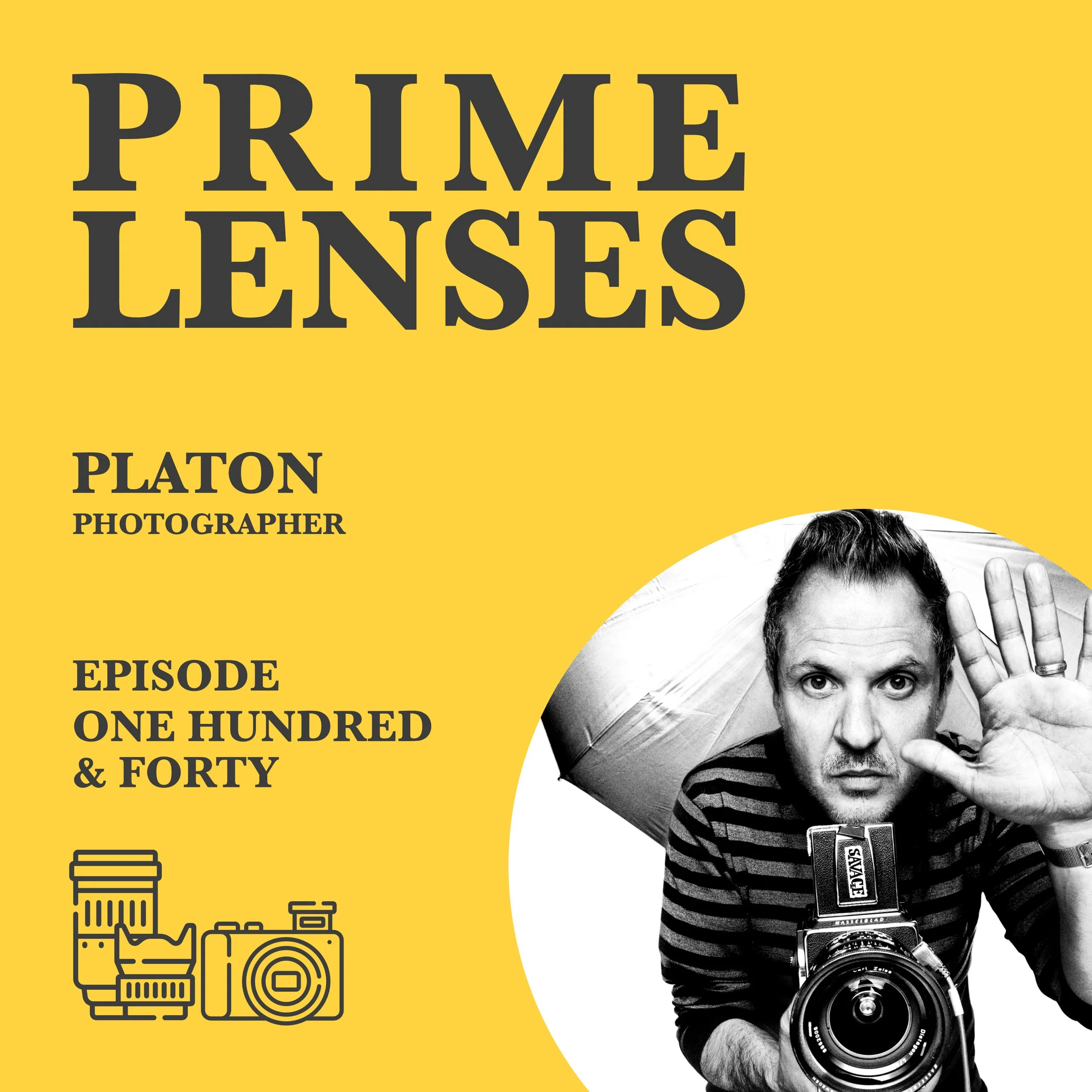


Today Platon tells me about the book he’s been working on for 40 years and the old lady who never got to see it.
Guest: Platon — portraitist of presidents, dissidents and unknown villagers, and founder of The People's Portfolio · https://platonphoto.com
In this episode
Platon has photographed more world leaders than almost anyone alive, but we start somewhere smaller: Paros, the island of his childhood, and the book he has been laying out on studio floors and hotel rooms for years. From there the conversation moves through why his white backgrounds began as the whitewashed walls of village houses, how a café called Parliament and a single post office phone line shaped a photographer who ended up working in parliaments, and why he thinks curiosity beats judgment every time. He tells the stories behind the portraits: Netanyahu twice, Obama before the smile, and Bill Clinton with seven and a half minutes of good behaviour and a wide-angle lens. We also get to the box, and what it means to the people who sit on it. A listener question about being constrained by a signature style gets a better answer than I expected. It ends with a message for anyone working alone.
Highlights
No timestamps were available, so positions are approximate (share of the conversation elapsed).
• ~0% Forty years to deliver a promise to an old lady in the village who never got to see the book. She is in it.
• ~8% Where the white background really came from: the white houses of a Greek village, not Penn, Avedon or Bailey.
• ~22% The village as the original social media: one phone line in the post office, and a café called Parliament.
• ~34% Replace judgment with curiosity, and what a picture of P. Diddy or Harvey Weinstein means now compared with when he took it.
• ~43% The box. Pussy Riot and Putin sat on the same one, and so did a pregnant woman who told him nobody had ever asked how she felt.
• ~53% Netanyahu twice, a year apart: "When he's vulnerable, he's volatile."
• ~64% Obama's first Time cover, and why he refused to ask him to smile.
• ~76% Clinton, the wide-angle lens, "show me the love", and a cover that went out to cable news outrage.
• ~96% The Little Rock Nine portrait in the Smithsonian, and why the school canteen means more to him.
Chapters
Positions are approximate, from where each topic starts in the transcript. Please replace with real timestamps from the edit.
• ~0% Cold open and the Paros book: layouts on the floor, the title, the old lady
• ~5% Defenders, Republic and permission to make something personal
• ~8% Learning to take pictures on the island, the white background, film and the Leica
• ~15% From magazines to filmmaking, and the first recorded interview
• ~22% Village life, the phone line, Café Parliament
• ~28% Influences: architecture, album covers, Churchill, democracy as a Greek word
• ~32% Trust, legacy media and "all you need is attention"
• ~34% Curiosity over judgment; Diddy and Weinstein
• ~41% A listener asks about being constrained by a style
• ~43% Dyslexia, reduction, and the box
• ~53% Netanyahu twice
• ~59% The responsibility of other people's stories, and The People's Portfolio
• ~64% Obama, the first Time cover
• ~73% Seduction, Icarus, and being immune to power
• ~76% Clinton and the Esquire cover
• ~85% Truth, film, AI, and standing your ground
• ~90% Neil Young, Van Gogh, and not chasing validation
• ~96% The Little Rock Nine
• ~99% "You are needed"
Mentioned in this episode
Books and reading
• Paros by Platon — the book at the centre of the first third of the conversation. MW Editions, 370 pages, 225 black and white photographs. · https://mweditions.com/?p=1576
• The Defenders: Heroes of the Global Fight for Human Rights — Platon's human rights book, made with The People's Portfolio. · https://mweditions.com/books/the-defenders-heroes-of-the-global-fight-for-human-rights/
• Be Quiet, Be Heard: The Paradox of Persuasion by Susan and Peter Glaser — the book Platon saw on Obama's desk. The authors say it appeared in the New Yorker photo essay. · https://elgl.org/new-sensation-drs-susan-peter-glaser-glaser-associates/
People and institutions
• Platon — official site. · https://platonphoto.com
• Smithsonian Institution — acquired Platon's archive of African American civil rights and cultural leaders in 2020; the Little Rock Nine portrait is part of that story. · https://platonphoto.com/about-1
Quotes
Replace judgment with curiosity, and it will serve you well.
— Platon, ~34%
I'm immune to power. I don't want it. If they offered me any kind of power, I wouldn't know what to do with it.
— Platon, ~70%
Look in the mirror, talk to yourself and say, you know what? I am needed.
— Platon, ~99%
Mentioned but not linked
• Platon's Republic (book, Iain) — a search turned up only a Goodreads page mixed up with Plato's Republic, so I left it unlinked.
• The People's Portfolio (Platon's foundation, founded 2013) — confirmed as a non-profit by the MW Editions page, but I could not verify a standalone URL.
• Short film accompanying Paros (~15%) — Platon expects to release it early next year; no page found.
• Cillian Murphy film (~28%) — Iain mentions rewatching it; I found a Port magazine cover but could not confirm which film, so no link.
• Henry Kissinger recording (~15%) — Platon's first recorded interview, about Frank Sinatra; no public page found.
• Reid Miles, Peter Blake, Alan Fletcher / Pentagram, George Lois, Le Corbusier, Frank Lloyd Wright (~28%) — Platon's influences; not searched.
• Hasselblad, Leica (~8%) — the gear mentions are brief; add brand links if you want them.
• Time, Esquire, Larry King, Bob Woodward, John Lithgow, Neil Young — named in the stories; not searched.
Credits
Hosted by Iain Farrell. Guest: Platon.
Prime Lenses – Episode 140: Platon – Cleaned transcript
Platon
The number one It's the most amazing thing to do, but it's also a long-term project. I mean, it took 40 years to actually make the pictures, but it took a good five, six years to begin the process of putting it in a book. Because, you know, the way I do books, I want to make—I don't want to have any compromise with the materials and the production of the book, the design of the book. So a huge part of it is creating a financial platform underneath it that does the book justice. So it starts way back, you know, to try and build that financial structure to do it, and then you get the design, and then you get the editing. And I've been laying this book out.
You probably saw it in my things, in my videos. I cut out all the images and I lay them out on my studio floor. I lay it out in my home.
Or if I'm in a hotel room, I take over the whole hotel room. And I like to look down at it and then you can move bits of paper around. And it's a language because you've got the images as standalone images. But then it's how they relate to each other. What kind of narrative does it say? And also visually, the sensory perception: as you turn a page, you kind of always want to be surprised, so you create a rhythm of patterns, and then occasionally you break it, so it stimulates you. It's sort of like a palate cleanser. So this goes on for years and years, and then, of course, I spend two weeks on it, and then, you know, a big commission comes in, so I put it aside, let it sit in my head, record what I've laid out on the floor, come back to it six months later, do another round. And, um, you know, I've even got mock-ups of the cover I was trying to do, which are 20 years ago. Wow. And I was trying to decide, what do I call it? What's the title? You know, should it be something poetic? In the end I just felt it's of a place. The whole book is about being honest, and so the most honest thing is not to try to add an extra layer of poetry to it or philosophy, because it is what it is. The people are what they are, and if I learn anything from this project, it's, you know, authenticity, and just be honest about what it is. It's a place, a magical place that taught me everything I know. So, um, it's done. There was a—I remember when I started in 1990, 1985, I think, and I was taking pictures in the village and this old lady came up to me. In Greek she said, 'What are you doing?' And I said, in Greek, I said, 'I'm making a photography book about Paros,' and she said, 'Well, I look forward to seeing that.' And she never got to see it. She now rests in the cemetery behind the church in the village, but her family got to see it, and she's in the book. So it took me 40 years to deliver my promise to that lady. And I never forgot. I never forgot it.
Iain
I've been looking at Defenders and your Republic book as well in preparation for this. You've dealt with all these world leaders and incredible, like famous figures. And I imagine there comes a point where, you know, you have a degree of comfort with dealing with the famous or whatever, because they're just they're another person coming through.
I imagine once you photographed Putin, Pussy Riot and every living president, you've kind of, you know, that takes. But it's so that might make it easier in some ways because these people are owned by all of us. Whereas the Paros book is so personal to you and includes so many stories like that.
Was it was it also harder to, I don't know, give yourself permission to make that one?
Platon
You know, for me, Paros was was a place I would return to to practice as I developed. And so there are pictures in there where when I first started, I hadn't figured out how to use a light yet. I hadn't figured out how to use different lenses on my Hasselblad.
So I just had one lens, an 80mm lens. I don't like talking about technical stuff too much, but just to say how simple it was, I had a light meter, which you need, and I just used available light because that's all I knew how to use. So I'd put people next to a window or shoot them. Against sitting outside their porch where you have the white house in the background so it's a white background so that's how my white background start it's got nothing to do with Penn and Avedon and Bailey in that tradition it ends up looking in the same tradition but I came at it my white backgrounds came from the white backgrounds in a village um of the houses some of them the earliest pictures I'm really learning how to take pictures how to be a photographer and every year I would return with new lessons I'd learn you know when I went to the royal college I got a bit deeper into it then I started starting to understand how to light in a studio so then I I bought a little mono light and I I would build little photo studios all around the island you know in a fisherman's hut in in someone's house in the village you know in the in the in the community center, wherever, wherever I could. And I would invite people to come and sit for me. Gradually, as my operation grew in New York, eventually, I now had a team.
So gradually, I would bring my team with me, and we would augment. And, you know, I had assistants, we had more equipment, and the studios that we built became grander. All the way through this period, I was still returning occasionally. On my own with my Leica, where I'm just shooting just me, no studio, raw images that will be about atmosphere. And they become palate cleansers in the book for the detailed portraits of people. And I always like this idea of opposites in my work.
So something is really considered so you can see all the information of their character. And then something is really atmospheric where it's not about detail. Sometimes it might be really grainy and dark. It's more like a charcoal sketch.
And it allows sort of informality, formality, informality, formality. And it keeps changing your perception, the narrative as you're going through the pacing of the book. So I always used to do that in my portraits with a magazine.
If I'm shooting Edward Snowden, you've got the portrait that would probably be the cover shot where he's holding the US flag. But then I would shoot 35 mil stuff in the hotel room, all available, right? Really dark and more moody.
And, you know, magazines always often resisted those because it's really grainy. I would shoot, I would really push the film in processing so you get golf ball grain and it becomes, Yes, it has much more atmosphere and tone and mood. And I always liked that roughness.
So when it came to the book, the good thing about doing a book is I'm not compromising at all. I'm just working the way I want it. This is about as pure an exercise as you get from Platon's head.
And in the end, we start shooting film as well. We have actually made a short film. To go with this project which will release probably next year early next year and I invited musicians all over the island to come and play for me and we went into churches and recorded the ladies singing in the church choir and we recorded sounds all over the mountains the sea the the crickets the the breeze through the wind dogs barking and we filmed lots of beautiful moments.
Sometimes we even filmed some of my shoots, the making of the shoot, and we put it all together with my images into a sort of love poem. And I think we'll release that next year. Yeah. So I want to get the book out, give it a runway of its own, and then we'll add.
There's another way of looking at the material, which is in a short film.
Iain
That's wonderful. I've noticed that you've been making a lot more films recently. That felt like that was a lockdown skill, maybe that kind of happenstance came about. It kind of was.
Platon
It's also a collision of the times we're living in. You've been at the game as long as I have. The environment changes.
There are sort of different generations you work through. And each era, has its own way of communicating. So, you know, when I first started, magazines were everything.
You know, that's how you functioned. You got commissioned, you got access to fascinating people. The magazines never really paid much. If you're lucky, they would have covered expenses.
But it was a great way to build an archive in those days. Gradually, as I moved on, you know, I started to build an archive. To get frustrated with the business.
I'm a really curious person. And as I got more and more involved with politics and human rights, I started to feel that magazines are not really... Everyone has a slight agenda.
Everyone has a point of view. And I started to see that I'm actually trapped in that magazine's particular point of view. And I would say to my editors, well, why aren't we covering this?
This is what's happening on the streets. And they would say, well, that, you know, that might, you know, that might upset our viewers or that might upset our readers or, or maybe celebrity is more popular with our readers. So we're not going to really talk about human rights too much.
So I, you know, I started to feel, well, I want to cover these stories. And I want to interview this person. I would often tag team with a writer back in the day.
And I would do my picture with someone and I would have the most amazing conversation with them. And I'd really connect with them. And then the writer would kind of miss it.
Sometimes I'd get frustrated. I would say, you're not asking the right questions. You're not getting in there.
I had them. They were sharing their humanity with me. And now they've gone all defensive. And they're just giving you one-liners that are already rehearsed. So I started to see, well, I have the capacity to get something different. I'm not going to check boxes with data and information.
I want to share what it's really like to meet this person and ask them philosophical questions about winning and losing, loneliness, things that we all really want to know because we want to know ourselves. How to deal with loss, how to deal with success, You know, and how to deal with feeling fraudulent when you've been given a huge opportunity and people assume you're a leader when really inside you feel anxious that you can't live up to expectations. These are the questions I'm fascinated by.
So I started to feel frustrated politically, morally, because magazines weren't covering the big stories of our time in my opinion um as well as I started to feel that I I cannot I want to ask them questions and but I want I need to record it somehow so I started experimenting with just recording their voice at the beginning and my first one was henry kissinger and I asked him to talk about frank sinatra uh because I knew he loved frank and he knew him and I always wish I met frank And, you know, that told me a lot about Kissinger. But then I thought, okay, we can go more. And now I can, I want to film it.
So then I expanded my operation. We started to film it. And then we started making these little films. And that coincides with the decline of magazines.
So all of a sudden, I realized, well, hold on a minute, I can build my own platform. My pictures don't go in a magazine anymore. They go in my film.
And it becomes the end of the film. So my film is kind of born out of the experience I've built up working with magazines, knowing how to create a narrative, knowing how to connect with someone, knowing that you need different elements and different assets that you collect on the shoot. And then you put it all together and you have this human experience with someone who is shaping our time.
And that's where I'm going. So the film in Greece, all the project in Greece, this has been developing through this whole journey over 40 years of me kind of moving and keep moving. And the film is just the Greek project is just a constant evidence of me growing and learning.
But what I didn't realize is that by doing that and just practicing, I'm actually capturing a culture that has disappeared to some extent. You know, the old ways have gone. In my village, when I was a kid, we didn't have electricity in the village.
Everything was candlelight at the beginning. So you can imagine how beautiful that is at night. And when it's dark at night, you come out of your house and you look up and you see the stars like you don't see now because we're flooded with contamination of light, with lampposts and houses.
But at night, if you're just in candlelight, you know, that's a magical thing. And then there was one phone line in the village, which was in the post office. And all the old ladies who worked in the post office, you go there once a month to make your important phone call. And all the old ladies are listening in to your phone call.
By the time you've left and you've gone back to your house, the whole village knows your business. But that's the original social media right there. It happened there.
Not at Facebook campus.
Iain
No.
Platon
And then you think of the village life of every child was safe because and played in the streets. You know, you could go out and disappear for three hours, four hours, and then come home for dinner. And, you know, your parents aren't worried because every neighbor in the street is watching out for all the children as if they're their own. It's a natural framework, social framework of respect. And protection. And on top of, so the kids are free. Kids playing in the street, playing in the village square for hours on their bikes.
No one's at home on their devices. There aren't any devices. There's no TV.
And then the old people are not cast aside. We see them around all the time in the village. And we think of them not as sort of a burden, but we think of them as, the center of the village wisdom.
They've lived the highs and lows of life. They know how to navigate a difficult life. They know how important joy is and how fleeting it can be and how important human relationships are.
So everyone in the village turns to the elderly for constant advice and they're respected. The cafe, which is called a Cafe Neon was called Parliament because that's where all the old people would sit and debate about the well-being of the village. So you can imagine I came from that.
I came from the cafe that's called Parliament and ended up working in Parliament. And I saw the original phone line with all the old ladies gossiping. And, you know, then I work with Elon Musk, who wants to send people to Mars. And Zuckerberg. So it's been quite a journey for me to do that. But it's very grounding.
And it's, strangely enough, allowed me to have different kind of conversations with the tech titans, as an example, and the politicians, because I came from very simple, humble beginnings. And those values I learned from the village are still with me every second of my life. And it was the old people in the village who taught me about studying character.
They taught me about posture, how mannerisms work, because I used to draw them as a kid before I was even taking pictures. My dad was an artist and an architect. So I was always drawing.
And then eventually the camera becomes a sketchbook. I learned about studying the human condition in the village.
Iain
I'm very grateful that it's someone like you who is in front of those people because I've seen it in your videos and it's evident in the way that you're speaking about the way that you connect with your subjects the way that you sit down you know and the way that you then make films about them afterwards like the Cillian Murphy one was one I was watching again this morning because it's just it's beautiful the way that your your background in drawing your background in graphics your illustrative the stills but it's motion but it's moving very slowly you're kind of leaning on every piece of that background and that history.
Platon
You put everything in and it's so rich when you have creative curiosity. My influences are so broad from Le Corbusier, Frank Lloyd Wright, Peter Blake, Reid Miles from Blue Note album covers, Sinatra's capacity to tell stories. Winston Churchill's capacity to communicate a really complicated idea with simple words, to move your heart, to mobilize people into action.
Martin Luther King's speeches, George Lois from Esquire, who was kind of like my godfather, really, who I worked with and knew very well and loved. And Alan Fletcher, who created Pentagram. He commissioned my dad when I was a kid.
So all these people have influenced me and then you mix it in with the earthiness of Greece and then a deep fascination with democracy and how it works and how the ancient Greeks sort of intended it to be and what it is now and the challenges that come with democracy. You know, these are philosophical questions that we're still trying to figure out now. Democracy is actually a Greek word. And it's made two words demos and kratia. Democratia is the ancient Greek way of saying it. Demos means the people.
Kratia means power. So it actually means power of the people or people power. And so technically speaking, democracy isn't about the politicians.
It's about the people. And if there are to be politicians, We think of them as political leaders, but actually they should be servants of the people. Somewhere along the line, that sense of service gets transferred into leader.
And it starts getting a little complicated. So I find that very, very interesting. And we're seeing that sort of tension play out in our societies around us. The world right now that the people are starting to feel they're not being listened to and what's also interesting because of the internet is that the people have a capacity to communicate with each other in a way that the legacy media is getting left behind and in some cases the politicians are as well yeah and the successful politicians now are the ones that really know how to use social media and they're able to mobilize a new a new type of support system a lot from young people. So you're seeing a new wave of younger politicians who are really communicating in a new way. And it's leaving the legacy media behind, which I think in many ways is a good thing.
Iain
I think everything has to be reinvented and of the time. I think it's kind of naive to assume things will stay still. And as we get older, there's a danger that the The biggest word in our time is trust.
Platon
One of the most valuable currencies that we have is trust. And the legacy media, because they ran the show for so long, they told us that they are the most trusted name in news or that we should trust what they are telling us. And there were no other options.
So we believed everything. We were told and then gradually we're now seeing that hold on a minute that's not quite what happened yeah we know because it's on the internet and someone was filming it on their phone so it didn't really go the way you said it did and and I think the the legacy media has broken trust in many cases and the people are now calling it out so they're holding it accountable which is a good thing is, can the legacy media win trust back and compete for attention? In the 60s, John Lennon said, all you need is love.
But now I'd rephrase that to all you need is attention. Because everyone's fighting for attention and clicks and followers and metrics. We're living in really interesting times.
And I've learned the most important thing, to be honest, is not to be judgmental, but to be
Iain
Yes.
Platon
You know, replace judgment with curiosity, and it will serve you well. And in my pictures, you know, the portraits that I've done throughout my career, whether it's someone unknown on the Greek island of Paros, or whether it's the president of the United States, curiosity is what drives that picture. And it's not for me to judge.
You know, when I was younger, I have to confess, I was judgmental. I would be asked to photograph someone who I fundamentally disagreed with. And it would kind of color my picture.
And gradually as I matured, I started to realize that judgment just reduces your capacity to discover. My job is if I go in and make a judgment, well, then I'm only going to learn so much from the experience. And I'm actually going in trying to confirm what I already believe.
But what if there's more to it than that? What if there's another side to this person that maybe helps us understand why things might be going horribly wrong instead of just confirming what I already knew from other people? So I started to be more curious and think, OK, well, let's just put that all aside.
Let's just open things up and talk to this person and ask them about their family and their childhood and their value system. And then often I would come away with a whole different sort of outlook and a much broader context. And it starts getting really confusing when you do that.
Iain
Yeah.
Platon
And John Lithgow, the famous actor I worked with recently, he said something amazing. Things. Bad people do good things.
All of us are capable of both. So we are now living in a time when you are either good or bad. The truth is the human condition is complicated.
Iain
Yeah.
Platon
And we're all capable of doing great things and terrible things. And some of the people I photographed have done really great things. But they're flawed people.
And some people who, have done some really bad things and they have really hurt people on a massive scale. My job is to hold up a mirror to society and say, this is who we are. Let's look at our reflection and let's have a debate about it and ask questions about what is a hero?
What is a villain? And I photographed many people who were at the time. But as history has gone on, what I actually caught on film was not a hero or a celebrity, but actually a demon.
My picture of P. Diddy, when I photographed him, it represented bad boy music swagger. He even called his record label Bad Boy Records. It was in plain sight.
And I caught something in him. Which didn't make sense at the time. But because I don't know what's going on behind the scenes with all these people.
But then now that very same picture represents something different. It represents an absolute monster who abused his power and authority in the media. And my picture of Harvey Weinstein is exactly the same horror story, different industry.
Same story. So the question is. These people for a long time.
And I keep hearing, well, a lot of people suspected there was something wrong, that no one said anything. So what's that about? How does that work?
So it's interesting. The debate is what's important. And I'm not promoting anyone. I'm not selling anyone.
I'm saying these are the people that shape our times. Whether they are famous or not, they're still influencing the current history. And I'm here as a cultural provocateur to stimulate a respectful debate.
And I hope that we listen to each other more and ask each other questions. You know, we have one mouth, we have two eyes, we have one mouth, we have two ears. So we should look twice as much as we speak.
And we should listen twice as much as we speak. And if we could do that, Speak less, listen more, just like your podcast. I think that's good.
Iain
Put that on the box. No, I love that. That's excellent.
But I think you're absolutely right. And I think a lot of people are starting to feel that way and feel that frustration. And if, you know, looking at your images, there's a, you know, a Platon image stands out in the best possible way. You know, I can, when I see your images, I know they're yours, not least because of the the kinds of the subject, but the way that you frame things.
One of my listeners was asking, I was talking about you were going to come onto the show. There was a lot of excitement. And one of them was asking about whether or not your style, you feel constrained by it at all, because you've got such a strong visual style. And I know that you've allowed yourself like with projects like Paros and probably with others to play with a bit of like the, a lot of people would be surprised to see environmental portraits shot on 35 from you, for example.
And there was more color in your back catalog, the more I dug into it than I'd really fully clocked, fully understood. So do you feel constrained? You feel like from this conversation, like a person always on the move and happy to change? Yeah.
Platon
I mean, I've reduced, if anything. I've got more and more focused in. It's a really interesting question because I was brought up by an architect.
I'm a modernist. Form follows function. There should be nothing on the page, nothing in the building that isn't necessary.
And when you are authentic and true, all the additional things that are irrelevant should not be present. So remove the mask from the person, remove the curtains from the window, remove the fancy chair and just put a box there, remove the wallpaper. And put a white background.
And I am, as you probably know, I'm dyslexic. So it's in my nature to try and simplify content because I actually have problems with processing complicated amounts of information. So that's why I've never sent really an email.
I have trouble, can't type very well. I type with one finger, painfully slow. Reading is really a struggle for me. All the words get jumbled up.
So what happens when I'm photographing someone is that I need to reduce all the information. So what we're left with is the bit I'm interested in. No distractions.
I'm not interested in their office. I'm interested in their face, the look in their eye. And if there's big shapes in the background with curtains and wallpaper and paintings, then that's the distraction.
Visually, from the detail of seeing someone's eyebrow just raise a little bit that tells you something about their feeling at that moment, or the slight toughness of their lip, or a quiver of their bottom lip if they're getting a little emotional. You won't notice those things if there's loads of other things happening. So you've got to strip it all down and say, I want you to look here.
It's a busy world. We're all really distracted. By so much information right now, so much so that it could be that we see less and we discover less because we've got too much to deal with.
So I'm trying to create moments of pause and reflection in a very busy time for everybody. And I'm saying, look into this person's character. What do you feel? Of life to read this picture. What does it tell you about the person but also yourself? And another thing that happens when I reduce is that you actually discover more.
If everyone sits on the same box, I mean, I've been told more world leaders have sat on that box than any chair in history, which is a bizarre thing because it's not even a chair. It's actually a box. And but they all sit on the same box.
So then that that box, It means something. And it certainly means something to human rights defenders who sit on it. Because if you have, like when pussy riots sat on the box, they were put in prison.
Iain
Yeah.
Platon
In Siberia for two years. And they know that you could, I don't know for sure he ordered it, but Putin, Putin's sort of system definitely authorized them to go to prison. Putin sat on the same box himself.
So can you imagine how Nadia feels and Marsha feels when they sit on the same physical object that the man who put them in prison also sat on? And that plays through with, happens all the time. I mean, I photographed homeless people in America who sat on the box or an undocumented woman who came across the, border from Mexico when she was eight and a half months pregnant.
So where is she going to have her baby? Is she going to have a baby in a cold alleyway? There's no doctor.
I've seen my wife have two children, and I know how vulnerable a person is when they're in that position. And not to have access to any health care and come across a border. You don't have any friends. You don't have any family you're fleeing from gang violence I'm taking I know there's politics in this so I'm just looking at the humanity because there are other reasons why you could argue the other way too but this is just a human moment so imagine when that woman sits on the box and she knows that six u.s presidents have sat on the box including the mexican president and she's from mexico can you imagine what what she's feeling. I mean, what the lady I'm referring to, I remember at the end of the session, we had a real heartfelt conversation and it was very moving. And I thanked her.
I said, I want to thank you for sharing your story with me. I said, it's really moving and I will do my best to do you justice in the picture. And she said, no, no, no, no, no. She said, I must thank you.
And she said, I want to thank you for giving me this moment. Because honestly, I've never had a conversation like this. No one has ever asked me how I feel.
Iain
Wow.
Platon
That's a simple thing. How are you? How are you feeling?
No one ever asked her ever. And now she's sitting on the same box that all the US presidents sit on. How she feels.
She couldn't believe it. It gave her a moment that was important for her because she's being seen and she's being heard and her voice was being amplified. And I have the great privilege to share that moment with you now.
And your listeners will hear that story too. So by simplifying everything and creating continuity, it actually does the opposite. It expands my human experiences because I can now see the differences between people because the environment stays exactly the same.
Iain
Yeah.
Platon
The box is the same. The white background is the same. My camera is the same.
I am the same. But my subjects change dramatically. And I'm able now to see the range of humanity in front of my camera.
So it's a kind of ironic thing. Some people would say, well, your pictures are all the same. Well, the white background is the same.
Yeah. The person is not. And if you think all the pictures are the same, you are not looking enough at the pictures of the people in front of my camera because they change dramatically.
And sometimes I photograph the same person two or three times over a period of time and they change too. I photographed Netanyahu twice. First time was at the UN General Assembly.
And we were surrounded by about 15 other heads of state and government. So he was in performative mode. And he's a very skilled performer.
And he kept whispering to me, Platon, make me look good. So that playfulness is in his face. That skill as a communicator. But then, within a year of taking that picture, something dramatically changed.
His father suddenly passed away. And he loved his father. His father was his hero, his backbone, his champion, his advisor.
And Netanyahu was suddenly devastated. Emotionally, intellectually, intellectually flawed. And he went into official mourning.
But before he went into mourning, he invited me to his home in Jerusalem. So I would be the first person he meets as he comes out of official mourning. And I would document him as he faces a new world without the strength of his father's support.
And what I caught that day was of a different man. He was emotionally unstable. One minute he was very emotional and there were almost tears. The next minute he got aggressive and defensive.
And then he took me into his office and showed me pictures of him and his dad. And then he turned again and it became difficult and abrasive. And I realized something.
When he's vulnerable, he's volatile. And I caught that in the picture. And the irony is that that picture of emotional volatility that I caught has now become, to many people, representative of what's happening right now in the Middle East.
Now, it obviously was not directly connected because I was just capturing his character. But what we forget is that it's not just policy that shapes the time. It's the characters of the people in power.
And their mood swings and their background and their upbringing and their value system often plays a big part in the history that we are forced to live with. So I've seen this a lot with world leaders, whether it's defiance, whether it's compromise, whether it's vulnerability, whether it's aggression, all these things. I capture them on film.
But those are the things that seem to shape their legacy, even more than the official policies that they promised during the campaign.
Iain
You're one of the few people probably because you have a tremendous power when you're a photographer in that situation to choose what the world sees as well because in rarely are you capturing only one frame as well so you're getting a sense of the person and if they're if they're in a place where they're changing quite a lot that's a lot of weight to carry I've talked to other photographers in the past about you know you think very deeply about what you're doing as well not just in the moment as a creator of an artifact in the time. How do you kind of manage that weight? Because a bit like you, I think everything's connected.
And so one of my private personal things for the show is that lots of people who do creative things can do lots of other creative things. It's a bit like athletes who are good at multiple sports. And you're an example of one of those people who I think you can draw as comfortably as you can make pictures, as comfortably as you turn your attention to make pictures. That could be overwhelming for someone. That constant wave of potential or worry about it. How do you manage that sense of... It feels like you feel responsible and there's maybe a weight to that.
Platon
I do feel very responsible when it comes to human rights. I've learned so much about the importance of narrative, changing narratives. The responsibility that comes with someone's security alone.
Many of the people who have willingly sat for me, they are taking great risks because they shouldn't be doing that and it threatens their life or their family's life. So what I do with that information, I have to be very respectful and make sure that not just I don't make a mistake, but the magazine that I might give the images to, They must not change the context or the narrative. So I learned that, you know, taking the picture is just one thing, but the promise I make to deliver their story in a way that is does them justice and makes them proud and that the story doesn't get twisted and taken out of context along the way.
That's really, really important. So I've learned over the years with my foundation, the people's portfolio, that it's not just taking a picture. That's just the beginning of your journey of trust.
You have to carry that responsibility all the way along. And if someone's going to share perhaps the only thing they've got, which is their story, I photograph former political prisoners, I photograph people who have been tortured, I photograph survivors of sexual violence, people who have really lost practically everything. And all they have is their story.
And that's sharing that with me. It's like a millionaire sharing a million dollars with you. That's all they've got.
It's like giving you a million dollars. This is bigger. They don't have anything else but their narrative and their story and their experience.
So it's my duty to make sure that I do them proud and I don't let them down. So that's very important. The other thing is, yeah, that debate that I care about in society.
Now, my role, I don't believe in taking political sides with my work. I have my own private views, which I would naturally have, especially considering the things I've seen and heard. But I never, that never comes into my work.
I am there to connect with somebody and to document that connection and try to discover what this person is really like as a person. What it's really like to meet them as a person. What is their character?
What is their soul like? And you can't always get it right because it's only one five hundredth of a second. So how do you document someone's whole life and sum it up in one five hundredth of a second?
It's impossible to do that. But when it's working, when I'm on form, I am able to capture a true moment. And sometimes a true moment, we all see ourselves in that story.
Now, often, at the time, that moment seems a bit confusing, because it doesn't quite fit with the narrative that we all understand at that time. And it's happened to me a lot with pictures. Where I would, you know, I mean, I remember with Barack Obama as an example, I did his first ever Time cover.
And it was something like 24 minutes after he announced he's running for president. It was the very beginning of his political journey to the top of the power pyramid. And I had followed him for quite a while, even by then, because I was in the convention center when he made his first big speech at the Democratic convention.
I was sitting next to, I was sharing a chair with an old veteran reporter from the BBC. It was an old timer and I was like a young gun. And we saw this speech from this unknown young politician and the whole room just stopped.
It was like a bizarre moment. Everyone, all the noise just turned into a gentle hush. And Obama makes this speech.
And this cynical old reporter leaned over to me and he said, that's a future president right there. I said, you think so? He said, I'm telling you now. I never forgot that.
So then I get to photograph him sometime later as he's just announced he's running for president. And I remember before the shoot, Time magazine said to me, look, we like this guy. He's very charismatic.
He's got a beautiful smile. Make him smile. And I said to them, I'm not going to make him smile.
I haven't met the guy yet. I don't know what I'm going to. I'm there to be true.
I can't make him smile like a performing circus animal so that it confirms what you what your hunch is. And it sort of solidifies the narrative that you are cultivating. And ironically, when I met Obama, yeah, there's moments of charisma and he does have a nice smile, but there's something else happening there.
He's much more cautious than we all expected from that early charismatic campaign. He likes to weigh up all the options in the room before he even thinks of making a decision. And, you know, when you meet him in person, he's very thoughtful and he ums and ahs and he hesitates over his words.
It's not like the speeches that you see him giving. And I remember there was a self-help book on his desk that he was reading. And it was called Be Quiet, Be Heard, which is very interesting.
It was essentially a kind of how to raise delicate issues with an opponent and still find common ground, kind of how to compromise. Now, when I photographed him, I took this black and white portrait. Of him and it's really that's the obama that I saw yeah that a man who is willing to compromise the interesting thing that history teaches us is that with his political legacy you could easily ask the question did he compromise too much some things you should not compromise over and sometimes you have to draw a line as a political leader and say, I will not go beyond this line.
And many people might say that actually my picture was right. That there's, he's thinking about, he's weighing up his options all the time, which is probably good for a lot of times, but sometimes you just have to say no. And I didn't catch that side of Obama. It wasn't there.
Iain
Yeah. Yeah. Yeah. The stories of pragmatism that come out of his White House about how they would sometimes sit around making decisions, wishing terribly that all they did was sell the white, they sold white T-shirts in one size and they would apparently sit around and they would tough decision. And one person would go white shirts and the other person would go medium.
And that was if they desperately wished for a life where there weren't no good choices in front of them at all times. And they could just make one.
Platon
You know, it's really complicated and I think all political leaders I've had the privilege to photograph, I wouldn't want that job.
Iain
No.
Platon
And it's very interesting because I'm immune to power. I don't want it. If they offered me any kind of power, I wouldn't know what to do with it, to be honest with you.
Which, strangely enough, gives me immense freedom to talk to them. Because I want nothing from my subjects other than to share a human connection. I've seen so many hangers-on in my life and it's always made me uncomfortable and nauseous.
And I always said to myself, I never am going to be one of those people. I'm in it for the work, the integrity of the work, and I'm trying really hard to be as honest and authentic as I can in my pictures. Is can seduce.
It's very, it's very seductive. And I have sometimes felt the seduction. I've been in the room with someone super famous or glamorous and, and you do get a buzz from being in their presence.
And you do have, especially when I was younger, you, you do get a bit of a, you know, rush of thinking, well, maybe I am cooler than I thought I was because I am with the president. And we are in the motorcade and I am in 10 Downing Street. And I am hanging out with Prince.
And it is seductive. But that's a very dangerous sensation to feel. Because what it's doing is fooling you and conning you.
And it's pulling you away from yourself, your authenticity, your sense of real truth, your humility. Your curiosity is pulling you into another world yeah as a kid going back to greece I was brought up with greek mythology and each lesson taught us in school and at home an important lesson to leading a righteous life and there was always that story that stuck in my mind about icarus flying too close to the sun and it melted his wings and he fell to his death And what killed him was the seduction of ambition. The ambition clouded his judgment.
And it stopped him listening to his father's advice. Don't fly too close to the sun. But he wanted to fly higher and higher to prove he was the best.
Well, I've seen that play out so many times in society. And I have felt myself slip a couple of times. I have to admit.
And I'm very lucky that I was either able to pull myself back or I got pushed back by fate for some reason. And I got lucky that I was rejected in the end. Thank God I was rejected because I know so many people who got lost in that seduction.
And now I'm older. I'm very grateful that, you know, I'm just in it for the work. I wouldn't know what to do with it.
Iain
I've written in the past about the danger of believing you're hot shit. And that's a real bad place to be. But what's great about this conversation is that when you said to your editor, contact or whatever at time, I'm not going to make him smile.
That's the platter on I'm glad is in there, is the one who's like, don't tell me what to do. Even if it was a really great idea, I love that there's this instinct in a lot of us where we're like, well, let me, I'm going to get there on my own. And we might end up there.
But I'm not going to assume anything. I've got a way I do this. Let me do the thing I do.
Platon
You know, there's a great word, which is just truth.
Iain
Yeah.
Platon
And I'm going for the truth that I experience on the day. So if someone doesn't want the truth, then they want a lie. There's no middle ground here.
And I'm going to say, well, this is the truth. This is what I experienced. This is what I caught on film.
And this is how I saw it. And that's the experience I had which was authentic. Now, if you don't like that, you're saying you don't want the truth.
And if you don't want the truth, well, then we've got an interesting situation here.
Iain
Sure. Yeah. Now,
Platon
When I was working with Clinton, for instance, he was my first president. So I had not come into contact with that level of power before. And it was a similar situation.
Esquire told me, I hadn't shot a cover of Esquire before. I hadn't shot a president before so it was a big deal and it was his last official portrait as president so it was very important to the magazine and it was you could say it was one of the big breaks I got at the time and they said what we want here is a nice elegant head and shoulders portrait you know hand on the chin looking off into the horizons very noble and they said but we've seen that you sometimes photograph people from a low angle with a distorted sense of perspective they said for goodness whatever you do, do not do that. So I went, I got seven and a half minutes shooting. And then I thought to myself, I had that moment.
Thank God I behaved myself for seven and a half minutes. It was an eight minute shoot. And I said, I had that moment where time stands still.
And you talk to yourself and you say, come on, let's be honest. I'm a bit of an imposter. I said, it's a miracle I got this far.
I'm standing in front of the most powerful man in the world. And considering where I've come from, this is fluke. I will not get another chance to do this again.
So what have I got to lose? I might as well take the picture I really believe I should take. I should reflect what I'm feeling as a person, not what they told me I should feel.
So to the horror of my assistance, I put on the wide angle lens. And Bill has charisma oozing out of his body. He's one of those people.
He's the most charismatic person you can see on stage. He's like a rock star. And so I said to him, Mr. President, show me the love.
And all his aides went, oh, my God. You know, I think it was his chief of staff stepped forward and said, whatever you do, Mr. President, do not show him the love. And then Clinton accidentally created the moment of authenticity because Clinton said to his team, shut up, shut up.
I know what it means. And he puts his hands on his knees and gives the charisma. I call it on film. I got like one, two frames.
And I brought it back to the magazine. And he's like, you know, it's a total Platon picture. I put it at the bottom of the pile of all the headshots in their offices. And I was terrified at the time. I thought, you know, I'll never work again.
You don't do that kind of thing with the most powerful man in the world, you know. But to their credit, they ran it on the cover. And as it hit the newsstands, I remember it was Larry King that kind of launched it on CNN.
But he didn't launch it in a good way. I was watching it live. I didn't know it was going to be on TV.
And Larry King says, viewers, I just got my hands on this. It's hot off the press. First issue out.
No one's seen this yet. This is disgusting. This is an outrage that we show our president in this lurid sexual way.
And I've invited Bob Woodward of the Washington Post, who brought down Nixon to analyze the picture for the whole hour. And then Bob Woodward starts talking about it. He says, yes, Larry, I've been in the media all my life.
This picture is all about sex. And I think we should blame the photographer for everything. Wow. And he said let's break down the clues and they talked about the hands being big to grab you, the legs being spread apart, the faces smiling as if to say I got away with a sex scandal but the most important clue was that the tie was an arrow pointing to his crotch and it became dubbed the crotch shot.
So I thought well that's the end of that. I had a good That was a nice winning streak. Now it's losing streak time.
But you know what? That picture has come to represent the Clinton years in history. And even more than that, it's come to represent almost the 90s for many Americans.
You know, rock and roll president. And I was right. That's who he was.
You can read into it that it was about sex or whether it's about charisma or just simply that he was a new type of president and I was a new type of photographer. You put us together, you're going to get something different that's not following the usual protocol of presidential pictures, poses. And going back to that question about reduction, It's the same environment he's in.
It's the same environment that everyone else is in. And ironically, I photograph Putin in almost the same shape and Gaddafi in almost the same shape. And no one has ever said to me, well, it's the same picture because their characters are so different that you get a whole different vibe when you look at it.
Gaddafi's portrait is complete defiance to America. The corruption of power and morality is all there and putin has this icy cold performance of power for me a flick of his finger and history changes and uh yeah the shape is kind of similar yeah yeah people are so different and I think that's what's interesting yeah it's truth you've
Iain
With each of your subjects is truth.
Platon
And we can see the true moments more when the environment seems the same. The moments change, the people change, their environment stays.
Iain
On the subject of truth, film in a digital age where any image can be anything and we can start to prompt software to generate ever increasingly realistic images. I think there is a truth to film and analogue as well. You've kind of stuck with film because it's the medium that you like using.
And it's a big part of Paros and it's consistent through that 40 years. But does it have a slight, is it taking on a slightly different meaning for you now? Is there a kind of truth to the artifact?
I know street photographers, people try and call them out online and say their images are generated and they sort of hold up the negative. And you can go, no, look, this isn't content credentials or any complicated thing like that. This is, here is the moment.
Look, I captured it.
Platon
Well, it's very interesting because, you know, that's only a little piece of evidence that you can hold up as the negative. In the end, you know, what's important is that I'm an artist and it's my opinion. It's my it's my vision and it's my experience that I'm sharing.
And, you know, in the end, history will say whether I was fraudulent or not or whether I was honest or not. I always tried my hardest to be as true and authentic to the experience I had on set. I happen to think that the most valuable currency will be in the next five years will not be power and will not be money or material belongings or even validation.
I think it's going to be genuine human experiences between people, real human connections. And it's strange because we're moving into this era of AI where we don't really know what we can trust, what we can believe in. It's what you're referring to, I think.
I know the guys who are creating all this stuff. I've photographed them. And I actually think the most valuable thing for all of us is gradually, we're seeing it happen quite fast now, is this deep respect for real human connections and something that we can believe in.
And I feel very privileged and lucky that I've dedicated my life to that very same idea. And it seems the further along we get with technology, the more important my beginnings are of just being honest about being human. And I'm just standing my ground.
And I think, as I've been proven right many a time, when at the time everyone criticized me, history took, taught me that if you stand your ground and you're honest, you're okay. And I feel it's the same thing happening around me now. I'm the photographer who's always said the most important thing is the human connection.
I once asked Neil Young about being criticized. I said, Neil, you are this legendary musician. And I said, people love your music.
I love your music. I said, but you've sometimes done albums that were not commercial and that people really criticized and didn't like. And I said, how did you deal with criticism and judgment?
And he said something amazing. He said, if you're an artist, your job is to speak directly from your heart to your mind and then use your mind to put it out. He said, when you're speaking directly from your heart, you are never wrong.
Never. You're only wrong when you start lying to yourself. He said, now, some people might not like what you're making, and some people might not even understand what you're doing.
He said, that's something different. But if you can say to yourself, I was honest about what I was feeling in the creative process, then an artist is never wrong and if we look back at history we look back at an artist like van gogh who spoke from his heart and described what he's really feeling so much so that he didn't even sell one painting when he was alive and no one really talked about him until 40 years after his death yeah and he was just completely ignored and discarded by society but he was right And what courage it took to stand his ground and talk about what his genuine feelings are and try to express them through his art. And musicians have done the same.
And so many beautiful people through history have done the same. So we can't look for validation and allow that to contaminate the message that comes from our heart. When I'm on set, I believe what I'm doing.
I am 100% committed to those human moments. And I have said that to many of my sitters. I have said, especially sitters who are not famous, I have said to them, look, I'm all in on this.
And I'm giving you all my creative energies to try and create with you a human moment. And if I think it's important, and you think it's important, It might just become an important moment. And we don't have to chase the system of fame and follow what other people are doing.
We can say, no, this is important whether people believe it right now or not. If we make something that's meaningful and from our hearts, it might just help shape history. And some of my human rights pictures have gone on to help someone win the Nobel Peace Prize.
Some of them have helped get someone out of jail in different countries. Some of them have helped tell a story and changed a narrative about sexual violence or freedom of speech. And these were not famous, but the moment was so powerful because I believed in it and my subject believe in it.
And it shows in the picture. So I'm for that. I'm all in for passion and commitment.
And it's a bumpy road. And it can be a lonely road. I'm not looking for validation anymore or proof that I'm on the right track.
You feel it in your heart when you're doing it. And history will tell us whether I was right or wrong.
Iain
Between you and me, for what it's worth. A madman with grey hair in the Highlands is like, no, you're absolutely right. Definitely.
Platon
Well, the people know. That's the beautiful thing. You know, the system might not like it because it often plays with their narratives that they've set in stone.
But the people know. And when I release images, it's normally the people that get it. And that's the greatest award you could ever have.
I was recently sent a lovely note from the daughter of one of the Little Rock Nine, who I photographed. And I did the last portrait of them all together before one of them passed away. So they're standing in front of their Gothic high school. Where they once made history as elderly statesmen and women. And that picture now hangs in the Smithsonian. But the amazing thing really is not that it's in the museum, but that picture also hangs in the canteen of the Little Rock High School where all the kids still go to school and they eat lunch every day.
And they look up and they see this epic giant mural of the nine high school students who changed America's conscience with race. And one of the ladies' daughter wrote to me recently and thanked me for photographing her mother in that respectful way. And she said, I helped tell the story to a new generation of students.
And I think that is the greatest honor. It's more than the museum. The museum is nice on my CV or whatever.
But like to be in a high school canteen to teach, to inspire children, that's the real, that's the award I'm searching for.
Iain
Yeah. Having a camera in your hand takes you to amazing places. And if you can just be open, open to the experience and open to where it takes you, like, oh, what a way to live a life. It's amazing.
Platon
It's a privilege.
Iain
It really is. I am conscious you have a job to do in a life, so I will let you return to your day. But thank you so much, Platon.
Platon
I've loved this it's been wonderful yeah it's been really nice talking to you you ask good questions and that question from one of your listeners was a good question so I would say this to all your listeners before we sign off you know there are times when you are made to feel lonely and we're all desperately need a pat on the back these days and tell ourselves that or someone to tell us we're on the right track and often especially in in my in the creative world, there are days where you feel really lonely and you don't have it. But those days, I'd say this to all your listeners, look in the mirror, talk to yourself and say, you know what? I am needed.
I am needed. And it's just enough to get you back in the saddle and carry on. And sometimes that's all we need.
Good luck. You are needed.