Episode 100 - Misan Harriman
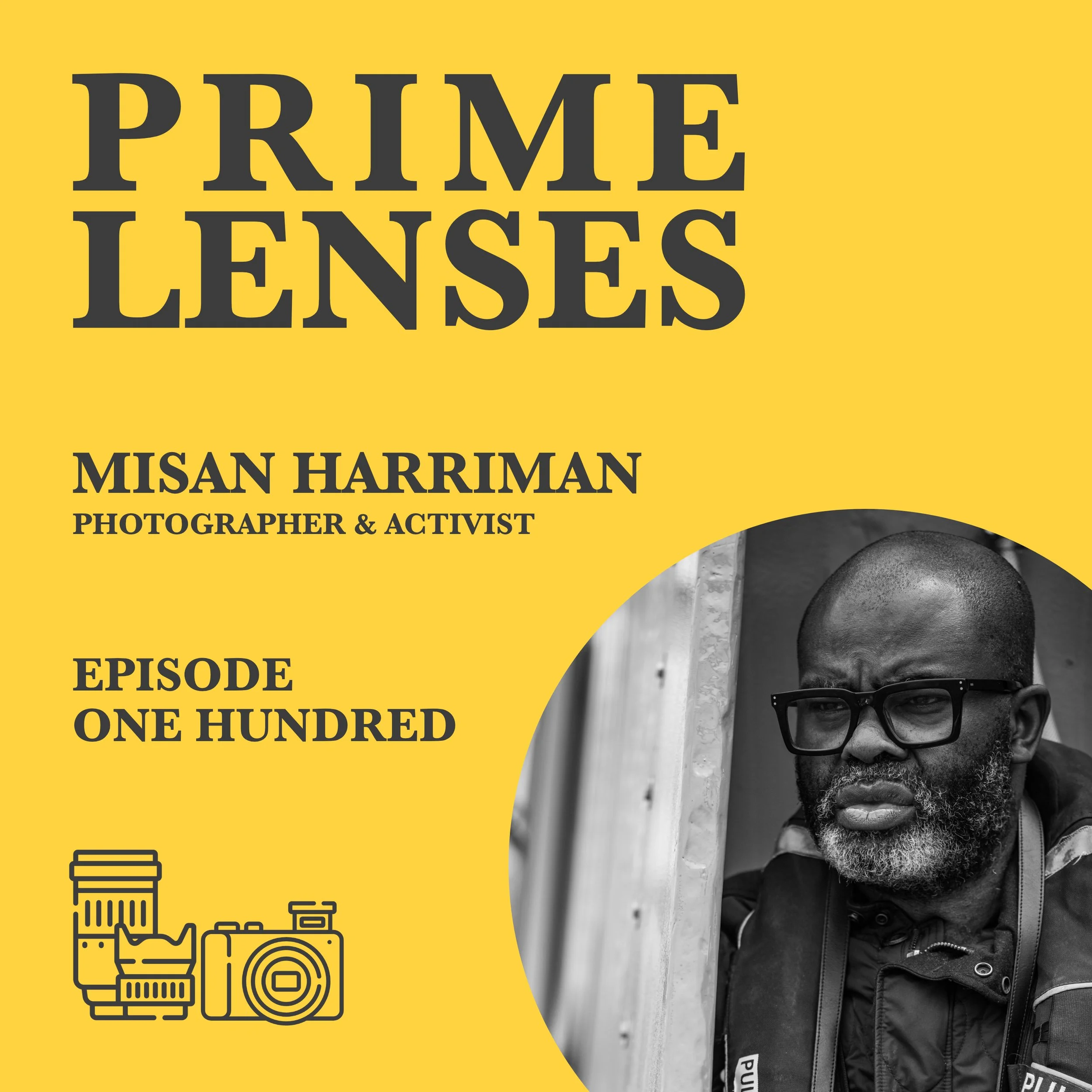


Misan Harriman is an award winning photographer, activist and Oscar nominated filmmaker. His work shot to prominence in 2020 after he covered protests following the murder of George Floyd. Since then he has continued to shoot protests and has been outspoken in the face of injustices he sees in the world. I met him at his exhibition titled The Purpose of Light in London and am delighted to have him as my 100th guest on the show. We cover creativity, gear and even a smattering of video game chat so for my money this is perfect Prime Lenses.
Sign up to the Prime Lenses newsletter for a mid-week treat.
Support the show on Patreon.
Episode Transcript:
Iain:
Hello, welcome to Prime Lenses. I'm Iain. This week, my guest is Misan Harriman. Misan is an award-winning photographer, activist and Oscar-nominated filmmaker. His work shot to prominence in 2020 after he covered the protests following the murder of George Floyd. Since then, he's continued to shoot protests and been outspoken in the face of injustices that he sees in the world. I met him at his exhibition, The Purpose of Light, down in London at the end of last year, and I am delighted to have him as my 100th guest on the show. We cover creativity, gear, and even a smattering of video game chat for good measure. So for my money, this is perfect prime lenses. I really hope you enjoy it. Here's my conversation with Misan.
Misan Harriman:
yeah because I I sometimes see that question um about if you're going to travel around the world is would you take what's the one lens you would take and all of that sort of thing and I've always struggled with with finding the right answer because I generally shoot um quite large prime then we'll get into this um but I also love I love I love um 28 um so much but let me just think in my head yeah okay I've got three cool it's also three now right like
Iain:
that's the other thing that's happening now I'm getting up onto two years of doing this I have people back occasionally and I chat to them and it's a nice little kind of oh yeah I know I said this but actually I do this now and I think that's kind of a nice Gadget Barlin was on a little while ago and he was saying about he'd been a prime person I'm a very primes person and he'd like managed to let go of that snobbery and pick up a a zoom for the SL system I know no he loves it he's the 24 to 90 I think it is he's like it's unreasonably good
Misan Harriman:
it's really clean I mean it's technically almost perfect but there is magic I mean, many, many people far smarter than me, beyond pixel peeping and how the lenses are made. There are some primes that there's some funny, spiritual, primal fucking like ghosts, ghosts of the heroes whose shoulders we stand on are within a prime.
Iain:
So here's the thing. On the primes, so I use, and I also almost get banned from the club for this, because my favourite is a 35 Zeiss. But it's because it's extremely small. And I always go for size and weight and portability. But I'll send you some pictures afterwards. Like you say, there is magic in it. There's something about the way it renders, especially in black and white, that you just go, the texture is delicious. And you're just, no, this is the stuff. This is the source. And lenses are a bit like mines. There's no point having one unless you can change it. So, you know, like no one's taken away the other one. But yeah. Well, I have to say, this is a lovely beginning. I love just jumping in. This is great. And I'm so, so excited to talk to you. I was watching and doing a load of reading and research and things. I want to touch on the stuff you're using, but I also want to touch on the film as well, because you're no stranger to film. Not everybody starts photographing and in their first decade is Oscar nominated. That's quite exciting. So, or maybe it isn't. Maybe you're like, I've taught that to death.
Misan Harriman:
No, no, no. It's, yeah, I think the language of imagery for me has always come from cinema. You know, I fell in love really with imagery from Stanley Kubrick's Barry Lyndon. Yeah. and uh that film is a living painting basically and and the lighting is astonishing much of it the indoor scenes are candlelit with very little external sources of light and I think it's now a famous story that he converted was it let me just check now nasa in those days had a um a prime lens I think was it 0.75? Let me check. And it's a talk of legend, right? And he used that for some of the indoor scenes and that kind of thing. You know, this is way before I picked up a camera. It just made me realise what a camera lens was because I was a kid when I first saw that film. And it's just really, really interesting how composition and lighting for me as a photographer actually came from watching really beautiful films. And I don't think that's rare. Yeah, it was a Carl Zeiss 50mm 0.7 that was originally developed for NASA's Apollo moon missions.
Iain:
God damn. Yeah, so that would have been stuck on the front of a Hasselblad, I guess, and taken to the moon.
Misan Harriman:
Yeah. And then he would have had it converted. I mean, the camera systems were so basic in those days. It's really, really interesting. And I think all those films look better than anything that we have now on the big IMAX mega stuff, which is a whole other conversation. But, yeah, I mean, how the hell do you even nail focus on? Oh, right. Jesus Christ. Yeah.
Iain:
But focus pullers can. They do it. They can. There's something amazing. I mean, Alan Shaller on the camera on the stills front can do that. He's incredible at just nailing focus. He took to it like a musician and just practiced.
Misan Harriman:
It is. It's a muscle. It's a muscle. And, you know, for street photographers, especially if they know the way around their lens, it's amazing what they can do without even any need of having the camera sometimes anywhere near their eyes. It's wild.
Iain:
Yeah. No need for autofocus. Exactly. Well, that's maybe a nice way into your story because your story begins, it sounds from a photographic perspective, the camera is in your hands and you go out on the street. I think you've talked about that a lot, but just sort of prior to that, when I was doing research and reading as another man who in his 40s decided to abandon his proper job and try and be an artist and see if that could work. Because there's this kind of gnawing voice in your head that is you appreciate these things. And it's not just that you like them or can recognize good things, but that you want to make things. And when I started doing this, a friend of mine said, good, you've been dancing around this for a decade. So I could relate to that aspect of your story. But when did you know it was time to kind of make that the work? Because I think the impact you've had is so significant that I'm really, really glad that you did. But I'd just love to know kind of how, because I get a lot of messages from listeners who are creative. We're all happy amateurs. But I just think it's rare for someone to take the risk. And that's why I wanted to kind of touch on that.
Misan Harriman:
Yeah, well, I think it's the love of a good partner. And in my case, a good woman who, you know, I'm a person that suffers. And you wouldn't, if you Google me, you probably wouldn't believe it. from crippling self-doubt and imposter syndrome. I am also, you know, on the autism spectrum, and I am on paper, at least for most of my formative years, seen as someone that was not capable of much in the British school system. So that's quite a lot of things. It's a recipe for not necessarily being a big dreamer. But when I first started dating my wife, and this is the thing when you have a different mind, she was just fascinated by this guy who wasn't interested in football, didn't identify with any kind of obviously patriarchal things, and would be so excited to arrange film screenings, like just me and her. And it wasn't just Netflix and chill watching, It was me saying, oh my God, last of the week, let me just tell you what Michael Mann did and about the scenes and about the soundtrack and everything. And she was like, you speak about films as if it's part of, like you lived that film, like you were there. She goes, this is not normal. And she kind of just observed and observed. And, you know, as I was nearing 40, We were off to India for a really special trip. And she bought me a camera. And she said to me, I'm tired of you being a fan. I'm tired of you standing in the outside. Walk into this room and have a point of view. And sometimes you just need someone to look you eye to eye and say that you're more than the sum of all the parts that you've been told that you are. and um that was the beginning of the journey and it was um it was one of the earliest fixed uh fuji film x 100 it was an early one I don't know second one or third one I don't know and we went to rajasthan which if you don't know it's just one of the most beautiful places in the world so we're in jodhpur and jaipur and I took hundreds if not thousands of the most flipping awful images of the most beautiful part of the world that I may never see again all overexposed, mostly out of focus. And that was my beginning into being a photographer. And it wasn't really till a year later when we had our first daughter that my photography just started jumping in quality. And I think because she was premature, my daughter, I was really scared. And the thing about traumatized people, becoming parents is that sometimes we don't think we deserve something so beautiful as a child you know and I hid behind the viewfinder and by doing that I learned not just to love myself but to recognize that I deserve this this celestial being in my life and as I was observing my daughter getting stronger and healthier the images just started climbing out in a way that I I didn't fully appreciate. So there's that. And the other thing is, as a dyslexic person with all sorts of other challenges in how I focus and see the world, YouTube videos were amazing because there was no fear of judgment, right? I've said in many talks that how did I become one of the most visible image makers at this point of a generation, right? How could this happen in five years? Well, a big part of it is that um without fear and judgment I could sit in my little office and find a man or woman in their garage who has figured out something regarding iso aperture right dynamic range that I didn't understand and then I could watch 350 billion lens videos um by people just as obsessive and nerdy as me about gear right and that really was a big part of it as well is just going on the internet and going down multiple rabbit holes of enthusiasm enthusiasts people just like we're interested in this in this medium and then the third part of it and this is a really important part is recognizing the legacy of those that have held the camera because too many people are born into a world where image making has been reduced to something that billionaires have built. I mean, Facebook wouldn't exist without pictures. It was not a very big company until the JPEG was used. And it really hurt imagery for a long, long time. And I always say to especially students when they ask, how do I become known? And I was like, why do you want to be a photographer? put the camera down and ask yourself, why do you want, if it's for clout, vibes, reach on Facebook, TikTok, wherever you post, nine times out of 10, no one's going to care about your images, because the intention is one that won't reach a broad range of people. But if you look at all the extraordinary, and we can, you know, Eve Arnold, you know, Cecil Beaton, especially early Cecil Beaton, Gordon Parks, I have many, many, as you do, heroes. And of course, the kind of ones everyone else talks about. Nan Golding as well. You know, you look at all of these people and there was an intention, you know. Vivian Meyer is really interesting because I generally think she had no weaknesses as a photographer. I remember when I saw the documentary and I was just floored. I'm like, this isn't just good. This is outrageous. This is actually outrageous compositionally, everything. And those people's images will outlive us all, right? And they weren't thinking about the reach and vibes and influence and value of their work. And I think if you can, and I also don't copy those whose shoulders we stand on, but recognize why they held the camera. And it may lead you to the place of why you want to hold the camera. And that will translate into a type of imagery that maybe will speak to a broad range of people. So the combination of loving cinema, having a wife that says you're not that useless, the Internet allowing me to learn without fear or favour or judgment. And me being someone who obviously civil rights and history and injustice is integral to literally my DNA. The camera became a good friend.
Iain:
Yes. And a tool that you wielded extremely skillfully, especially around 2020 happens. We have the murder of George Floyd. We have the protests and against COVID. The world seeming to shift significantly on its axis on a number of fronts. And you went outside and started to capture the most extraordinary images. I met you at your exhibition, which was extremely good timing. That was great. But talk a little bit about that journey, because the prints are incredible. I know we spoke about it at the time, and it's unfortunate to people listening that they can't necessarily get down to London to see them. But they really are remarkable images when you see them up close. You go out with a camera, sometimes you get a feel for like, I'm capturing something. But do you know what you had when you were doing that?
Misan Harriman:
Know what I had? I was deeply, I was having a lot of panic attacks. Because remember, we were in lockdown. I was advised by everyone that, you know, I would catch COVID and die if I went. Literally, it was like, you can't go. I had a newborn at home. And I looked at my wife and I said, well, what am I going to do? like this this I did people can't just keep dying in front of me and she's like look to your camera and I I went you know when I went to the first one I went to was in hyde park I certainly wasn't thinking of you know within within four months I would be shooting a vogue cover like all I was thinking of I hope I don't get sick and I hope people turn up because something has got to give and I arrived early and the way I shoot protests you know I get the train or bus I never have any help right I never use any uh artificial lighting or anything so I just have my backpack and I shoot with three cameras all primes uh 28 a 50 or 55 depending if I'm using medium format format or not and then either a 90 or a 110 or medium format so I have three cameras hanging off my neck and I walk and I got there and all I saw were a couple of policemen and a few sort of students hanging around I was like oh my god miss hand you're risking your own health for this and then the people it was like um do you remember field of dreams yes kevin costner if you build it they will come yeah and it was I don't want to get too emotionally thinking about this but it was really extraordinary the first group were a whole bunch of kind of 70 to 80 year old ladies some with Zimmer frames and I was like watching at all and I walked up to one of them and I said our auntie what are you you know what are you doing here and and and she said we heard that the people were going to come and we wanted to see it for ourselves because we never had the chance of having a real voice well and and I just want to witness this whilst I'm still here blimey flooring and I'm holding the camera already tears in my eyes and I and even in that moment I don't think I'd even taken a picture then I was like oh my god I realized then that what what was gonna come on that day and obviously months to follow was going to define a big part of my life and and I think that day maybe 3 000 people turned up and I was it was I was in as in in a in a zone and I was just snapping away and time stood still and I I remember I got home my wife said how you feeling you okay and I said yeah I think so and she was like how the pics and I was like I I don't know I don't I don't I don't remember what I took and and and you know I sat next to my light rumors as many else photographers have and I started looking at the files and I was like oh Misan you idiot you shot you shot the whole day on jpeg I was like oh you know I I you know I I did not have raw files set up and it's just funny you know it's first first time I've been to that sort of thing and uh but the jpegs look great and the images were really lovely and um I started going out more and more and more and um I realized quite quickly that people started um trusting me because I think the the thing about my images that people ask is like how how why does it feel so intimate and when you go to a protest you'll see literally hundreds of other photographers I am not the only one and one of the things that always does my head in like I can't get over it is how if I'm stood there and I look right and I look left there's photographers literally right by me yet the images they take look like sometimes to me that it's in a different place and that's the thing about photography is that it's it's for everyone but everyone has their way of seeing the world right and it's it's it's it's not just about the kit I think it's about how you cherish what you are observing many of the people I shot were giving me a piece of themselves for me to be the custodian of and I I I really I I yeah I feel that before I press the shutter and you've been to the show I think there's a there is that in that room and a lot of the other there are a lot of other great photographers there which are beautiful shots but there are a lot of those kind of guys that turn up and they work for I don't know reuters or getty or whatever it is and they have no emotional connection to this thing they just want to get as many shots as possible and then send it down the wire and then from then they don't own the images and from then it can go to a journalist that will decide journalists who wasn't there yeah that will decide what that was someone that was not there is now going to say that this guy is a violent antifa or this woman is this or the police were overwhelmed and I'm just like no no no no no no and I think that's why my image has really exploded as well. So people were realizing that I wasn't working for anyone. And I was only posting on my own profile. This was not going to be picked up by newspapers. And that really helped people say, oh my God, this guy is actually showing what we were doing without fear or favor or any kind of bias and that also matters in um very vulnerable strangers who are very emotional feeling comfortable when they see a camera near near their face so I ramble a bit but that that's like that was the genesis of it and of course the social media element I had no followers relative to what I have now. And this is a beautiful thing about the borderless reach of the internet. There are lots of things that are wrong about the internet, but I would never be sat here talking to you if it wasn't for the internet because something about my images just kept going bonkers online. And I remember opening up my WhatsApp and I couldn't even, you know, just message after message. And my notifications, I had to switch off on my Instagram because my friends were saying, the son of Martin Luther King has just shared your image. And then Kanye West, 50 Cent, a myriad, just huge stars, were all sharing it. And they didn't even realize that those images were taken in England. They presumed it was a protest in America. And that's how it went bonkers, is somebody just came across a shot, shared it. He has a big profile. other people with big profiles were clearly moved by it and then my friends went online and said no that's miss hand please tag him tag him and then mlk3 who's now a friend of mine who is in my documentary tagged me and then the rest as they say is history absolutely bonkers story yes but
Iain:
how wonderful I think it's that you're absolutely right because similarly this would be impossible without the way that the internet is structured right now and it will be a moment in time and a decade from now if I'm lucky I'll be talking to people about how I started and the internet will have changed and I'll have to say well it would be different now because it will all be in messages and chats and private groups because they're easier to manage you know the the big town square open internet platform ideal has proven to be more complicated than it was when you were just at south by southwest and everyone's kind of broadly you know the the venn diagrams of people's views kind of overlapped a bit more and then suddenly everyone is invited and is different And so, yeah, I think it's wonderful that you've recognized what you have and recognized this platform and kind of picked up and moved. And you said something, actually, I want to get onto the documentary, and this might be a way in. You have this feeling that people are innately, there is goodness in them, but the goodness needs to be fed. And that the way we're building things is not always very thoughtful. And so we're not actually building stuff that nourishes. We're not giving people good food. We're giving them junk food. That presumably is in the back of your mind when you're also making the documentary as well, that you want to communicate more clearly what's happening. You know, like you were saying, these images you're making or other journalists get taken by people. The documentary presumably is an opportunity for you to bring together all the things that you've enjoyed and tell a longer form story. Because photography is amazing because it captures a moment and it's instant. But you can't necessarily get across, especially in a scrolling world. You know, people see it, they might like it and resonate with them, but then they move on.
Misan Harriman:
yeah and the doc is a really intimate observation of my life and it's a very scary thing to do because you know the director andy mundy castle uh who's an amazing bafta or you know award-winning filmmaker I had to give him my life right and um if I'm being honest uh black artists usually have to be dead for a major feature-length film to be made about their life so this is happening in it you know I'm still here um and it's a really surreal thing to experience and what I wanted people to do is just see my journey of growth because we're all imperfect and if if we one of the most dangerous things in a very angry world is confirmation bias and arrested development so if you only play golf take photos hang around go to the pub with a whole bunch of people that believe exactly the same thing right it's really hard to grow and the confirmation bias of that group is going to give you arrested development and I think about my childhood and some of the friends that I went to school and uni with and they have such a binary worldview and you know some of the most beautiful kind people I know are actually people that have traveled the world walked a mile in other people's shoes and recognize that something or somebody different isn't always something to fear and that's a journey that I've been on and that's how I try and use my voice and my art to show that we are always better together and that should not be a radical thing and frankly speaking it really has become almost radical for someone to have that
Iain:
worldview it's crazy it's it's a very it's a troubling time to be you know thinking about like image making because because these tools exist that can now manipulate or create from thin air just nonsense and it's getting very hard to tell you know up until quite recently I was fairly proud of myself that I could spot it and go yep that's definitely not real and it's getting by degrees harder and harder because you know it's not just about fingers anymore or dodgy animation you know it's getting you really have to pay attention to something and I'm not sure everyone's equipped I studied history at school and I do remember like the quality of sources being such an important part of studying that and they are so our history choice you say yes but I don't know like I don't know where that happens anymore because the the the fire hose of information is so great that even if you you know you're going to have moments where you don't clock something and
Misan Harriman:
then you reshare things it's very difficult well we live we live in the post-truth world already that's a fact um and curation is going to become the most important thing um and in independent publishing and media is also going to be trust curation and trust is the future yeah um so and that's why I think you know big legacy media good billion dollar companies are fucked and they don't quite realize it you know um also I have to also be honest I think certain and you know I'm sorry to say this to photographers that are listening but certain parts of the photography ecosystem are dead so what I mean by that if you are a small product photographer right so if you shoot um phones and uh consoles and you know medium to small size technology you're not gonna I mean the ai just renders it perfectly lights it perfectly composes it perfectly because these these shots just need to be clean and represent the product and don't get me wrong it's a beautiful art form for humans to do but I think if you are a lazy greedy brand and nine tenths of it can be done by a uh piece of software it's going to save you a fortune so you know I don't think large product photography is quite dead you know like if someone needs to shoot a ferrari um you know driving through you know um you know italy or something that that that the ai can do it but there is a human aspect to it that still I think the brands would want um but certain aspects of product photography are dead on the opposite side to that people that shoot humans is interesting there is now a specific interest in a lot of people both online and in the fine art world that want to see that an image is fully a human experience and I think that's only going to kind of increase you know technology hasn't improved the quality of art if you think about filmmaking right you know the vfx that we've had for 30 40 years now hasn't made films necessarily better I mean godfather one godfather two uh goodfellas there will be blood just naming a few masterpieces right I didn't see a huge amount of you know machine learning to make you know it's a script It's the human beings, it's the DOP, it's the ability to create in the way that is ancient and powerful and goes all the way back to us, you know, around the fire, telling wondrous stories. That is a great magic of homo sapiens. And I don't think that's going to go away anytime soon. Is technology a tool? Yes, it is. But it has to be a tool that allows an ancient art form to be as powerful as it's always been.
Iain:
yes and I think the for me I and I worry about filmmaking and tv and stuff like that I think when you're mentioning those films I immediately think of things like true grit as well like the jeff bridge's version of that because that film and slow west you know things like that look you put me in a western headspace but they look incredible and people took time to make stuff and they weren't necessarily in the grand scheme of things terribly expensive to make and I think it's it's important to remember that restrictions and limitations are good and that you the film industry is a useful model sometimes for the way that teams come together to make things because they come together then they separate and go and do other things and what that means is there's that cross-pollination of experience you get that experience of working somewhere else and working with other people and you you give them something of yourself they give you something of themselves and you bring that back and then the the whole is enriched and I think one of the challenges for photography and other industries I used to work in video games the games industry has this similar sort of problem as well is that if you can do a lot on your own that doesn't teach you or train you to to kind of naturally go outside of yourself you don't even realize what you're missing I always used to say this that electronics engineers on the hardware side would make always make great project leads irrespective of medium because if you design electronics you can't always make it on your own you can prototype up to a certain point but there's a soon as you have to send something away to someone else to get manufactured and get prototypes back and things like that there is a natural point where you have to work with someone else and I feel like that's good and if we can find the way of making other people and this is why these conversations exist it's a way for you to kind of hear from and work with other people without having to go out
Misan Harriman:
absolutely and and I also think the credit you know the arms race of technology um is always better we've reached a critical point where human beings don't need that I'm a massive gamer mega And there was a time when the jump in graphics technology was just from 8-bit to 16-bit, and then the N64 came out, and then GameCube, and you could see jump, jump, jump. But from Xbox, PS3 onwards, EPS2 even, folks don't care. once you've got to God of War level graphics, I don't really want anything. I don't need any more photorealism. And I think about the games that I'm playing now, a lot of them are indie games, really good side-scrollers. I've just revisited Metroid Dread on Switch, which is such an outrageously good game. I don't need anything. It's really, really interesting that the chipsets that are coming out for gaming, I think there's a there's a disconnect with what a lot of consumers that actually have have also have money to buy games are looking for. And that's why analog and vintage gaming is just exploding. I mean, I've got I've got my Vita here, right, which I just love such an extraordinary machine. I have a Steam Deck. I have, you know, all sorts of toys. It's the original Switch here as well. And I look at Nintendo and, you know, Ocarina of Time is probably my greatest single gaming experience. You know, graphically, it wasn't up to much. Obviously, there have been many Zelda games that look better than that. But the core dynamics of the game are what it was. So that also applies to my iPhones. The M chipset by Apple is so extraordinary. that an m1 chip is more powerful than any unless you are running something you probably shouldn't be running out of your home yeah it is crazy powerful and I don't think anyone 99.9 of people need anything close to the processing power we have just in our phones you know the ipad pro that I have. I mean, I'm editing 100 megapixel images. It doesn't even it doesn't even wake up. It's like, yeah, whatever. It's crazy. So so before there was an arms race for the for the consumer, but the consumer doesn't need anything anymore. So they're trying, which is why a lot of new device launches are like, whatever, my phone works. I like I can do any and everything. I've got incredible screen I've got incredible refresh rates. What more do I need? And the next thing they're doing is saying everyone needs a foldable phone. So that's gonna--
Iain:
- Yeah, you gotta change the shape of it.
Misan Harriman:
- Yeah, yeah, and then this is all off the backs of black boys being crushed in mines in Congo, right? So this is the other thing that, you know, and a lot of people, it's really interesting because a lot of people are waking up to the fact that every September I'm being told buy a 1,500 quid phone. Yeah. What? Yeah. You know, and we can change the behavior of these trillion dollar companies as consumers and force them to do something above and beyond this hyper-extractive behavior. You know, you can easily have an iPhone for three years, right? You can also force someone like Apple, which has literally $1 trillion in cash reserves to make sure that, you know, the roads, schools, universities to find the best mines in diaspora and in country in congo to make sure no child no one under 18 works within the ecosystem of mining cobalt and other things and it isn't just apple because this um these minerals are needed for every single electric car as well and we just need to people I think the average consumer of even five years ago did not connect congo with their fancy phone yeah oh yeah and people are beginning to do that which is interesting yes well I think
Iain:
companies like fairphone help as well and sort of talking about stuff you know that they and they seem to have a really good product now as well which is really good and that takes you know it takes time it takes time to be that overnight success obviously but no it's it's it's a fascinating connection between things and it applies to photography as well because I was talking to um I do like to say this occasionally having a podcast like having a cab and I had that I had that phil penman in the back of my podcast the other week and we were talking about like the m for example it's like what do you do to it at this point you know they've done an evf one they've done you but again it's kind of it's playing with the form factor to try and kind of just it's sort of I can see the marketing meeting where they worked out that this is a barrier and therefore
Misan Harriman:
we have to make a thing so I do understand why it exists it's for all camera company I mean I've got where is it I don't know where it is but I've got uh yeah this the uh the the the re the rico right love those gr I think this is the gr3 yeah you do not need a new version of this I'm sorry like they can try and tell you you do you don't I still have my fuji xc3 I never got an xc4 and xc5 I love the sensor in the xc3 I love those those um lenses on on that aps-c system it's just incredible absolutely incredible and it works beautifully and you know when people a lot of people say oh miss him what camera system should I have you know I know you're a leica ambassador and I was like do you need to do video that's the first thing I asked I was like do you need a hybrid camera and they'll be like no I just want to be a photographer and I said this is what you should do a second hand leica sl the first one stunning camera right is cheaper considerably cheaper this is just the body than a new sony you name it whatever sony it is it's cheaper right if you're only going to use it for imagery there is the l mount alliance right between sigma panasonic and leica and those sigma lenses are so good for the money yeah so you can for the same price you're going to do for a kit lens and one prime and a sony body you can get a leica sl start off with a couple of good sigma primes and if you're just doing still imagery you will be shocked at the imagery that you've taken many many of the shots you you're talking about prints many of the shots you saw with the prints that you saw were taken on an sl and at the time I couldn't afford uh a leica lens many of those were on a sigma primes yeah you know and and you saw what they look like yeah so so so I I you know yes it's amazing to have the best of the best of the best of the best and keep updating but honestly today the sl1 not two not three is still one of the most extraordinary cameras. I think it's a 24 megapixel sensor. It's really good. Great low light as well.
Iain:
There was some magic in that kind of full frame 24 megapixel. There was a reason we sat there for about a decade, I think. It wasn't just cost. They seemed to work really nicely. And I've had a couple of other guests on a bit like you were saying earlier about the magic. It's hard to explain, but there's something about size of pixel, the way things mated, just the way things, everything connected. It was just chef's kiss. It was fantastic. I love this. This is exactly, This is exhaust. Just without realising it, this is perfect prime lenses. I love it. So we touched a bit on the gear there a little bit. You're running around with SLs and Sigmas. You've got the dock out now. I feel like the climate is now different to five years ago, but also the same. How are you feeling about your work? Is this an ongoing body of work for you? Or is it kind of like a project in your mind? And now have you reached a point and you're moving on to something else?
Misan Harriman:
or in what aspect the exhibition or the the work on following process I know you're going to you're
Iain:
going to continue to be outspoken and use your platform and I feel like that's a wonderful thing
Misan Harriman:
yeah because yeah I mean I'll do protests yeah um for as long as I can hold a camera great um and and it will it will become what it becomes but there are many aspects of you know obviously the documentary is is a is was was a an amazing thing and it's had a really incredible run so far the exhibition will be a living, breathing organism. You know, the purpose of light, I think, I don't know of any gallery in London in the six month period that we had it. And the art world's really struggling right now. I had anywhere near the amount of people. On some days we're getting 300 people come through the door. We're getting people flying in from Cambodia. I mean, what the heads. And also because the art world is snobbish and has looked down on photography as a medium, Frankly speaking, because they can make one painting, which just drives me so mad, one painting can sell for X million, and very rarely do you get photos that get anywhere near that. So it's actually not in the interest of the big, big blue chip galleries to even care about what photographers are doing. And I think there's a disconnect there because let me put it this way. If I picked 100 of my most moving images, right, I could go toe-to-toe with any painting, any 100 paintings, in terms of what the human reaction would be. Because I have seen people collapse onto the floor in the show. I have seen people have connections. There's a woman that wrote me a letter. after the show closed saying she doesn't know where to go anymore that she she she she that it was it wasn't just about what was on the wall that it was the only space where she didn't need to second guess herself and I'm just like what the hell like this is much more than I realize and you realize you know this is the thing about art is that you do the work you hope is good you you print and frame it at the highest quality most photographers are unable to even do this and you're like will they care or will they just rather doom scroll and just look at tiny little thumbnails of your work but from the first day the way people reacted and they kept coming I realized that photography when it's allowed to breathe when it isn't part of an algorithm when people walk in there yeah and they have their own conversation with it I I honestly don't know a more powerful medium you know than a printed still image and don't listen to what influencers or other people are saying the the printed image is as powerful singularly as powerful an art form that we make as you'll ever get when when it's allowed when it's allowed to be what it should be And I'm so glad you came to that show because I'm still scratching my head about what it's done to people. And my respect for, again, the shoulders of those that we stand on, but also for at this time, what a frozen moment can do. It can be cathartic to people. It can help trauma. It can be healing. right? It can also help them on a journey of being better and not being afraid of the world, or from a decisive moment. It's nuts, really. And I think sometimes I look at a lot of photography influencers on YouTube, and a lot of them aren't photographers. They're people that talk about stuff right and they talk a lot about pixel peeping and gear and everything else but I really wondered whether if you think of the top 50 greatest photographers whether they would be um influencers or observe or observing the human condition right yeah there's no way there's because
Iain:
the motivation and again secret secret reason why I think these conversations are important and why I want to have them because what it's about is your perspective and your point of view and having an opinion. For me, art, what you make has to have a point of view, has to have a perspective. You're sharing, I think, this whole idea of I'm just there capturing the image. It speaks to those journalists you were talking about, the photographers who are there on a gig because they're there to capture and there to observe. You can't be a passive observer, especially in the moment we live in right now. No photographer in the US watching someone getting ripped out of a car for no reason can really, truly say to me that they're watching that and they're just an observer and they're just capturing it for, you know, NBC or whatever. Because I'm thousands of miles away and I'm not an American citizen and I'm watching it aghast and horrified. So you have to have an opinion. You choose when you press the shutter. Sarah Lee has been on the show and she's become a friend through the podcast. Wonderful human. And she's talked a lot about the power she has when you're capturing an image of someone. Because in that moment, if you don't like that person, you have to wield your camera very carefully. Look at what happened in Manity Fair last month with amazing imagery. There is the opinion of the photographer writ large.
Misan Harriman:
I'm sorry for him because people really went after him, but I think he'll be remembered. Oh, yes. As a great, it's the greatest photographic takedown probably ever. I mean, it was, it was, it was, you know, guns loaded. Yeah, brutal. Press fire. And Sarah, I know Sarah. And, you know, I will say this. I have DM'd this woman probably on more than one occasion, just telling her how I just think she's a poet of light. Like randomly, I've just said, I don't know anyone that does what she does as well as what she does. And she's, as someone that works in, I've obviously been to many award shows, I'm chairman of Southbank Centre, so I currently, the BAFTAs is hosted in one of the buildings I oversee. Sarah, you know, she has to maneuver herself around like annoying publicists and agents and bodyguards and everything. And she always finds a way to make the most extraordinary observations of people. And I think she's the best at what she does. You know, I really do. She's a very, very, very special photographer. And that's the other thing about me and photography is I won't name anyone, but I've had a couple of people say, Misan, you know, you've taught me about the cult of individualism within the photography ecosystem because they've repeatedly said you are one of the only like properly high profile photographers that consistently shares other photographers' works. And you don't care whether that may take work away from you. You just do it all the time. And I hate the fact that photographers are in a place where they can only focus on what they're doing rather than the ecosystem. But I love seeing amazing images by other people. And I just can't help myself. I'll just share it immediately. I don't really care. I'm like, well, look at this. This is amazing. And I wish we were more like that within the social media ecosystem. Because of course, a lot of us, a lot of the most talented photographers don't have reach, right? I'm reaching between 80 and 100 million people a month. And at this point, I don't know any photographer that's reaching that many people, right? So it's kind of my job to shine some of that attention, especially if they're up and comers. Like I love, like when the Notting Hill Carnival happened recently, every single photographer, it kind of traveled that I would, if they tagged me, I'd basically, if the images were halfway decent, I would just post it. And I posted so many. And, you know, it meant a lot to them. But also my audience really like, wow, this is amazing. And they followed these photographers. That's what we're supposed to be doing, right? Or does it always have to be about me, me, me, me, me? You know what I mean? I'm like, what's the point?
Iain:
Well, I think that what you're touching on there, I think increasingly I'm of the opinion that that's the secret actually, is that in marketing parts, they would call it inauthenticity or whatever. You're being you and you're being very, very you. And I try and do that as well. And I think what happens is you find them people with whom that resonates and they can see that they I think folks resonate with it because it's honest. And so you being excited by something, if you love loving things and you share those things, I think people just it attracts that energy and it attracts people who also like to do that. And it also people can't be things if they don't see it. So if they see someone who's high profile, whereas if they see someone like you and then the day after your stuff blows up online, suddenly it's very clear you have someone managing your social media and someone else is doing it for you. Well, it sends a different message. It teaches people a different lesson. And whether or not we mean it to, what we do, you've got children, I've got children. They do what they see. So if they see you lose your temper with whatever or those examples. But it's the same applies to this. Absolutely. Yeah.
Misan Harriman:
Yeah. And then it also, it goes to the other side of that is the high profile photographers that I know. The really big names. Almost all of them have been silent in the last five years about anything political. And I'm not asking them to suddenly just stop doing fashion shoots and big brand shoots. But, you know, if you work in imagery and imagery is able to make the world stop and pause, I don't expect you necessarily to be a big fashion photographer or big celebrity photographer to be stood next to me in the middle of a protest. But you can at least share images that are taken in Minnesota, images that are taken in Dearborn, Michigan, in L.A. on your blooming profile. you know if women are being attacked if you know if indigenous people are under fire if the trans and queer community if you care about any of that but again if it's just building yourself up to extract to sell this book to sell your prints to sell the and that is all that it is I think we're going to get to a place where a lot of your fan base is going to just switch off because you know I said this about hyper-famous influencers and celebrities, is that people are beginning to want more from their idols. People, like the fan base, is not just happy giving you their money for vibes. And I can only see that growing.
Iain:
The parasocial nature of all of this is fascinating. You know, like, how we feel. I remember saying this a few years ago, you and I are no closer to being like the king of England than we were if we'd lived when Henry VIII was king. But it feels somehow more attainable now because it tricks our brains, these things. I think it's why books are so good at convincing a story's a real because it's this thing that's really close to you that you're engaging with and why people fall for email scams. It's like, well, it's addressed to me. It must be for me. It must have, you know. And so I think the same is true. there's some part of our brain that can't quite handle this constant flood of perfect lives and things and acquisition of stuff and I think sometimes it's good you need to take a step out of it like these things exist I'm not saying throughout your tv and like but but you've got to kind of be able to critically assess what's coming at you and what you're actually seeing and that comes from connection that comes from conversations with friends like go out into the world go and talk to some people find out what they think they won't all agree with you that's good like you know because the other challenge we have is like unless you believe everything I believe on terms that I
Misan Harriman:
have not shared with you then we cannot be friends it's like well that's the confirmation bias and and actually it it's also goes going back to photographers um breaking through because a gazillion anyone can get a hold of a camera you can get you can get a decent camera if you know to look for 50 quid today that can take a very good image so most people can get a hold of a camera what another thing I think for your audience is that we should touch on that's really interesting is that when I first started shooting because my heroes all shot uh you know quite stripped down like I I don't I'm not that interested in studio photography um I sometimes I have to do it I don't retouch images right I don't photoshop images and I use available light you know even at night time I will use a fast prime and find light sources for my imagery I do not use flashes so that's the first thing so with the look of my images I remember and I had already shot probably the most important british vogue cover in a generation at least right first black man the cover of Vogue took 104 years to get there lots of heat around me I go and meet one of the top uh photography uh what do you call them agents and at this point I'm already doing lots of shoots organically you know I'm shooting lots of really famous people organic because they want the look that I have and I think you know a lot of them love Peter Lindbergh and how he shot and they're like oh there's there's some whispers of Peter and you and I was like oh my god he's my idol thank you um I sit down with this woman and she's like yeah miss sun your work needs to be more glossy and I was I was like what uh what what what do you mean and and I was like I I don't like that shiny skinned stuff she goes yeah but you know you're never gonna really be remembered you're never really gonna work if it looks it's just too raw I mean I I can see how old this actress is and I think I was like what did you just say it was this weirdest conversation and and she's like yeah no it's not you're not gonna you know you're not gonna really get anywhere with this you know you've had a one-off uh viral moment but look you know I'm just trying to be honest with you no one's gonna care for this work and I before I got up and left and I said but I'm looking at your portfolio of photographers that you look after and it's like 80 pages and I said if you told me these all of these images were taken by one photographer I believe you I was like there's no there's no sign of any individualism in this work and she goes well you don't understand how photography works obviously have a nice day wow and and and I left that and I remember calling my wife saying I think we're going to have to do it our way and I found an amazing lou lou howe you know amazing woman who had worked for the best of the best and she completely got me and she she is still my photo agent and we just did it our way and what what happened is that every time I shot someone I photographed someone they would have such a strong the celebrity the person would have such a strong reaction to the image that they would talk to it about it and then another very famous friend will then just directly get in touch and I would say I've I have you know in and I haven't really ever shown it I've never printed them which is crazy but I have one of the most unique collections of portraits of the icons of our time you know and I've been very very lucky to shoot everyone from you know david asenborough I can go on all day, you know, lots of really interesting people. But I've shot it in my way.
Iain:
Yeah.
Misan Harriman:
Right. And the talent likes it. And clearly people like it. So why are there pockets of the industry that told me that they wouldn't go anywhere? And on top of that, may I live long, but when my time is gone, I hope people will remember what I did when I held the camera. And this is a really important point for people listening. If I had listened to that woman and started smoothing out skin and making my images lit a very specific way and the glossy look, as she said, I think I would have just faded into obscurity. So, you know, please, even very powerful and smart people, if they have a point of view on your work and your inner person says, but no, that's not. Please listen to your inner self. Honestly, honestly, the amount of people that have told me that my imagery is not the way it's not. This is not that. This is how it works. I didn't listen to any of them. And I am somewhat doing things. So please bear that in mind.
Iain:
That is perfect. And a lovely note to end on. I will say, you're episode 100. And I cannot think of a better person and conversation for episode 100.
Misan Harriman:
But we haven't said the lenses. I'll say three lenses.
Iain:
Sure. Yeah, yeah, yeah.
Misan Harriman:
So I love the Leica Q. Again, get an original Leica Q if you can afford it. The 28 Apo. The 28 lens. So the Apo is actually on the 43. The 2817 is all things to all humans. I can't get over how it renders. And when you print, like some of the prints in my exhibition are on that camera. And people, I've had so many photographers come and say, oh, this is, you shot this on film. I'm like, no. And they're like, what? So 28, that's my always wide option on any Leica. But if you can't afford the two or three, get the Q, the original Q. And then I love the 50, the big 50 1.4. So not the Apo on the SL system. It's a massive lens. I've never seen anything like it. No. Honestly, it's the most ridiculous. It's a very expensive lens even today. And the 50 Apo is a technically better lens. But there's some witchcraft happening in the 50-1.4. Honestly, rent it for a day and you will just start crying. when you look at the image. So those are two likers. And then for them, the big telephoto, the Fujifilm medium format. Yes. 110 F2. My God. Yeah. My, I have no words for that lens. It still does things that I'm just like, is this a painting? Yeah. Like, how is this possible? And especially with natural light, the way it renders skin tones is so filmic that people can't tell. There's so many people think they know their stuff look at my prints especially with that lens yeah and they tell me they tell me it's film I'm like no it's not yeah um so those are the those are my my that's my triangle of observation
Iain:
If those are the three things you're lugging around I don't worry about you getting a workout let me tell you that is because that's that's some weight
Misan Harriman:
yeah yeah yeah and I have a full bag of um other lenses right so so I'm carrying around a lot you know but I get my steps in it's good yeah keeps me young I love it so good but this is a wonderful conversation
Iain:
thank you so much for being on the program I really really appreciate it I'm so glad we met up in london for people listening who maybe don't know miss and where can they find more missan
Misan Harriman:
online um you can find me crying and ranting about the world on um my instagram that's my main sort of thing um and on my facebook because they're linked so depending which one you choose I also have a sub stack where I you know have a lot of things that are a bit more personal it's all my name so it's really really easy to find and my Oscar nominated film is on Netflix it's called The After and it's an observation on grief it's a hard watch but it's my first foray into the moving image so also check that out
Iain:
yeah dude David Yello is alright isn't he? That man just I mean it's I watched it and it's difficult I showed a bit of it to my wife as well because you know as a person with a family and stuff it's it's yeah so a tough watch but a worthwhile one but also like he's just so there's so much said with an eye and with it just when he's just looking
Misan Harriman:
off camera especially at the end just oh amazing yeah well yeah and that's the other thing about being a photographer going to the moving image that my muscle memory of composition was was just I felt like I was just doing it just with a collaborative group of people and I love it and david and I are working on my first feature um which I I I can't wait to tell people more about
Iain:
so yeah buckle up yes well come back and talk to us about that when you can
Misan Harriman:
I will that'd be wonderful brilliant.
Iain:
Misan, thank you so much
Misan Harriman:
My pleasure thank you
Iain:
well there we go, a huge thank you to Misan once again for being on the show and thank you all for listening this is episode 100 which is a really big deal getting to this point and getting to meet so many of you uh online and in person and to record these episodes and put them out into the world is an absolute joy and a privilege that is not lost on me. Not everyone gets to do stuff like this. So from the bottom of my heart, thank you. I love this. And I look forward to talking to you all again around episode 200. Who knows? I said to Joseph de Giovanna that I would do this for 20 years. I may have made a rod for my own back there, but we'll see. Imagine that though. What a terrible bind making something that you love making for 20 years. Well, if you're new, the good news is there are 99 other episodes for you to go back and listen to, not to mention other cheeky midweek ones. So go back and find those and you can rate and review the show wherever you listen. So if that's Apple Podcasts, Spotify, YouTube Music, Amazon Music, all those lovely places. Please do leave a review, leave a comment, get in touch, head over to Patreon if you'd like to support the show and you can also buy some Prime Lenses merch as well. All of this is on primelensespodcast.com. I think that'll do for now. All that remains to say is thank you once again and we'll see you next time.
More about this show:
A camera is just a tool but spend enough time with photographers and you’ll see them go misty eyed when they talk about their first camera or a small fast prime that they had in their youth. Prime Lenses is a series of interviews with photographers talking about their photography by way of three lenses that mean a lot to them. These can be interchangeable, attached to a camera, integrated into a gadget, I’m interested in the sometimes complex relationship we have with the tools we choose, why they can mean so much and how they make us feel.