
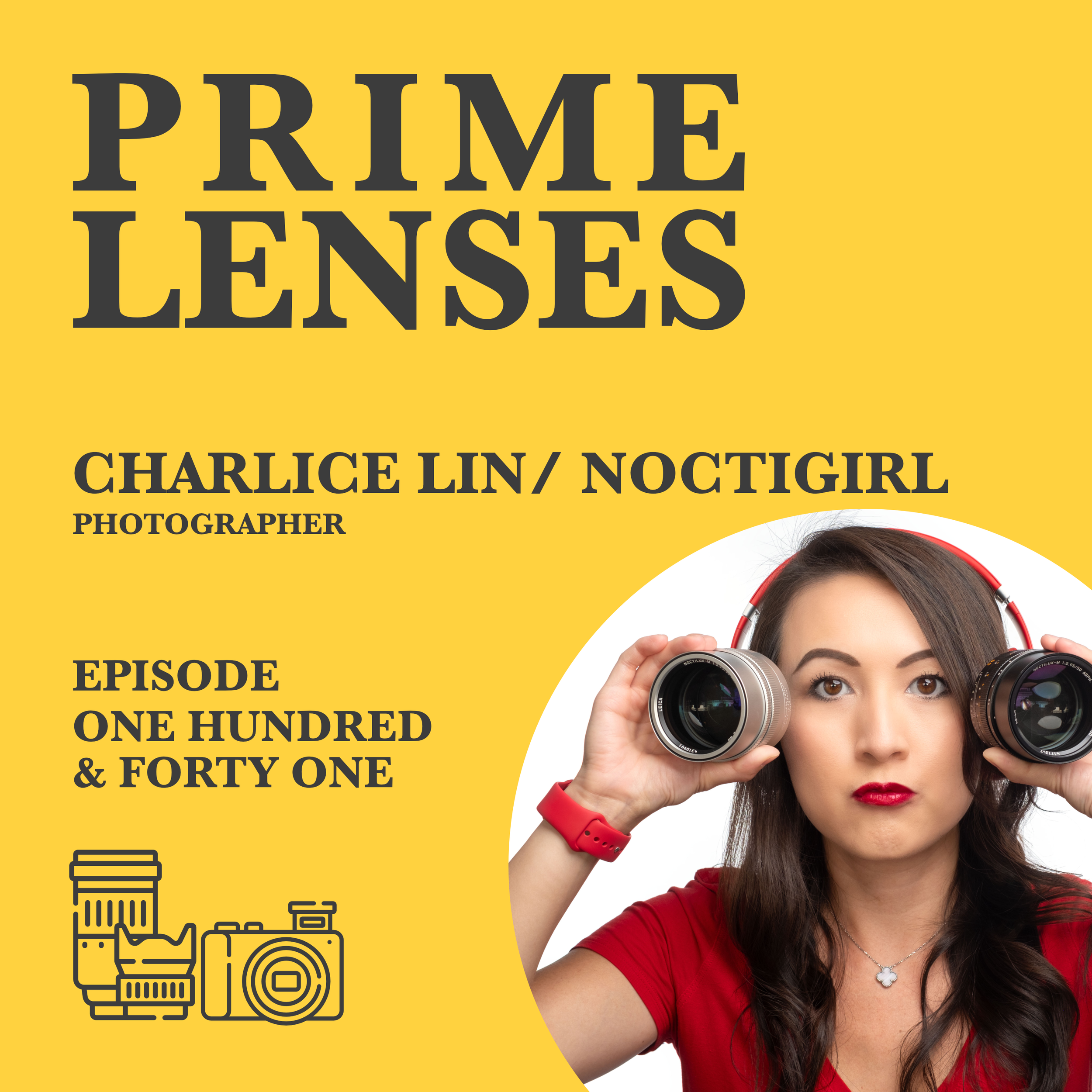


Charlice Lin bought her dream lens, held a mock wedding to celebrate, and accidentally started a YouTube channel.
Guest: Charlice Lin, aka NoctiGirl — Leica obsessive, film shooter, portrait photographer · https://www.charlicelin.com
In this episode
Charlice Lin saved for years to buy the .95 Noctilux she first heard about in a college photography class. When it finally arrived in 2016, she married it, in a white dress, at a golf course. The YouTube channel that followed started as a joke about exactly that.
We start there and end up somewhere I wasn’t expecting. A childhood spent moving between countries and keeping friendships alive by post. A film-school degree her parents thought was business classes. A decade of weddings, then burnout. And the projects that grew out of an unresolved grief: more than fifty older people photographed and interviewed for library exhibitions, then people chasing their dreams, now women working in traditionally male-dominated industries.
Along the way we talk about the rising price of film, developing colour at home, why neither of us is any good at chasing platforms, and why a printed 4x6 with a handwritten note still beats any message.
Highlights
No timestamps in the source transcript, so these are positioned by where they fall in the conversation.
• Opening — Growing up across countries, disposable cameras, and mailing 4x6 prints to friends, then waiting a month for a letter back
• Opening — The college professor who mentioned the original Noctilux, and the lens that became “my Lamborghini”
• First third — The mock wedding with a lens, and the golf-course guests who congratulated her
• First third — The first scratch on the lens hood, in Kyoto, and a shop that had to send it back to Germany
• Midpoint — Why she’s perfectly happy with a Noctilux and an M6, and what happens when she sees a character lens with crazy bokeh
• Midpoint — Film prices: buying HR-50 by the 30-roll brick and being “too poor for portrait” film
• Final third — The seniors project, what came after it, and the friends who told her to stay away from old and sick people for her own sanity
• Close — The woman at the retirement home who said Charlice was the reason she got up on Sundays
• Close — Volunteering, the retirement home, handwritten cards, and where to find Charlice
Mentioned in this episode
People
• Charlice Lin (NoctiGirl) — the guest · https://www.charlicelin.com · https://www.youtube.com/@NoctiGirl · https://www.instagram.com/noctigirl/ · https://linktr.ee/noctigirl
• Kevin Fickling — Leica-focused photographer and YouTuber, and Charlice’s friend and workshop co-teacher · https://www.instagram.com/kevinfickling/
• Mathieu Bitton — photographer, and an earlier guest on the show (Episode 82)
• Marco Bezzecchi — Aprilia MotoGP rider, who “married” his bike in February · https://www.cyclenews.com/2026/02/article/bezzecchi-renews-with-aprilia-racing-on-a-multi-year-contract/
Tools and products
• Leica Noctilux-M 35 f/1.2 ASPH. — the new 35mm Noctilux Charlice was among the first to try · https://leica-camera.com/en-AE/press/new-leica-noctilux-m-35-f12-asph
• CineStill Cs41 “Color Simplified” 2-bath kit — the two-chemical colour developing set-up Iain uses at home · https://cinestillfilm.com/collections/col/products/cs41-simplified-color-processing-at-home-quart-kit-c-41-chemistry
Places and events
• Charlice’s seniors project — profiles and portraits of Palos Verdes seniors, shown at the Peninsula Center Library · https://easyreadernews.com/168833-2/ · photographs in the library’s local history archive: https://palosverdeshistory.org/nodes/view/121
• Introduction to Effortless Analog (Los Angeles, March 2026) — film workshop Charlice and Kevin taught with Leica Store LA · https://leicacamerausa.com/introduction-to-effortless-analog-capture-develop-scan-los-angeles.html
Watch
• After 9 Years with One Lens... — Charlice on living with the .95 Noctilux · https://youtu.be/rGNtz-FVKTQ
• Leica 35mm Noctilux Review: The Most Practical Noctilux Yet? — her take on the new lens · https://youtu.be/KJWftLwrtQo
• I Developed My Film at Home... And This Happened — her home-developing experiment · https://youtu.be/iH6WqOHhzz8
Quotes
I am into the stories that I have to tell in my voice. And if people could resonate with that, that’s great.
— Charlice
But when you receive a 4x6, a print of you and someone else in the mail with a card with some handwritten message. That’s going to stay in your head for a long time.
— Charlice
I had a mock wedding, a fake wedding with my lens.
— Charlice
Mentioned but not linked
• Pro Photo Connection (Irvine, California) — Charlice’s colour film lab; couldn’t find an official site
• Ilford XP2 Super — black and white film processed in C-41 chemistry; only retailer pages found, no Harman page
• Adox HR-50 and Leica Monopan 50 — the film Charlice bought by the brick, and its Leica-branded sibling; not confirmed, see editor’s note
• Kodak colour film “100 and 200” — which stock exactly is unclear
• “Mary Irene” — the person at Leica who invited Charlice to try the 35 Noctilux; spelling and surname unconfirmed
• Leica R “100 APO” — Iain’s macro lens, presumably the APO-Macro-Elmarit-R 100mm f/2.8; confirm
• Gear in passing — Rolleiflex, Hasselblad 500 C/M, Fujifilm TX-1, Leica M6, Leica R9 with DMR, Canon 50mm f/0.95 “Dream Lens”
Credits
Hosted by Iain Farrell. Guest: Charlice Lin. Subscribe and find every episode at https://primelensespodcast.com
Prime Lenses – Episode 141 – Charlice Lin (NoctiGirl) – Transcript
Iain: Charlice, it’s lovely to see you.
Charlice: Thank you so much for having me.
Iain: Of course, of course. I think we’ve been, I’ve said this to a few guests recently, but I think we’ve been kind of ships in the night at events in the past, sort of passing, crisscrossing. I may have seen you across a room and things.
It’s wonderful to get to sit down and actually chat to you for a bit because not many photographers that I speak to kind of build, brand is kind of the wrong word, but like build your online persona a little bit around the world. A tool that you love and that you use, right? Like calling yourself Noctigirl online.
So I guess I was, it’ll be no surprise to anyone listening what kind of cameras you prefer, but I wanted to kind of talk to you about what maybe started you off with photography and use that as a jumping off point into then like what puts a Leica in your hands? Because everyone’s journey to those cameras I think is always interesting.
Charlice: Yeah, yeah, definitely. So I actually grew up moving around a lot. Before the age of 10, I lived in different countries, was constantly traveling because my parents work.
And I always had cameras in my hands. I don’t even have specific models to tell you. I would have disposable cameras.
And it was mainly to document the people I was meeting and the new environments I was in. And back in the days, I would be dating myself here. But back in the days when I come home, I would get my photos processed.
And then I would mail people four by six photos. Right. And I’d be like, hey, remember like all the great times we had like last month, you know, when we went here and there.
Right. And then I would wait like a month later to receive another letter back, you know. So that’s how things used to work back in the days.
So that really got me started with photography. And then my dad got a camcorder when I was younger. So he started recording family videos and stuff like that. And I actually have it here.
I found it. They actually moved earlier this year and then everything’s in boxes and I actually came across it when we were moving. So I actually have it here.
It’s like an 8mm, like a camera that takes an 8mm cassette tapes. So I have that. So he would record family videos and stuff.
And then I became interested in the story, in documenting memories specifically. And like I said, having lived in different countries, that meant a lot of times I had to say goodbye to a lot of the people I love. So growing up here in Southern California, I never really had a close connection. With my paternal grandparents because they lived in Taiwan. And I would see them like, you know, once every few years. Right.
And when my dad’s dad, my paternal grandfather passed away, and that was like the first death in the family. I was in high school, but I wasn’t sure how to feel about it. I felt like I should be sad because that was a death in the family. Family, but I was not super sad because I never really had a connection with him. And then we went to his funeral and I was really sad. Everybody was crying and I was just struggling with like, I should be sad, but I am not super sad.
Something’s wrong with me. So there was that. And I didn’t know that I kind of carried that with me until later in my life. And I’ll come back to this. Story later. So, anyway, so storytelling has always been a huge part of my life, right? Me.
So, then in high school, I was doing video production. I was doing photography. But it was mostly video.
Like, video was the thing for me because it, you know, I could capture people’s dialogue. You know, I could capture people’s expressions. And I was on the school’s news team, you know, and I was covering events and, you know, sports events.
And we used those huge, cameras that take VHS tapes back in the days. And I’m only 5’2 as well. So you can imagine a short, tiny girl running across the field with this giant camera that was bigger than half the size of my body.
So that was crazy. But I survived through that. And I actually enjoyed it.
So when I went to college, I actually went to film school. I went to USC cinema. I also majored in photography.
So I did that back in college, but my parents didn’t really want me to do that. So I kind of had to lie about going to school for that. Wow.
Yeah, while telling them that I was studying business.
Iain: That’s impressive. That’s a commitment.
Charlice: So that was crazy, but I was really just taking business classes just to show them that I have those classes on my transcript, my econ classes and whatever. In full disclosure, I was never good at math. I know Asians are supposed to be good at math or whatever, but I was never good at math.
I got my first D in my life back in high school and it was in calculus. And all of my friends made fun of me and they were like, what kind of Asian are you? Like, can you get a D in calculus?
You’re a disgrace. You’re a race.
Iain: Oddly kind of positive racism. I don’t know what that is. They’re trying to push you and encourage you, but at the same time.
Charlice: I know I’m like no I know I’m a disgrace yeah so that was funny um but anyway so it was in college um in one of my photography classes that one of my professors talked about like Leica in like the original 1.2 Noctilux um and it was I guess launched in 1966 and it was like the fastest lens available at the time Actually, take that back. The Canon Dream Lens was the fastest before the Noctilux was launched. But then something was very special about the Noctilux, the original one.
And every element was hand polished and it contained a spherical element. So somehow I had it stuck in my head that that was my dream lens. It was like my Lamborghini that I was going to own one day when I become rich or, you know, whatever.
So I graduated from college. And then I started looking into it and I realized how expensive the lens was, right? Especially it being a vintage lens then.
I was like, oh my gosh, like, I don’t even remember how much it was. It was like $50,000 or something like that, you know? I mean, it was always in the back of my head, right?
That like, okay, one day, maybe if I win the lottery, you know, that would be the lens to own, you know, whatever. So, so I graduated, I worked for BCBG Max Azria, which is a fashion company. I had the best boss slash mentor that who taught me so much.
And there we shot I kind of stuck with that. And then after that, I also shot weddings and events for almost a decade. But one day I just told myself, you know what, it’s time to really pursue my dream, right? To own the lens, right? And then I did some more research at the time and I found out that there’s a newer version, like, you know, the .95.
And it’s also, So that works to my advantage. So then I saved and saved and saved. And eventually in 2016, I bought the lens.
Finally bought the .95 Noctilux. And I started my YouTube channel as a joke. I was so happy to finally own the lens.
I was like, I need to do something special. To commemorate this event, right? So then I was talking to my friends. I came up with this idea.
So I actually had, okay, your listeners are going to think I’m so crazy, but I had a mock wedding, a fake wedding with my lens.
Iain: Nice.
Charlice: And I was like, everybody is going to start calling me Mrs. Nocky, okay? So I actually wore not a wedding gown, but like, a white dress, right? And I went to my local golf course, which is a lot of people get married there.
So I went there with my lens and I had my other friends document the whole thing, like shoot our wedding photos and videos with his phone. So we did that. We went there and I was looking very pretty, very happy.
It was the happiest day of my life. I was to become Mrs. Nocky. And funny enough, people that were there actually congratulated me for my wedding.
They thought I was actually there for a real wedding.
Iain: Her husband will be back soon.
Charlice: Right, right. I was like, well, my husband’s right here. Amazing.
So then after that, I was like, well, you know what? I need to share this with someone. I couldn’t just keep this to myself because I was so happy.
So then I started my YouTube channel as a joke. And then I posted this video on my YouTube channel. So some people that’s followed me for a long time might have seen that video, which I eventually took down.
I was like, oh my gosh, I can’t believe I did that back then. But I did. So that’s the start of Noctigirl.
It really started out as a joke, I guess.
Iain: As a joke that got out of hand. Well, I mean, I say that. You’re in good company.
The podcast started as a dream I had that got out of hand. I, a couple of Christmases ago, dreamed that Jason Momoa was showing me his lens collection because he’d been doing those videos during lockdown where he was talking about his lenses and which ones he liked because everyone was a bit crazy and he was just doing his lens. And I dreamed that that happened and then I woke up and I thought, oh, that should be a thing.
I should make that show. And so that was kind of the origin of the show. But it’s funny, I love the MotoGP.
And this year, Marco Bezzecchi, who rides, Italian rider who rides for Aprilia, married his motorcycle. They started the season. They had a whole ceremony. They wheeled it out. It was white.
They held a ceremony with the chief mechanic and his manager and stuff. It was crazy. He married the bike. Hasn’t helped him.
He’s not winning the championship at the moment. But you’re not alone in kind of appreciating where you’ve got to, to such an extent. That you’ve done that.
That’s lovely. So when did it become not a joke to you then? So you’ve released the first video, you’re obviously working in photography and hats off to you as a working wedding photographer not to be put off photography because that’s such a hard gig, isn’t it?
Charlice: It was so, it was really difficult. Long hours and we’re running around all over, really fast processing times, right? I got, I did get really burnt out. After a decade. So I just one day sold all of my Canon gear and I was like, no more. Like, I can’t do this anymore.
I need to start doing something more creative, more me. I don’t want to say that weddings weren’t storytelling. Like, they were definitely storytelling, but not in the way that I wanted to.
Iain: So,
Charlice: Yeah. So I don’t do weddings and events anymore. Yeah, so nowadays I pursue photography projects and then I have my YouTube.
But I want to say it was about maybe 2018, 2019. And by then I had already posted a few other funny videos of me and my, my Noctilux. I shared my first like scratch on the lens hood when I was in Japan and I was crying.
I was so sad when I was in Kyoto. And so I have my Noctilux on the M6 around my neck while I was shooting with the Q, right? And I was so I don’t have you I don’t know if you do this, but I do. So when I shoot, especially wide open with my point nine five, I try I tend to rock back and forth for the focusing, right?
So I was doing that while leaning against like this, this fence thing. And then my lens was just like, I don’t know.
Iain: Yeah.
Charlice: Yeah. It scratched. And then, you know, so I was really sad. I cried. I went to the like a store in Kyoto.
I told them I was like, can you fix this? They were like, where’s the scratch?
Iain: You know,
Charlice: I was like, it’s right there. It’s right there. I see it, you know, and they were like, oh, we have to send this back to Germany and it’ll take forever. I was like, oh, my gosh. Anyway, so I eventually just lived.
Iain: Yeah.
Charlice: With that scratch.
Iain: Yeah.
Charlice: But yeah, so then I would post videos like that, my reaction to my lens and some other silly things I was doing with it. Then my friends were like, “Hey, have you thought of taking your channel more seriously and maybe just take a different direction to actually start reviewing things?” And I never considered myself to be in front of the camera.
Because I’ve always been behind the camera. Like I’m a camera person. And I never considered myself a great on-camera person.
Like a speaker or anything. I was like, ugh. Like I could do goofy things.
But like want me to talk about serious things? Like actually seriously reviewing an item? Like I don’t know about that. You know?
But I did take their advice. And I just.
Iain: I gave it a shot and like today I’m like reviewing different things I guess yeah that’s really cool what do you think because a lot of people I speak to one of the common threads that comes through when you speak to creative people is that they they have this real desire to make things but if you find yourself in a certain pocket early on there’s a kind of trepidation or worry about stepping out of that but I always find that like those people are exactly the right people to step out so was it Did you just kind of find a way to work through that? Like what was your way of kind of moving beyond what you were doing before, which I guess you were feeling it sounds like you were feeling comfortable doing?
Charlice: In real life, I am not a very serious person. Also, I like to goof around, right? So that’s like, I guess the real me that I was putting out on the internet, right?
But they were like, hey, we see like potential, like if you actually like, work out at it and do like more serious reviews other than just like goofing around with your lens your husband um like it might go somewhere and I was like oh okay well I’ve never really thought of that and like I had my nine to five I was working a corporate job at the time so I never really thought of like becoming a youtuber and like especially like me someone like me a youtuber no way you know um I’m good behind the camera and I’ll just be doing my 9 to 5 sitting in the office. I’m okay with that too. But yeah, my friends really encouraged me so I started just kind of branched out of doing my silly videos.
But then nowadays I’m always, like when I look back to my older videos, I’m like, wow, I can’t believe I started out that way. These videos are so silly.
Iain: But that’s kind of, I think that that’s, it’s interesting what you say there about you, you, you started with really leaning into you, you know, making, making something that played to the way that you like to be and the way you like to do things. And then the branching out sounds like although it was new, and you hadn’t necessarily considered doing it yourself, seems like it’s working. Like, you know, I see your videos, and I see you posting and you go into events and things like that.
So it seems like you’ve found this in yourself, like this new string. To your bow. Does that mean now that you’re kind of looking further ahead and you’re like, right, if I can do this, you know, I can do anything?
Charlice: I think so. Because I, well, maybe not everything, anything. But I realized that I enjoy sharing knowledge.
I enjoy sharing, right? And then having that connection. And part of my whole thing with photography is the connection with people.
Like I photograph, I’m a portrait photographer too, right? Like I, I enjoy, communicating, connecting with people, and before I even take their photos, right? So that’s part of me.
And I realized that, oh, like sharing knowledge is not as scary as I thought. Like, I don’t have to be super serious. Like, I could be me while sharing my knowledge.
And then, you know, people who like what I’m saying, they’ll respond, and then we could go back and forth. And that’s how relationships are formed, right? Connections are formed.
So I started enjoying that. Then I was like, oh, I think I this could go somewhere. I could go somewhere with this, you know, and I’ll just I’ll do another video and give it a shot.
And then like people responded more to that one. And I’m like, okay, I think I think this could work. Maybe.
I mean, I’m still figuring things out right now. So it’s not like,
Iain: Yeah,
Charlice: It’s not like I figured it out. Like this is what I’m going to do for sure. Like, you know, forever. No, it’s not. That.
Iain: Yeah. Well, I think that’s really hard to do because there’s a lack of stability on the platforms. So the reality is that what they, you know, we all, I’ve been talking to some people recently, I was editing an episode today, actually for this weekend where Ron, who I was speaking to, was talking about early days of Instagram and his photos being picked up by Instagram and promoted by the platform.
And that’s pre carousels. That’s before Instagram did video. Everything was square.
You had to post one picture. There was a bit of a as to whether or not you should post a picture on Instagram that wasn’t taken on a phone camera like was that cheating was that okay like all of you know all that stuff was being figured out whereas now it feels like every six months the platform’s change in some way like YouTube has just done their thing with the count you know where they one frame of a video now counts as a view but it’s not a real view and we have a second number that we show you you know all that sort of nonsense and it’s how do you sort of reflect on being able to run your business effectively and being able to do but but when you can’t control the whole thing
Charlice: I will just be honest I am not a good social media person same I don’t really look at all the analytics and stuff like that I post what resonates with me right and I respond to people who um respond to what I have to say. So I see all the changes and stuff like that, but I am not, I guess, completely on top of all of that. If that makes sense.
Iain: No, it does. I think it’s nonsense. I think it’s almost impossible to navigate is why I think.
Charlice: Exactly. Exactly. It keeps changing.
Right. And I am, I don’t, that’s not the game I’m into. Right.
I am into the stories that I have to tell in my voice. And if people could resonate with that, that’s great. But otherwise, I don’t want to keep chasing after the platform changes and the newest whatever.
It just never ends.
Iain: No. Actually, on that topic of stuff that never ends, one of the things that I think when you speak to someone who’s in the YouTube world often or some of the social media, the reviews side of things, That never ends for them and results in this kind of unending quest for gear and for bits. And oh, if I just have this thing or if I just have that thing.
Charlice: Yeah.
Iain: As someone who found their dream set up fairly, you know, you knew what you were going for for a long time and you were shooting other stuff.
Charlice: Yes.
Iain: Are you do you feel at peace because you kind of have what you’re doing? Like, yes, it’s nice to try things, but you kind of have your dream set up. Is that good? Or do you still kind of look beyond the Nocti?
Charlice: I’ll be honest I’m very happy with my setup I am living my dream right and I know this might be a very weird response I didn’t know most people were you know not like this sure I try things here and there and because I need to make more videos and more reviews right like that kind of forces me to branch out and try things but if I didn’t have to do that I’d be I’m perfectly happy with my Noctilux and my M6. You know. Yeah.
I just I love that setup. And I also love my Rolleiflex. I love my Hasselblad.
You know. I love cameras and lenses that allowed me to capture the world from different perspectives. In different perspectives.
Right. So like you know I have my Rolleiflex and my 500 C/M. They’re like square formats.
You know. Obviously, my M’s are 35mm format. And then I have my TX-1, my Fujifilm TX-1, which is the Japanese X-Pan, right?
And that’s the Pano format. So I’m set. I’m good.
I love, love my setup. But of course, once in a while, I see amazing images with crazy bokeh that really captures my attention. I love character lenses.
That draws my attention. I’m like, "Oh my gosh, this image is amazing. Look at the bokeh. Look at the swirl.
Look at the rings in the back." I want to learn more about that lens. That’s how I get distracted sometimes.
Then I go back to my Nocti. I’m like, “I’m sorry, husband.”
Iain: That’s when you pick up the phone to Kevin and you go, oi, Fickling. It appears to me you’ve probably got one of these. Give it a try. It’s a bad time to follow him and Mathieu Bitton, I would say. Those two have led me down some dark paths of expensive lenses.
Charlice: They’re crazy, crazy. I’m always telling him to downsize. I’m like, I think you have a little too much.
Iain: Well, maybe. I don’t know. Maybe his big plan is this is his pension.
Who knows? Because those lenses, they’re not getting cheaper. Some of those really old ones, there’s not that many around.
I recently picked up a DMR, the R9 with the digital back. So the film camera, but with the digital add-on. And part of that was, like you, I’m very happy with my M. I use a 35mm Zeiss. It’s actually my favorite lens ever.
Charlice: Wow.
Iain: Okay. Because it’s so tiny and it goes back to when I was a kid and I used to shoot 35mm. Compact camera that my stepdad gave me that was a 35 f/2.8 and so the world to me appeared and it was a zeiss I think but so it’s a 35 to a field of view is kind of how I see photos that’s kind of baked in and so I’m very happy but it is fun to go and kind of occasionally pick things up and explore a little bit the lens I got recently which I shoot on my m that I think you would love if you’ve never tried one and it’s hard it would be I think impossible for you to I have an R100 Apo that is stunning.
That’s an incredible lens. And it’s a macro as well. So you can get one lens and you can get super, super close and then stand back and make great portraits of people.
It’s absurdly versatile. Wonderful lens. I was using it today to photograph a Lego set. So it’s incredibly versatile.
Charlice: Wow. I definitely have not tried that lens. I’ll look into it.
Iain: Yeah, yeah. Because you shoot so much film. Do you like to, I mean, I’m assuming that’s for you, but like, do you dabble in digital much at all?
Charlice: I do shoot digital when I am feeling lazy.
Iain: There you go.
Charlice: Or when like some of my clients requested, right? They’d be like, we don’t want the film look. You know, we want like the super sharp and clean look, which I totally get it, right? So I also I also have requests like that. But if I had a choice, and if time and money weren’t like a concern to me, I definitely I pick up my M6 my film cameras for my TX-1.
Iain: Yeah, no, I like that all of your cameras are so different as well. That’s really cool. When you say different perspectives, you really mean different perspectives.
Charlice: Right? Exactly. Exactly.
I just I, I, I love I I actually really, really, really love my Rolleiflex. Like I just, yeah. If I’m not, if I was a Nocti girl already, I’d probably be Rolly girl.
Iain: This is the, this is your moment. This is the time to get a wig and start a new channel and just be like, I know we look similar. You can be like Thompson and Thompson in Tintin, you know, similar but different. This, this sounds like your moment.
Charlice: That’s funny. Yeah. My friends always tease me that because when we go out on photo walks, like a lot of times I I actually bring my Rolleiflex on my m6 and my noctilux you know so I don’t know so what’s the at home darkroom situation for you are you still developing elsewhere or are you processing it yourself black and white we are doing that ourselves color um I found I recently re-found I guess I used to use them a lot but I stopped it then I went back to them um so pro photo connection in Irvine California um Really cheap. So a color, a roll of color film, 35 millimeter is like $4.99.
Iain: Wow.
Charlice: In 24 hour turnaround. So I was like, yeah. Cause like if I were to do it myself, you know, like I developed and I have to drive and I scan, you know, it’s just, it’s such a time consuming process. Unless if I am really connected to the shoot or like the subject that I shot,
Iain: Um,
Charlice: I,
Iain: I prefer not to do it myself yeah yeah no completely reasonable I um I’ve recently discovered I was doing black and white at home and then shout outs to Jess listener to and friend of the show and she encouraged cajoled maybe badgered a little bit but basically was like Ian color isn’t that hard and I’ve been using I mentioned this out loud because I think some people listening won’t necessarily know about it but CineStill do a two chemical set up which is extremely easy to use to the extent that you know I could do it and then I’ve been shooting because I’ve made those chemicals up and they’re sitting in bottles now ready to use and I can just warm up warm up a bath with a little sous vide thing get the temperature you know exactly leave it on for half an hour go and get on with your life and it helps because I work from home so of course I am saying all this of like you know this is like making bread like it’s really easy as long as you’re around and you can just go and poke it every half hour but But it was great. And I got that set up. It’s been fantastic. And I’m shooting, because they’re color developing chemicals.
Have you used the XP, isn’t it? Ilford XP2, which is black and white, but you develop it using color chemistry.
Charlice: No, I have not used that. It’s amazing.
Iain: It will change your life. It’s a wonderful film. It looks incredible.
HP5 brings all the boys to the yard. But I think XP2 is actually, that’s where it’s at. It’s amazing.
Charlice: Wow, okay. Yeah,
Iain: Really, really lovely. I’ll send you some pictures afterwards, but it’s a beautiful film to work with. And it scans beautifully.
It’s got a really nice refined grain to it. It’s not Monopan fine, but it is, but it’s not kind of crunchy, you know, like I’m trying to be Moriyama or something like that. I’m not trying to do Japanese street photography from the 80s. It’s kind of, it’s a really versatile black and white. I really like it.
Oh,
Charlice: That’s great.
Iain: And then you only need one set of chemistry. You can do color, you can do black and white.
Charlice: That’s great.
Iain: Yeah, it’s the future.
Charlice: Awesome. The future of film development. Exactly.
Iain: Yeah. Well, it seems like everyone’s investing, which is quite good. Yeah,
Charlice: I know.
Iain: What are the film prices like for you at the moment? Because I’m imagining, if you can develop it cheaply, but I’m imagining the film itself isn’t cheap.
Charlice: Yeah, it’s not. It’s not cheap. It’s not cheap. I am actually running out of film. Some of my older stocks right now. Literally, I have tabs open comparing prices online. I don’t have any secrets to that. I also just go on Google and try to find the cheapest place to buy them.
I bulk buy because the prices increase so fast. Just earlier this year, I bought 30 rolls of HR-50, I really love that film because it’s such fine grain and it’s just very sharp. I love it.
But the Monopan version is like getting a little expensive. You know, it’s $15 a roll now here in the US. Yeah.
So I was like, you know what, I don’t need to shoot the Leica one. It’s fine. You know, it’s the same film.
Iain: Yeah, yeah, I had the same experience.
Charlice: So the HR-50, when I bought them earlier this year, it was $7 something a roll. And it’s like $8 something a roll now, you know, I don’t know, like the pricing just keeps going up. And like, last year, I bought like, two bricks of like, code of color 100 and 200.
And now they’ve increased in prices as well. And I am like completely out of my portrait film. So I looked online, and they’re like, 15 to $17 a roll. I was like, I’m too poor for portrait.
Iain: This is how they’re getting us. Yeah. And the price of new digital bodies.
I think there’s just no way to do photography affordably anymore. Like even if you try and buy an old camera, the price of old cameras is through the roof. The new bodies are expensive.
The new, I went to London for an event for the new Sony, the a7R VI, amazing camera. But even at the price of their bodies, they’re starting to make Leicas look reasonable. It’s kind of crazy.
Charlice: No way, really? It’s like $6,000.
Iain: I mean, it’s incredible, to be clear. It’s like an SL kind of style camera, but on steroids. It’s like it does incredible video and it does 120 frames, blackout free, and all that.
It’s a weapon, right? Without a doubt. It’s amazing.
But I did just look at it and when they were doing the briefing, and I think this is the same with most cameras now, But they were running through all the features. And then when they jumped to the video stuff, I was just thinking 10 years ago, this would have been a different camera. They’d have tried to sell you a different body. And now it’s just all packed in to, I think, justify the price because the cost of everything is going up. So I think, unfortunately, we’ve picked the worst time in history to be excited by the hobby from a financial perspective.
But as a user of things, it’s just kind of never been better. I feel really optimistic about photography as
Charlice: Yeah, definitely. I feel like we have everything at our fingertips. And, you know, all kinds of cameras with all these functions. And then meanwhile, there are people like me who’s like shooting film with like cameras from the 50s, 60s and 70s. Yeah, like I am not I am not a tech chaser, you know, like I don’t chase after the newest technology. Like maybe when I used to be on Canon system, I was a little bit like oh you know the new 5d mark 3 mark 4 or whatever but nowadays I’m like you know what it’s fine you guys could have all the newer technology like I’m not really into that because I’m more focused on my stories you know the stories that I want to tell so
Iain: So on that can you yeah I think that’s the way that’s the way the great the good creative work comes from, you know, it’s less about capability and it’s more about what you want to do. Say more about how you’re approaching like stories and your own projects that then presumably influence the professional work as well. Like where do you, where does an idea start for you?
Charlice: That’s hard for me to say. I just, my, my head’s just like constantly filled with thoughts and ideas. It just keeps going, you know.
But I, so going back to the story of how my grandfather passed away when I was in high school. I didn’t realize that I carry that with me. So then when I was like 29, and I don’t know if other people do this, like before you’re about to cross into a new decade, you do like, oh, what have I done with my life this decade, right?
So I was like totally in that like kind of mindset, oh, like what have I accomplished? And then I just couldn’t get over the fact that I started thinking about my grandfather for some reason and my grandmother who had passed away a few years prior and how like I never really had a connection with them. And I just I felt like I had a void in me because I didn’t have that connection.
So then I actually reached out to my local library and I spoke to somebody. So then we started this project of photographing and documenting senior citizens in the city. So through that project, I was able to meet like over 50 like grandparents, you know, so to speak.
And I interviewed them, I got to know them, they share their stories with me, and then I photographed them. And then we had three exhibits. At the library.
And it was amazing because I feel like, wow, like, I feel like I accomplished something to fill my own void, but also gave them a channel to share their stories, right, and all the amazing things that they’ve accomplished. So that was so, so fulfilling for me. And I was so happy I stayed in contact with most of them until they started passing away.
And it was the saddest moment because they were all passing away one after another. And in the span of two years, I just was constantly attending funerals and memorials. Services.
And I was so devastated, you know, because when I was creating a story, I was so inspired, you know, I was inspired by what they’ve accomplished by their life stories and feeling very fulfilled. And then shortly after it was like, you know, like, oh, my gosh, they’re they’re gone now. Like, I can’t talk to them anymore.
And we just formed this connection. So that that got really sad. And then my friends were like, oh, my gosh, Charlice, your next project, it needs to be more optimistic, it needs to be happier.
Right? And I was like, okay, you know what, like, what if I started, like, telling stories of, like, cancer patients, or, like, ex-cancer patients, and they’re like, um, that’s not a good idea. Stay away from older people and sick people, like, just for my, for my own, like, sanity, right? And I was like, okay, well, What can I do?
Right? And then COVID happened. And I also did a lot of self reflecting and thinking.
And then I started, I just came up with this idea of photographing people who are actually actively pursuing their dreams, right? If they’ve given up something, a corporate job or something, and then they’re pursuing their new dream now. Up her corporate job at Walmart, like at the corporate side of Walmart, not like the grocery store.
And she started her own gelato shop and she went to Italy and she trained under a gelato master for like six months. And then she now she has a very successful gelato shop in San Clemente, which is like so, so amazing to me. And then I talked to this ballerina who’s always been a ballerina, but it was like her lifelong dream to be, you know, a beautiful professional ballerina.
So I also documented her and talked to her. So, yeah. So, so then I could, I started seeing my projects getting slightly more like hopeful, you know, instead of like just talking about the past, like I’m documenting the present and probably, like talking about the future or you know so that was cool so I did that that’s still an ongoing project but meanwhile I started also I guess thanks to the 35 Noctilux launching earlier this year and Mary Irene reaching out to me asking me if I wanted to be like one of the first ones to try out the lens I decided to kick off my new project which I had been brewing in my head for a while, which is documenting females working in traditionally male-dominant industries.
Iain: Oh, wow. Yeah.
Charlice: So I was introduced to Jessica, who’s like a female Porsche driver. She races as well. So I documented her, and we just had so much fun. And her story is pretty awesome, too. And she’s so badass.
So now I’m shifting gears from my dream. The project where I was documenting people pursuing their dreams to females working in traditionally male-dominant industries. So I’ve shifted into that project now.
Iain: That’s a project people might not expect if they’ve only come across you in passing online. They’re like, oh, she’s the naughty person. But actually, it sounds like the project with though in a way was kind of necessary for you and that you can kind of because that feels like that did that helped you to kind of find a bit of closure with what had happened to grandparents and then as you move through it now just like realizing I think that you could be more serious with the YouTube it just seems to me to as a from an outside perspective another example of you just finding something and then running with it and like that project sounds fantastic how long have you been making the photos of because the people doing following their dreams and then now women in male dominated industries these are fascinating topics they could just go and go thank you right
Charlice: Exactly and um easier in a way to find subjects but also harder to get people to actually want to commit to be on camera too yeah so that’s always been a challenge like you talk to people they’re They’re like, yeah, sure. And then when you actually follow up and they’re like, silence.
Iain: Right. Yes. Let me tell you about inviting people to be on a podcast, Charlice.
Charlice: Oh my gosh. I can’t imagine. I can’t imagine.
Iain: These days, I’m now getting to the point where I’m like, I mean, most people at least reply. Like, it is just funny when you get silence. You know, when you get like, like a stone wall, you’re just like, well, most people reply at least. At least tell me like, no.
Charlice: I do have to say though that persistence is key because in our world today, everybody is so distracted and I can’t speak for other people, but let’s say for me, sometimes I see all these messages pop up on my phone and I am meaning to respond. I literally have the window open or whatever, the chat open. I am mid-typing, and then I get distracted by something. I turn away, and then that message is like, might as well be gone, because then I’m getting more messages, and then that one message gets pushed down, you know, and then I just don’t think about it. It’s out of my head.
Iain: Yeah, yeah. No, it is bad.
Charlice: I don’t know if that happens to you.
Iain: It does, and I have to confess that it also sometimes happens when I’m mid-conversation with someone. They go away for a long time. We’re arranging to talk, And then they go away.
And then it’s a day or a week later, they’ll come back and go, hey, so about the thing? I’ll go, yes, yes, of course. But it’s, you know, the last two weeks, the boys have been off school for the school holidays.
And so it has been, you know, because I’m the parent without a proper job, you know, like I can work my job around, you know, school schedules and things like that. You’re the flexible parent. Yeah, exactly.
So I’m, you know, it’s been a wonderful two weeks. We’ve been to the pictures, we’ve made Lego models, we’ve. We’ve done loads of cool things but it’s also it’s pockets of time you know like you bake for a bit like today today was the worst kind of school holidays day because it was raining and so you spend the whole day like you just have to go right well this morning we’re doing this and then we’re going to go out to get everyone out of the house because otherwise you won’t leave the house all day and then we’ll come back and then we’ll we introduce them to Avatar today that was today’s big adventure was popcorn and watching Avatar they love it so
Charlice: That’s right.
Iain: 2009’s Avatar. But you, yeah, so I sympathize because I miss stuff like that more than I would like to. But you’re right. It’s the world is noisy and busy.
So I think you’re absolutely right. The persistence is key.
Charlice: Definitely. And especially for you and I, sounds like you’re in, like we’re in the freelance world, right? Where we have to, like we’re on YouTube, we’re on podcast or whatever. And then like, like I’m also chasing clients, you know, to see if I could help them.
Iain: With some like campaigns and stuff and you just have so many people constantly like wanting something from you right um yeah it just it gets so distracting so yeah so persistence is definitely key to getting what you want yes and also I think a level of comfort with uncertainty you know like I’m off to frankfurt tomorrow and I’ve never flown from edinburgh I’ve never well I’ve never driven to edinburgh airport and I’ve flown in for events but you get picked up and then you go somewhere rather than going to the city and then like right I’m on my own so I think that’s the thing about being freelance as well is that you have to kind of embrace the chaos a little bit and just have a place you’re going and not worry about how to get there
Charlice: Exactly. Exactly. And so I will add that when I was shooting weddings for like a decade, I also had a nine to five corporate job.
Yes. So I never completely let go of my corporate job because I need stability. Like I just I never like imagined myself to be completely freelance. Because then I don’t have the stability. I don’t have a steady paycheck. I don’t have my benefits, my 401k. What am I going to do?
I don’t have any of that. Also, I came from a pretty traditional family. My parents were always like, you go to a good school and then you find a great job and then you stay there forever until you retire.
Then you’ll have pension. You have your you know your 401k you have all your benefits and whatever so that’s what they kind of drilled into me um so I for the longest time I could not let that go but I was in it for 15 years before I started doing like youtube and photography full-time um and it’s scary and like you said I’m I’m still figuring it out you know like I I don’t know where I’m going with this but I’m I’m enjoying it I’m having fun And I think that’s pretty important.
Iain: Above all else is what matters. Going back to what you were saying about older people. Talk to older people. Talk about what they wish they’d done more of. It is the things that they like and with the people that they like. It is not, I wish I’d spent more time commuting,
Charlice: You know? Oh my gosh. Oh my gosh. Definitely.
It’s the, I wish I had spent more time with my family, you know? For one year, in my younger days, I volunteered at this retirement home. I was playing the organ and the piano for their Sunday church services.
I’ve just always volunteered and worked with homeless shelters and stuff like that because it just fulfills me. Like I said, I grew up traveling a lot. I see how fortunate I am.
I live in a great country. I don’t have to worry about food. Whereas some people might still need to worry about that today.
Or the clothes on their back or whatever. Their safety. With the wars going on. I can’t imagine having to worry about your personal safety when you’re living under your own roof.
Oh my gosh, I might get bombed today. That’s so crazy to me. I grew up just knowing how how lucky I am to be born in the time I was born in, in the current state that the world is in right now.
So I’ve always volunteered, provided service to people. But going back to the retirement home story. So during holidays, I would see a lot of these older people there alone with without family.
And it was just the saddest thing. And they were always so appreciative to see me because I think I was probably like the youngest person that was going there. And then I would play the piano and the organ for them, you know, and they were happy to listen to my music.
And one of them even told me that I was the only reason she woke up every Sunday.
Iain: Oh, wow.
Charlice: And this is the type of impact that I hope to make with my art, whether it be my music or my photography.
Iain: But I think it goes right back to what you were saying at the start, that actually going to the trouble of processing your film, making a 4x6 and sending it to someone and giving them something physical as well is a way that us listening, like if you can’t volunteer, send someone something in the post or do something like that. I have friends that send me things. One of the great joys of doing the show is listeners have sent me things.
And it’s wonderful that people think of you and that they’re on the other side of the world. And that’s what this thing we love can do, is it can just provide connection to someone in their day. And they don’t have to need it. They could have a family and a good life, or they could be having a rough time.
But whatever the reason, that connection, I think that’s powerful. And that’s why we love what we do. But yeah, that’s beautiful that that was the impact you had. Wow.
Charlice: Thank you. But I totally agree. In our digital world today, everything’s going so fast.
Communication’s fast. The way we communicate, we send an email or a text message or a message on social media. Like I said, the second you get distracted, like, oh, that message is gone. It’s out of my head. It’s as if it never happened.
But when you receive a 4x6, a print of you and someone else in the mail with a card with some handwritten message. That’s going to stay in your head for a long time.
Iain: Yeah, there’s nothing like that.
Charlice: That’s what I enjoy providing and receiving. And I still do that today. I still send out cards and holiday cards. Where I write messages on photos to people. And they enjoy it. And I enjoy doing it.
Iain: Yeah. No, it’s good. I think that’s the reminder. When I get back from Germany, I might send some postcards while I’m there. There we go. That will start the process.
Get things out in the world. That’s great. Yeah.
Amazing. Well, Charlice, I feel like I could talk to you all day. This was lovely.
And I’m really excited to see what you do with those projects.
Charlice: Thank you so much.
Iain: There’s a good book or exhibition in that stuff. I just think they’re so good. Some incredible women that you could introduce to the world. But for people listening who want to keep up to date with all of that stuff, where should they go to find a bit more Charlice?
Charlice: So they could go on my Instagram and also my website. I try to keep it updated as much as I can. Yeah, so my Instagram is just my handle, Noctigirl, N-O-C-T-I-G-I-R-L. And it’s funny, a lot of times when I share my handle with, People who are not familiar with the Noctilux lenses or whatever, they’re like, Naughty Girl?
Iain: Oh, no.
Charlice: What kind of channel is that? I’m like, no, no, it’s not what you think. It’s a photography channel.
It’s named after my lens, not what you think. Yeah. So Noctilux girl or my website is just my full name, CharliceLin.com.
Iain: Fantastic. And there’ll be links to all of those things in the show notes as well. Otherwise I would be a terrible host.
But yeah, this was wonderful. Thank you so much. I really enjoyed it. Thank you.
Charlice: Thank you for having me. This was a pleasure.