
Episode 137 - Ron Timehin
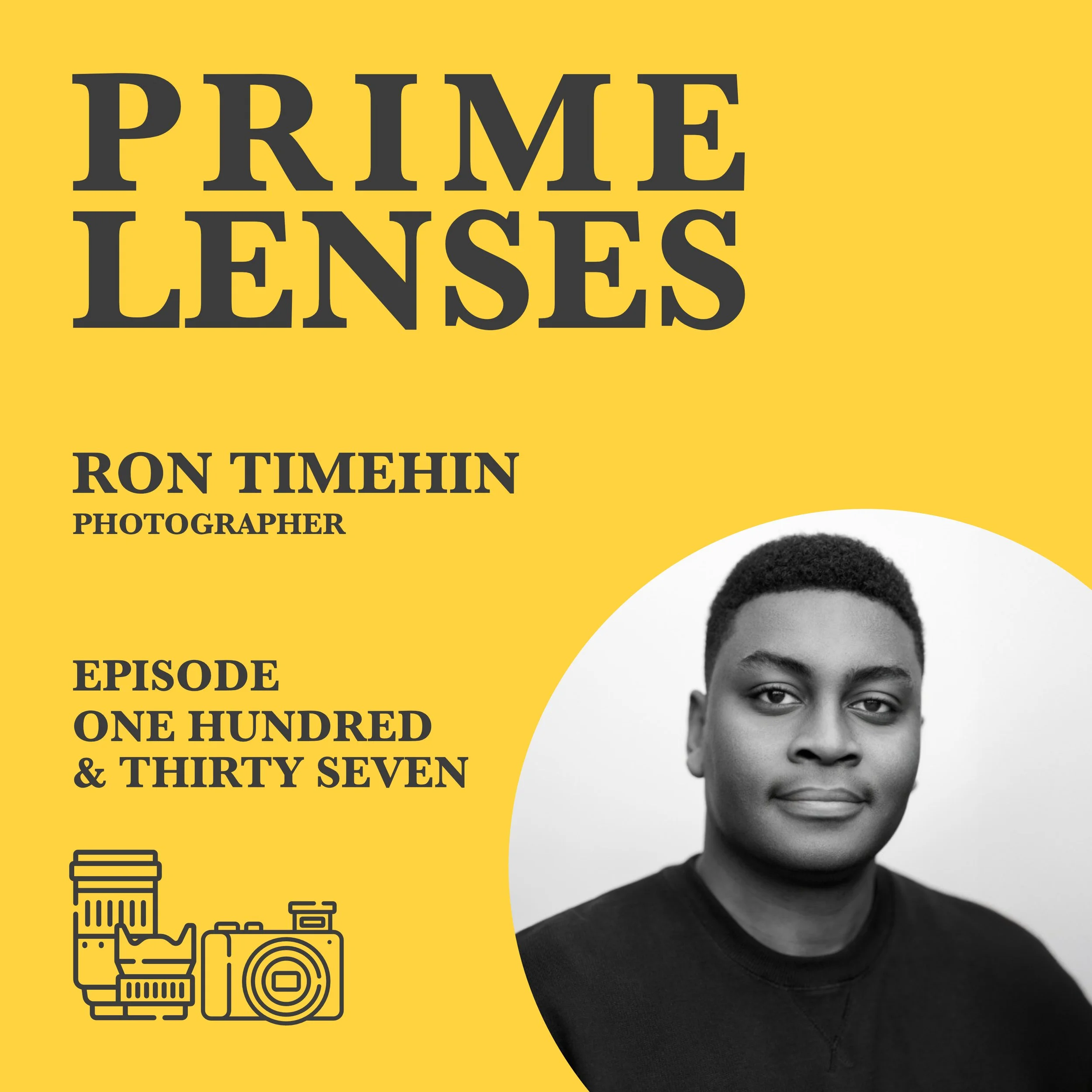


137. The World’s Best Visa
Ron Timehin on trumpets, fog, Vogue, burnout, and why a body of work outlives a post.
Guest: Ron Timehin — London photographer and director, Sony European imaging ambassador · https://www.rontimehin.com · https://www.instagram.com/rontimehin
In this episode
Ron Timehin started as a trumpet-playing teenager, was made an Instagram suggested user before his pictures were good enough, and chose to get good rather than hide. Sixteen years on he has shot on the team behind British Vogue’s September 2020 issue, directed a Dove film about hair discrimination in schools, and this year has work at Somerset House and heading for the National Portrait Gallery. We talk about practice as scales rather than volume, why he won’t pick up the camera until a sitter has been given a chair and some music, the Canon-to-Sony story that ended with a 35mm f/2.8 Zeiss on an A7CR, the burnout that followed his first solo show, and why work built as a series lives longer than a post. It closes on The Black Rainbow, the project he is a third of the way through, and a practical plea to back up your hard drives.
Highlights
No audio timestamps were in the transcript. Positions below are approximate: how far through the transcript the moment falls.
≈12% He studied the business of music as a compromise with his parents, skipped lectures to photograph instead, then got a two-week Instagram feature that jumped his following by around 25,000 while he thought his photos weren’t very good.
≈16% Practice as scales: why targeted practice beats random practice, and how classical trumpet fundamentals carried into jazz and then into lighting and composition.
≈25% How a shoot starts long before the camera: emails, research, music playing, a team who are warm, and hair and makeup before a single frame.
≈38% After his first solo exhibition he couldn’t do anything for a month. Burnout, rent, and why personal projects keep leading to commissions.
≈41% Vogue found him through a photo essay on the George Floyd protests in London, which is how he ended up on the September 2020 team.
≈52% Iain’s airport story: socially engineered into buying a 35mm f/2.8 Zeiss. Ron’s version of that lens lives on his A7CR as his daily carry.
≈71% The foggy afternoon at Tower Bridge when he spotted a young Black trumpeter in an air cadet band and the portrait work began.
≈82% Photography as the world’s best visa: it gets you into rooms, and out of conversations with weird Uncle Ted.
≈86% What’s next: the National Portrait Gallery show, and The Black Rainbow.
Chapters
Positional only (no timestamps in the source). Swap in real HH:MM:SS from the edit if you want podcast-host chapter markers.
≈0% Opening banter and sound check
≈1% The studio, Tom Oldham, and how Iain and Ron met
≈4% Paying it forward: trumpet, mentors, planting seeds
≈9% Parents, expectations, and building a creative circle
≈12% Music business degree, Instagram, and getting serious
≈16% Practice, scales, and fundamentals
≈21% Why people: belonging, and preparing the room
≈27% The playlist (Coltrane, Cleo Sol)
≈30% A big year: Vogue, Dove, Portrait of Britain, Somerset House, NPG
≈38% Burnout, personal projects, and Misan
≈46% First cameras: point-and-shoot, Canon, then Sony
≈52% The 35mm f/2.8 Zeiss, the A7CR, and the workhorse
≈59% Play, small cameras, and other creative outlets
≈65% London Fog, books, zines, and rapid iteration
≈71% The air cadet trumpeter and the shift to portraits
≈78% From hero shots to bodies of work; Favela Brass
≈82% The world’s best visa
≈86% What’s next: NPG, Soho House, The Black Rainbow
≈91% Andrew Scott and "openly gay"
≈96% Where to find Ron, backups, and NAS prices
Mentioned in this episode
People
Ron Timehin — guest; photographer, director, Sony European imaging ambassador · https://www.rontimehin.com
Tom Oldham — portrait photographer; shares the London studio Ron is calling from, and has been on the show · https://worldphoto.org/node/4839 · ≈1%
Misan Harriman — lead photographer of the Vogue September 2020 cover; now chair of the Southbank Centre · https://en.wikipedia.org/wiki/Misan_Harriman · ≈32%
Adwoa Aboah and Marcus Rashford — the two cover subjects of that issue · https://en.wikipedia.org/wiki/Adwoa_Aboah · ≈31%
Alan Schaller — black-and-white street photographer, a former musician and past guest · https://teneues.com/en/authors-photographers/alan-schaller · ≈15%
Judah Passow — photojournalist and past guest, mentioned for access in conflict zones · https://www.hachette.co.uk/contributor/judah-passow/ · ≈83%
Tom Ashe — British trumpeter who founded Favela Brass in Rio · https://favelabrass.org/about · ≈78%
Books and reading
London Fog — Ron’s first book, published by Trope Publishing in 2019 · https://photobite.uk/the-word/trope-publishing-announce-london-photobooks-pop-up-exhibition-featuring-emerging-photographers/ · ≈65%
"I’ve been exploring what it means to be queer with African heritage" — 1854 Photography interview with Ron about The Black Rainbow · https://www.1854.photography/?p=76394 · ≈87%
Tools and products
Sony Alpha 7CR — 61MP compact full-frame body Ron carries daily · https://community.sony.es/t5/discover-sony/two-new-alpha-7c-series-cameras-have-launched/ba-p/3924123 · ≈54%
Sony Alpha 7R VI — the successor to the A7R V that Ron uses for jobs; announced May 2026 · https://sony.mediaroom.com/2026-05-13-Sony-Electronics-Accelerates-High-Resolution-Photography-with-the-Alpha-7R-VI · ≈55%
Companies and institutions
Sony Alpha Universe: Ron Timehin — Sony ambassador profile · https://www.sony.co.uk/alphauniverse/ambassadors/ron-timehin
Dove: Reclaiming School Picture Day — the hair-discrimination film Ron directed · https://www.lovethework.com/work-awards/campaigns/reclaiming-school-picture-day-1525417 · ≈33%
Vogue, September 2020 — Misan Harriman on the issue · https://www.pbs.org/wnet/amanpour-and-company/video/misan-harriman-on-his-historic-vogue-cover/ · ≈31%
Favela Brass — free music school in Rio de Janeiro · https://favelabrass.org/about · ≈78%
Places and events
Winston Taylor Photo Portrait Prize 2026 (formerly Taylor Wessing) — National Portrait Gallery, London, 5 November 2026 – 17 January 2027 · https://npg.org.uk/PhotoPrize · ≈35%
Sony World Photography Awards 2026 — Professional competition; exhibition at Somerset House · https://www.sony.eu/presscentre/sony-world-photography-awards-professional-competition-finalists--shortlists-okswt7 · ≈29%
Quotes
“Photography gives you the world’s best visa, because it allows you into spaces and places you would not be allowed otherwise.”
— Ron Timehin, ≈82%
“As much as you are planting seeds in your garden, make sure you’re planting seeds in others as well. So you can watch them flourish.”
— Ron Timehin, passing on a line from Chadwick Boseman, ≈5%
“It was like my two worlds colliding.”
— Ron Timehin, on the air cadet trumpeter, ≈72%
Mentioned but not linked
Portrait of Britain — Ron’s image shown on screens across the UK this year · ≈33%
The Labadi Community — likely the Ghana series shortlisted at Sony World Photography Awards 2026; not confirmed from a primary source · ≈34%
The Black Rainbow — Ron’s current project; no project page found · ≈87%
Andrew Scott clip on "openly gay" — couldn’t find the clip · ≈91%
Brandon Talbot — YouTuber and a friend of Iain’s, mentioned as an athlete who knows about putting in the reps; no channel link confirmed · ≈16%
Tobishinobi — close friend Ron shot with every day, who gave him a spare Sony A7 and started his switch to Sony; no profile link confirmed · ≈48%
"Sam" — mutual acquaintance who vouched for the first A7 · ≈50%
Photography Show / London video and photography event — where they first met; exact event unconfirmed · ≈2%
28 Sunbury — the studio location; unconfirmed · ≈1%
Zeiss 35mm f/2.8 — the lens; model not confirmed · ≈50%
Misan’s Soho House workshop — end of October; details not confirmed · ≈87%
Cleo Sol, John Coltrane — on Ron’s studio playlist (Iain also mentions Superfly) · ≈27%
Credits
Hosted by Iain Farrell. Guest: Ron Timehin. Prime Lenses is an audio-only photography podcast, new episodes every Sunday.
Transcript
Prime Lenses — Episode 137: Ron Timehin
Iain: Oh you sound good. I can see there’s a proper microphone there and a pop filter and everything. This is a pro setup.
Ron: I’m trying.
Iain: He’s not messing around, ladies and gents. It’s good to see you. I recognise that white wall.
Ron: Yes, it is twenty-eight Sunbury.
Iain: Lovely.
Ron: The lovely daylight studio that I share with uh Tom Oldham.
Iain: Yes.
Ron: Who has been on the podcast as well.
Iain: He has. He is he unfortunately for him I got on with him like a house on fire and so consequently he is part of the Prime Lenses cinematic universe that I’m building over time. So yes.
Hopefully we’re gonna add you to the ranks as well, and then you’ll be stuck with me as well We met in person, which I like always if I even if I don’t record in person with someone, it’s really nice to meet someone in person first. At that um at the London video and photography event. It was like just over a year ago And you were rushed off with people asking you questions because you are the Adobe Whisperer.
Ron: Yeah, the photography show is amazing. I’ve I’ve been doing it for I want to say this is coming up to my twelfth year So it’s um yeah, it’s a great place to connect with people, to learn. There’s some also really good deals as well for camera equipment.
So um yeah, it was really nice to meet you there actually. It was a lot of fun. Yeah.
And the Adobe thing as well, I’ve I’ve used Adobe software for well since the start of my career. So um I actually work with them long term now. I’m one of their ambassadors.
And so uh I try and teach and You know, give help where I can.
Iain: With you working as a photographer, you touch on this a little bit in in writing and other things that I’ve seen you do online where you talk about like your interest in um education or like supporting the next generation of photographers and creative people. Was that always on your radar? As someone coming up, were you lifted up by people on the way up that were kind of made you go, well, when I get to a certain level, I’m gonna pay that forward?
Ron: 100%, yeah. I think I think it started actually when I used to play music and I had a lot of mentors and teachers Um for those that don’t know, I used to play the trumpet when I was younger and did my grade eight when I was fairly young, so I got to perform and travel. And that’s how I got into photography.
It was a way to document what I was seeing. So I think just learning from other musicians really inspired me to to pass on that knowledge as well. And then when photography became my my main bread and butter, really, that sort of ethos Um remained.
And I’ve been very fortunate within the photography industry to have amazing mentors. People like Tom, they’re fantastic. They really give a lot to other people.
And um there was a quote actually that I heard from the late actor Chadwick Boseman, who played The Black Panther. And he said, as much as you are planting seeds in your garden, make sure you’re planting seeds in others as well. So you can watch them flourish.
So I think that’s a really good mindset to to have and I’d like to hope I do that as well.
Iain: I completely agree. Anytime there’s any way and I learned this a little bit 'cause I tried stand up for a for a brief time in London, and every comedian you met, almost I irrespective of how well known they were and how established they were Would if you said you were doing stand-up as well, they would stop. And like there was eye contact and right and repeatedly I was asked like, right, what’s your name?
Where are you doing stuff? Because they know as a fellow performer the kind of peculiar mental illness that is required sometimes for for bashing your head against a creative wall. Like sometimes Sometimes that’s just really hard.
Um at stand up especially. But any creative endeavour, if you meet someone else mad enough to try it, then I think I feel like it’s our duty to stick together and and and help out as much as we can, irrespective. So no, I I love that.
I think that’s very healthy.
Ron: Definitely. I I think so, especially in the photography industry where it can feel quite lonely. And isolating, um, just having people around you that you can bounce ideas off of or seek information is really important. So um I mean I often get messages through emails, DMs, and I try and respond to as many as possible because I know what it feels like So um yeah, we’re doing good work.
Iain: When you were growing up then, was that also a part of 'cause you you were into music and m you know, you were in a creative You were on a creative path from very early on. So were you surrounded by that kind of support network or did it come from your family to kind of show you that way?
Ron: I would say a mixture. I’m trying to word this in a way that isn’t disrespectful to my parents. My parents don’t really understand the photography industry, really. Um or the creative industry in general. They’re both medical professionals and they are also of African descent. So their idea of what a career should be is normally along the lines of a doctor, accountant, lawyer, that sort of thing.
So um they were really supportive of me doing These sort of creative endeavors, but they didn’t expect it to be a career path for me. And so that took a little bit of convincing. Actually, a lot of convincing.
I’m still convincing. But um no they have been brilliant. They they have been very supportive along the way.
And uh I think just friends and I’m very fortunate a lot of my close friends are not only accountants, but they DJ at clubs and festivals and I’m surrounded by artists and other photographers and filmmakers. So I think building that network of create of creative people is really important Um not just for your knowledge but also for your sanity. Just to know you’re not losing your mind.
Iain: You mentioned their kind of their expectations. What were your expectations, I suppose, coming into photography? 'Cause initially it sounds like it’s something you’re just doing to kind of document and stuff.
I had a recent guest called Graham who did a similar thing when he was travelling and working with NGOs, and picked up a camera because he was rubbish at writing his blog. And so a camera was a way for him to do that. But when you kind of make the mental shift that you’re like, actually, I think I make I like the image making more than I like the music making.
What what do you want do you know what the outcome you want is at that point?
Ron: Um it’s it’s a really weird one for me because I didn’t know it would become my career. I was sort of pushed into it. Very thankful thankfully actually.
But um I mean I went to university to study the business of music, so the industry, record labels, artist management, because that was in essence um What’s the word I’m looking for? A um a compromise between my parents and I. So I’d learn the business of music instead of being an outright musician. And unfortunately, that didn’t go too well.
I really fell out of love with it was almost like the um what’s the time I’m looking for? It basically the my eyes were opened into how the music industry works. And that really wasn’t pleasant.
It was all about commodity, money, and the artistry of music was sort of secondary to that And I actually didn’t go to lectures that often and instead I’ll take my camera out and go and photograph instead because that was creatively fulfilling for me. So it was around about that time that Uh Instagram was born, so 2011. And I finally found a platform where I could share my work and have instant feedback and connect with other like-minded creatives.
And Yeah, luckily Instagram saw my work. They featured me for two weeks as a suggested user. And so my following jumped around 25,000 followers within that space of two weeks And I freaked out because my photos weren’t very good.
But I was suddenly propelled into this limelight where a lot of people were judging and instead of sort of crumbling hide away, I decided, you know what, let’s actually really pursue this thing and just be as good as I can. And um that was the sort of push that I I needed.
Iain: That’s really interesting because you’re You’re talking there about like set seeing an opportunity and sort of committing to it. And then committing to it with a with a kind of practice. I love talking to people who’ve got a background in music for that reason.
Alan Schaller has been on the show and he was a musician before his and he seems to have there’s a rigour that I think comes it’s a bit like being a professional athlete. Another mate of mine, Brandon Talbot, has been an athlete. And I I think that kind of mindset of You get up, you do the reps, you assess your performance, and then you come back around.
Do you think am I onto something there? Do you think that helps?
Ron: On the money. 100%, yeah. I mean practice is really important.
Um not just any practice though, but targeted practice. So if you have weaknesses or things you’re aware of that you can improve on, then focus on those. Um I think if you’re just practicing and doing random things, you’re not gonna grow at the rate that you really want to.
So music definitely taught me that. Scales. I hated doing skills, but they were really necessary.
And when I then fell in love with jazz, because I was classically trained, because I I had the foundational knowledge, I could then apply that to jazz. And I think that’s the same with photography If you have the fundamentals when it comes to lighting, composition, um storytelling, then you can apply that to to nearly any sort of genre, which is amazing. So practice is very important for me, yeah.
Iain: So what were your photographic scales?
Ron: Um well lights, first and foremost. Uh I at the time I didn’t have money for lighting, so natural light predominantly. Actually the stuff I was using then was really landscape landscapes and cityscapes.
So that was a lot easier than the stuff I’m shooting now, I would say, because buildings aren’t moving. Um you just have to turn up at the right time and uh Yeah, it takes a lot of effort actually to go repeatedly to the same location to get the conditions that you want. But um that gave me the sort of space and the time to focus on lighting, composition.
Um and then when I slowly started moving into portraiture and street photography and documentary photography, I understood the fundamentals. And then now it was about learning how humans play their part within that scene, um especially for environmental portraiture. So um I think that gave me a good foundation to work off.
Also just understanding my camera, my settings. To get the desired outcome that I wanted so that when I was then shooting portraits and street photography, all I’m thinking about is the connection between myself and a person. I’m not faffing around with settings.
Um that’s all already banked in my mind
Iain: Looking at your portfolio and doing a bit of prep for this, there are some images there, especially in the personal work, that sort of stood out as like being more landscape and cityscapy. But it’s clear that with you, it seems like it starts with people. That you’re like incredibly interested in human beings. Is that just always been the subject that gets you out of bed in the morning?
Ron: It does now, for sure. And I think that’s taken me this long to realise.
Iain: Oh really?
Ron: Because at the time when I was shooting landscapes and cityscapes That for me was creative expression. It was fun. I got to explore.
I got to meet people and shoot together with them. Um, but I mean it is quite personal, but I have a lot of underlying um fears and um I don’t know, I’m I’m on a process of discovering myself. So I recently came out to my family as as being gay Um and I’ve always sort of wanted that sense of belonging to a community that I ru that really gets me.
And I’ve realized that everybody wants that as well. So I think that’s a sort of baseline uh I’m not sure like a foundation that I go into with every interaction I have because I want to know what makes this person tick. I want them to feel seen.
And um that’s a real driving force for my work. I want people to be proud of who they are and the way they look. And I want them to celebrate that.
Iain: So it’s a very collaborative process for you.
Ron: I think so, yes. I would like to think so. A lot of it is communication, conversation.
I try not to pick up the camera when I’m doing shoots in the studio, for example, for as long as possible, just so we can get to know each other first. And then that’s a way you can really because having your photo or your portrait taken can be intimidating. Like all of your sort of Self-conscious fears come out.
And so if I can find a way to sort of neutralize that so we come to a place where you’re proud of who you are and the way you look, then that’s a good place to start for me.
Iain: Yeah, in the room you’re in when I last was in London and visited Tom. We did he did a quick little session with me at the end. And like we’ve been talking for two hours or something.
And even then, all of a sudden when the camera comes out, I I was conscious that I went very rigid and not very relaxed. And he was just like, alright. Mate.
It’s just okay. It’s not it’s not for the cover of Vogue. It’s gonna be okay.
Just you know, chill out. But it is funny how how that can happen and if that can happen when you know someone then walking into a space, do you like to kind of prepare the space for someone coming in? Are you quite sort of particular in that way?
Ron: I think the environment is really important, yeah. So I will normally start obviously a warm greeting. Well actually it starts before they even walk into the space because we’ll be communicating whether that’s over emails Text messages, phone calls.
And so you get to learn a little bit about them during that. Um if it’s somebody who has some sort of notoriety, then I’ll do a deep dive into their history and their career and Some of the interesting facts, things I can talk to them about. So that when they come into the room, they don’t feel like a stranger.
Iain: Uh
Ron: I then always have music. Again, I think music is incredible, really powerful, and so I’ll always have music playing in the background. And then also the team that I have with me.
So I like to choose people who are friendly, warm, really good at what they do, and normally we’ll start with hair makeup or grooming. So they’ll be sat in in a chair. They’ll be taken care of and then that’s the best place for me to start having a more in-depth commun um conversation with them.
So that’s when it starts for me, yeah.
Iain: No, I do like that. I do want to know what your playlist is now. For like being in the you know like is this uh do people walk into Coltrane or something, is that?
Ron: Coltrane is on the playlist actually, yeah. That’s a good guess.
Iain: I thought with the jazz connection you see.
Ron: Yeah Um Cleo Sol as well, amazing artist. Really, really nice to um to put people at ease. Um gosh, just there’s too many to list. But yeah, the playlist is good. I’ll send it to you.
Iain: Uh yeah, please do. I find with playlists it’s a it’s a difficult thing to strike the right balance because I’m quite an energetic and upbeat person and people come into my playlist sometimes and they’re a bit like, whoa, like you gotta gotta ease us in Whereas I’m straight in with like, you know, Superfly or something, you know, like something quite bouncy that’s got a bit of a bit of rhythm to it and sometimes that can be a bit overpowering. Like my wife and kids are like, What are you doing, Dad?
It’s not a disco. Like just Bring it down. Just one notch.
But yeah. So when you’re when you’re working then with folks and you you know we’ve established this about people and stuff, you you’ve had You’ve had a year of kind of like well not just a year, but like a lot of success has come your way recently. You’ve had exhibitions at Somerset House, you’ve had stuff published in Vogue.
That was why one of the things I was gonna get onto was a little bit the kind of the paying it forward and kind of what’s next.
Ron: But
Iain: How do you feel now this is under the beginning of your career? But you’ve achieved so much already, you must feel like you’ve got to kind of reassess a little bit of where you might get to or where you want to get to because like those are that’s a big deal. Like an exhibition at Somerset House, big deal. Being in Vogue, huge flipping deal.
Ron: Oh thank you. That’s very kind. Yeah, I mean I’m so I’m thirty-three now and I’ve been shooting for I wanna say sixteen years.
So it’s but that journey has been very it’s been varied. And I did have that sort of reflection moment maybe about four years ago, and that was transitioning from the sort of cityscape um travel photography into portraits and documentary storytelling. And so I feel like I’ve started again really weirdly.
I feel like I’m back at year one. I’m learning so much And uh it’s been a brilliant journey so far. I’m very, very blessed to have had the success that I’ve had so far.
Um the Vogue shoot in particular with with Marcus Rashford and Adwoa Aboah was Incredible. I mean to to be able to to work for Vogue, especially for a historic um issue like the September issue was in 2020. Um that’s front cover, the team behind it, we were the first um black team ever in British Vogue history to to do a cover.
So I was assisting Misan Harriman, who was the lead photographer. He’s also now the chairman of the South Bank Center. And so just to be on set and see that many people of color for such a historic publication was a memory I’ll never forget.
And it really, really propelled me to want to do better and to to keep working. Um and yeah, it’s been brilliant. I’ve been able to work on video stuff as well.
I produced a documentary, well, I directed a documentary for Dove, which was around race-based hair discrimination in schools. And that actually went on to change the law. So that was really amazing to see that actually this work can have real-world influence, you know.
And uh I’m very grateful for this year. This year’s been special. I was in the portrait of Britain at the start of the year.
So my image was in every single train station, bus stop and airports in the country, which was insane. And um Yeah, the Somerset House exhibition, that was part of the Sony World Photography Awards, where I was shortlisted for the professional portrait category. I think this year there were four hundred and thirty-six thousand entries and so I got into the top ten, which is it’s it’s insane to think about.
So yeah, as part of that competition, the um the shortlisted and winners get exhibited at Somerset House. Um that work was from a community that I’d photographed in Ghana late last year Um it was about their resilience really, about how gentrification, corruption, all of these things impede on their lives, but actually they still stand strong and they find ways of reinventing and building. And so that work did really well.
Another community that I photographed in Ghana, uh three images were shortlisted for the Taylor Wessing competition this year. Um one of them has been selected to be exhibited at the National Portrait Gallery. And I also got news that one of my images is going to be the front cover of the book as well.
So it’s been pretty insane. And I’m just really grateful for the opportunities and it’s been a lot of hard work. I really, really worked hard.
Iain: Yeah.
Ron: But um It’s not a given that it gets recognized, you know. So I’m I’m very happy.
Iain: Yeah. Oh that’s amazing. It feels like the right time to talk to you for sure.
So just rattle that stuff up. You could take your foot off the gas probably for the rest of the year now. I feel like you You know, like I mean all but on the one hand you’ve got like nearly a quarter left.
Like let’s go. Let’s see what we’ve got.
Ron: I’m still building something coming. Yeah.
Iain: I guess you kinda have to kind of Process stuff like that fairly quickly and then move on. Because there is also the reality of like it’s very nice to be told your image is being selected for this or whatever. But as a creative person who does this for a living, you know That’s not actually someone recognizing your thing or getting likes on something is not a paycheck. So you presumably have had to you’ve had to learn to kinda go, Well I enjoy this, this is great, but now I have to go back to work and do something.
Ron: Yep. Oh gosh The emotional struggle is real.
Iain: Yeah.
Ron: Like you’re you’re having these amazing moments and then you need to pay rent and you know, work is quiet. It’s it really messes with your head, I think. Um The other thing as well, so I had my first solo exhibition this year, which was featuring all of the work from Ghana, and That really taught me a valuable lesson.
Well two two lessons. One, it’s really terrifying putting your work up on walls for everyone to judge. It’s really scary.
Um and two, burnout is absolutely real. And after that exhibition I just I couldn’t do anything for at least a month. I just had to rest.
And I think that was the second lesson. Make sure you’re resting because y I mean, going back to the money side of things, I’m doing jobs at the same time as this stuff. So I’m working on sets, I’m working on productions Um I’m shooting stuff for out of home, I’m shooting stuff for editorial.
So it’s it’s difficult to find a a balance and I don’t think I got that right last year. I completely burnt out. So going forward, I’m making sure I’m trying to rest as much as possible.
Still need to earn a living, so that’s very important. But I think the personal projects are the things that really keep you going. And actually lead to more commissions, strangely enough.
So I think it’s about striking a balance between all of those things.
Iain: For personal stuff, do you like to kind of is that where you experiment with things that then turn up Maybe in the work or try stuff out and go, oh thank goodness I didn’t try that out on a job.
Ron: Yeah, 100%. Yeah. It’s it’s the the freedom to make mistakes, I think.
Um that’s really important. And you can do that with personal work. And um it also allows you to speak your truth and to talk and talk about what you want to talk about and share your vision because that’s what brands will look for. Or people commissioning, they will look for that. They want to hear your voice and see your style. Um that’s actually how I was selected for the Vogue shoot.
So I had photographed the George Floyd protests here in London. I’d done a photo essay on that. And somebody from Vogue saw that work.
And that’s how I was selected to be on the team for the Vogue shoot. So there’s been many cases like that and so yeah, I urge everyone to to work on personal projects.
Iain: Yeah, I mean it would make sense if they were selecting Misan as the lead on that. Um he’s been on the show and I know him fairly well, so it’s been quite nice to see I’ve enjoyed watching his work over time just snowball from that from that kind of 2020 moment where he was just a dude at a protest to now.
Ron: Yeah. His journey is just mind blowing because I knew him before he was a photographer. So uh we crossed paths and we were friends before he was actively shooting.
So it’s amazing to see who he was before to who he is now. Um it’s been really transformative. And I think the work he’s doing is amazing.
I mean he’s a real activist and he’s speaking for so many people. Um, I think especially in times right now, which are really dark and really hard. Um it’s nice to know that there are people out there fighting for the right thing.
Iain: Yeah. So consistently as well. And knowing that it doesn’t it d that’s the thing for me with Misan is like, you know he often tags the show account and me in stuff to repost and share things for and it’s just he’s I’m I message him sometimes I’m like go to sleep please Stop for a minute.
Just and and also to check in with him. It’s it’s like that community thing you were talking about of needing folks around you is to make sure that that we’re all checking and he’s got good people people around him and his wife and family are a sensible bunch and you know whatever. But it’s not a guarantee in the moment because the these tiny things in front of our eyes, these phones or whatever uh feel all encompassing and all consuming sometimes.
And I think it speaks to what you were saying as well about sometimes being a bit lonely, is that you gotta be in your body and move around the world. And go and do something completely different for a bit to regulate yourself. Otherwise yeah, otherwise it’s just all consuming.
When when you were first starting out then, 'cause occasionally we nerd out a little bit about a bit of gear a little bit just don’t tell anyone.
Ron: Okay.
Iain: But occasionally when you when you started out, what were you picking up then? Was it kind of like point and shooty type stuff? Or did you fairly quickly go down a rabbit hole?
I am always interested in whether or not people have like an uncle or a grandfather or someone who like handed them. Quite often they’re the they’re the reason. Like my kids are ruined for cameras because I just put little instaxes in their hands and then they run around the world.
But who was it for you?
Ron: For me it was Hmm. I mean the first instances that I can remember really loving photography was family holidays. And it was a simple point and shoot.
You’d send it off to, you know, snappy snaps or something silly to get developed. Um, but I loved that process. I love not knowing what you were gonna get back or if it was gonna turn out okay Um and then when it turned to a real love for photography when I was at university, that was on my phone.
Weirdly enough, it was an iPhone. And so I downloaded every single editing app you can imagine under the sun and just began experimenting with taking photos and editing. And it was shortly after the Instagram feature that I got my first um first camera.
I think it was a Canon 650D Saved up some money for that and uh I really really loved it. I just fell in love with the whole process. Uh I then moved up to a full frame camera And I think it was a 6D at the time, a Canon 6D. And then my camera broke.
And I had a really good friend. I mean, he’s still my friend now. His name is Tobishinobi.
And we used to hang out together every single day, just exploring and photographing. And he said, hey Ron, you should you should try Sony. And so he had, I think it was an A7 that he had spare and he gave me that to use.
And since that day I’ve been Sony the entire way. And that’s that was nine years ago now, I think. Yeah.
So um and now I work with Sony regularly. I’m one of their uh imaging ambassadors for Europe. And so everything I use now is Sony.
I think they are unbelievably good pieces of kit. The technology inside them is phenomenal. The glass.
I’m not being paid to say this as well, I promise. Um but yeah, Sony is my my go-to.
Iain: Yeah. No, it’s I mean it’s absurd. I had the first A7.
When it first came out, um our mutual acquaintance Sam, I hit him up. I was like, this appears to be the real deal. Is it the real deal?
And he just went, Yeah, yeah, it is. And I bought one and I had that camera for like a decade. It was amazing.
I loved it. And um I would run around the world with that 35 Zeiss 2.8, the really compact one which just made the world look spectacular and is so sharp.
Ron: Yep.
Iain: And the rendering and the colour on it was lovely. And I just yeah, I loved it. And for me it’s always a 35 2.8.
Whatever I’m picking up. This it’s funny, the only camera I have to hand right now, but is my um is my stepdad’s point and shoot. It was a 35mm cannon with a 35 2.8.
A funny little slidey front on it. It’s really cool. It’s proper 80s design.
It looks like something out of Blade Runner. Um and it’s great.
Ron: I have the 35 2.8 in my bag right now.
Iain: Yes, it’s a banger, isn’t it?
Ron: So good.
Iain: Yeah, so good. And it but it’s and it’s like Not to get too nerdy about it, but like it’s it’s sharp across the frame and 2.8 is like sort of fast but not too far.
But it’s and it’s just so versatile. Like there’s nothing you can’t do with it really. Um you get more separate and for people it’s it’s actually even kind of good for portraits in the right conditions, you know, like you can make it kind of work.
So yeah, I I really loved that thing, it was tremendous. I bought my copy of that lens I bought in an airport I was on my way out, I’d just sa we were expecting our first child and Alice was in Boston for work and I was I’d just sold one of my motorbikes because I’d had I had three at the time and I was like I was being a responsible soon-to-be dad. I was like, right, I’m gonna sell the bikes.
And so yeah, I was feeling a bit sad about having sold my really big my big BMW bike. And um I was in an airport and two guys successfully engineered socially engineered me into buying that cat that lens before I went on a trip and I’ve never been happier at paying probably slightly more than I should have done in an airport. Um but it was brilliant.
And it was it was well worth it. It’s really good. Do you get it out of the bag then very often, presumably if you’re carrying it around, it’s one that you pick up
Ron: It’s my go-to. It stays with me. So I use it with the Sony A7CR. So because it’s small, and then I’ve got that camera body, which is also small, it’s the perfect Camera just to carry daily.
Iain: Yeah.
Ron: Um brilliant pairing. Love it.
Iain: So is it still for you because you’re doing this professionally, but is is the camera still for you like a little note-taking object as well that you’ll kind of like let yourself have that one for fun and then something probably like I’m assuming like an A7R6 now.
Ron: Yeah, R5.
Iain: Yeah, yeah, oh yeah. Is your go-to for most things
Ron: Yes, yeah, exactly that. So for anything uh job wise, I use the Sony A7R5. The R6 is out, you’re right.
It is It’s so good. I just I don’t know what else to say. I genuinely think it might be the best camera in the world right now.
Um again the technology, the autofocusing The white balance rendering, everything is just every year they seem to make it better. And um this is something that Tom said as well, which I fully agree with, is it just allows you to do the thing. There’s no friction between yourself and the camera.
Anything you want to do, you can do it. And it just enables all of that. So Um yeah, so that’s my my workhorse, the R5, which is also really good.
And then the A7CR with a 35mm 2.8 Zeiss is my carry around. Um and I often take that traveling as well.
Iain: Yeah. You can shove it in a bag. My my stepdad has one of those now.
This and he loves it. It’s it’s the size of the thing is just spot on and I’m I’m a fan of rangefinder style. Shapes of cameras and it’s got a nice grip and a flippy screen and it does a bit of video stuff.
That’s the thing for me is every year that goes by with every type of camera, it seems like one of the things that people like you and me had to learn to to do the thing we wanted to do. Like one of the one of the pain points or one of the things that you had to know through getting it wrong loads of times that actually you have to preset this to do that to then uh it seems like every year another one of those kind of gets taken away to the point where I you you can get there that little bit quicker can’t you? Just that the the the distance between you and the thing is just that little bit shorter every year.
And I don’t know where we go from here. Because we’re already at like hundreds of megapixels and insanely sharp performant lenses. Like I just don’t know where it goes.
Ron: Yeah, I I have no idea either. I think for me creatively, I would love to see Sony bring out a medium format camera. Because I feel like that’s somewhere I would like to explore. So Sony, come on, please.
Iain: Yeah, bigger bigger centers feels like about the only place we’ve got left now. Yeah. But it no, it’s it’s it’s rad.
Having said that, I’ve been running around. I have um little like a sofa, like a little instant instax. It’s an instax camera.
Effectively. It’s a Fuji. It’s a rebadged Fuji.
Like, I’m not gonna pretend it’s anything more than that. But it it’s really fun to kind of make little in the right conditions. And with that kind of challenge, like even that can like make fun things.
And it’s nice to kind of switch up a little bit and take the pressure off. I assume the CR for you is a little bit of that as well. You can just be at play a little bit more
Ron: Definitely. I think it’s important just to have fun with it.
Iain: Yeah.
Ron: Um because there is there was a time actually where every shoot I was doing was for a job. Um and I didn’t really want to carry my bigger kit out with me all the time. And um I think actually that sort of stifles your creativity.
I think you should be constantly looking for things so you can train your eye to see continually. So um I think having a smaller body, smaller lens, it just gives you that space and freedom because it’s uh there’s less pressure on you as well to create something incredible. Um yeah, lots of fun.
Iain: Do you still now you’ve you know you’ve established your life in photography, do you still dip into other creative practices to kind of do something cum to to work that muscle but in a completely different way
Ron: Um, at this point in time, not really, which I’m sad to say. I still consume a lot Whether it’s film, music, art, I’m always going to exhibitions. I often go to workshops, talks.
Um photo books are big for me. I love photography books Uh so I’m always sort of reading through those, analyzing them, looking at how they’re sequenced, how they’re edited. Um but again that’s still photography.
But um I mean I still love music. I go to gigs, I go to Raves. I love so much about music still and I think that informs um Almost how I practice again and how I see things.
Um I’m a very audio-visual person. So really bizarrely, like if you played me a soundtrack to a film, I could remember what was on the screen at that time because I have such a strong connection between that. So I think there’s something there.
I would definitely like to explore that, I think, creatively, the tie between music and visuals and see if there’s a way they can be paired. Um yeah, not in a video sense, but in a still sense. Um but yeah, I’ve been exploring arts a lot more as well.
So yeah, there’s more for me to do I think. I’ve got a a thirst for it at the moment, definitely, so
Iain: Well it starts with consuming, that’s for sure. It starts with finding things that inspire you and then you know, who knows where it goes from there. Um but no, it’s really cool.
I look forward to kind of your exhibition space with big speakers and, you know, cool sounds as we move through it and stuff. Do you ever envisage that you would like to do something like a pop-up space or make books or zines or things like that? Is any of that in kind of your future?
Ron: Yeah, 100%, definitely. Um I published I had my first book published, I think in gosh, when was it? 2019, I think.
Um and that was a real introduction into the process of making a book and how difficult it is and how hard they are to sell. Um but what amazing pleasure they bring, just having a physical you know, book with your work in is very very special. So um that book was called London Fog and that was Essentially, I think at the time it was 11 years of photographing London in the fog.
And I think that was a way for it was a way for me to sort of differentiate myself from the other cityscape photographers at the time. Everyone was sort of taking the same photos of the same locations in the same light. And I think for me As somebody who loves jazz and blues and soul, fog for me was almost a representative of that.
So I’d wake up at, you know, 4 a.m. In the morning. I would track the fog and then I would head up to central London and just photograph London in this really ethereal fog. And um I did that for years.
Iain: Yeah.
Ron: And uh yeah. I was approached by a book publishing company called Trope, based in Chicago, and uh had my first book published, which was amazing. It was a a nominee for the Times Photography Book of the Year, which is great.
So I went on TV. Um it was amazing. But yeah, I’m definitely looking to do another book.
I think The recent Ghana stuff I shot would make a m an amazing book. So I’m talking to a couple of publishers at the moment for that. And um I’ve got lots of little photo essays that I’ve shot along the way. That I would love to put into zines. I’ve not made one yet. So I think you’re right with that.
And I think it’s um it’s less you know, heavy lifting than a than a full-on book. Yeah.
Iain: Yeah. Less pressure all round, probably. And you know, it’s something that comes out on the show a lot is It’s my kind of my pet theory of the show, if you like, that great work comes from rapid iteration cycles.
So if you, as a creator, can get something to what feels like a sort of an endpoint Even if you then go back in straight away and revisit you know, so it maybe it starts as a small exhibition in a pop-up space with a zine that people can take away. And then that becomes a proposal to publishers which then becomes a book, which then becomes a touring exhibition and book. But then you know, so like you can, you know, the uh to use a musical analogy, the crescendo builds then over time and then you’ve actually, you know, you you’ve got to get there and Yeah, so it’s it’s nice to hear 'Cause I’m I love having my own biases confirmed.
Like I’m a I’m a selfish host in that way. Um but yeah, it’s nice to hear you say like it’s some some version of that one when you were out photographing the fog and running around London, then looking back at that landscape work now and then looking at the kind of more maybe portrait commercial work that you’re doing now that’s editorial and there there’s a team of people Are there things that you look back on from that London stuff that informs what you’re doing now? Because you would think on the face of it they’re very different.
Ron: Yes, I think communicating a vision clearly, I know that sounds very vague, but differentiating yourself and putting a bit of yourself in everything you do is what I learned from that. Because before then I didn’t really have anything that would really differentiate me from any any other sort of cityscape photographer. And then when I found that fog really meant something to me, then that became um a motif.
Throughout the work that I was shooting, the mood and the atmosphere. And there was actually one image that comes to mind when I was photographing the foggy stuff, which I think propelled me into the portrait work. And I found this um a group of air cadets who were They were performing outside Tower Bridge and it was really foggy.
And I saw the lead trumpeter, and he was a young black boy. And instantly I saw a bit of myself in this young black trumpeter. And so I went to the cadet officer and I said, Hey, I would really love to take a portrait of this boy Can I can I ask him?
And uh the teacher said, yeah, go for it. And so then I spoke to the boy, I asked for his permission, and I explained why I wanted to take his portrait in front of Tower Bridge that was really covered in fog. And for me, that was a really serendipitous moment because it was like my two worlds colliding.
There was me as a young black trumpeter. Than the fog in the back as a photographer. And it’s one of my favorite portraits to date.
And I think that just really spurred me on to take more portraits. Um yeah.
Iain: This nice connective tissue between the two between the two bits of work. Oh I love that. And the and the it’s uh the the luck of him having the instrument. Because do you think if he hadn’t been a trumpeter, it might not have Stood out to you as an or if he’s a drummer, it’s a great image potentially, but it maybe doesn’t speak to you and your situation specifically.
Ron: Hundred percent. Um and I think also I mean it at the time when I was sort of first starting out and shooting that stuff I was really just trying to create these one-off hero hero moments, right? Um because at the time my main outlet was Instagram and Carousels on Instagram didn’t exist at that point, so it was really about getting that one shot that would grab somebody’s attention.
And I don’t think like that anymore at all. For me, it’s a about a photo essay. It’s about creating a body of work.
And that’s definitely been a shift that I’ve been exploring over the last few years. And um I think from having exhibitions, having a book published, it’s really held my mindset mature and realized that a body of work can live well on after it’s been released publicly. Whereas when you’re creating just for social, it goes on a platform, it’s swiped away, and then it’s sort of done.
Iain: Yeah.
Ron: But having, you know, touring exhibitions is something that I’d really love to do. And uh it allows the work to live and breathe and go on its own journey.
Iain: Yeah, there’s something I think that like songwriters, movie makers and stuff I’ve heard a few times where they say that once it’s out, it’s kind of not yours anymore that it becomes because with a song it can become you know it can get adopted by a football club and get a chance you know like it it it’s imagery is sort of the same thing, people are gonna read into it. Do you like that ambiguity? Because people will see your images and maybe take you bring you bring a lot of yourself to the things that you perceive. Are you comfortable with that or would you rather have a little bit more control over, you know, how someone responds to something of yours that they see?
Ron: Um, no, I’m I’m fine with that. I think the main reason for me is to inform and inspire I think the people that I photograph, I find them interesting. So I’d hope other people would find them interesting.
Um I think representation is a massive thing for me. It’s a big deal. And so just seeing somebody that looks like you doing this sort of stuff is really important.
And I would hope that just from viewing my photos, they can learn something about the communities that I photograph as well. Um I recently did a project in Brazil in the favelas and that was ah I loved that project so much because I’d found a British trumpeter His name is Tom Ashe, and he visited the Favelas in oh gosh, when was it? In 2011.
And he fell in love with the with the favela that he went to. And one thing he realized was that none of the kids there played any musical instruments. And so he left the UK and built a free school in the favelas for people to come and learn instruments.
And so I I saw a documentary on him not that long ago. And so I reached out to him and when I visited Um, he put me in touch with the school. I met the teachers, I met the students, and I sort of documented their um their practice.
And now these students play at Rio Carnival every year. He grew it from four students to a hundred and fifty students now. And they all have opportunities to perform and play.
And so for me it’s it’s telling those types of stories which I think are really important. And also bring a little bit of joy um to the world.
Iain: Yeah. I saw a friend of mine made a video recently, he’s a does stuff on YouTube and made a f video about how he felt this was like one of the worst times in the history. Photography and I couldn’t disagree more.
I just it’s it’s people like you, it’s stories. You’re not alone in telling tremendously uplifting and great stories and I think that’s the power of this thing that we love. That like everyone listening to this, whether they do it professionally or whether like me they’re a tourist who’s just a really overly enthusiastic tourist and their world is full of like cameras and lenses and stuff.
That’s the power of this, isn’t it? It’s it’s through communication and it’s how we I said this on a recent episode, but it’s how we show love to the world and to each other. Um you’re the person in your group of friends, I assume that everybody just goes, well Ron’s got a camera.
I don’t need to take pictures.
Ron: But I’m happy with that. It it’s fun for me. Um yeah, it’s nice to be that person. Because people will look at those photos and reminisce and You know, it’s nice that you’re able to freeze that moment in time and share it.
Iain: Yeah. I also between you and me like that I’ve got a job. You know, when I’m uh a family thing especially.
Oh, the the the flexibility and freedom you’re afforded when you can extract yourself from a conversation with weird Uncle Ted and go, hang on, I’ve got a sorry, I’ve got to go and take pictures. I’d love to hear your opinions on Brexit, but I’ll be right back. It’s a way to escape.
Oh were you Oh yeah, nice rough times man. It’s like yeah.
Ron: This it’s there’s a saying that I like to I like to say and it’s um photography gives you the world’s best visa because it allows you into spaces and places you would not be allowed otherwise And I think that’s really special. I think some of the stuff that I’ve been fortunate enough to witness wouldn’t have happened unless I had a camera in my hand So um it gets you out of stuff and it also gets you in stuff.
Iain: Yes.
Ron: It’s good.
Iain: No, I like that. And I I like the access, the time and access if you can get it. Nothing quite like it.
I spoke to um on the show a guy called Judah Passow who in maybe 30 years ago was covering Gaza and Israel and you know. He was talking about how at the time you could easily and freely cross between sides Because both sides were aware of how valuable it would be to get images out to the outside world and that him as an American photographer who was living in the UK at the time, the the benefit for them to open up their lives to him so they could get the story out for both sides was was really useful. And that’s one thing that’s kind of gone away and changed as the world has become become more polarized and so I think it’s it’s really powerful that you’re doing the work you’re doing, finding people like the that music story of like creating a school and this positivity in the world and going, look, there are bad things.
There have always been bad things.
Ron: Yeah.
Iain: But there’s also just overwhelming wonderful amounts of good stuff as well.
Ron: Definitely. I think you have to have a positive outlook on humanity. I think I think most people have a lot of positivity inside them and mean well.
And uh I look for that in my work. I always look for the good. That’s that’s how I like to do it.
Iain: I’d be so worried. If you as a person with a camera were going, Yeah, actually, I’m looking to like just make people out to be monsters. That was my secret planning all along.
Uh all this time I actually just wanted to get to a position where I could like actually make people look terrible. But what is next then? Because we were joking earlier about you’ve had this fantastic year.
You’ve had a few fantastic years. I expect you’re gonna have a few more. What’s next?
Like do you have a plan? Is it is it get through to the end of the year and then plan, or have you got big plans for 27 already?
Ron: So obviously the the National Portrait Gallery exhibition is coming up. That’s in November. Uh until January.
So I’m going to make the most of that as possible and just bring as many people as I can to that. And I have a workshop slash talk with Misan, actually Misan Harriman, at Soho House at the end of the month in October. So that’s gonna be a lot of fun Um but in terms of photography work, I have a project that I’ve wanted to do for years and I finally started it.
I’m about a third of the way through, and it’s called The Black Rainbow.
Iain: Right
Ron: And it’s essentially exploring what it means to be, you know, a dual identity of both queer and black, and what that means. Not only the triumphs, but some of the difficulties Um and that’s been something I’ve wanted to make for so long, but I just hadn’t I couldn’t do it because my family didn’t know about my sexuality until A couple of years ago. So yeah, I only came out to my parents at age thirty.
Iain: Right.
Ron: So yeah, about three years ago. And um there’s a lot of trauma there. There’s a lot of pain.
Um and it’s I’m using this project as a way as a way to really self-discover and to learn more about my sexuality and members of the queer community. Um and also shed a light on some of the difficulties that come with living this life. And um I want it to be used, I want it to be beautiful.
But I also really want it to be educational and informative so that other young black queer boys don’t have to go through what I’ve been through. Um and again I’d love to turn that into a book, an exhibition, and uh just see where that goes. But it will be the first Projects where I’ve really addressed my sexuality and it’s scary and it’s brutal.
Every shoot I’ve done so far, I’ve cried when I’ve got home just because Some of the stories are really harrowing, but then there’s also a sense of joy that comes with knowing that you’re not alone and other people have been through things, you know So, um, The Black Rainbow. That’s what’s next.
Iain: Sounds amazing. Absolutely brilliant. I will look for that sounds also like it’s got legs in terms of it could be a long that can be a long running project as well, a bit like the fog and a bit like you know, because the your relationship with that community and with yourself and the EO will grow and kind of mature and and and change over time. So yeah, that sounds fantastic
Ron: Thank you.
Iain: Did you see there was a really good clip of Andrew Scott doing the rounds on social last week where he was talking about retiring the phrase op openly gay.
Ron: No, no, I didn’t know.
Iain: Because it’s like you you don’t he was like you don’t say it about any other it only appears in the media and they only ever talk about in relation to it it he said it’s adjacent to it being scandalous in some way. It’s like can you believe that they are openly themselves?
Ron: Yeah.
Iain: And it’s you know like nobody nobody goes, yeah, I’m proudly straight. Like what? Like you don’t you do you don’t have to you know it’s so stupid So he was like, you know, can we just retire that one?
Because it’s not it’s not using not openly have cancer or openly you know, have long hair. Like it just seems like an odd but we’ve picked that. It’s very strange.
And in a world where I think we’re very lucky in the UK that It’s not it’s not something that I think is really debated anymore. It’s like, you know, uh for all of the things that politically get kicked around as punching bags Things like we’re very fortunate, like gay marriage in the UK is just not one, for example. Like that that is done.
It’s just not it doesn’t come up anymore. Good. In America, I’ve got gay friends who’ve been married, they’ve got married three times, literally Because they have the right to do it, then it gets taken away, and then they do it again quickly, or they go somewhere else just to kind of cement it.
They’ve had to fight their entire lives. Um just and and so we’re very fortunate that that’s not the case. But yeah, I thought that was really good that that was doing the rounds.
Yeah. Just because he’s so so correct.
Ron: Yeah, completely agree with that for sure. I think there there still needs to be more done more work done for the trans community. They have really been a punching bag.
Um and I am fearful for queer for queer people. The world seems to be going a certain direction. Um, but it takes people educating, standing up.
Um that helps push the needle in the right direction. So hopefully this can be one of those things that helps. Legislate yeah, legislative stuff, fair enough.
But um in terms of just inspiring and educating, I think that’s enough for me. Um yeah, let’s see let’s see how that goes.
Iain: Well, knowing your images as I do, I can’t see that any of it will be uninspiring or not beautiful to look at. So I am very confident this will be great work. When you do something with that, you’ll have to come back on and We can do a little midweek one, talk about the exhibition or whatever it becomes.
Ron: That’d be nice. Thank you.
Iain: Brilliant. Well, mate, I’ve loved this. It’s lovely to sit down with you and have a chat.
I hope that we have the excuse to do it again. You’re definitely now part of the Prime Lenses cinematic universe, not least because I’ve roped Misan in as well and Tom, and so there’s too many people you’re connected to that I’ll hopefully the gravitational pull back to us. For people listening who maybe don’t know your work yet but want to, where can they find a bit more on?
Ron: Yes, so I would say my website is the best place. So www.rontimehin.com. No one ever knows how to pronounce my surname as well. It’s Nigerian, so it’s pronounced Timayan, but it’s spelled Timehin.
So if you put Ron and then Timehin.com, you’ll find my work. And Instagram, same handle.
You can find me there as well.
Iain: Yeah, we can go back and scroll back far enough to find those hero shots from the early 2010s. Oh god.
Ron: That’s a last tip for everybody. Back up your stuff. Please back up your thought because I lost 30,000 images from not backing up correctly.
Iain: Oh no.
Ron: Yeah, and that was my earlier stuff as well. So I felt like I lost a lot of my memories. Yeah It’s a backup, please.
Iain: Yes. Yeah. I ha I have picked the worst time in history to have not quite a large enough NAS sat on the desk next to me.
I’ve got um two two terabytes mirrored at the moment and my images and and it keeps bugging me. I’ve got like 250 gig left Which depending on if I keep making video episodes, like that might be a problem. So I keep looking at the price of hard drives and what I’ve paid for them in the past and It’s not good.
Ron: It’s insane. I’m very lucky I bought so I have um a five-bay NAS system and I’ve got three 12 terabytes and then two eight terabytes. And I bought the last 12 terabyte maybe a month or two before the price is really hiked.
Iain: Yeah.
Ron: So I’m hoping that’s gonna last me. I might have to do a cull because I’m already nearing space. Um but yeah the prices right now are just absolutely insane.
Iain: Yeah.
Ron: Insane. It’s not easy to be a photographer right now. It’s expensive.
Iain: Yeah, I think if you if you’re in the business of making things. Like you’ve got to hope to God that you make like tiny text files, like writing. Great time to just do things in Word.
Yeah. Oh cool. Right.
Well thank you, mate. It’s been an absolute pleasure.
Ron: Thank you. Likewise. Thanks for your time. It’s an amazing platform. And I honestly I love what you’re doing here.
Iain: So thank you.
Ron: And uh yeah, keep up. It’s nice to listen to. Okay.