
What I’ve Seen with Nicklas Pettersson


You Cannot Escape the Widelux
Eighty pictures from Ukraine, a fortress that had never given anyone a solo show, and a panoramic camera that makes everything harder.
Guest: Nicklas Pettersson, Danish photographer and documentary filmmaker who drives medicine and vehicles to Ukraine and photographs what he finds · nicklaspettersson.com
In this episode
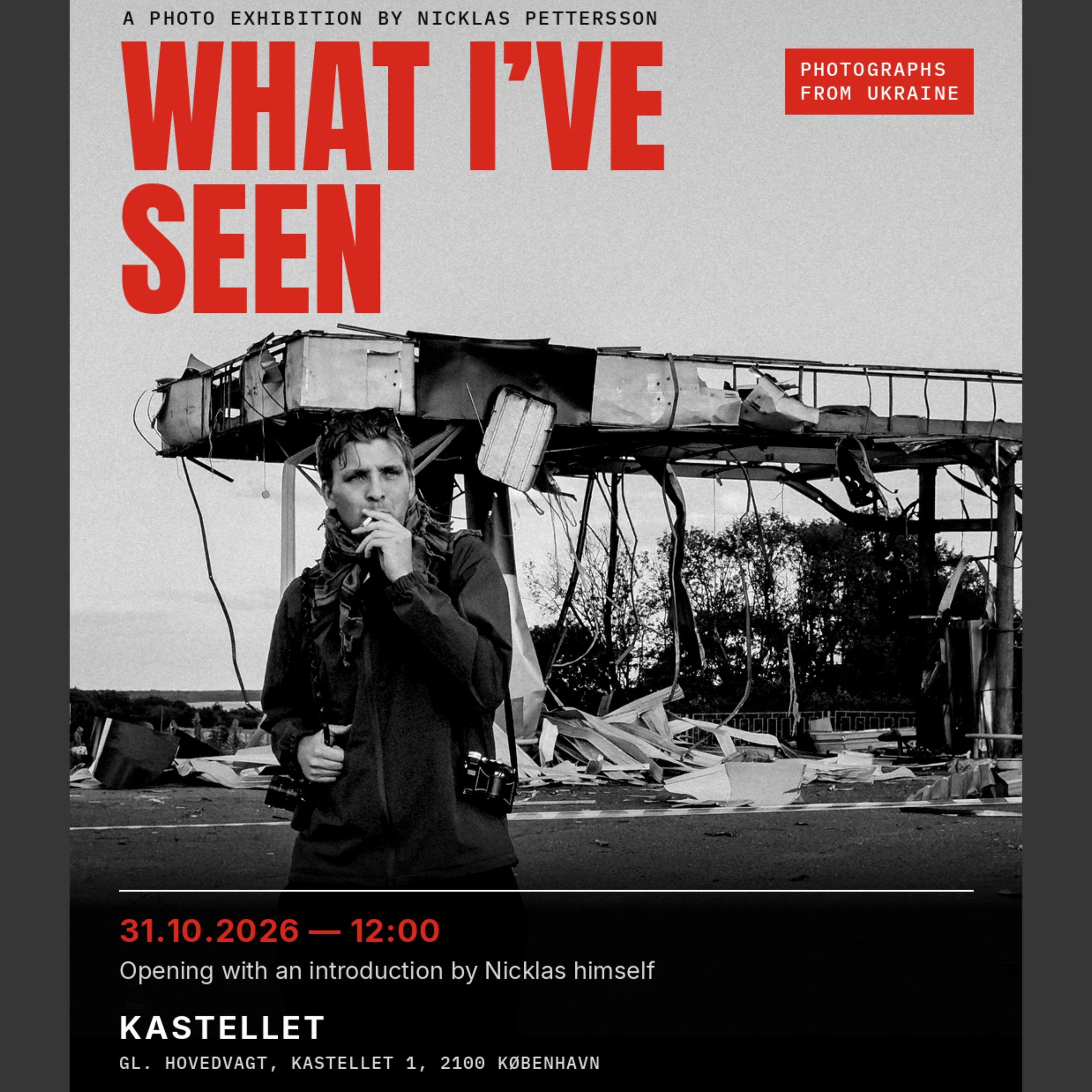
Nicklas Pettersson first came on the show in July to talk about taking a clockwork panoramic camera to the front line in Ukraine. This is the follow-up, recorded while I was on location, because on 31 October he opens his first exhibition at Kastellet, a working military fortress in Copenhagen that, as far as he knows, has never hosted a solo show. He explains how a press-manager friend, a festival and a conversation about medicine runs turned a flat no into a yes. He talks about why he turned down a corner of the fortress's info centre to get a room where he could show everything, not just death, and how 40 pictures quietly became 80. There's a first trip without a camera, a graphic designer baffled by Widelux files, thoughts on the new Widelux, and an honest account of funding the work, the book that isn't ready yet, and why the exhibition will travel.
If you're in Copenhagen
• What: WHAT I'VE SEEN, pictures from Ukraine by Nicklas Pettersson
• When: Opening Saturday 31 October, 12:00, with an introduction from Nicklas
• Where: Gl. Hovedvagt, Kastellet 1, 2100 København
(Details from a public LinkedIn post about the show. Confirm with Nicklas before publishing, and swap in his own event link if he has one.)
Highlights
• Why the fortress said no to a solo show, and the pitch about driving medicine to Ukraine that changed their minds
• Turning down a corner of the info centre so he could show everything: "Ukraine is not just death"
• The walk on which 40 pictures became 80, and the regret that followed
• His last trip to Ukraine was the first one he took without a camera, and why
• The graphic designer who looked at the Widelux files and said something must be wrong with them
• Why the Widelux is hard to print, hard to repair and impossible to give up on, plus what he makes of the new German-built one
• Selling prints, the photo book that has no obvious finish line, and a touring exhibition that starts with a single day on a military base
• Iain on the rules a solo creator sets for themselves, and why they matter even when they make life harder
Chapters
The transcript has no timings, so these are positional. Send me the audio timestamps and I'll convert them to HH:MM:SS for the host's chapter markers.
• Opening: Iain's intro, and the excited-and-frightened look of an exhibition coming together
• Early: A dream, and why a nice picture on a wall isn't enough
• Early: How Kastellet came about, from a festival to a meeting to a yes
• First third: The info-centre corner versus a room of his own
• First third: From 40 pictures to 80
• Midpoint: The cutoff point, and the trip without a camera
• Midpoint: The Widelux meets the graphic designer
• Two-thirds: The new Widelux, the Frankfurt event, and what a hand-built camera costs
• Final third: Prints, the book, funding, and the touring plan
• Close: Captions, rules you set for yourself, and a project manager
Mentioned in this episode
People
• Nicklas Pettersson — Danish photographer and documentary filmmaker · nicklaspettersson.com
Earlier episode
• Episode 123: Nicklas Pettersson — his first appearance on the show, on the Widelux, the Leica Q3 and driving to the front line · primelensespodcast.com · Opening
Tools and products
• Widelux — the fully mechanical swing-lens panoramic camera Panon first made in 1958, which Nicklas shoots in Ukraine · Wikipedia · Midpoint onward
• WideluxX — the new hand-built German revival by SilverBridges, first run limited to 350 cameras · Kosmo Foto launch report · wideluxx.com · Two-thirds
Places and events
• Kastellet (the Citadel), Copenhagen — the 17th-century star fortress that is still an active military site, and the exhibition venue · Visit Copenhagen · Opening, Early
• Chuhuiv, Kharkiv Oblast — the Ukrainian city where one of the captioned pictures was taken · Wikipedia · Late
Quotes
It's a choice one makes with their heart, not their head, I think.
— Iain, on the Widelux, midpoint
I know I'm not going to show just death because Ukraine is not just death. And because there's a lot of things, but it's also sadly death. So I want to be able to show everything.
— Nicklas Pettersson, first third
It's not easy going to those places, so why should it be easy to take the picture? But now I'm just like, but why should it be easy to print?
— Nicklas Pettersson, midpoint
Mentioned but not linked
• "Digital Q" (Opening, Iain) — almost certainly the Leica Q3 Nicklas described in Episode 123; no link added
• The off-brand Widelux-style camera (two-thirds, Nicklas) — he thinks it may be Russian-made and couldn't confirm it; I couldn't identify it from the transcript
• The Widelux event and documentary in Frankfurt (two-thirds, Iain) — I couldn't find a public listing
• Nicklas's Instagram — he says it's the best place to follow him, but the handle isn't given and I couldn't confirm one
Credits
Hosted and produced by Iain Farrell. Recorded on location. Support the show on Patreon.
Transcript:
Iain
Hey everyone, welcome back to the show. A special midweek episode this week with Nicklas Pettersson, who was a recent guest on the program talking about his work in Ukraine with his digital Q and also his Widelux film camera, which was how I found him. Nicklas has an exhibition coming up at the end of the month, and I said we should get on a call and talk about it so I could share it with all of you and we can get lots of people there.
So here's my conversation with Nicklas, recorded whilst I was travelling on location last week, so the mic does sound a little bit different to normal. Nicklas, it is lovely to see you again and welcome you back to the show. And I think we're going to talk about something that you sort of hinted at this when we spoke first time, I think, that this was a direction of travel.
And we said, we must get back together. And now I'm delighted this is the time we get to get back together. So it sounds like you have an exhibition upcoming and that you have that kind of excited and frightened look on your face that comes, I think, with organised
Nicklas Pettersson
Yeah, yeah, yeah, yeah. I have my exhibition 31st of October at Kastellet in Copenhagen. It's like a military base kind of thing, so it's really appropriate to do it there. But it's going to be pictures from the last couple of years I've spent in Ukraine. And yeah, it's really difficult to make an exhibition, apparently.
Iain
But it's funny because for people listening, I think we've all at one time or another fantasized about you'd put on a show of your work, right? And you'd organize a space and how you'd hang things and things like that. Is this something that you always wanted to do and that like, it's almost like planning for your wedding? You know, like you've got it in the back of your mind, like I'm going to do this, I'm going to do that. And then you're presented with the reality or is it kind of, is this something you've kind of reluctantly done almost?
Nicklas Pettersson
Yeah, no, it is something that I've been thinking about for a long time doing this. So it's like a dream, you know, but it's just it had to make sense because for me going to, you know, an exhibition with photos that are really nothing, you know, it's just, oh, this is a nice picture. It doesn't do it for me. So I really want to do it how I would like it.
But then you get the chance to do it and then you do it. And then you end up, you know, putting so much of your life and everything in it.
Iain
It's like this is too much man this is this is difficult I'm trying to do a part of me here at this exhibition but it's it's certainly been a dream for a long time and but you know we all have that photo exhibition and I want to make a photo book one day and but it's yeah so it really is a dream come true but it's yeah so how did this one come about because you've mentioned the location as well is is kind of working here is this that you found the location and then we're like we have to put something on there or how did it come to you
Nicklas Pettersson
I actually in the summer I got home from Ukraine. I can't remember what month or something like that, but I got back from Ukraine to Denmark and I texted some friends and I was like, what are you doing? It was like, oh, we're at this festival at Kastellet. I'm like, oh shit, I didn't know there was a festival there. So I was like, how can I get in? And my friend was like the press manager and he was like, yeah, bring your camera and you can get a And then I went out there and I was like, this is so cool.
Like, it looks really, really nice. So I just, after that festival, I texted them. I was like, I have this idea.
And is it possible? And at first they said, no, because then, you know, they don't do solo exhibition and they have like an info center for themselves where they have a lot of information about Denmark's involvement in different wars and stuff. So they said, no, it's you know then you get permission then the next one should get permission and then the next one and next one but then I told them like we had a meeting and I told them about I do more than just you know the pictures I do the humanitarian work I I drive a lot of cars there I drive a lot of medicine to ukraine and and all that stuff and then I just gather pictures you know while I'm there and and then I think they were pretty intrigued to to the whole idea and then they ended up saying yes but I don't think anyone has ever
Iain
Like a solo exhibition out there so that's so cool that's really really exciting that you're kind of also blazing a trail a little bit for you know other people or for yourself to come back their initial reluctance and then they're saying yes has that changed what you're putting into the exhibition
Nicklas Pettersson
To kind of tell the story yeah we we did a lot of talking back and forth like what pictures should be there and what pictures shouldn't. So first they said, "Oh, you can get a corner here in our info center, like a small corner where you can have a couple of pictures." You know, for me, I was like, "That's amazing. That's great. I'd love to." But then we went over there and I'm like, "I don't think my pictures would really suit in here." No, they would be kind of forgotten, I think, because there's not... I'm not going to do like a whole text about Denmark's involvement and the fighting in Ukraine and stuff because it's just pictures.
So then it was like, okay, they could understand what I meant. And it was like, oh, we have this other place actually over here. And I was like, and then we went over there and saw it. And I was like, this is perfect.
This is great. Because if it would have been in the info center, they would be restricted, like what pictures I could show. And for me, I'm like, I know I'm not going to show just death because Ukraine is not just death. And because there's a lot of things, but it's also sadly death.
So I want to be able to show everything. And when you have your own space for that, it's like people's choice to come and see it. And it's not just something I want to read about. I'm a tourist in Copenhagen. I want to read about Denmark's involvement in war.
And then all of a sudden it's like, wow, too much. These pictures are too graphic. So it works out there.
So now I got to do everything. Every picture I wanted to.
Iain
Yeah, because you've got fewer constraints, I guess. So you're there, right, you've got a lot of space. Because how much space do you have? I don't know the exact, but it's... Well, I was just thinking that must mean that you're feeling, you're going into this feeling like you've got all the space in the world.
And you're like, I can, you know, from going from a corner to going to like a quite a large room. But then you're faced with the reality of that's actually not that many pictures. I'm assuming it's like, what, like 30, 40, maybe?
Nicklas Pettersson
I actually found a way to do 80 pictures.
Iain
Oh, cool.
Nicklas Pettersson
Yeah. But we started out with 40 and then all of a sudden I went for a walk one day and I was like, "Why don't I just do 80 pictures?" No, before I started doing anything. I was like, "Let's do 80 pictures." Now I wish I would just duck to the 40,
Iain
But it is what it is. Yeah. Mistakes were made, Nicklas. Mistakes were made.
Nicklas Pettersson
It's the learning by doing, I guess.
Iain
I mean, that's the hard thing with this, isn't it? Because when you think about your photography, you think about making pictures in general, that iteration loop is really short. You can capture something, you can see it, maybe you get the film developed or you develop it. It's not that long a loop, but exhibitions, you're going to do this once and then it might be a couple of years before you do it again. So you must be just trying to absorb as much as possible from this experience.
Nicklas Pettersson
Yeah. Yeah, exactly. And it's, I think, especially doing, you know, pictures from a war zone, I think it's, it's more difficult, because I don't want to, you know, I don't want to put anyone's life out there, but it's still their life is in Ukraine.
But it's, you know, it's difficult, because it's, I have these beautiful pictures of, of elderly people and an IDP shelter, you know, and They're there still in Ukraine. I hope they got away from the IDP shelter, but who knows? Right.
And I was like, I'm going to show a picture of them here in Copenhagen. And yeah, it's really weird to do this. I'll bet.
Iain
Because you still go back. You've been back. I mean, since we spoke, you must have been back like, what, three or four times?
Yeah. With cars full of aid and things like that. Did you give yourself a cutoff point for the images you're including?
Because you're still capturing So there's kind of, I guess, right up until the most recent trip, you could still have been capturing things that you might have wanted to include. Did you try and cut yourself off and go, no, this is afterwards? Or was that quite fluid?
Nicklas Pettersson
Yeah, it's from my, not my last trip, but my last trip before that. It's actually up until that point, because my last trip was actually my first trip where I didn't bring a camera.
Iain
Oh, wow.
Nicklas Pettersson
Yeah. And it was very difficult, but it was a very personal choice. Because it became at some point it became difficult for me all of a sudden to go to Ukraine and deal with all these things I've experienced in Ukraine and so I decided to give myself a short break and then just focus like hyper focus on this exhibition and no I still drive cars and I still drive the medicine but I'm trying to give myself a break from what I bring back home because for me that's the difficult part.
I go there and take pictures and some of them are about joy and happiness and all that stuff. But some of that is also about tragedy. And when I bring it back home to Denmark, I kind of take it back into my life.
And it's just been a little difficult period of my life. So I was like, I don't think I should do that right now. And yeah, it was really weird.
Normally, the only thing I pack is my camera and then the clothes is like, oh, yeah, I have to do that. I need the cameras for sure.
Iain
That sounds healthy. You know that you're recognizing something because it will still be there in all likes of good next time you go back. Even if the war ended tomorrow the hangover from it is going to be long lasting and you will no doubt still be going there for a long time and delivering.
The need might change slightly but they'll still need stuff. They'll still need help. Yeah I think it's wonderful what you're doing.
The What images you do have then, the ones in the exhibition? Because you love shooting with the Widelux as well, which was how I found you. Have you been able to include much of the Widelux stuff or is it a lot of digital?
Nicklas Pettersson
No, it's... When I sent the pictures to the graphic guy and he said, I think something is wrong with these pictures. I was like, what do you mean? They're so wide.
They're so narrow. It's like, what do you want us to do with these pictures? I was like I just want you to print them because they look nice.
He's like yeah they are really nice but he's like how do you expect this to work? I was like I have no idea. This is my first time so we tried to like come up with something that worked but it surely wasn't made it didn't make anything easier.
Iain
No. I feel like that's the Widelux story like in a lot of ways that using that. Yes. It's a choice one makes with their heart, not their head, I think.
Nicklas Pettersson
Yeah, exactly. I remember last time we talked on the podcast, I said, yeah, it's not easy going to those places, so why should it be easy to take the picture? But now I'm just like, but why should it be easy to print? Why should it be easy to do?
I'm like, something has to be easy at some point, otherwise it will be, you know, a Widelux will really change your life. It will make it more difficult in anything you do. But I still love that camera.
But wow, yeah. Yeah, they were just like, what are these pictures? What are the ratio?
What is all this? It's a Widelux. It's a fun camera.
Yeah.
Iain
I like that you're still encountering people who don't know what it is. Because I think to us in, you know, in Cameraland, that camera, we're like, yeah, we know the Widelux, but it must be nice to sort of share it with people who've just never seen that perspective.
Nicklas Pettersson
Exactly. And it might actually be the perfect camera to cover, you know, war and other things. Because it takes a frame of the world right there.
With the swing lens, it really captures everything. My Leica, it's 28. It's wide, but it's just not super wide.
Something happens right across where the picture ends. That was the Widelux. You have no choice.
You can be in everything. Even if people don't want to be in the pictures, they try to move to the side, the Widelux will get you, man. There's nothing. You cannot escape the Widelux.
That's how it is.
Iain
No, you can't. As an aside, on the week that this is going out, I'm going to Frankfurt to a Widelux event. They've made a documentary in Germany about the new Widelux. Yeah, that's going to be going on. So that'll be quite exciting to sort of meet some Widelux fans. I can try and at least get my hands on one briefly.
Nicklas Pettersson
Yeah, have you pre-ordered one, the new one? No.
Iain
3,000 euro kicking around down a sofa somewhere. I'd love one, but yeah, I think that one. I don't begrudge them charging it.
Nicklas Pettersson
I just bought a, like a, I can show, it's like a, I would say an off-brand Widelux.
Iain
Oh, okay.
Nicklas Pettersson
I think it might, not ideal, but I think it could be like Russian made or something. But it do like the same thing.
Iain
Wow.
Nicklas Pettersson
It's just not as nice as the Widelux. The Widelux is always just looking at me. It's like, what is the next adventure? I'm like, you're not going because you're just going to break wherever I take you.
Iain
I think that's going to be the challenge with the new ones. Making a clockwork camera is hard, as it turns out. And hand making them in Germany to a small number. I think that's what's so interesting, though.
Because as you say, there is something magical about that camera and everyone who uses one loves it. But it is, what is the global addressable market for Widelux cameras? Like, I don't know.
Nicklas Pettersson
And the price, I was really shocked by the price. I was like, it's, is it really worth that? Who knows?
Iain
It depends if it lasts another hundred years or whatever, you know, like some of those cameras are 50 odd, 60, 70 years old, you know, or they're knocking on that door. So maybe, I mean, you get Leica M's and, You know, original M's that still shoot.
Nicklas Pettersson
Yeah, yeah, yeah. But I thought it was expensive to buy a Widelux, but surely the most expensive part is keeping it alive.
Iain
Yes, yes. You've had to do a lot for yours. Having said that, I don't know if every Widelux has as difficult a life as yours has had.
Nicklas Pettersson
No, it could be, yeah. And every time I go back home, I just see, oh, I lost this little screwy thing. And I'm like, but where does it go? It's just around my neck.
But yeah, I'm not too easy. I know that. But yeah, it's doing a great job.
Iain
So with the exhibition then, you've got these photos going up. Are you going to be selling prints and things? Is this the beginning of a book project? Or is there something you could do with this afterwards?
Nicklas Pettersson
People have the chance to order a picture if there's a picture they like or something like that. But I'm surely working towards a photo book at some point. But the money is just, you know, I do all this work when I don't have an assignment.
I do all this work with my own money. And I've spent so much time in Ukraine and I try to be really fair, like my fixers and stuff. I try to pay them what I think is like what they're worth to me.
So I pay, I think, a little over market, if you can say so. People to donate money to me to keep doing this work if they find it important and inspiring and stuff. And at some point the book will come out, but it's difficult because I don't know when are you done?
When are you ready to make a book? I have the pictures now, but the pictures from three years ago are not as relevant as the pictures now, but that could also be the point that they, how the war has changed. But then you just take up space from how the war is now. And yeah, it's difficult.
Iain
But people can support me and buy a picture if they want to. Well, we'll put a link to your website and I'll make sure and share links to the exhibition like nearer the time. How long is it on for from the 31st?
Nicklas Pettersson
Yeah, because it's like in a military base, it was only possible to do one day. I already got arrangement in the bigger city in Denmark. So it's actually going to be like a traveling exhibition.
And yes, I will take it back to where I lived most of my life. And then I would take it further and to all the big cities and do different shows and people can meet me. And, you know, yeah.
Iain
Fantastic. Do you have a mailing list or anything that people can sign up to for updates on where you're traveling to?
Nicklas Pettersson
No,
Iain
But it's a good idea. I've just added something to your list. I'm sorry.
Nicklas Pettersson
It's great. Now it's also there. Yeah. It's just it takes so much time doing an exhibition. It's really difficult.
Iain
Especially when you're doing it all yourself, I assume, really.
Nicklas Pettersson
Yeah.
Iain
Yeah.
Nicklas Pettersson
And I really shouldn't be. I wish I had the money to pay someone to do the captions or something. But people don't know.
Like if I say, oh, this picture is shot in Chuhuiv. But then it's like, how important is it that it's Chuhuiv? Like, who knows Chuhuiv?
Iain
Yeah, I think it I guess it comes down to with all of these sorts of things similar with the show. It's the rules that you put around it yourself. No one else, you know, as a solo creator of things as well. It's like you establish the grounds for yourself and a bit like with the Widelux, sometimes that makes your life harder and sometimes it doesn't. But it's if it's important to you that it's included, then it's important. And it needs to be there.
Nicklas Pettersson
Exactly.
Iain
Well, that sounds super exciting. That's going to be really, really good. I'm very excited to share it with everyone and make sure that people know and that people know that they can come and buy prints and things like that. Because I think, yeah, what you do is really incredible. And you might need a project manager as well.
Nicklas Pettersson
I might. I might, yeah. Yeah. Could be a good idea.