Episode 136 - Colin Prior
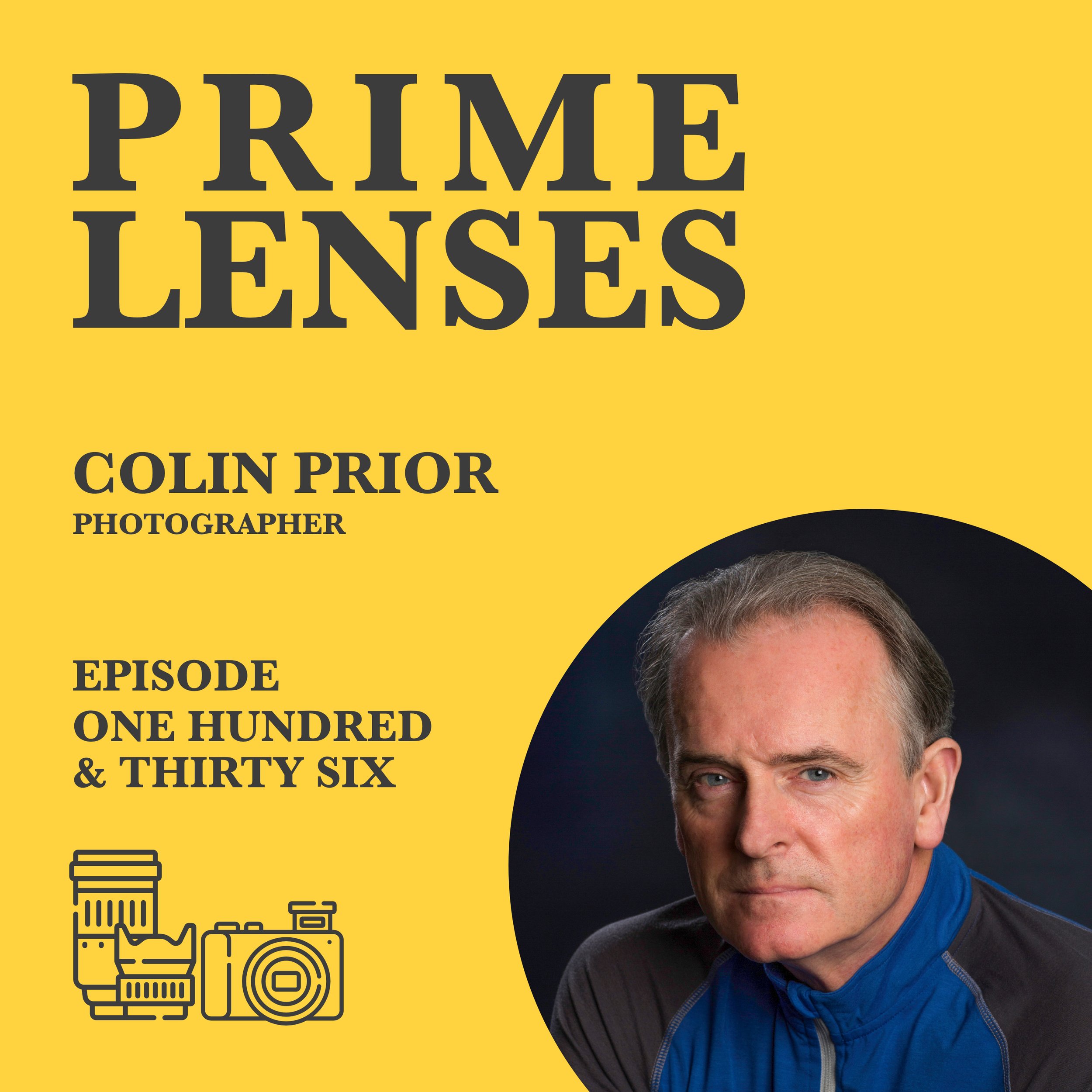


Prime Lenses Episode 136 – Colin Prior
Four decades of Scottish landscapes, the camera he sold and never went back to, and thoughts on the future of photography and AI.
Guest: Colin Prior — Scottish landscape photographer, best known for his panoramas · colinprior.co.uk
In this episode
Colin Prior has spent four decades photographing Scotland’s mountains, much of it on a Fuji 6x17 panoramic film camera, and he opens this conversation with the one thing he says to everyone: it’s not what’s in the picture, it’s where it takes you. From there we talk about the eye path, which he’d like you to think about instead of leading lines, and why he’ll take a few stray white dots out of a frame. He explains why he sold the camera that got his early work noticed and never went back, and he’s blunt about the world it left behind: magazines that no longer pay, video eating stills, and inkjet ink that costs more than a good whisky. His case for books, and for handing yours to a publisher and a designer, runs through the middle of the episode. We finish on AI, an AI-made Odyssey, and the book he’s been working on for ten years and isn’t in a hurry to finish.
Highlights
~9:00 “Leading lines” is the wrong idea. Colin calls it the eye path, and he’s happy to remove a few stray white dots to protect it.
~15:00 If you have to ask yourself whether you got the picture, you didn’t.
~16:20 Why he sold the 6x17 camera behind his panoramas, and why stitching digital panoramas never tempted him.
~22:20 The brain stores a still image as a single moment. Video, he says, goes in one ear and out the other.
~24:50 Inkjet ink that costs more than a 21-year-old single malt, and the case for letting a lab do your printing.
~29:10 Why he has never self-published: you sell to the choir and the congregation never sees it.
~40:20 On his workshops: the camera stays in the bag while he walks the landscape looking for evidence.
~56:30 The book he has been making for ten years, and why he doesn’t want an end date.
Chapters
0:00 Cold open: “It’s where it takes you”
~0:20 Iain’s introduction
~1:20 October light, and four winters without snow
~5:30 Why landscape? Birds came first
~9:00 The eye path, rogue highlights and what editing really is
~14:00 Self-taught, and what failures teach
~15:40 Selling the Fuji 6x17
~21:00 Magazines, video and the brain that stores single moments
~23:50 Megapixels, prints and the inkjet problem
~27:40 Books: design, distribution and why not to self-publish
~37:20 Running workshops: critiques, and the camera that stays in the bag
~42:00 Thinking in layers
~44:40 Undisturbed places, Skye as a theme park, and Munros
~49:00 Trends, 500px and colour in print
~53:10 AI, and the AI-generated Odyssey
~56:30 The ten-year book and the underground archive
~59:50 Where it takes you, and where to find Colin
~1:01:40 Outro
Mentioned in this episode
People
Colin Prior — the guest; Scottish landscape photographer, best known for his panoramas · colinprior.co.uk
Joe Cornish — landscape photographer and a friend of both Colin and Iain · joecornish.co.uk · ~3:50
Graham Niven — Nethy Bridge photographer and an earlier guest (Prime Lenses Episode 131), whose conversation led Iain to Colin · Niven Photography & Arbor Gallery · ~6:00
Ansel Adams — Colin’s comparison for digital dodging and burning · The Ansel Adams Gallery · ~13:20
Music, film and video
Behind the Lens — the Sigma video series Colin and Joe Cornish made together, which Iain mentions enjoying · Colin’s write-up · PetaPixel on the series · ~31:20
The 2.5-hour AI-generated Odyssey movie is 2.5 hours too long — the Verge review Iain read that morning, of the AI film Odysseus: The Fall · The Verge · ~53:30
The Odyssey — Christopher Nolan’s 2026 film, released around the same time · Wikipedia · ~53:30
Tools and products
Fuji GX617 — the 6x17 panoramic film camera behind Colin’s panoramas, with the 90, 180 and 300mm lenses he mentions · Specifications · ~15:40
500px — the photo-sharing site Colin was once told to put his panoramas on · 500px.com · ~51:10
Companies and institutions
The Royal Photographic Society — Colin says he told its president that nobody will print while printing costs this much · RPS Distinctions · ~26:30
Waterstones — Colin on why photographers’ books need mainstream distribution, and what the shelves look like now · waterstones.com · ~29:10
Places
Isle of Skye — the Quiraing, the Old Man of Storr, the Fairy Glen and the Fairy Pools, and Colin’s view that Skye has become a theme park · VisitScotland · ~45:50
Schiehallion — the mountain above Kinloch Rannoch in a friend’s photograph, with sheep creating the eye path · Wikipedia · ~9:50
Find Colin’s work
Quotes
“I say to people, remember it’s not what’s in the picture. It’s where it takes you.”
Colin Prior· 0:00
“It’s your failures that teach you more than your successes.”
Colin Prior· ~14:40
“The danger with self-publishing is you sell to the choir and the congregation doesn’t see it.”
Colin Prior· ~29:10
Credits
Hosted and produced by Iain Farrell. Guest: Colin Prior.
Prime Lenses is a series of interviews with photographers talking about their photography by way of three lenses that mean a lot to them.
Sign up to the Prime Lenses newsletter for a mid week treat. Support the show on Patreon.
Transcript
Colin Prior
I say to people, remember it's not what's in the picture. It's where it takes you. And that's the important thing. And if it takes you to a good place, then you know it it it creates hopefully an enthusiasm amongst other photographers to go out there and find their own voice and express themselves in similar ways. That's the magic of photography.
Iain
Well with an introduction like that, there is an argument that you could almost stop the episode there. Cause Colin has summed it up brilliantly. And that's what's great about speaking to someone who has had such a long and varied career in photography. Colin really knows his onions and when he came up on my conversation with Graham Niven, I thought, well I've got to reach out to him and speak to another brilliant Scottish landscape photographer He is opinionated and forthcoming in his views, but I love this conversation for its honesty about where photography is today, and although a lot of things are changing and it's probably never been harder to be a working photographer Colin's optimistic and thinks that this is also an incredible time to be a photographer and to have access to all these amazing photographic tools. I loved sitting down with him for a little while and I hope you do too, so here's my conversation with Colin Prior.
Colin Prior
How's life treating you?
Iain
Really good, really good, thank you. Um it's gorgeous up here today or a bit windy, but but the light is gorgeous. Um but it's passing through because I'm up near Aviemore, so Nethy Bridge.
Colin Prior
Well that you know it's it's it's dropping a bit in the sky, the arc, and it's it's just it's getting really interesting now. Um because October's the best the best month of the year, isn't it? For landscape photography and you know we get five five months of of greenery and what we essentially get a month of autumn, really. And you know when you get a great day, you think to yourself about the places you would like to be and of course the next day still the same.
Iain
Yeah.
Colin Prior
You never get enough time to really do what you want in the autumn.
Iain
No, this time of year is definitely it's interesting. Like driving down to like to Grantown and stuff and sort of seeing the valley where I live Just the scenery's stunning. Like this time of year you've you've actually got some depth and some texture to it. There is that period like you were saying where everything's just green and there's nothing There's nothing that differentiates anything. There's kinda almost no interest some of the time.
Colin Prior
No no, it's very difficult to to differentiate one element in the landscape from another. And you know, you go there in October and even if you're driving through Glen Coe, it's just a wall of green
Iain
Yeah.
Colin Prior
July and August. You go there in October and November and you've just got these all these browns and goldens and you know And of course what we always struggle for, I mean you're a bit different than the Cairngorms, but on the west coast for the last four years there's been very, very little snow. I mean, I've been trying to get shots for four years Specific shots.
And there's just not been the stability. I mean, if you get a bit of snow it it's gone and and the following day. It just it doesn't lie.
Iain
Yeah. No, it's this it's and it's been the same here, like we last season wasn't too bad. Um taking the kids skiing and stuff up on the mountain wasn't uh actually the patch filled out quite nicely and they managed to keep it going.
But Yeah, it's the year before there was there was very little and yeah, just it's funny. I mean it's it's changing a lot. We've talked we have a friend in common in Joe Cornish and he and I've talked a lot about like just the change in the seasons and the scenery and stuff and it's just you see it happening and you're having to go f more and more extreme to still get any any snow at all, really.
It's kinda mad.
Colin Prior
It just it just I mean, I've been trying to get shores in the coolant for four years and it's just not happened.
Iain
Yeah.
Colin Prior
Um and this year I was up in the north. I went to I think the third of January. I was up in Otherpool for three days and It uh there was quite a lot of snow there. It was wet snow, but there was there was hail showers and and sleet and I shot nothing. Three days nothing.
Iain
Right.
Colin Prior
And I went back in early February And there's just too much cloud around. Um I never got a thing last year in the winter. Not a thing.
Iain
Nah, it's nuts, isn't it? Wow. Yeah, thank goodness you've got a back catalogue. You still look back on some of it for the Christmas calendars.
Colin Prior
Well and indeed I'm always struggling for snow pictures. Always struggling. And it you know, it would I mean I normally like a bit of snow in the mountains, November, December, January and February, but to represent the British climate, the Scottish climate now If you had one month with snow on it, you know, whether it was January or February, you know, that that would that would um be typical now of the climate we have.
Iain
Yeah, yeah, no.
Colin Prior
Not four months over.
Iain
No. There is so much that is worth picking up with you, I think, because talking to someone like you who has photographed a lot for such a long time and seen so much of the world. You've traveled everywhere. Like it's not just sort of landscape in the UK and things like that.
You've been you've been everywhere. When I was sort of doing some prep for this, you came up in conversation with a previous guest, a guy called Graham Niven, who lives local to me. He and I recorded an episode walking around Loch Garten and uh went went out just recently.
It was lovely. There was um little bits where Graham's pointing out for me to not step on a frog while I'm talking to him and stuff like that. It sort of gives it a different a different feel Um, but he was talking about being really inspired by your work, Early Doors, you know, when he was seeing this work and just like, wow, and it's inspired him to go out and camp and things like that.
There seems to me that photography, when I talk to a lot of photographers, there is a kind of I can't find a better word for it, and I don't mean it in a bad way, but it's like it's kind of a selfish art form and a selfish pursuit, because you do have to be there. So if you want to get amazing landscapes then you just have to like really be motivated like we were talking about at the start. You've got to be motivated to go.
And I'm curious with you, there are so many forms of photography that you could anyone who's proficient could pick up. What was it about landscape and the drawer of these outdoor places? They must have a pull on you.
What was it that kind of first got hold?
Colin Prior
Well, I it's a good question, Iain, that um uh and uh um I mean I've always had this deep-rooted passion for the natural world. And my first love was was actually birds.
And um I I I was really inspired by by birds and Uh when I discovered photography, um I realized that I could say more about the natural world through the medium of landscape than I could through birds And I was kinda drawn to landscape in a way that I wasn't drawn to photograph birds. And if you kinda think back to the the sort of you know, mid eighties, the ability of even professional wildlife photographers to capture the sort of images that are commonplace today with the tracking um that's now in cameras, which is really fighter jet technology that's migrated uh into cameras for tracking missil missiles in flight. I mean it's just um mind boggling.
It might have been a bit different, but I kinda felt um that, you know, despite the fieldcraft that wildlife photographers need to have, that the difference often between a fantastic wildlife photograph and a mediocre one is what the the the animal itself does over which you've no control. And sometimes it's a bit true of of landscape, particularly seascapes where Uh you can set up a fantastic composition, you think, but the the waves create lines across uh the your your frame and the conduct the eye in a way sometimes that you hadn't intended the viewer to follow So I in a way that movement creates graphics uh o or elements that aren't positive within a landscape that that destroys the eye path. I refer to it as as the eye path, the way that your composition conducts the viewer's eye through the landscape.
I mean magazines call it leading lines, but It's not really about leading lines. It's it's about that eye path. And it if if I'm doing my job properly, everyone that looks at the at one photograph should navigate it in exactly the same way.
Iain
Yeah. And I think what you're talking about that's interesting if 'cause a leading line does assume a sort of very direct route into the image and that kind of layering of things. Whereas as you say, an eye path can be you're following interesting elements through the image. A friend of ours photographed over in Kinloch Rannoch and has a wonderful shot of the kind of the foot of Schiehallion in the mountain with sheep kind of sweeping across and the sheep are creating that path and it's a curve and and it's cheap so they're like they're spread out and they're sort of dotted but if you squint there is a kind of line through and it doesn't follow any rules of thirds and it doesn't follow any straight lines but it just works. It just pulls you in.
Colin Prior
Sometimes that's the case, but I mean often I find with sheep that are in the distance, um they create, as you know, these tiny white dots. And they can they they have the same effect as what I refer to as rogue highlights. So your eye and your brain's very good at picking up um things that uh in the landscape that um are anomalies.
You can't help it. And often I take them out. Mm a lot of people won't notice them, but the brain and I goes to these white spots and explores them.
It's the same as having little bits of black stones on on a on a white coral sand beach. Because they stand out And sometimes I don't mean to sanctify the whole um beach, but sometimes there are aspects uh that there's l there's there's there's a few of these elements that I might remove And I don't really believe that that changes the integrity of the photograph because I'm not adding things or I'm not making a fundamental um change to the photograph, but what I'm doing is just um ensuring that the the viewer's eye is conducted through that eye path without having to go and explore things that are irrelevant.
Iain
Yeah.
Colin Prior
To the the experience of looking at the photograph.
Iain
Yeah, it's editing, isn't it, in a way. I mean I'm I'm just y and by editing I mean like when people write, some of the greatest writers in history were made great because they had great editors Who helped them to kind of keep to you know stick to the point and and keep things focused. J Joe sent me an early copy of his book to have a look at, the one he's working on right now.
And we were talking about it's wonderful. And we were talking about one page in particular where he's he's got so many big ideas that he wants to convey in this one page of text. That he and we were talking back and forth about the challenge of like putting all of that across in one thing.
And so I think about it in terms of image making as well. There's a I think a naivety sometimes. With photography where and it comes from film photography, people or people's understanding or lack of of film photography, where they're like, well, what was in front of you was this sacred thing, and you know, it was exactly as it was, and you can't possibly change it.
And it's like, well. We've always made choices, whether it was exposure, whether it was in the dark room later, you know, emphasizing certain areas of the photos. It's never been, or it's never had to be a perfect reproduction.
And I think what you're talking about is exactly the same thing, is that changing an image or rem it's no different to removing dust or scratches on a negative.
Colin Prior
Exactly. Exactly. I mean it it uh it's actually I in a way it's the same as as digitally dodging and burning. Yeah I mean, you know, and what Ansel Adams did back all these years ago, as you know, in the dark room was to conduct your eye uh in a way that followed that eye path more accurately in the way that he wanted you to do that. So he would lighten up shadows and he it would it burn in the highlights so that you're your eye wasn't stuck on the highlight and you know the eye tends to go to the brightest point in a photograph. So it's just uh it's managing um that eye path
Iain
When you were learning and being taught photography, was this something that you feel like you arrived upon in your process in your practice of doing it or is this something that came to you via mentors and and stuff that you were looking at that sort of trained you?
Colin Prior
No, I it I mean, it you know, it it's all self-learn. Um I mean w we're all inspired by other photographers. And and have been, particularly when you're younger.
But it it's it's looking at what you're doing and and asking yourself how how can I make this better? How can I improve? Because Uh it it it it's the failures, it's your failures that that teach you more than your successes.
I mean you kinda know when you've shot a great picture because it screams at you, you vote, look at me.
Iain
Yes. Look
Colin Prior
Look how clever I am. And it doesn't happen very often. And I say to people, if you have to ask yourself, Did I get this picture? The answer's no.
Iain
Yeah.
Colin Prior
Because when you do it announces itself immediately. Um so I it it's it's uh it's it's looking at your mistakes and and thinking how how can I How can I avoid that pitfall again? You know, because when uh you know I was more active in the mountains and and you know that commitment of time and you know the physical energy pushing twenty-five kilos up on to you know the tops of mountains or round the tops of mountains.
Um you you had to make sure that if you got the conditions that you were hoping for, that you were going to come back with something. And of course I was shooting with a a 617 film camera and um uh uh uh uh an ambient light meter. So uh you had to have a process that was going to guarantee you that uh a result when you come back.
And of course the only way you could do that was was with bracketing at that time. So um, you know, I I wasn't sad to lose film. I I was sad to lose that three by one format in a way.
But I had reached a point in my life or in my career where I was feeling that three by one format was becoming a bit of a Uh a creative street jacket and uh digital photography had come along and um I kinda felt liberated when I I I started shooting digital again with a with a range of lenses um because you've got a very limited scope um to use on on on a a a Fuji six seventeen
Iain
I've developed a bit of nostalgia well, I didn't come up using film. Like I discovered photography, although I shot film like when I was younger. When I really wanted to start making pictures with w was with digital cameras and it was with a Nikon D40 bag Back in the day.
And then I'm mostly digital now, but I've allowed myself to get bit back into film. And it's funny you were saying about like refining that process and being stuck I've ad re I've this week admitted defeat that when I'm developing my own film at home, I just need to get a proper scanner now. Like I've been trying to use my camera and it's just a faff.
And I'm just, I need a thing that I can put it in and that will scan it consistently every time. So like, as much as I'm enjoying the process, I do know what you mean. Like you can't get through those iteration cycles.
But when you made that switch, was it a sort of you say it was liberating now uh in hindsight. At the time were you sort of apprehensive about making that move?
Colin Prior
No, I I knew it was the time. I mean I'd produced quite a lot of books uh with that three by one format and I just kinda felt there was an awful lot more that I wanted to do and explore
Iain
Yeah.
Colin Prior
So it was time for that um format to to um to go and you know I sold the cameras and I've I've never um I've never really wanted to go back and shoot that format. And ironically a lot of people said um to me at the time, um you must be shooting panoramas digitally But that didn't float my boat either because as you know if if you if if you're gonna shoot panoramas digitally on an upright format. Some uh some images will demand that you shoot say eleven images which are then stitched together Um and the next time you go out and find a panorama, you might find that you've obviously got a different focal length um uh lens on. Um and you only need six images. So not only are the panoramas different lengths, they're different heights as well.
Iain
Yeah.
Colin Prior
And there's no the you know, if you're trying to do a book there's no synergy.
Iain
Yeah.
Colin Prior
And it's not as if you can crop the the longer panoramas because they'll lose their impact. Yeah. So you've got you've got panoramas that are different sizes and uh you know, different heights and lengths and there's very little you can do in that creatively.
Whereas with the 617, there was a you know there's that there's a you know it there's a a rectangle there, there's a a letter box format which is consistent and it means that Ye I mean you could use the two lenses, the the the 90 and the 180, but the the 300 was really pretty useless because you you know it was a crop that you could have done with many other formats But um uh it it was you know I wasn't I wasn't sad to see that go. It it was great at the time and when I started using that Nobody had really seen that format. So newspapers and magazines were very, very keen to publish it, and it gave me a lot of exposure in the early days.
And of course it, you know, it attracted the attention of publishers and eventually British Airways commissioned me to do calendars in that format. But um now I think, you know, with the younger generations, th these formats they can't ha you know, they they don't have the same impact because, you know, everyone in their dog's got a drone now
Iain
Yeah.
Colin Prior
So they you know they can put them up and they can shoot um those types of vistas uh with their drones and and obviously shoot panoramas with the drones. From points that are not um earthbound. So the you know it's it's people with drones that um um that you know that that's there that wasn't there back in the the you know the day when um these wide format cameras uh had so much visual impact and of course there was so much more imprint at the time.
Iain
Yeah.
Colin Prior
I mean, you know, you go back twenty odd years, twenty-five years Um there were fifteen photographic magazines. And you know, these fifteen mag fifteen photographic magazines were being supported by advertising because they wouldn't been there if there hadn't um been enough money to to sustain them. And you know who looks at magazines now, photographic magazines? And of course there's no money being put into photography.
Iain
No.
Colin Prior
You know, if if you went back twenty years ago the magazines were featuring the work of professionals that were shooting you know, fashion uh shoots that were out, you know, uh with big name fashion brands. Um there were car photographers travelling around the world. There were commercial architectural photographers There were calendar photographers, you know, what the and and you know the magazines had these big features and these were the showcase features that that kind of created the passion for aspiring younger photographers and for you know for amateurs as well. And of course that whole mechanism is that doesn't exist anymore because If a brand wants to publicize itself, the first thing it wants a video now.
Iain
Yeah.
Colin Prior
And I'm really quite surprised uh um how quickly photography has been eclipsed by videography. And of course it's because all the algorithms on the web are geared towards moving image. Yeah.
But the fundamental thing that people seem to have forgotten is that the human brain cannot store moving images. And the human brain stores image is uh images in single moments. So if you see a really powerful still image, it goes into the memory very quickly.
And importantly, it can be recalled very quickly. Whereas a lot of video content whistles in one ear and right out the other and doesn't stick.
Iain
Yeah.
Colin Prior
And we've kind of lost sight of that because Moving images are now for the first time in their history not that expensive to produce. But it's not going away and photography's not coming back. And the technology that's been produced is for videographers now. I mean there's a There's a big emphasis on f/2, f/1.4, f/1.2 lenses, and it's so that they can go on a on a video um camera or a DSLR, sorry, a mirrorless camera rather, but Um and and shoot um uh interviews wide open.
Iain
Yeah. Yeah, get that background separation in, yeah.
Colin Prior
Yeah, I mean you see it every night if you watch the news. You know, if you're watching news there'll be a political correspondent there in Westminster or behind and You've got these lovely bokeh bowls and the traffic lights and the buses in the background. I mean it it looks quite nice.
Iain
Yeah, it is fun.
Colin Prior
We're not important to the manufacturers anymore. Not as not as important as we used to be. And we you know we we're we've got these hybrid solutions.
I mean, don't get me wrong, the equipment is absolutely fantastic at the moment. This is the golden age of photography. I mean to have the resolution in these cameras and the lenses we've got is just great.
I mean Yeah, I mean you can shoot images if you want more intimate landscape images, you know, with the same camera that you can use to try eagles in flight
Iain
Yeah.
Colin Prior
You know, and the eye has been tracked in motion, one camera doing it. And you know, who actually needs 60 megapixels? I mean, who needs a hundred?
Iain
Yeah.
Colin Prior
You know, I mean professionals don't need more than thirty, really. Because that's big enough for books. And nobody's buying prints really. You know, every I can do huge prints. Oh good Who's buying them?
Iain
Yeah, yeah.
Colin Prior
Oh you should be printing your work. Oh really? Yeah.
Don't leave all these images in your hard drive. No, no. Spend a fortune on inks. And then put them in a folder that sits under your desk that no one looks at.
Iain
Yeah.
Colin Prior
And but ink inkjet printing is a complete and utter joke I mean, when a carton of inks becomes more expensive than a bottle of 21-year-old single malt, you know they are taking the Mickey. 21-year-old whiskey is uh one of the curtains and what you got, 12 and one of these inkjet printers. It's complete madness. And you can I mean, if you go to a professional lab, they'll print your prints for next to nothing.
Iain
Yeah.
Colin Prior
Compared with what you're gonna waste on an inkjet printer
Iain
Oh yeah. No, they've they've got us for sure. And I I I found that I've got a a Prograph behind me.
Um and it's for doing it's high days and holidays You know, 'cause I I talk on the show a lot, like I'm a tourist, so I'm enjoying making images and talking to photographers, but I don't pretend that I am a photographer. I'd approach things I think slightly differently Um, which is why it's so good to talk to people who are actually doing the work. Because I think there's this romantic notion that you see on Instagram of print your work and do this thing, but then there is also the the practical reality of that of that the investment you'd need to do that all of the time, you'd you know, you'd better be working to to justify that cost and cover that cost.
We've kind of got things slightly out of whack for sure
Colin Prior
Well it's the manufacturers. They they need to bring in a credible way to reproduce photography that's inexpensive Because nobody's gonna be printing. I mean I said this to President of the Royal Photographic Society, you know, because they've now got the scholarship uh on digital.
Um Uh it as a den a digital submission and I don't know whether they've done it with the associate shit. But uh it nobody's gonna be printing Because of the cost of it. I mean and uh it they're just shooting themselves in the foot.
I mean people would like to make their own prints, but at the cost that um it is at the moment it's it's it's not feasible for for for what you're getting back I mean a technology v is fantastic. It's what my you it's fantastic to watch these machines work But from a business perspective, it makes no sense. If you've got the money and you want to put it down the drain that you've got to pay for as well at, you know, sixty pounds to replace.
That's um, you know
Iain
Yeah.
Colin Prior
But
Iain
Go for it. But you
Colin Prior
Get go for it. You know, I mean it can give you a lot of pleasure because you print your own work. Don't get me wrong. I'm a great believer in in uh print being the end product for photographs, not screen.
Iain
Yeah.
Colin Prior
But inkjet prints know. A book is the most authoritative way in which I think you can um interact with photography. It's got to be really well printed and really well designed. And it's design that lets most photographers' books down. Because they're creative, they think they can design, but they don't usually have a very good grasp of fonts
Iain
Yeah.
Colin Prior
And what fonts work with each other and they don't know how to lay the book out in a way that a designer will lay a book out. And there is a protocol for books. There's a standard protocol which most of them don't understand.
So y by all means do your own books, but get a professional designer to design the book. That would be my advice. Because that's where the the they're really let down.
They're not proof red either.
Iain
Yeah.
Colin Prior
And so they're full of typos. Um and punctuation marks. Self-printing, um self-publication is what most photographers are having to do because it's very difficult to get a mainstream publisher But um my argument I've never self-published books because my argument is that um I want my work to get out to a wider audience. And there's only the only way you can do that is through distribution the distribution of mainstream publishers because Waterstones will not deal with um photographer publishers and bring books in They they want to deal with fewer suppliers. And the danger with self-publishing is you sell to the choir and the congregation doesn't see it.
Iain
Yeah.
Colin Prior
And that is the difference. The purpose of a book is to get your work out into the marketplace. So the people that um are gonna buy the book, you know, the people that follow your work and are familiar with your your work.
They're gonna buy it whether you publish it or whether a publisher buys it. But it's all the people that don't know about your work. And people perhaps overseas if they manage to get um a a co-publisher in in another territory, another country.
Um that is um still worth a great deal than self publishing. Um but for most photographers It's the only route to marketplace and they can make more money from it than they'll get from a royalty. But for me it I mean Publishing a book f financially is madness.
I mean you're gonna put ninety-five percent more than you're gonna get back out it. You know, it's yep Yeah it's it's about passion. It you know, it's uh it's about having that in the marketplace.
And um Uh you know, I would urge photographers to work towards a project um that is meaningful rather than a collection of random landscape photographs. It's trying to um illustrate some idea that um has a purpose.
Iain
Yes. And you don't have to talk to the guy making the audio only podcast in twenty twenty six about making the thing that you're passionate about rather than rather than the thing that's commercially viable potentially. Um but you're absolutely I think you're absolutely right.
And I think the The thing about books and the thing about publishing, it also brings you a network that you become part of. Because this this is one of the things we talk about a lot on the show as well with photographers, is that if you're not careful, it can be a really solitary thing that you're doing. But there's also value not just in making the asset, but making the connection with people doing other things, which then presumably leads to contact with other people, like the stuff you've done with Joe and uh for Sigma and things like that.
Loved watching those little videos you guys think. They're fun, great.
Colin Prior
They're really fun to me.
Iain
But it it's because you don't get to see necessarily two working photographers discussing their process out in the wild and talking about that stuff. And things like that don't happen unless you put yourself out there. You know, if you just sit in your cave and make stuff You don't get to develop those connections and I think that's the stuff that A keeps creative people in the work because you don't feel isolated but also B leads to things happening. You've got to go out there and and take the risk and maybe not maybe not get a spectacular return on a project. But it will give you something you can take out into the world and it'll introduce you to other people.
Colin Prior
Well I think uh I mean it's essential for photographers to create books um because Y you know, having your work online is important, but um it you know it it's it's it's fleeting. Uh whereas a book, um it is is always there and and the important thing about a book is that it needs to be accessible. And the strength of any book is that whoever buys it actually picks it up and looks at it on a reasonably regular basis for an inspiration hit.
I mean that's that's what you're hoping for. Um, but there is a danger with landscape with any photographers in particular landscape photographers. Uh, you know, we tend to work in a silo And um it's difficult to get feedback about what you're doing um um with other people.
But you know, having worked with quite a number of um mainstream publishers and and the editors that they work with and the designers they work with. They you know there's there's there's a great deal of expertise there that, you know, particularly in the editing
Iain
Mm
Colin Prior
That you just don't have access to um if you're doing that yourself. And it's the difference between something that that really sings and something that um you know can disappoint
Iain
I'm a big believer in kind of finding people to work with and finding the right person to work with on something because we always bemoan the loss of skills when something goes away. When you know when photographers I w I knew a sports photographer once who'd started in film and so he'd shot MotoGP on film. You'd finish the race, hand your roles to someone else, they would go off and develop them, the editor at the magazine or the newspaper would pick out the images, and your job was done. And over time what we've seen with photography is that just more and more of that is getting pushed onto the photographer themselves and then not necessarily the the greatest editor or the the right person to choose from their images because there'll also be the image they love that they submit that the photodesk editor never gets to see And actually might have chosen and might be able to give you valuable feedback as a photographer, like go more in this direction. This is more useful.
Colin Prior
Very much. Um it's feedback. Um and it's it it's um It's just having the opportunity to produce the best possible um representation of your work.
And of course the the big asset is distribution. You know, you don't need to um be filling a bedroom up with you know a thousand or two thousand books and um it you know it's easy to spend money in print it's very difficult to turn it back into money that print And distribution is the key. It's absolutely if you don't have distribution, you just can't get your work out there.
Um I mean there there's only thing yeah, I remember going um to uh a seminar um many years ago and the guy started the presentation of well he said all he said was there's there's only three things you need to know about business He said the first is distribution. He said the second is distribution and he said the third is distribution. And that, you know, I know photographers not recently, but ten, fifteen years ago that had published uh um there was one Australian photographer and he went out to the US and he shot a book in the US and he he'd managed to get um distribution in New Zealand.
Um and he thought he was gonna get it in the US and I thought he's got no chance and he you know, he'd he'd published the book and he couldn't get anyone to touch it. Because, you know, the the unl unless the publishers own the paper, they can't make the profit.
Iain
Yeah.
Colin Prior
So he wanted the profit and he was gonna let the publishers do the job that he couldn't do. Big mistake. I mean no one's gonna touch that.
Iain
Yeah.
Colin Prior
Um so um it it's uh y you know It it it's it's difficult now to get pu um a publishers just because the book market is, you know, it it's Much smaller than it was and there's not the same distribution out there for for books and and Waterstones, um it's you know, they're they're holding less and less stock and I mean Waterstones if you go to the airport, you know, if you go to Terminal Five And you go into Waterstones, all the best sellers are there. And there's no depth. There's no depth of books in there.
And Waterstones in general are becoming like that. They're you know they're there's they're not filled with the big bigger books. They've got much, much fewer of them.
The bigger ones have still got quite a lot of art books But um there's just not the same number of photographic books out there in the marketplace now. They're very few and far between.
Iain
You mentioned something earlier that just briefly there about feedback and things. And I'm curious as to when you're you lead a lot of workshops. Like there's a lot you're doing a lot like end of this year and into next and They look like fantastic locations, amazing stuff to do.
How do you like to approach that? Because presumably people are coming to you, they aspire to make wonderful landscape photography. Do you like to kind of take people back to first principles or do you meet them where they are?
Like how do you like to approach that that feedback with people?
Colin Prior
Well, that's another good question, Iain. Uh I mean most of the people that are coming uh on my trips are you know they're they're sort of fifty plus the people with disposable income. Yeah.
Um and y you know there's there's quite a number of people over the years that have been into photography, um then their career come along, children come along schools, universities, and you know, once the the you know the the kids are away and got their own momentum they've suddenly got a bit more time and money to um follow their own passions and And many of them wanted uh to go back and and develop photography. So they've many of them have have got you know that they're pretty competent with a camera, but you know, they're trying to develop the um their work and I mean what I I normally do on on on the the trips I run is I've I take a projector with me And towards the end of the trip we'll have um a critique session. So I'm spending time with them in the field But people want to go out and take their own photographs rather than, you know, follow me around trying to find a picture.
They want to go and do their own thing. And I'll give them feedback based on say six or eight pictures that they'll present, um I drop them onto my laptop and you know I'm trying to build confidence there. It's not it's not an assassination attempt.
You know, I'm building confidence. So I'm I'm trying to see, you know, what they're doing well and if there's things there that I feel You know, often you you can tighten things up um or the composition's not maybe quite um as um as well executed as it might have been and sometimes as opportunities to recompose that Obviously in Lightroom slightly. Um so it's it's just trying to to um show them um that there might be slightly better way to um to do one or two pictures.
But it's also about approach the approach of um uh of how to take pictures. People are interested in in your methodology, as it were. And um I mean I often y you know you you draw people in in in places which have got a lot of photographic potential and they'll they'll not go very far and suddenly the camera's out and it's on a tripod And you know, I'm I'm you know, I'm trying to give him advice that you know, I I mean my camera stays in the bag And I go and I walk round the landscape and what I'm looking for is evidence.
I'm not necessarily looking for for um well I will be looking for compositions but that's not my first I I'm trying to get to know the the landscape and what potential there might be there and and just trying to build a a a picture about the environment and I mean um you know I'm I'm I'm I'm listening to bird sound um I'm looking for r you know, if we're in the right places. I'm always looking for raptors in the sky. I'm just trying to build up a visual picture of the environment I'm in because it It all helps um you y you know, inform the way that you feel um about that place.
And that um That will help you eventually find an image. Sometimes you do, sometimes you don't. But you know, I'm out there hunting for images, and that's exactly what we're doing. We're hunting for images.
And you know, we're hunting and gathering. We're gathering the images and and you've got to listen to cues, um, you know, visual cues, but You know, the whole experience of of of smell and sound is is is all gone into your brain as well. And that that informs you to take better pictures ultimately.
I mean composition's obviously the single most important thing, but it's th th there's there's myriad factors there And sometimes I say to people, it's it you know, if if you can think about things in layers in a in a way. I mean You know, what kind of sets your mindset when you go out initially is the fact well it's it's the it's first of all the location and then you know roughly what the potential might be But it's also it's also the weather uh and on the day. And depending on the weather and the day actually might influence what because I don't carry a lot of equipment but Um I might decide not to take a lens because I know with the with the conditions I'm not likely to use a particular lens And, you know, as you go through the landscape, you're obviously um monitoring everything, including the weather.
And as I say, that composition, um uh I is really a first. You know, that that's th that can't really be altered. That once that's in place and d that you can look at sort of light in another layer in a way and color and texture and that could be another layer And you know, a fourth layer, because I'm quite interested in wildlife, uh even though I'm not a wildlife adult governor, um, but I see wildlife as a as as as yet another layer in the landscape And all these layers are in constant um motion and they're interacting with each other.
Um so and we're trying to, you know, it's just trying to it's a model to try and get your mind round. All the elements that are that are happening out there as you walk through the landscape. And you know, if you're trying to communicate things to people about, you know, how to become a better photographer.
It's just trying to um d to you know to have a model that they can they can think about. And of course, you know, if you've got that wildlife or or a figure in the landscape, that can affect all the other elements within that uh um equation as well So it's it it's what makes photography so fascinating, I think. Um and you know it's something of which m I I I will never d uh tire.
I mean, although I make my living as a photographer, it's also what I do for recreation.
Iain
Mm
Colin Prior
And you know, people often in what shops say to me, What what do you do, Colin, when you're not um you know, when you're not v working, you know, and I I don't know what they expect to say that a goal for fish or something and but, you know, I I try and take pictures. I try You know, um and and I'm still I still go out regularly. I mean I've been away three or four times this year looking for new locations.
Not with a view to taking workshops there, but For me, I'm looking for new locations for me. Um, you know, I've spent a lot of time looking at f uh forests all all around Scotland and places people never go. Um And you know, I found some great places, but they're there.
And, you know, photographers tend to go back to exactly the same locations all the time. But in Scotland we're so lucky, particularly with the islands, because there are what I call lots of undisturbed places. They're not wilderness areas.
I mean there's nothing really wilderness anymore. But they're places that people don't go. And there's a lot of undisturbed places in Skye that people go to I mean people that go to Skye obviously want to see the Quiraing and they want to see And the Old Man of Storr.
But you know, you're gonna be there with, you know, three, four, five, hundred to thousand people. Yeah. Um or more.
Um when you go to these places, the Fairy Glen, the Fairy Pools, I mean Skye has become a theme park.
Iain
Yeah.
Colin Prior
And um you know, there's a lot of people want to see it, but it's very, very challenging to run trips to Skye, photographic trips to Skye. I run one, but we go early in the year right at the beginning of the season. It's still busy, but nothing like it is in the summer.
Iain
Yeah.
Colin Prior
And and um it's it's very, very challenging now to be in these places. Um These locations. And of course there's lots of photographic workshops there.
Iain
Yeah. Yeah, no show.
Colin Prior
And they're going they're going to all these places and they've got to compete with Um the you know, the the public. Um th that that's that that that's the that's the challenge. But As I said, though there are there are there are I there are many, many other locations um in Scotland where There there there are there's nobody there and there's a lot of photographic potential.
But you've got to be prepared to, you know, get your bag and off you go. You know, you're out for the day. The problem with camping is that you're carrying an awful lot more weight on top of your camera equipment.
And, you know, I'm at an age now where that isn't really a proposition that um I get too excited about. I still do it A bit. But I'm more inclined to be staying you know in campsites where there's there's good facilities.
Um and I'm just gonna um on early excursions. Um you know, you know, trying to get there for dawn and it's easier to hang around for for for for sunset. But uh Um, you know, having to carry all your kit and, you know, a mattress and you know uh your bag and food and I mean people that have done it all know what I'm talking about. As well as your photography equipment and a tripod. It's it's um you know you've got to be doing that regularly so your muscle tone can cope with it. And as I say, it's uh it's not something that I'm doing a great deal of now.
I mean I'm kinda looking at mountains that you know well when I'm saying mountains, I'm going to high points that are generally five hundred meters rather than, you know, the full Munro. I mean I've done that, so but um, you know, five hundred meters downwardly, I'm I'm kind of looking at these sort of locations and you can get fantastic photographs from them as well.
Iain
Yeah.
Colin Prior
So um and many of them in Rose now they're like motorways as you know. Yeah. Um that there's huge paths up and a lot of footfall.
Iain
Yeah.
Colin Prior
And um you know the places and islands that don't have Munro Zone are a good place to start. Because you're not gonna get um anyone that aspires to be a Munro as going to them and that creates footfall in itself.
Iain
Well that's the interesting thing. You've got to find you're finding something that also can be more distinctly you because I think that's the other that's the other challenge is starting to look like everyone else like the the medium has moved from newspapers and print to screens And the screens fire hose us constantly. We'd we're just bombarded with imagery, whether it's moving or still or whatever.
There's just a constant stream of it. And you see these trends kind of very quickly shift over time. Someone starts doing something, and then before you know it, it seems like everyone is doing that thing. Single light flash photography has enjoyed a renaissance in portraiture for the last couple of years. I don't particularly l love it myself, um, and I don't think a lot of people know quite what to do with it, but they're aping a style And it just means you end up looking at things that all kind of look the same, and so they just blend into one another. But with with landscape, I think what's interesting in the last 10, 15 years especially, as the smaller cameras have gotten higher resolution and there's a greater level of perceived detail in a lot of these things, it feels to me like landscape imagery.
I've got some older cameras that I love to shoot for portraits If I've got a really strong single subject that you your eye can kind of interpret straightforwardly, it takes beautiful photos. But if I point that thing at a landscape, it looks flat now because it's not resolving as much detail. It's not resolved it's it it's not it is a fault of the tool and that's changed the way we feel about that style of photography, everyone is chasing high dynamic range, beautifully saturated colours you know, really bright orange sunsets and things like that.
Do you try and steer clear of some of that influence on your stuff if you're trying to find new places and kind of still find new ways of seeing? Do you avoid kind of looking at the other stuff around the edges?
Colin Prior
Yeah, I've I've no real interest in in following these trends. I I never have had. I mean I I've I kind of know what I want to say and and and what I want to express And I mean when um was it uh what was that? 500px, that website, was that what it was called?
Iain
Yeah
Colin Prior
I mean when that was very popular, I I remember um someone saying, You should get your pen on Amazon that Colin and I said, What for? I said though the you know, there's people with, you know, thirty thousand and fifty thousand likes. I said, my panoramas, you know, if I put them on they'll look poor compared with what was on there because it was all super saturated, highly you know, colored panoramas.
And you know my panoramas Well, uh as as all my work is it's rendered as naturally um a a as as as I can make them. You know, I'm I'm trying to replicate what I saw and felt at the time. Mm-hmm said that, you know, when you're in the medium of print, you've sometimes got to exacerbate the the You you know, the colour when you're changing from RGB to CMYK, you know, you you you do lose colours there and once that conversion's done you've kinda got to go back And revisit the images to make sure that they've got enough a enough pop in print.
Because, you know, if you think the medium from what you're seeing in your screen when it goes into print, you know through a stochastic screen and you know with liquid inks. It changes medium. So I it's it it's understanding and it's only through experience that you learn this.
Um uh how your image is actually will look in and reproduction in in the CMYK process, in the lithographic process. And that takes experience. Uh but there's there's a lot to be learnt there, um in in in print and um uh There's no shortcut to that.
You've got to be very, very careful with digital files when they're they're going for lithographic printing.
Iain
Yeah. It's I think the the nice what you're talking about, I think, and I I don't I think with the reaction that I'm seeing online to AI and generated imagery and things like that where in general it seems to be giving people the ick. They don't like it.
They don't you know, and it's It's the output will get ever more convincing. Um like moving moving images. There's um I was reading this morning, someone's made a fully AI generated retelling of the story of the Odyssey.
They just so happened to have released it at the same time as Christopher Nolan's. And the the Verge headline that I read this morning on on the Verge.com was um the two and a half hour AI generated Odyssey is two and a half hours too long. And it's because it's still filled with It's broke filled with broken when people are rowing the the oars bend and it's not that the people don't look kind of like people, but there's still kind of no consistency. And the clips are very short and there's no emotion in the faces because they're not people. Right? There's no there's no way they they sort of typed into a machine, got what they got, and they've stuck that together and edited that together into a long form thing That over time though, unfortunately, will improve.
So then the question becomes, how will people use it? And what will people make? And I think The fact you might have two things side by side that look remarkably similar to one another, but at some point the fact that one was actually made by a person or team of people and people put effort in, I feel like that's actually what matters.
And I feel like that's what's lovely about what you've discussed today is everything you've talked about today is about going out, going through the cycles, learning how to make something. Understanding why something works or doesn't and then going back and doing it again. Which I love because that's like one of my secret it's the secret thing the show is actually about.
It's about iteration cycles and image. Improving. So I'm kind of hopeful because people seem to hate this stuff.
Do you kind of feel the same way about the AI? So it's great for like a I've used a generative fill, I've removed dust, that's brilliant, but I don't want it making the image
Colin Prior
No, I mean it it there's no doubt it's here to stay and it will get better and better. Um and Uh you know, people will always find the cheapest way to do things. So there's there's there's a lot gonna get knocked in the head, a lot.
And in the creative industry it it's gonna be really seriously affected by by this. But um y you know, it's it's a machine doing this. It might be able to do things as well as as I can, but You know, I want to go out and and discover the the passion and um Uh it I mean it's interesting in a way that y you know, in my lifetime I've obviously through experience you learn how to Make good compositions and yet you know AI can do that just as quickly.
And that that that's what's a wee bit worrying about that. But can it Can it create the the sort of thumbprint and the synergy consistently that someone like me can over a long period of time And when I say a long period of time, I mean I'm also working on another book which I suspect will probably be my final um illustrated book and I've been working on that for about ten years and I'm still not ready uh to to publish it yet because I've there's not been any snow for the last four years, so I'm looking and I want some more, you know, snowy pictures. Um and hopefully we might get it this year.
Who knows? Um but um you know I'm I'm I'm pretty far down the line with it, but you know, if if I go and start approaching publishers and I get a tug from one, the first thing they're gonna say to me is When can you have this finished? So then I've got an endpoint and I don't want an endpoint now because when I've finished this project you know, I'll be sort of aimless in terms of projects.
I don't have something that I can immediately start working. I mean, uh inevitably I will find that in the course of time. But I you know I'm I'm I've got a vision for this project and I quite like it.
So if it takes me another three years I don't mind. I I I I I'm I'm enjoying where I am at the moment because I've got this body of what behind me now that I keep underground. You know, I don't post stuff.
Um because you know ten or twelve years later people say I've seen that, it's been around for ages. Um you know year in year out and um but I don't have uh work new work on my website um and I I you know it it just stays underground And it's in a format that no one will have seen. So when, you know, it eventually gets out there, people will think, God, I need to have this.
You know, I'm well that's hopefully that's hopefully the good thing
Iain
Oh amazing. Well, when you do, let me know, because I do this episode's a Sunday episode, but the Wednesday ones I give myself a little bit of room to talk to people about books and shows and exhibitions. So Keep me on the list. I'd love to talk to you again when that comes back around.
Colin Prior
Yeah, I'd I'd I'd I'd be great to do that. I mean getting that out there is is is what it's about. And um and just and and just uh you know, uh it's it's the inspiration that, you know, that that gives me great pleasure if if I can inspire people with my work Um then and you know I I say to people, remember it's not what's in the picture, it's where it takes you.
And that's the important thing. And if it takes you to a good place, then, you know, it it it creates hopefully an enthusiasm amongst other photographers to go out there and find their own voice and express themselves in similar ways. That's the magic of photography.
Iain
Oh there we go. See that's the episode. That's the little that's the intro.
I love it. Um where it takes you. I love that.
That's really lovely. Well Thank you, Colin. This has been amazing.
I really loved sitting down with you for a bit. For anyone listening who doesn't know your work and wants to go and find it, where can they find a bit more, Colin?
Colin Prior
Well they'll find it my website, but um my website I'm a bit disgruntled with. Um it it was actually refreshed in 2022 um and it was built as a shop and the advice I was given was not to have my uh work on it but there's completely no backstory on there
Iain
So
Colin Prior
That's one of my big projects at the moment. Um I uh you know I've I've you know, throughout four decades I've created a lot of work and I want the galleries on there and Um and and it's coming and uh there'll be nobody happier than me when it's on there because um I you know, there's no provenance and there's no backstory and everyone's a photographer these days, don't you know?
Iain
I have heard it said, yes. It's why it's why I make sure I stand up every week and go, I'm not although I feel it's siren cool, um, but you know, I'd have to have the right project. But yeah.
Oh brilliant. Well thank you, mate. I really appreciate that.
It was lovely. Lovely to talk to you. Good.
Colin Prior
Well hopefully there's enough sound bites in there to make it popular.
Iain
Well there we go, look at that. What a thoroughly splendid episode. Wasn't Colin good company I really enjoyed that.
And to end on such a banger. I think this is the great thing about speaking to people who've worked in the industry for a long time and they've done lots of workshops and they've seen lots of other photographers. It's lovely.
They just want other people to pick it up and enjoy it and get something out of it. I think that's great. So I I love when I encounter that energy.
Fantastic. So thank you again to Colin for being on the show. If you're new here, don't forget you can like and subscribe to this show and support it and help it grow.
Tell a friend, leave a comment. Leave a rating or a review. All of those things will help Prime Lenses and help me to keep bringing you lovely episodes.
There's a Patreon, there's a merch store. You can come and hang out on Reddit now with loads of other listeners I'm really trying to now build more of a community sense around this thing. And I've chosen Reddit specifically because things like Discord servers and live chats and stuff like that, I think create um a pressure to be online and a pressure to engage.
And I don't want that to be what this is. I want this to be a lovely thing that you come and listen to and enjoy, and then you go away and get on with your life, or maybe get out and make some pictures. Speaking of which, on the day that I'm editing this, uh the weather was dreadful when I got up, but now is glorious.
So I am gonna finish this episode and put it to bed and then go outside with a camera and try and make some images Have a wonderful week, whatever it is you're doing, thank you so much for being here, and I'll see you next time. Bye for now