Alfie [BOXX] camera with Dave Faulkner
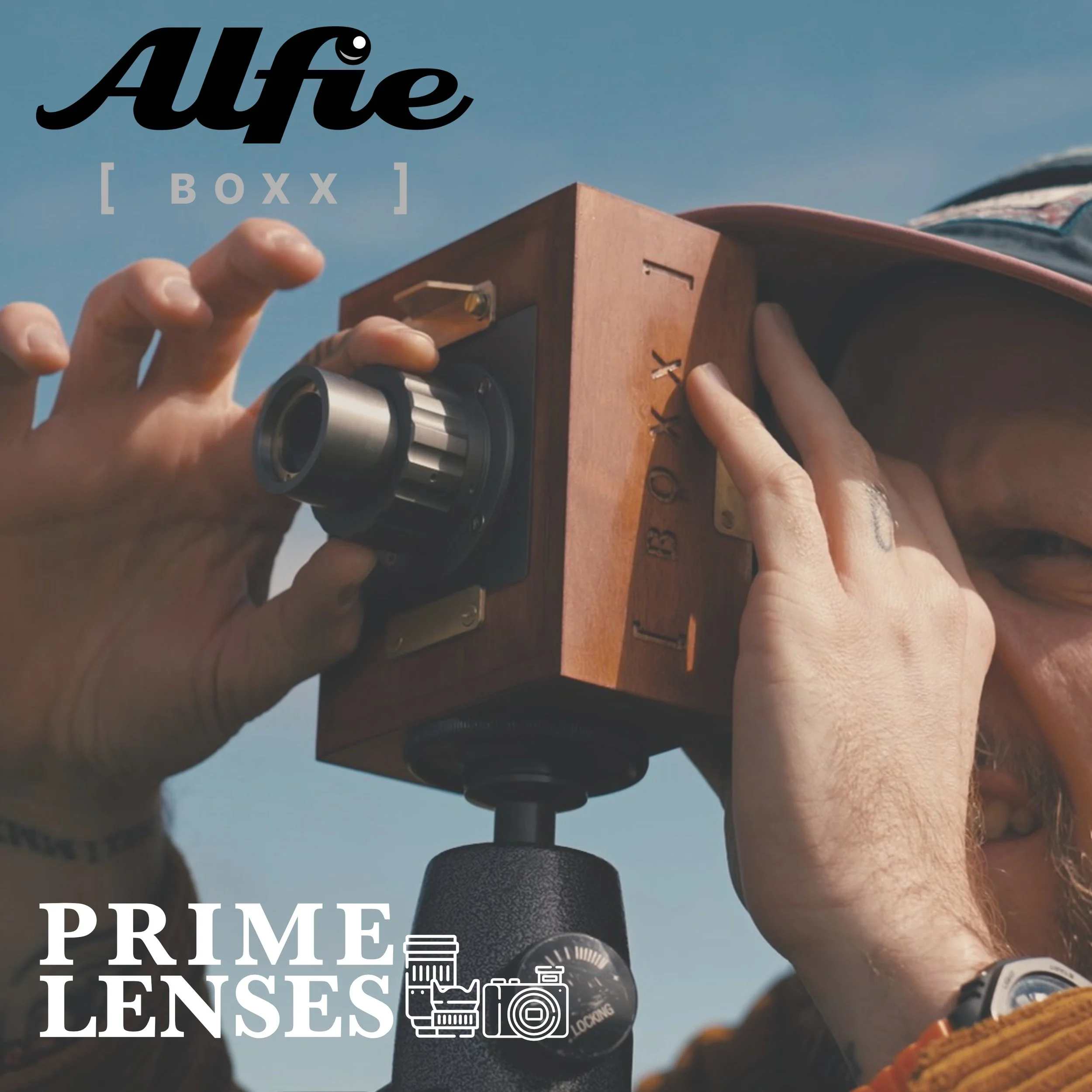


Dave Faulkner is a product designer and engineer turned camera maker. Having successfully released the Tych half frame film camera in 2022, he’s back with a new project, the Alfie [BOXX] Camera is designed to allow a user to make beautiful small prints using a handmade wood and brass camera. Dave agreed to come on to the show to talk about the new camera and what he’s hoping folks will get out of it.
You can back the kickstarter here, and if you use our link, Prime Lenses will receive a kickback at no additional cost to you. Thanks for considering supporting us and Alfie Cameras.
Sign up to the Prime Lenses newsletter for a mid-week treat.
Support the show on Patreon.
Episode Transcript:
Iain:
Hey everyone, back this week with a midweek episode, this time talking to Dave Faulkner of Alfie Cameras about the Box Camera, which is a beautifully handcrafted wooden camera that integrates a complete darkroom inside its body. No screens, no electronics, and instant film cartridges that capture images directly onto photographic paper that is 6x9cm, so about 2x4 inches. Simple wet chemistry, an integrated process, a deliberate tool in an age of instant gratification and satisfaction, and instant capture of thousands of images that you then never look at again. I was really pleased when Dave said he would sit down and have a little chat about the project and the Kickstarter, and you have about 24 hours to back this if you're listening when this comes out. So your clock is ticking. You need to get over to Kickstarter and have a look. There is a link in the show notes and full disclosure, it's an affiliate link. So if you do choose to back the project, Prime Lenses will get a little kickback as a thank you as well. So a great way to support analog photography and your favorite podcast at the same time. Without further ado, here's my chat with Dave.
We have increasingly, I think, through this kind of this period of time in history with with AI and with the way that like devices are going and closed platforms have opened things that we're increasingly disconnected from the tools we use and how they work and they're unrepairable, which I think is one of the nice things then when we come across a project like yours, where you're building a camera, but that camera is going to be understandable by anyone who picks it up as well. And if something goes wrong, they'll be able to see what it is.
Dave Faulkner:
Yeah, totally. I mean, when you dig into it, the basics of a camera are fundamentally quite simple. and over the years as they've been refined from what they're originally designed originally developed as just wooden boxes with a lens and film on opposite each other they've got more and more complex and imagine someone like Talbot looking at a modern digital camera compared to what he's developed that was cutting edge at his time it'd be like walking into a spaceship
Iain:
complete mind blown for people listening who don't know talk to us about what the project is and how it came out like why you have decided because I've worked in manufacturing and I know it's not easy so talk to me why you've decided to put yourself in a situation where you're going to
Dave Faulkner:
make tons of cameras yeah so um I've I've my whole career has been as a design engineer doing you know everything from um medical devices to sanitary bins and and everything in between and And I absolutely really enjoy solving the problems and getting a product to market. That's my bag. Actually seeing a product out there that I've designed and developed is really exciting for me. And so this project was all about creating a camera that people could understand and do the whole process from start to finish of analog photography. So being able to compose their own image and understand what's going on with focus and aperture, and then being able to load your own film or photographic media, and then create your exposure using a shutter or lens cap in this case, and then actually go on to develop it as well. So you can literally pick up this camera and go from not knowing what you're doing with a bit of guidance you can spend an afternoon creating a whole set of lovely prints um and and just be completely immersed in the whole process yourself which is wonderful and I think for anyone
Iain:
listening who hasn't looked like you've got as this comes out this is the final day of the Kickstarter so go and have a look and go back if you want to because I think the that exactly that point of like you could you can show someone expose is a I mean no pun intended expose someone to the fundamentals of photography in a really short period of time and because that loop even you know people talk a lot wax lyrical about film photography but you still for a lot of people you're sending it away a lot of people don't have and developing film at home you know it's a time consuming process whereas this is so much quicker isn't it and you've got a print at the end of it
Dave Faulkner:
Oh, yeah. And the prints are completely unique. I try and be really consistent with my developing process, but there are always variations in it. Sometimes the variations are pretty subtle, and sometimes something goes wrong and you get some cool sort of chemical effect going on on the image. and you're like oh wasn't expecting that but oh that's kind of cool I like that so it's just that whole and and I think what people don't realize is the consistency that people expect from a 35 millimetre canister they send off to the lab that has come through years of honing the process and all of that process is controlled by the electronics of the developing machines and if you start doing stuff manually you start getting variability which I as I found recently I was
Iain:
developing some stuff in the dark there's a dark room up in Inverness that I go to and some folks knew the podcast and were chatting to me whilst I was doing my turning and whilst I was like agitating my film and I underdeveloped it as a result because I miscounted so it's like yeah it was I was pushing film and doing some fun stuff but so yeah so you're absolutely right but it but it it wasn't bad in the end actually what I ended up with was a was a sort of slightly underexposed negative that I can do more with. It's a bit more neutral, a bit flatter, but a bit higher contrast and stuff, which I guess is also part of this because this tool is going to allow you to kind of experiment and iterate very quickly.
Dave Faulkner:
Oh, yeah. I mean, I think for my ideal customer is someone who just wants to explore that process from... They want to learn, really. They want to try it and maybe they've never done developing before or they've done a bit of developing, but they really fancy trying something very vintage in the lenses side of things. And they just want to learn part of the process and then they'll take that learning and they'll build on it. And every time they revisit the camera, it's like another opportunity to build on their knowledge and experience and try something different.
Iain:
What should they expect then when this comes through? Because if you've got stuff to market before, I was fearful going in before I looked at the Kickstarter and read a bit more about your background. I was fearful that manufacturing and stuff is no small feat. But you've made a few of these. Hamish has had a go on 35MMC as well. It's worth going and having a look at his article. He wrote about it with one of your prototypes. What should someone expect once the Kickstarter ends and you start manufacturing and shipping these?
Dave Faulkner:
Yeah, so it's going to arrive as a complete and a finished product. So it's going to be packaged nicely, the sort of thing you could give away as a gift at Christmas if you're feeling rich or just buy for yourself as a gift. And so it'll come with a guidebook to help you through the process. We're going to be doing videos to supplement that guidebook because it's always helpful to get the instructions in different ways. And some people absorb the information better differently. Maybe we should do podcasts of how to do it. I don't know. But so you get that complete product and you open the box and there will be your camera there with whatever lenses you've decided to add on as part of your backing. So we've got like a pinhole lens, which is the cheapest entry point, right up to 100 millimetre Wollaston with different F stops you can drop in. And you'll also get a film holder in there. So each camera comes with one film holder ready to go and a pack of film. You'll need to add chemistry to your backing, but I haven't made that sort of a mandatory part of the package just because I know some people have their own chemistry and-- or maybe they don't want to ship it across the world and they want to buy it locally. So there's a bit of flexibility in the backing. But there are some packages on there that are like everything, all the lenses, a bag, the chemistry, some extra accessories. But the point of it is you should have everything that you need to go out and take some pictures, bar the chemistry. You have to add that on. And what you should expect is it's not something you just pick up, take a picture and, oh, there we go. No, this is something that you sit down, you plan or you think about how you want to use it. and you start playing, you start looking at it, start seeing how to interact with it, get your head around it and get yourself in a calm space and really set aside time to just do this process and dedicate, it's almost like me time for photography. Don't try and squeeze it in in half an hour before you're dropping the kids off. Actually set aside some time to really enjoy the whole experience and it is an experience.
Iain:
It's very reminiscent. I've had wet plate people on the show in the past, and it's reminiscent of like the level of planning and thought that needs to go into making. And I think it's so much more satisfying. I was talking to someone, a listener on socials yesterday, in fact, about this, that I think sometimes he was saying that the film process makes him appreciate the images he makes more because he actually spends more time. he thinks before he presses the button. And I think a lot of folk feel that with digital, that it's so quick, the moment comes and goes, you get the shot, and then you're sort of moving on because it's trapped in your phone or it just lives on your computer for eternity. Was that some of the origin of this for you? Yeah, definitely. I mean, it's part of the whole
Dave Faulkner:
ethos of Alfie Cameras and the previous camera that we did and this one. It's about putting more value into more effort into taking the picture and then put that puts more value into the pictures you create and it makes you treasure and value them more so for me a kind of analog photography came I was massively into digital I would take my camera everywhere and gradually I got more and more sort of analog curious now I'm old enough to have used analog back in the day when I was at university, I was having to take pictures of the products I designed on my course with an old Zenit E, which was a bit of a challenge in itself. And so I knew a bit about analog, but I'd never really deep dived into it and really understood how to do it properly. And so as I drifted out of that sort of digital instant gratification of getting images and started exploring the analog side of things, I was picking up different cameras and some of them I was spending a lot of money because I just loved them, thought they were beautiful. And then I'd learn how to use them and discover they were a pain in the ass to use or they were actually really, or there was one that I really loved using. And so I gradually honed in on the cameras I liked. And as I did that, my analog skills improved. And I'm now at the point where when we go on family holidays or when we go out for any sort of family activity, I take all my pictures on film. Digital photography, my son does a bit of that and my wife does a bit, but it's all on film because it creates these beautiful memories. And I will sit down at the end, over Christmas, New Year period, we'll be like, right, let's pick the ones we're going to get printed out. And so as a family, we'll kind of look through and go, yeah, let's get those done. Let's get these done. And we'll select which ones we fancy having as prints, which is really lovely.
Iain:
That's tremendous. That's a lovely way to work it. And I think it's funny. I did something similar recently because listeners won't be able to see this, but I'm going to wave a book at Dave. I love incident photography. And so making little scrapbooks of prints and things, when you've come back from a trip or when you've been somewhere and having that tactility of something I think is really meaningful. You know, like if I disappear tomorrow, my kids might not be able to get into the computer or might not know where everything is and it's stored on a NAS and that's kind of impenetrable, but everybody knows how a book works and they'll just find it and thumb through it and look through it. So I think you're right to say a lot of us become analog curious because we get a little bit bored almost with the instant nature of digital. I don't know why it is, but it's such a common refrain that people kind of go through that bell curve of extreme excitement. I could take pictures all the time anywhere and with modern cameras practically in the dark. And then you come down the other side, you sort of miss the challenge. And I guess it's satisfaction as much as anything else.
Dave Faulkner:
Yeah, I mean, so I still do digital photography. If I'm doing marketing images, it's a workhorse. It gets you the result as efficiently as possible. And I do it for myself when I'm doing wildlife photography. But with wildlife photography, the process and the learning is about the learning about the animals, the behavior and catching the moment. And the tool is that I'm using the digital cameras secondary to that. And it has to be good enough to do the job. But I do occasionally do wildlife stuff with film, but the cameras are generally a bit too noisy for the sort of photography I like. I like to kind of stalk out a badger set one evening and if you're sat there with a Mamiya press camera that sounds like a gun going off when the shutter goes.
Iain:
It's not really going to... Yeah, you can't go up to a badger and go, I'm in my F8 and be there phase, So I'm going to need you guys to stay still and a flash is going to pop in a second. It's also worth pointing out to folks, this is not your first rodeo in terms of like developing cameras and products and things like that. How are you feeling as you kind of come close to the end of this? Because the Kickstarter's hit its goal. So that must feel really, really good. But how are you feeling about like getting this out? Is this kind of like the project and then you'll take a pause? Or are you viewing this as you want these things to be, you know, like WideLux, for example, just launched. They did their first 350. And then I think we'll see what the global addressable market for a clockwork panoramic swing lens camera is. Right. Are you thinking the same about this or do you plan to have this as an ongoing product?
Dave Faulkner:
So this will be an ongoing product for us like the previous camera was. There's fundamental differences in the way I've developed this camera. So the first camera we did, the Titch, it was very much for me learning the Kickstarter process, building a brand, getting a product out there. I had a lot of hopes and expectations that it would sell in the thousands. And it sold well, but it's not been the product that's built the company. And in no small part, because I had a full time job while I was doing it. And the opportunities that we created by developing the camera just wasn't able to exploit. And so with this camera, I left the full-time job late last year. This is now what we're doing as a business. And so I'm expecting to build many more of this camera. It's been developed with a view to unbelievably, you look at it and you think, how are you going to volume manufacture it's been developed with a view to make higher volumes than the previous design so we have um for example the the film holder that we call it the pocket dark room that's predominantly injection molded parts and uh you know we can make the main camera body by hand and I have a craftsman doing that for me um and we can do that in hundreds or even low thousands without a problem but when you consider that everyone buying a camera is is I'd say the average number of pocket darkrooms they're buying is probably four or five uh so for every hundred cameras we're selling sort of 400 pocket darkrooms we can't do handmade artisan film holders they've got to be a volume manufacturing technique so so we have designed the camera with that in mind we wanted something that people would treasure and value and really enjoy interacting with it's why we went for a wooden and brass camera body but we've had to make the concessions on hand making things that would just be ridiculous to hand make um so that we can get the the volume pricing down and hit a price that people, you know, we've got 188 of backers, so, you know, enough people are excited about. And then we also have interest from the professional community as well. So by that, we've got distributors who are interested in selling it into education markets and people who are interested in using it in workshop environments. So I think that the potential for for this camera exceeds the previous camera. And I'm very glad to hear it because I think you are
Iain:
thoughtful and focusing on the bit that matters. You focused on making the device fun to use and have a great feel and tactility to it. And then I think actually something like the pocket darkroom piece, you just want that to work. It's like the battery or, you know, you just want a thing that is consistent. There's consistency across them. You never want a situation where you're like oh that one was made by Steve and he always finished it a bit like this and that one was made you know like you don't know this is about because that's developing your image that's
Dave Faulkner:
got to be consistent and predictable yeah yeah the only unpredictability with the pocket darkroom is the person introducing the chemistry so yes well I was just going to say like that and the temperature
Iain:
outside and you know did you do it did you do it all correctly as I found the other you know the other week in the dark room that's brilliant so it sounds like you're very exciting because I too have have left full-time work to do a thing that on the face of it might seem a bit bonkers so like hooray like nutter creative people of the world unite um but I think for for people listening then where should they go what kind of timeline should they expect on on the cameras the Kickstarter ends tomorrow then presumably there's a little wait while you kind of ramp up production and get these
Dave Faulkner:
out into the world? Yeah, so when the Kickstarter ends, it's actually then a couple of weeks before Kickstarter deposit any funds into our business account. At that point, we are expecting to be pretty much ready on all of the long lead time items. So people who've joined and backed early will have seen some little tweaks and improvements going through on the updates. We're pretty much done on those. I think there's a few minor tweaks left to the design of the wooden box to help volume manufacturing for my craftsman guy who's CNCing out those wooden parts before he glues them together and finishes them. But so the expectation is that then we start placing our long lead time orders. So our tooling, for example, is eight week lead time before we're going to see the first sample parts. So the expectation for us and for our backers is that we're going to build those cameras over the summer. So we'll be ordering those long lead time items, they'll come back in and we'll do the manual assembly required to complete them and turn them into products. Whilst we're waiting for those long lead time items, we'll finalise our instruction manuals and our packaging so that come September time, everything's coming together. I'm panicking and trying to organize and streamline a manual assembly process. And then we're expecting to ship cameras
Iain:
out in October timeframe. Oh, that's fantastic. I'm so excited. It's a very, very cool project. It's a wonderful thing to see coming together, truly. And you must be excited because people must be really excited to backing this and messaging you and stuff. Yeah, there's a lot of
Dave Faulkner:
excitement in the community. One of the funny things, because being a company, you have to publicize stuff on so many different platforms. So we're like on Kickstarter, we've got emails coming in from the website, we've got people commenting on Facebook or Instagram or YouTube. And sometimes I just lose track of it. And so my phone's like pinging with different comments. And maybe I have to respond to something maybe between five and 10 responses a day on all these different platforms. So that I'm going to be pleased when that calms down a little bit. Yeah. It's been sort of three months really of marketing the product from pre-launch phase through the actual Kickstarter campaign. And that intensity is quite hard to maintain, I would say. And so once we once we reach that the closing point tomorrow, that will calm down a bit. We'll still promote the camera. We'll still be talking about it and posting about it. But there's not so much urgency around that. And the focus very much shifts to delivery. We need to be able to deliver and build the camera. So one of the biggest challenges I'm dealing with at the moment is this is my current workshop, which you can see. It's not very big. So we're looking at getting access to a new workshop space so that we've actually got the space to do this manual process efficiently, because we would be tying ourselves in knots in this space.
Iain:
Yeah, because also you're assembling stock, which means that when you put things together and put them in boxes, you've got to then put the boxes somewhere. And so the big empty room starts to fill up very quickly with boxes as you pile them in the corner. And you needed the big long table. You can start at one end and go to the other end because you can't miss stuff out. So, yeah, so I, yes, you've got lots of fun times ahead of you once you stop replying to comments on multiple platforms.
Dave Faulkner:
Yeah, yeah. And then and then, of course, so we're then expecting to have. So my minimum batch size on this product is 500. So we'll be for the stuff we have to order in bulk, we'll be ordering way more than is needed to deliver the Kickstarter project. So not only do I have to store the parts that come in for the Kickstarter rewards, and once they're built up, those boxed products before they're shipped out, but I've got to store the excess stock as well. So, yeah, my loft at home is no longer going to cut it for the excess packaging. I think there's still a fair few boxes up there for packaging purposes, But no, we need a bigger space to work from.
Iain:
I hope you're getting time to kind of grab a couple of behind the scenes shots and things like that as well, because years from now, you'll want to look back, I guess, and remember like the madness.
Dave Faulkner:
Yeah. Yeah. So that's been really fun, actually. So my son, he's he's 13 years old and he has been helping us do the making of videos. I think I sent you a link. So he's been my cameraman for the making of videos. And we've basically been trying to create this behind the scenes story that we can tell about the development of the camera. And I was discussing it with someone the other day. And in most other industries, that would be lunacy. You'd be like, well, we're sharing all our secrets of how. And I'm like, well, there are no secrets that everyone can find out how to make this kind of camera. So it's just we're sharing the journey because it's really interesting. And for people like us who geek out on this stuff, it's like, oh, yeah, I'll stick that on and watch that on a Sunday evening and just enjoy finding out how how Dave managed to spill chemistry across the lab and ruin his workbench or whatever calamity has happened on the way to producing the product.
Iain:
I think one of the really important things about making the show and in general is that hopefully people, because once you make something, put it out into the world. It's the same with an audio product. It lives in the world and people find it and they will find it years from now. And the idea that what you're making now and putting on YouTube and things will be found by someone years from now who goes, I'm going to make my own camera. Maybe I'm going to make something different. Or they scratch their own itch. So maybe they look at yours and go, that's cool. I want to make a panoramic version of that. you know like just to go out into the world so I think um no give it away like put it out into the world um you're never going to get rich from keeping the secrets of a Box Camera to yourself
Dave Faulkner:
no no I had um an interesting conversation with uh one of the backers the other day he's he's really keen to have a shutter on the on the camera and it's something we definitely want to do It's just at the moment when you're dealing with such low, low ISO photographic paper, you don't really need it. Most of your exposures are one second or more. You know, I'm typically I'm doing portraits of people inside. You're going to have to sit still for 10 seconds and they're up for it. They want to do the challenge. So that's outside. It's quicker than that, obviously. But he really wants to be able to put film in the in in the pocket darkroom, which is totally possible, but it means your shutter speeds need to be in the 10th or 50th, 60th of a second, or maybe even faster. So he's looking at doing a, I think he's looking at something more complicated. So I'm sharing some of the design details around the lens board with him so that he can have a crack at developing his own shutter. But we're looking at doing a really simple guillotine shutter, which fits to the front of the lens. And that's, again, it's a vintage technique, but it's really easy to create this gravity shutter, which is basically like a piece of, in our case, it'll be a piece of plastic that you let drop in front of the lens, and it has a slot in it. And the slot width defines your shutter speed, because it's going to drop at the same speed every time. So it's really simple to do. And probably once we've got the backings going out the door, we'll look at working on that shutter design. And either it will be an accessory we offer as an add-on later on for people who want to do that type of photography, or we might potentially just release 3D print files so that people can kind of make their own if they want to. That's so cool.
Iain:
Well, I'm very excited. For people listening who now desperately want to go out and back a camera, Dave, where should they go and look at that?
Dave Faulkner:
Yeah, so visit the Kickstarter page, which is just Kickstarter.com, and if you search for Alfie Box, and the box is spelt with two Xs, it will come up. Or you can visit alfiecameras.com, and there's posts about the Kickstarter that will link to it as well. I just this morning posted some more sample images on our website because one of the potential backers was asking about them. So we've got a few more samples up there. And yeah, just search for Alfie Box with two Xs. You will find it without any problem.
Iain:
Yes, and also there is a link in the show notes from this episode as well. So you can find it there too if you're on YouTube or on your app or whatever. Well, brilliant. Dave, thanks so much for talking about the camera. And congratulations again. I know it's a little bit premature, but you're backed at this point so it's now your problem to solve
Dave Faulkner:
yeah yeah it's been it's been great really nice to talk to you Iain
Iain:
yeah all right thanks man, take it easy.