
Artemis II and Space Photography with Paul Reichert
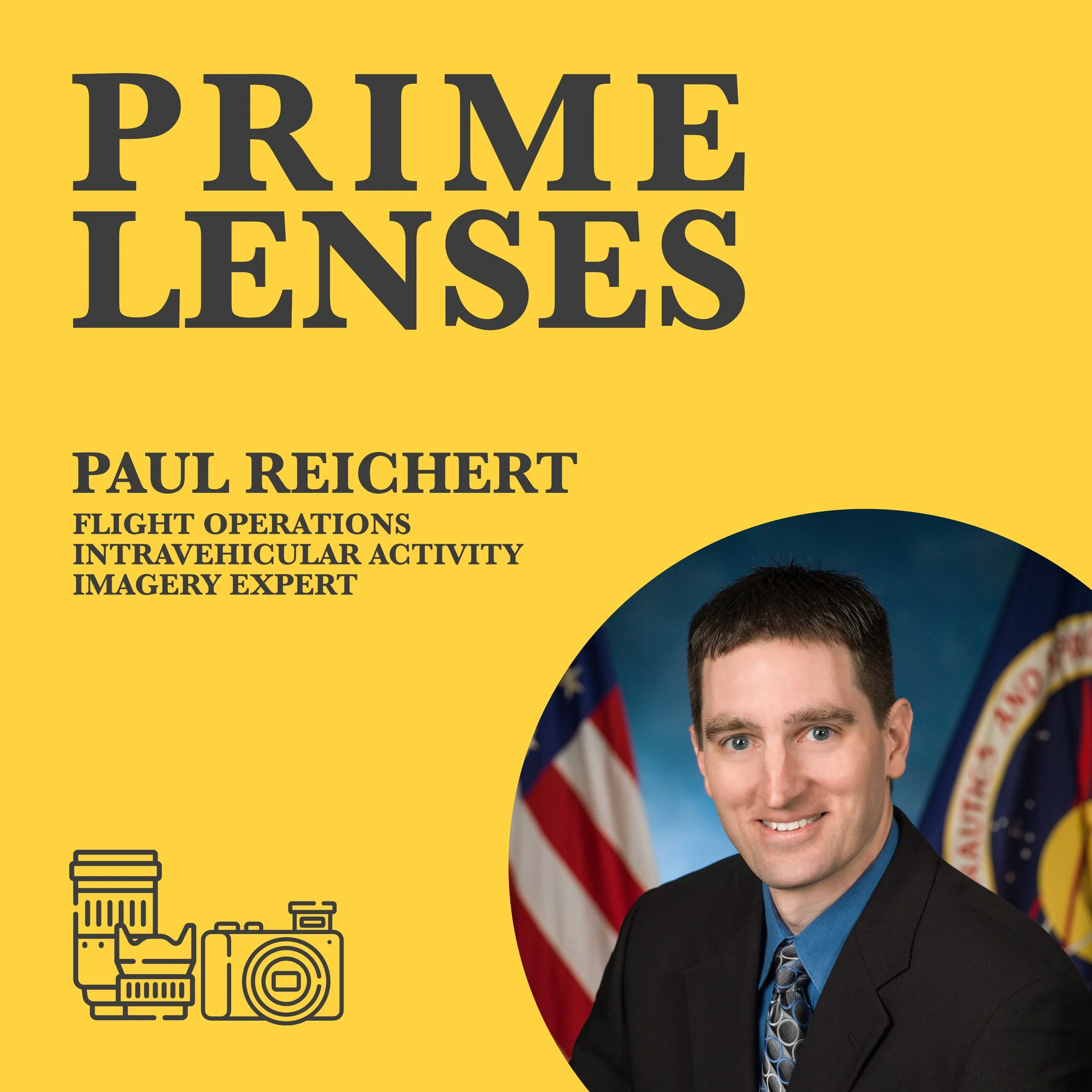


For the past couple of weeks, we've all enjoyed seeing some incredible photography coming back from space. The crew of NASA's Artemis II mission have sent back some breathtaking images of the moon, of space travel, photos the like of which we've just never seen. It's incredible, inspiring stuff and I wanted to better understand how that comes about. So I was delighted when I got the opportunity to sit down with Paul Reichert. Paul is a Flight Operations Intravehicular Activity Imagery Expert, which is a very long way of saying he helps astronauts and astronaut candidates get ready to make pictures in space. There is more to his job than just making sure that they know which end of a camera to hold.
Sign up to the Prime Lenses newsletter for a mid-week treat.
Support the show on Patreon.
Episode Transcript:
Iain:
Paul, it's wonderful to see you. I'm very excited to talk to you and share this with listeners because I think when we all saw the photos coming back from Artemis Uh what an incredible achievement to get those incredible photos back and to get to get them in the bigger achievement obviously getting the people out there and back safely uh in in fairly short order and making it look straightforward. I know it definitely is. But what I wondered if we could start by talking about your background in photography and kind of how you landed here and how you find yourself training astronauts to take pictures in space.
Paul Reichert:
Yeah, Iain. Well it's great to be at your show. Um my story is is pretty long. Um so I got interested in photography when I was in elementary school. So I think I was in second grade and I went uh My neighbor down the street was having a garage sale and I saw this cool little camera and so I was looking at it and he said how do you like that camera? I was like, oh, it's really neat. And he said, well, if you want it, you can just have it. And so uh he gave me the camera and it was an old 110 camera, so it took 110 cassette film. And so I shot on that for a couple years and then I got a little more interested in photography when I was in uh not elementary school, in middle school in eighth grade, I took a photography class and then I decided I really like this. So all the way through high school, I took photography classes and I was getting pretty good at it. I had won some awards and some different things. But as good as I was, I always wanted to go into to communications or broadcasting. And I went to the Rochester Institute of Technology on my senior year of high school just for a tour. And I went down this to the one of the programs was called the Imaging and Photographic Technology Program. And I was pretty good at math and I liked photography and I thought, oh, this could be a good match. And going down the hall The there were pictures of previous graduates and it was written under their names where they worked. And as I went down the hall, I saw NASA, CIA, FBI, Kodak, Adobe, Fuji. And I thought to myself, wow, these are pretty amazing places. And so that very day I changed my career path and decided to go to into the imaging and photographic technology program. And so then I I was there for a couple years and I did an internship at a different NASA center in Virginia. And we we did some really cool stuff there. Their main thing there was wind tunnels and drop tests. So I got to do some high-speed drop tests while I was there and that was really interesting. And then when I was a senior, the job at Johnson Space Center for training astronauts on their camera equipment came up. And so I applied for it and that's how I that's how I ended up at at Johnson Space Center in Houston.
Iain:
That's fantastic. Because I came into this assuming that training astronauts to use photographic equipment can't be a full-time gig. But is it a full-time gig?
Paul Reichert:
So We have many facets to our job. So that's part of our job is to train the astronauts how to use the camera equipment, but we also are kind of there we do what we call plan train fly. So at the very beginning of the mission there's a bunch of requirements and a lot of them are for imagery. that come in and it could be imagery of all kinds of things that have come in from across the community that are that need to be captured during that mission. And so we take those requirements in and then we figure out with the equipment that we have that's certified for spaceflight. What do equipment do we need to be able to capture all this imagery? And then once we figure that out, then we write the crew procedures the astronauts procedures and then we start training the crew how to capture all the imagery and then when they go in space we are their technical support on the ground. So during the mission we are actually in mission control on you know with a headset now we're on the voice loops and we can hear what they're talking about and all the conversations and so if there's any issue or question they have about imagery or the imagery equipment They call that down and then we work through the flight control team to get them an answer.
Iain:
Wow, that's fantastic. And so I guess from a planning perspective, because you're talking to a uh previous lives I was a project manager, so kind of I'm now fixated on this notion. Presumably lots of requirements come in. There is not enough time to to do all of these things because the photographs I'm assuming have to live alongside all sorts of other experiments. Because there are effectively other experiments So there's a big list at the beginning, is there?
Paul Reichert:
That's correct. Yeah. So during the mission you have all kinds of objectives that you have to achieve. And yeah, so they the The crew has a a timeline, and the timeline has activities from the moment they wake up until the moment they go to sleep. And so one of our jobs is to actually put a lot of these activities to capture the imagery on that timeline. And so most of the time they can get that done, but sometimes they may be running behind on something else And so it all comes down to priorities. And if there's a higher priority thing they have to get done, they will get that done first, and then they will move on to the next things. So Some of our imagery is actually very high priority and it gets done pretty much no matter what, but other things are in there And then if uh they can't quite get to it then the crew has to skip it. Right.
Iain:
Wow. And then once you've got that whittled down to a to a a list, it's you and your colleague Katrina, and presumably on bigger missions, maybe there's more of you Are you then getting together and working out, right, this is what we've got to do, this is who's coming in, this is you presumably know who's been selected at that point, and then you have to work out how much they know. Because I'm guessing most cases they know very little about photography coming in.
Paul Reichert:
Yeah, so the interesting thing about the astronauts is when they become astronaut candidates, they do not most of them do not know much about photography. But when they are announced as an astronaut candidate, they go through about two years of training. And so we give them about four to six hours of training in that timeframe. So this is way before they're ever assigned to a mission And so we give them kind of a basic photography class, a equipment class, and a skills class to learn some of the equipment and then also practice with it. And from that point, as long as they've had the class, they can actually check out the camera equipment from us. So we have enough camera equipment that we can check it out to them so that they can become familiar with it on their own and make mistakes and come back and ask us questions. But then once they get assigned to a specific mission, that's when the fun starts. So we have uh for Artemis II, they had about 10 imagery classes that we taught them And so again it starts very basic. We have the cameras and then we talk about skills and then we actually do skills and then we move on to more complex things. So for example, for the lunar flyby We work with the science team that NASA has to do some training. So there's some objectives that the science team needed to have the crew do. but there was also imagery objectives. So one of the really cool things that we did here was we have a mock-up in one of our buildings of the Orion capsule and it's this really big building and it's probably about 30 or 40 feet tall And we actually hung an inflatable moon from the ceiling. And we put it about the distance away from the mock-up windows. that the moon or that the moon would look at the distance they were going to fly by. So we brought in the real equipment, the real camera equipment that they were going to use. We had a moon, an inflatable moon placed at about the same distance, relatively, of what they would they would see it at, and then we actually practiced taking photos of it. And so that was a very specific task that we had to do, but we have a lot of generic tasks that we practice with them as well.
Iain:
Yeah, that's brilliant. And I noticed in the a lot of the conversation that was happening online around the camera equipment used specifically as well was that some of it was older, which I s think surprised some folks looking well, a weird mix. Like modern iPhones, older Nikon cameras. But you I think touched on it earlier. Is this a certification thing? Do does have does stuff have to go through quite rigorous testing to get used like that?
Paul Reichert:
Yeah, normally it has to go through pretty rigorous testing um because we don't want the cameras to get up there and either cause a problem that creates a safety issue or the cameras don't work because the radiation uh affected their their sensors or their microchips or whatever. So the the equipment has to be safe and it has to work. So the certification process can actually take a couple of years to do. And so for Artemis II, there was a huge debate over, you know, hey, you guys are flying these 10-year-old Nikon D5 cameras. Why aren't you flying the new Z9? Because You're already flying that on ISS. Well, the International Space Station has different requirements than the Orion capsule had. So We were in the process of certifying it for the Orion capsule, but it hadn't quite caught up yet. So When we manifest equipment for the the for the Orion vehicle or for the RMS-2 mission, we had to do that like before COVID. And so the the equipment that came out or that we certified initially for the Ari for the RMS two mission was certified five, six years ago. And so the Z9 wasn't even around yet. And so that was the camera that that we had a lot of flight time on on ISS. So it was a great initial step and through the process of we had several flight delays and it got moved out long enough that if at the very end We we still kept the D5s, two D5 cameras, but we ended up flying one Z9 camera. So we got we got a pretty good mix on board. The other thing is that we're also very limited on our volume and our space on the in the capsule. So we only get a handful of pounds or kilograms as they say in the rest of the world, and a little bit of volume. So all of that stuff has to fit within this volume because there's all these other things that have to fly. Like, you know containers to absorb the carbon dioxide. You know, you kind of need that when there's people inside the vehicle and their food and all the different equipment that they need for all their different activities. So There's uh definitely a balance there that we have to have to hold to.
Iain:
And it sounds like everything worked, which proves that that the process is you know needs to be that rigorous. It sounds like everything worked out as you needed it to and you captured what you needed
Paul Reichert:
Yeah, the equipment, um to my not to my total surprise, but to some surprise, all of our imagery equipment on the vehicle worked almost flawlessly. It it was it was kind of shockingly good. Um I was very surprised.
Iain:
And can you get images back through like whilst they're out. Is that a very slow connection? Are we living I've got no concept of how long it takes to get a JPEG from the moon
Paul Reichert:
Yeah, so that was one of our challenges on with the Orion vehicle is that it has two communication systems. One is fairly low bandwidth, around three megabits per second And another one called the Optical COM or Optical Communications has a much higher bandwidth, maximum of about 80 megabits a second. But you can only get it for a couple hours a day because it has to be over very specific ground sites to have have the laser connect to on Earth. So most of the time we're operating out of the slower system. And so, you know, you've got like a three-megabit link to Earth, and you know, you've these raw files on these cameras are 20, 30 megabytes apiece. So You know, what the crew had to do was after they were done taking their photos, you know, generally each day, they would put the card in a card reader and they have a Windows tablet, and they would pick off a few of the very best ones and they would s transmit those back to Earth that day and the rest of the images they're processing them right now. So Um yeah, so we get a little bit of of the imagery back during the mission, but not not most of it.
Iain:
Oh so cool. So there's gonna be more to come in like the coming months, hopefully. There's more to come. Oh fantastic. Yep Absolutely. One question I had when I was thinking about and you you've touched on a little bit of the training, but I was curious because there is a There is a scientific stroke experimental kind of angle to making a picture in space. Like sometimes you you know we need we want to see the surface of the moon, we want to see where there's new craters, we want to see where things have changed since the last time we were anywhere near it The other side though is making images that get people excited about space. And I was curious how you approach Uh helping an astronaut to make pictures that have some sort of soul to them or meaning, or maybe they've got some of their colleagues in them, or maybe they're you know, is this field trips to museums to see things? Is this Lone pushing photo books towards them and hoping that they like the work of Irwitt? Like how how do you approach that?
Paul Reichert:
So there's a few things that we do. So the first thing is when they're in our training with us, we actually, if you look behind me in the background, you can actually see photos from space. So in our classroom, we have a really kind of uh all-star pictures, the the some of the best photos ever taken from space on the wall. And not only we do that, but we We have the pictures along with the camera settings and the image number in NASA's database. So they can actually see, oh, this is how this picture was taken. These were the camera settings that were used, and and so on. Um as far as planning for the mission, so for Artemis II, we knew that we were going to have an Earth set in an earthrise over the moon horizon. So we planned pretty heavily for those photos and the crew was was had practiced that several times. We also knew that we were going to see some things on the far side of the moon, depending on our lighting, that human beings have never seen before. And so we practiced how to take those pictures and how to get really detailed photos of crater, certain craters on the moon. The science team worked with them quite a bit on which craters were the highest priority. But really, you know, you never know exactly what you're going to see on these missions. You know, you don't know exactly what the lighting is going to be until you launch. And a few days before launch, which was on April 1st, we knew that we were going to see an eclipse. But we didn't really know what we were going to see. We initially thought there was just going to be kind of the solar corona off the side of the moon, and that was a high priority target. We needed to get that. But when the crew called down during the mission, they said, we are seeing something really interesting. We are actually seeing the sun around the entire moon. It's glowing. It looks three-dimensional here. And and when we got those photos, that was actually kind of a surprise to me how how moving they really were, because it was taken from a perspective that no human being has ever been at before So yeah, sometimes you just never know what you're gonna see and you're surprised, but a lot of times we do plan it out.
Iain:
It sounds like the most extreme version of a photo shoot ever in a lot of ways. You know, like i in some ways you could break it down and go It's not really any different to planning any other thing that you plan out that like, you know, like a wedding or something like that. But it just so happens that no one's going back there tomorrow. You can't you can't set that up again. You get this one shot, and then that's it
Paul Reichert:
And you know, and something that that I didn't really understand until I saw some of the photos come back is the way that they flew by the moon. was not like Apollo. So when Apollo when the Apollo missions went around the moon, they flew very close. They were within a couple hundred miles of the lunar surface. But on Artemis II, they were about four to five thousand miles away. And so what that did was that created a totally different perspective on on when you saw the earth rise and the earth set. And one of the pictures that's really neat is you can actually see about half the moon when the earth is setting behind it. And that is just not a perspective that you ever really get to see from anywhere. And i it was just a completely new experience for me, but I think for also the whole world to see that.
Iain:
It's amazing and it's worth there's a video, I think. of that moment as well, that you can hear the burst mode of the cameras in the background, like it sounds like a couple of D5s going. Is that part of the training as well, that they're sort of encouraged to You know, you've got memory cards, fill them up. Don't worry about one and done.
Paul Reichert:
Yep, absolutely. You know, one of the things that we we had to do because You know, you don't know exactly what the lighting is going to be. You we can get very close, but we don't know exactly what the best exposure settings are. So we do bracket quite a bit. This is one of the huge advantages of using digital cameras is we can stick, you know, uh a 256 gigabyte card in the camera and you can bracket tons of photos and one of those is going to be really uh probably almost right on the right exposure But not only that is we record raw files, so that gives us flexibility after the fact as well to make adjustments to the picture. So we're using we're using the digital technology. to the full extent that we can to get the best imagery possible.
Iain:
I think if we were sitting here and you were going, Well, we sent him up with twenty rolls of Ilford HP five and Fingers crossed. It doesn't seem like the way to do it anymore.
Paul Reichert:
Yeah, you know, one of the interesting things in the Apollo days is they were using 70 millimeter film in a Hasselblad magazine And what they realized at first was that they could only get a hundred exposures on a roll. So what NASA did, this is way before my time, but what NASA did is they actually went to Kodak And they said, is there any way that you could make your film thinner so that we can get more pictures? Because we can't only bring so many magazines with us. And so their their their scientists and their engineers went back and they actually made a film that was half the thickness so they could get twice the amount of exposures so they could get two hundred two hundred pictures in a roll instead of one hundred and ended up back then that was a that was a huge deal And nowadays, you know, with these these memory cards, you could take twenty, thirty thousand photos on a single memory card. It's just astounding the advancement in technology.
Iain:
Yeah. Absolutely wow. That's such a cool story. God yeah. I was talking about that with my wife and my kids at the weekend when I was preparing for this and saying, you know, like imagine being in space in the sixties. You're not a photographer. And you just gotta hope you got it. And you don't know until you got back and you, you know, it may not even survive. It's incredible, amazing thing to be able to do. Yep. Well So you've got the pictures back now. What what kinda happens now? Are you thinking, are you already on to the next mission or do you get to spend some time kind of debriefing and deconstructing Artemis II and and and picking it apart.
Paul Reichert:
Yeah, so first up for us is this week we're actually having debriefs with the crew. So we're gonna actually get to talk to them about how the equipment worked up there If they had any problems that they didn't call down, maybe s maybe it's minor things, maybe something big happened that we just don't know about yet. But after that, we take that and we have a bunch of lessons learned that we start working on and putting into our development of our Artemis III classes and our Artemis III flight support. And so yeah, it's just this circular process where every mission you learn something and you integrate fixes into the next mission as best that you can.
Iain:
That's really cool. One thing that was just occurring to me actually, because I was thinking about when I was talking at the weekend, one of my kids commented, he said the D5s that that camera looks heavy. And I was like, yeah, but in space that kind of doesn't matter as much, you know, 'cause it floats around. Does that make using do the cameras themselves get confused? Because everything's developed, you know, with like modern cameras, I'm thinking of like IBIS and you've got um in-lens stabilization. Does that work in space? Or does because it might it all assumes gravity, I'm assuming.
Paul Reichert:
Yeah. So the image stabilization on the the 35mm cameras works really well. I'm not sure like on the the smartphones how well the um I think the image stabilization works okay. But you know, like on an iPhone, you can do spatial for spatial videos where it's, you know, if you wear the Apple Vision Pro, it's all it's like you're in that environment. But one of the requirements of it is that the phone has to be in the horizontal position. But in in microgravity, it really doesn't know what position it's in. So That is one of those things that we're not sure of yet. So we're going to actually ask the crew if they shot any of that kind of video. And if they did, then we're going to get our hands on it and see if it works or not. Because If we can make it such that when you're when they're in the capsule, they can make it, you can make somebody feel like, you know, post-mission, like they're actually in the capsule with them, that would be an incredible experience, not only for the public. But for future astronauts that are going to fly on this vehicle, it really gives you the feel of what it's like to be in there
Iain:
I mean if if they didn't and it didn't quite work, I'm fairly sure there's some people in Cupertino would pick up the phone, uh, if you called them. I suspect that they would be delighted. To be involved in something like that. I think that they've like all of us, they've grown up watching Star Trek and making making the future. I'm sure they want to continue to do that. That's really cool. So what's kind of your takeaway from this? It seems like a wild success and you've got what you need, what's kind of in your head for the, you know, you want to sneak in next time? Is it more of a certain type of thing, or is it you, you know, you'd like to revisit I mean it sounds like everything worked. It sounds like kinda like if it ain't broke.
Paul Reichert:
Yeah, I think for us it's you know, Artemis three is not gonna go around the moon. It's going to dock with the with the um what we call the HLS, which is the human landing system. So there's going to be a lander up in Earth orbit that the Orion is going to practice docking to. The crew is probably going to go in. the HLS vehicle and do a bunch of testing on Artemis III. But Artemis IV is is where the rubber meets the road. That's where we're gonna land on the moon. And so we've got some things coming up. We've been thinking about some of the pictures that we got back on Artemis II and what we can do to improve it. And not only improve it, but maybe even add in some some motion to it, some time lapse, some different things that can really show how fast they're moving or how far away they're they're going. Um all that kind of stuff. But then of course we have the lunar surface, which is its own its own activity all in itself. So we've got Our HULC camera, which is the Handheld Universal Lunar Camera, and you can go out online and find all kinds of information about it. But it's essentially a Nikon Z9 camera that we've done some modifications to And that's going to take some really important imagery, not just for what the public sees, but for scientific reasons and trying to figure out how things got to where they are on the moon and what is the history of the moon and and a lot of different we're going to learn a lot on Artemis IV.
Iain:
So this is just all the build-up will be ready for that, basically. Some fun macro stuff and all sorts of things, I imagine.
Paul Reichert:
Yep, all kinds of things. And you know it's it's one of the interesting things about the lunar surface photography is that when I talk to geologists in the NASA science team and I ask how important is the imagery? Because of course you can the the astronauts can pack up some rocks and bring it back. They can't bring all the rocks back, of course, but you know, a few hundred pounds. something like that. And they said, you know, the interesting thing is that they can bring all the rocks back that they want, but without the imagery, without letting showing me where that rock came from, the surroundings and every everything around it. I can tell you what the rock's made of, but I can't tell you how it got there. And so the imagery is really the second piece to the puzzle of solving the puzzle of the moon, is We get the rocks back, we can see we can this is what material they are, we can figure out kind of where they came from, but the imagery shows us all the how it got there, all that perspective. So the two things really work hand in hand. And I I was I was a little surprised by that, but it makes sense to me. And and it really Kind of made me reflect about uh about how important this imagery is going to be for a lot of people on the earth.
Iain:
Yeah, I guess because once something lands on the moon, there's no pesky humans moving it around. So it's left.
Paul Reichert:
Yeah. Right. Wow It just sits there, yeah. And you know, did it come out of a volcano or was it a micrometeoroid? Or you know, what it how did it get here and without seeing the surroundings before it's really touched by the astronauts? You may not really understand how it got there. Wow.
Iain:
God's so cool. There is so much to unpack. I feel like I could talk to you for hours, but I know you've got a life to get on with, so I think that's a wonderful note to end on. Paul, thank you so much for coming on the show and taking some time to talk to us. I hope desperately that I get to chat to you about Artemis III or especially 4. But have a wonderful rest of the day.
Paul Reichert:
Thank you Yeah, thank you very much for having me. I really enjoyed it.
More about this show:
A camera is just a tool but spend enough time with photographers and you’ll see them go misty eyed when they talk about their first camera or a small fast prime that they had in their youth. Prime Lenses is a series of interviews with photographers talking about their photography by way of three lenses that mean a lot to them. These can be interchangeable, attached to a camera, integrated into a gadget, I’m interested in the sometimes complex relationship we have with the tools we choose, why they can mean so much and how they make us feel.