Episode 110 - Matt Osborne AKA Mr Leica
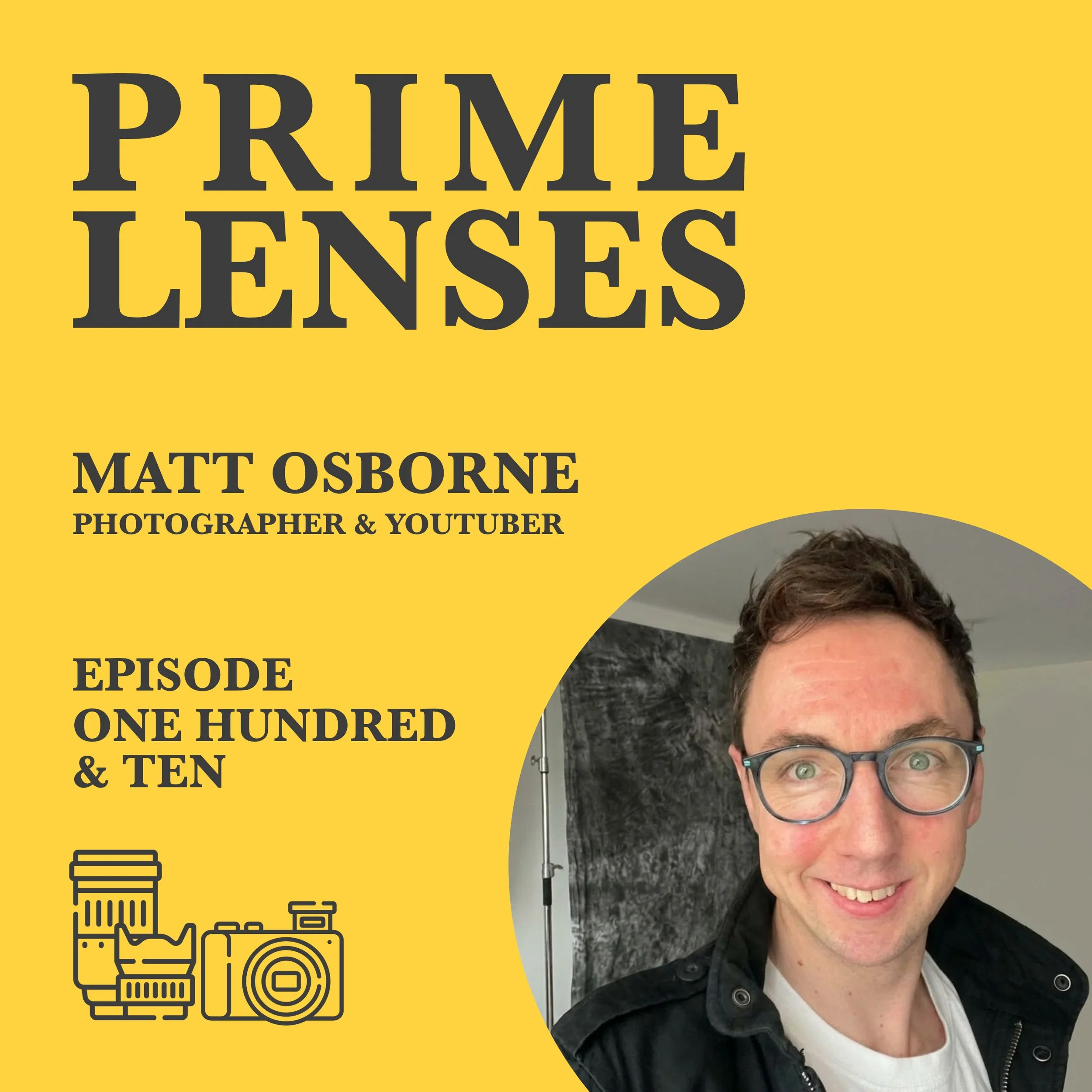


This week my guest is Matt Osborne. An experienced portrait and model photographer, he has made a name for himself as a font of knowledge for all things Leica shooting a host of digital and film cameras he loves to test vintage lenses along side modern options and has a wealth of experience at his fingertips making him a perfect Prime Lenses guest.
Sign up to the Prime Lenses newsletter for a mid-week treat.
Support the show on Patreon.
Episode Transcript:
Iain:
Hello, welcome to Prime Lenses. I'm Iain. This week my guest is Matt Osborne. Matt and I ran into each other last year at a photo event in London and finally managed to get in front of microphones and chat earlier this year. Matt started making camera-related content when blogs were still a thing, and since then has migrated to YouTube as he's transitioned from various Leica M's through CLs and Qs to the SL setup he uses today. He's created a really thorough resource online for anyone getting into Leica's family of cameras, sharing everything from settings and presets to guides to developing film. So it was great to sit down and talk to him about why he shoots and what he's using these days. As with all Prime Lenses episodes, I like to just start, and you join us as we chat a little bit inside baseball about the making of the show. Here's my conversation with Matt. Because the other good thing at the moment is I'm recording, so you will be actually in May. I'm recording way ahead of time. Yeah, well I used to be a project manager.
Matt Osborne:
So you know you can take the boy out of project management, but I recorded the same day I post my YouTube videos.
Iain:
That would stress me the heck out, man.
Matt Osborne:
It is. It knocks it over to another day sometimes, which is I mean or of your organizedness.
Iain:
Well, I can say to you, it starts with a spreadsheet. That's that's the the secret to all of this is lists. Um I've never come across a better foundational quality to a productivity method is l than lists basically. Like, you know, with interdependencies and then they get complicated and necessitate someone like me with grey hair. But fundamentally, lists and spreadsheets are your friend. Yeah there we go, it's coming in. It's coming in. All the best photographers, you know of grey hair. We've probably alienated some people there. But yes. Well it's good to see you Matt.
Matt Osborne:
Thank you for inviting me. Uh we bumped into each other last year, didn't we? photo show in London and uh yeah now I'm here so thanks for the invites. Yeah all good thank you.
Iain:
Yeah good. Well my first uh question a very important one did you manage to pick up another copy of the Biogon C
Matt Osborne:
No, but I was looking only yesterday.
Iain:
There you go.
Matt Osborne:
This is the Zeiss Biogon ZM 35F two point eight. Just to go straight into the technicals. And um yeah, Iain saw my video where I said I had a bad copy He's got a great copy, so he was suggesting or highly recommending I try another copy. So not yet, but it's on my list.
Iain:
It I was talking to someone last week and I think I can fairly safely say this because I don't think it will have come together in time. But I was I've found a contact at Zeiss. Uh and I'm gonna do uh I've been talking about it on social, so I'm gonna do a special episode uh about it, which is more it won't be an episode like this. It will be a kind of investigation this American American lifestyle documentary. I wanna try and find out a bit of the history about the lens, about where it came from, about why it is And I'm gonna speak um excuse me. I've been finding some folks online as well who like the lens as well, like it like me. And so that's taking me all over the world. One guy's in Turkey, a couple in Australia, just around. So Hopefully that will come together this year as a as a special midweek or one. Cause yeah, I love that lens.
Matt Osborne:
Yeah, I'll be super interested to hear about that. Um I like Zeiss lenses because of their sharpness, contrast and all those sorts of things. I've got other Zeus lenses. I've got the 21, the 25. I have a I know this in the past, so I knew it should be good, but my copy just wasn't the best. So yeah, maybe there's some sample variation.
Iain:
Yeah, yeah. No, I I I mean I hope you like it. That's the thing as I always say to people as well, is like it's not for everyone because and there's as you say Zeiss have some great stuff. I've never used the 21, but I really want to. The other Zeiss I've used a lot was the 51. 5 Which I think also has some magic in it. Yeah.
Matt Osborne:
Yeah, yeah. Excellent. Yeah, apart from yeah, the the focus shift on a range from the camera, but I just shot it wide open and I had no issues.
Iain:
You're an M shooter most of the time, would you say, or 'cause uh you you dabble around, but I when I think of you, I think of the M.
Matt Osborne:
Okay. It's nice that people have hopefully other people think the same, but uh maybe people that know me maybe even better know that I use the SL series a lot. So I started off with M's, film M's, then digital M's, and then if you want the whole history, then like a CL, which is an APSC mirrorless, then like a Q for wedding photography is like my second camera and then eventually the SL series. SL series just make it so easy because it's like mirror so what you see is what you get through the big bright viewfinder And so for shooting portraits with fast glass, the SLs is easy. So I 100% would say that the SLs made me a worse photographer. Because I used to be like a ninja with a like an M camera. So I used to shoot weddings with a 50 F1 not to look at F1 on a rangefinder. for the whole day. So if you can imagine the chance of missing is like so high, but because it's a wedding you can't miss and you've also got to get your exposure correct and blah blah blah. As soon as I switched using an SL camera as a second camera, I lost my kind of skills to guess the exposure and now the focus with fast glass at one working at speed Uh so I still own multiple M cameras and I still love the film side, but for digital I tend to use SLs. So a long answer.
Iain:
Yeah, no, it's good. I think the SL is has created a problem for Leica in some ways as well recently because they've got that MEV1 now which the the world seemed to be filled with reviews of that camera, filled with people going, Yeah, it's really nice, but I don't want one. And I think it's cause if anyone really wanted M glass and an EVF they probably already have an SL and an adapter or some other camera with an EVF and an adapter because the adapters work really well. And I think they've kind of left it a bit late almost. to do that.
Matt Osborne:
Yeah, absolutely. Um and the problem is the SL does a better job. The um EVF in the EV1 is pretty poor. from the I've got students and things that have had them and already sold them within the first few months. So there's a lot for sale on MPB, which is obviously a bad sign for Leica. I don't think it's going to be a great hit unless they can make a version two where they fix all the the focusing issues and EVF issues. But the concept was good because the biggest complaint with the SL series is they're too big. And they're too heavy. They are pretty heavy. They're about nearly a kilo, 931 grams for the SL2S, I believe. SL3 is slightly lighter. If I do street, which is not very often, but if I do street or travel trophy I'll use an M and if I have the option to carry a bigger camera I'll use the SL.
Iain:
So that's today. That's where you find yourself now. One of the things I was interested in was where did photography start for you? Because you, you know, one does not accidentally end up with as much Knowledge, you know, it's clearly a massive passion for you and you clearly really love it. Was it family members? Was it just a love in other visual arts? I'm always interested in kind of what a photographer's superhero origin story is
Matt Osborne:
It wasn't ever planned. Um I was a late bloomer, so to speak, for for photography. I had no relatives that did any kind of camera-related stuff, parents, grandparents, no one. An ex-girlfriend bought me a little point and shoot Lumix for Christmas when I was about 30, I think. And within a few months I'd already used all the features and so I asked her nicely if I could buy another camera with more features So then I bought the very first, I think, Micro Four Thirds camera, the Lumix G1, or one of the first. I then taught myself photography basically with that camera by buying cheap used uh SLR lenses from eBay and so got rid of all the auto effects and stuff and just used I was using vintage as Olympus lenses and the lens which I'll come on to which made me go to Leica was the Voigtländer Nokton 40 1. 4. So I bought that lens, used it on micro 4 thirds, that taught me aperture F-stop and all those sorts of things. And then I went to Nikon APSC with a D90, then D800 full frame Nikon. And then I started teaching. I basically found myself, I tend to go all in on things. So I found I enjoyed it, which meant I studied it to learn to master it myself. Within a really short time I then needed to learn how to do lighting because I was interested in the lighting aspect So I taught myself that and my poor girlfriend was kind of watching TV while I was like firing flashes at her from various modifiers and things just to teach myself. I then found that people were asking me how to do what I did, so I started teaching within like my first three years One of my students brought two big pelican cases of cameras to one of the workshops and he like lifts the lids and it's like the gold light comes out of these cases. One of them was like a D eight hundred with a full set of Nikon G lenses, Nikkor G, if you know your Nikon stuff. The other case had an Elica M9 with all Summilux lenses in which are like your best Leica lenses if you know Leica stuff. And uh the guy called Chris is like, would you like to try a Leica? Have you ever used one before? I'm like, no, I've never used one before And so he lets me try it and before he got home, which was about a two hour drive, I'd bought one on eBay and I was already selling my nick on stuff And to put it in perspective, the Nikon at the time was the best Nikon on the market. Almost the 810 was the best at the time. I had the D800, which was 36 megapixel. The older N9, which is what he had, was only 18 megapixels, but it was C C D. So I was really unhappy with the photos from the Nikon which I have to thank now because that pushed me to Discover Analog in my search for finding something that I liked. I searched on Flickr, looked at how they took the photo. That helped me teach me photography also. help me learn about the different cameras, the different lenses and I'm all right, okay, this is shot on film, I like this. So I bought into film. So I was already kind of transitioning away from the Nikon at the time and then the M9 is kind of landed at the right moment and I s I was travelling at the time as a job, we can get we can get on to that. And so because I had a lot of time sitting in like airport lounges, I might I might as well write about it. So 2013, I think it started photography in maybe What would it be uh 2009 perhaps with the Limics? And by 2013 I started founded the Mr. Leica blog and I called it Mr. Leica because at the time there was a guy called uh that nikon guy I think it was called Matt Granger he was called that Nikon guy so it just seemed obvious to call myself Mr. Leica obviously I was just like a noborn so it didn't really matter because no one knew me anyway So I looked at the domain, the domain existed, so I bought the domain and then I started writing about uh Leica and that's basically how it started in a very long-winded answer.
Iain:
No, that's lovely. And I d I think, you know, people of the world who discover a passion for something whilst doing something else unite. Right. That's kind of like my origin story for this too is you start to realise you love something and there comes a point where you just have to know. You have to choose, right? Like can you can you make this your living? And sounds like you have and hopefully I will follow you and do something similar
Matt Osborne:
Yes, um I never expected it to go to the l extent that it went to. Uh I mean for full kind of backstory, before I discovered the camera, I used to paint as a as a young child. Uh my grandfather was a great painter. So he lost an eye before the war. So While he was in the war he didn't have to fight, he was like in the kitchens. But in his spare time he used to paint in Burma. And so he taught me from like really young age to sketch, to draw, to paint watercolours I then learned how to do acrylic painting. And so I had that kind of arty background, even though at the time I didn't think it related to photography, but obviously it probably does, obviously when you get into photography. So with that in the background, I was then stuck at school whether to study art or to study uh science because I was quite interested in science at the time. We had like a chemistry set as a kid so we were like blowing things up in the garden and things So I was kinda stuck which one to where to go. And I always thought that artists were all kind of the whole starving artist thing, no one ever makes any money for the dead. So I was like, right, I'll do science. So I did a bachelor's degree in science. which is uh plant genetics and biochemistry, so very kind of technical. Um I then realized that wasn't what I wanted to do. So as soon as I finished I started doing stockbroking because I was also quite financial So I did stop breaking before the dot-com bubble with no experience. I did it just hide me as a temp. And then I was gambling, uh buying, day trading, it's the correct word it is, but it's basically gambling. I was trading all through working and then I was making like doubling my salary while playing the stock market. And then the stock market all crashed when the dot com bubble crashed, so then everyone got sacked. And then I was basically back then working a pretty average job that wasn't related to my qualification. And the people in that job said that I should study accounting if I were if that's what I wanted to do. So long story, I then spent eight years working full-time and studying evenings, weekends, holidays to become a chartered accountant So after eight years I was a chartered accountant. I did that for a few years. Then I became there's nowhere ready to go up in my company. So they suggested I did audit. So then I was an auditor, then senior auditor for the EMEA and India regions, which basically means like a Europe, countries in Europe. I had to go to Europe every three three weeks of every four weeks I was on the road uh auditing the different factories for like an American company. And that's roughly the time when I was discovering photography. And so I suddenly I was going to these offices in say, I don't know, Budapest or in Hungary and Poland. And it tended to be a female dominant area of the business. So that like I walk into the office and there's like 20 very beautiful women all sitting there asking me what I needed to like things I needed to tell them or ask them And that's where the model photography started. So I'm like, oh I'll need to work out how I can ask these people to like offer them photos. And so that was the very early things of what started. And then I started doing photography on the sidewalk doing my full-time job. And I was writing the Mr. Blog while sitting in the airport lounges because I was on the road like all the time. It's like a Monday to Friday. sometimes two weeks on the road. People get telling me to start YouTube, but as you can probably tell from my voice, it's a bit croaky today. But I was really, really introvert. I'm the eldest of four kids and so I always kind of grew up with like kids six years younger than me, so I always felt behind for my years, if I use that as an excuse, because I was the eldest, so I was comfortable um Entertaining myself, which is why I was doing the painting of things, it was all great, but I I didn't need to talk to anybody, so that was fine. Um I then realized that the blogs were dying around 2017, I would say. The blogs started to go downhill quite rapidly. YouTube was just kind of it was already a thing, but it was starting to obviously ramp up massively. So everyone was writing me saying you need to do YouTube and I'm like, there's no way I can stand in front of a camera and talk to people. Like if it sounds like complete like hell. So it reminds me of like sitting in school and y you have to write read a page from like your English book in your English lesson. And I just kind of crumbled and I was this this like shaking wreck and my face would go like completely red And I just absolutely hate it. But by the end of 2019, the blogs have got even worse. And I'm like, I'm gonna have to like give YouTube a try because otherwise nothing else is kind of It seemed to work. So I started YouTube at the end of 2019 and after I think four years I was making enough money on the side from a bit of YouTube money uh teaching. I started a Patreon account. uh selling presets, selling ebooks came a bit later selling ebooks. But I made in just enough money to get by and because I'm finance background, I was like, right, if I can make and then we were talking about this before we started recording, if we can make around a thousand pounds a month I was living cheap at the time, so that roughly covered all my bills and I could survive, I could eat and things. So as soon as I can make a thousand pounds a month for twelve months to make sure there's no like fluctuations in the you know the the monthly cycles then I'll quit my day job and go full-time YouTube. So I did that on my the to extend the story slightly. I was going to do it six months later than I actually did, but on my 44th birthday, I went into the office and my boss calls me in. He's like, Matt, can we sit down? I'm like, oh no, what have I done now? So I go in, shut the door. They're like, Matt, we want you to lead a project for the next six months. You need to go to this country, learn about it, come back, teach the like the factory, teach everyone else. You're like the lead project leader, basically. And I'm like, I don't want to be here in six months. And I don't want all the pressure on me if I'm then gonna leave because that'll like screw the company. So I'm like, boss, I'm like, I've got I need to tell you something. I'm like, um I'd like to give my notice. And so I basically gave my notice on my 44th birthday. Um had to work a three month notice because it's that kind of job where you can't leave fast. Um and then yeah, I've been a full-time YouTuber ever since. Um and I'm not starved yet. So uh yeah, we can talk about that, but um I'm not rich, but I'm not I can still eat. So yeah, that's that's uh the long story start to finish.
Iain:
It's brilliant. I love it. And it's it's so I suspect there'll be a lot of people listening who have either thought about doing it or have done it and had a very similar similar experience. your story marries up very much similarly with mine where there came a point where I went, Well, I'm either in this for a for the long term Or unlike you, I had a three month notice period and it's like, or I just tell them, do you know what guys? Actually, I'm out. And then we do that, and then that gives people time to organise around it and transition. Uh because yeah, it's No one ever says I wish I'd started this later. And if you'd done the six months, who knows how much longer it would have been before you could have actually extracted yourself from that project, because we all know how projects go They they never end on time and on budget, especially if they're far away.
Matt Osborne:
Yep, yep.
Iain:
Very tricky.
Matt Osborne:
I think one thing I did to try to uh cement my decision and so I only went forward is even though I spent what feels like a big chunk of my life, the eight years, studying that the ACCA qualification, which was really difficult because I'm not particularly gifted like academically I can do it but I was getting like 51% with the pass rate of fifty. So it was like kind of just scraping the the exams. As soon as I quit my day job, I also ran the accounting board and I cancelled my letters. So that's basically like being a doctor or dentist and saying, take me off the list. And so that means you can't go back. So the only way then was forward Right.
Iain:
Yeah, that one sure is one way to do it. Scorched Earth policy. Let's go. No, I love it. Well I'm glad I'm glad it's worked out and you're not now qualifying as a plumber Oh yeah. Yeah. So you mentioned there you you kinda landed on portraiture as your thing, because that is the thing that you're known for. Like like you, I still use Flickr Quite a lot. And so I see your pictures. You seem to be really, really good at shaping light and really really good at working with a collaborator in a photo shoot in a way that I think a lot of people would find really difficult. And it's interesting to hear you say that if you when you say, you know, I'm also kind of introverted. How do you find kind of I because I love talking to photographers who get to know their subjects and get and get you know get really great images out of them because I think there's that the old saying that a great portrait is not taken, it's given Uh you must be quite in the mode of doing that now, because you've shot presumably hundreds, if not thousands, of people at this point. But why was it portraiture? Because it must have, I would have thought, been at odds with kind of the way you felt a lot of the time. Like you you want to make these images, but it's not natural necessarily for you.
Matt Osborne:
Yes. Uh yeah, good question. Um I'll be honest, I started at probably what you'd probably expect someone to start out like in terms of the topic. So I started out with macro photography and nature. So basically I was photographing things in the garden and I was photographing these little bugs like people do because that worked for my personality. I didn't need to talk to anybody. I filled my time and I I just enjoyed it it wasn't until I learnt lighting and then I was kind of flashlighting these poor kind of birds flying around the garden with snoops and things, backlighting them with like speed lights hidden in the hedge and things. Wow. Um 'cause I was interested in the lighting aspect. And then I think to answer a question, if I'm totally honest with myself, I think I've always been really uh how to say this. I've always been in all very beautiful women, even last as a kid. The problem I had was I've always looked quite young for my age. So I think some people on YouTube think I'm younger than I actually am, but I'm old, like 48. So um I probably looked about fifteen when I should have looked about twenty-five or twenty, whatever. So basically no one at school especially the girls like gave me second minute of like chance or whatever. So I was always looking at these girls, I was always like totally amazed by the shape or whatever. There's good skin and things like that. And so I think it's kind of gone full circle. I'm kind of now living my dream of my childhood years where I'm meeting these amazing people, uh beautiful uh in uh individuals, and then trying to make them look even better. as you say by the use of lighting, posing, things like that. And then I think my history just happens to help just how things have panned out. It's just amazing how things I I guess have worked and now I'm thinking about it. So because I'm introvert, uh kind of a natural introvert, I guess people would call it an recovering introvert, I think is the fashionable way to say it. I love that. Like trying to get trying to get better. Because I know how it feels to be uncomfortable in a situation with someone else. I can then flip that so I know that they're going to be uncomfortable coming to me for photos when they don't know me, they've never had photos before say my apartment, I book an apartment in I don't know, Poland or something, they'll come to my apartment if we're shooting in the winter, which is an even bigger ask. Obviously coming to like a stranger's apartment from a different country and there's it's a lot of stress for them So I then try and play in my head like unconsciously, now it's all unconscious, but it I'm making them feel comfortable by me being more extrovert to make them feel comfortable. So if it's quiet, I'm super chatty, so there's never any silence. I just try to think I'm really good now. Again, it was never planned, but I'm very, very good at body language because I was a lot of my early years model photography, they didn't speak English. Right. So I had to learn body language because they didn't they were from Poland or Ukraine or Hungary. And so we were doing it all by like hand signals and like gestures and like smiley faces and me posing and looking like an idiot and then them copying me and things like this and then it creates some kind of banter. So I can tell if someone's uncomfortable without them even saying anything. I can tell if they're cold, I can tell if they're bored, I can tell if they're whatever. And then I can react accordingly without them even asking. to fix it, you know what I mean? Um try try putting these clothes on. Let's stop for a minute and have a cup of coffee, blah blah blah, whatever. So a combination of all these things is almost become like a superpower. Um and because I'm not an alpha male, I'm not massively um How do you say? I think if I was more of an alpha male it'll be more um maybe worrying to them because I I'm quite softly spoken and I'm Reasonably quiet guy, I think it's easier for them to feel comfortable faster.
Iain:
And presumably now you've got this such a body of work as well because it's it's one of those things where like portraits in general, I think, trying to get your foot in the door. Like I've got a a documentary project that I want to get off the ground at the moment But part of the problem is, like you, I've spent a long time photographing trees, because they never say no, and I live in the middle of the woods, and so I can, you know, I've got great photos of trees and great photos of my family. But there's asking someone to let you in to do a documentary style shoot when you don't have anything to show them yet and you just want to go, no, but I promise you this will be really good is a tricky place to be, especially when you're, you know, asking whether it's models or whether it's, you know, people in there. Let let me into your workplace. Trust me, I'll keep your secrets. Don't worry about it. You know, like it can be a tough sell, can't it?
Matt Osborne:
Yes. Again, I think I was really lucky with the timing when I think back because when I was getting into model photography, um people didn't have um decent phone decent camera phones or the there was no camera telephones at the time. Instagram was maybe only just starting or if not not a thing yet. So there's Facebook a little bit. And so people I'd go to these countries where The um average salary in those countries was way lower. So it's I think in the Ukraine as maybe four hundred dollars for a month for like a hotel manager. And so people couldn't afford cameras anyway. And so the fact that a foreigner was in town offering free photos and there's no other way that they can get these photos. They all come, they t one comes and then they tell their friends and then their friends come. So back then I think it was way easier to get models um or to get pretty people. None of them are actually models. They're just like normal people. Like you know me, they just happen to be quite pretty, which is why I picked them. You c it's not that easy now because now the if people are pretty they can just use their iPhone and get really good pictures. And now you've got AI filters. So people just cheat, cheat it even more and they'll just make themselves look best in reality but we call it uh catfishing when uh When they turn up they look nothing like their Instagram pictures because they've used filters very s carefully in all their images, so you don't really know what they look like. Right. Um so I was lucky to time it between the time of cameras being affordable and pretty um um it could take great photos and social media being where it is now. So more difficult now than it when I started. despite having a body of work now and non when I've started.
Iain:
And then also the other the other thing with it looks like fairly quickly you moved into teaching and training people because people presumably were seeing your images and then going, Oh, I'd love to be able to do that as well.
Matt Osborne:
Yes, yeah. Um it was kind of a two two-pronged thing, the teaching. So people asking me to teach the model photography because they'll see the model photos on the likes of Flickr or whatever and Facebook a little bit at the time And then also because I suddenly blew up a little bit in the liker space because of I was posting on the DPReview a lot because I was started the blog and so I was trying to share it. I was just like so passionate about it. It's like I need to talk to more like a people. So I was trying to post stuff like wherever I could. I was like spending a lot of time doing this people realized I was able to use a Leica camera. So then it was there was a bunch of people that they really struggled they they sold all their Canon or the Nikon or whatever kit. Like right I'm gonna buy a Leica because like it's a good and they're gonna give me better photos. And then suddenly realize they can't use a range for on a camera. And so then they're completely stuck. So then because I call myself mrlica. com purely by chance, they Google how to use a like a camera. They then come to me So that's how the Leica teaching started. Um that was like a that drops really suddenly as soon as the SL was released. Because all the people that can't use rangefinder cameras but want the like a logo bought into the SL system and suddenly what obviously what you see is what you get with a mirrorless camera. And so then they're all fixed. So you did see a big quite a big drop at that time when the SL came out. And the QLC does the same thing, it's all auto focus. So yeah, I'm split between model photography and uh helping people with like cameras, but as my kind of the demand and prices have gone up over the years. It tends to now be people with like a cameras 99%, and many of those want to try model photography or improve their portraits or improve their like portrait lighting. I don't get many people which don't own a Leica because I'm in such a small niche and I think to be honest you can probably find people teaching photography for way cheaper if you don't use a lucky camera. If you just need to learn model photography, you can probably find someone for I don't know, one of these these group day things for like a fraction of the price. So yeah, that's what I teach.
Iain:
I think the challenge though is if you do if you are bought into that system the challenge is you would you would sit down with whoever's doing the workshop and if you don't have the same camera as them, they might struggle to guide you round it. Like years ago I did a Woodland a day in the woods with Simon Baxter, who's a YouTube guy about Woodland stuff, former guest of the show. And um it's very funny, I took my stepdad for his birthday. Stepdad didn't know who he was, that blew Simon's mind. It was like no one's ever come on a workshop because they had no idea who I was. It was hilarious. But we all three of us at the time Sony A7s. So it meant when he was guiding us through setup and things like that, and if we wanted to emulate something he'd done, it was very easy to do. So I think it's a good niche that you find yourself in because It I wouldn't want to rock up to another photo workshop with my M not knowing how to do something for everyone to be like, check out the guy with the dentist camera. Doesn't even know how it works.
Matt Osborne:
Yeah, yeah. I mean I'll be honest, most almost well, all my workshops now are one to one, which is how they might differ from most workshops. So most people that seem to want to talk to me prefer a one-to-one experience because the problem with when I tried group workshops, small groups in the past, is you got a huge range of abilities and so one person might be maybe a bit more loud spoken and he wants to like dominate the group and get the model to look at his camera all the time. And then the quiet guy, maybe a bit like me, he then misses out because he he he's like at the back not asking the questions he wants to ask where in a one-to-one environment we really get down to what they struggle with the most and it's a real like a bespoke um experience or whatever like um what lens would you like are you interested in I'll bring you that lens so you can try it on the day things like that So yeah I try and make it tailored for th that particular person.
Iain:
It sounds a lot better, honestly. Like it sounds like a really nice thing to do. And then presumably when you were doing when I saw you, you were doing kind of a photo walk type thing with patrons, was that?
Matt Osborne:
Yes, yeah, that's a once-a-year thing. Um the patrons from various countries meet up and we do the uh photo London event. So I think we've done it three times now. I think and we're gonna be there this year as well. So if you're there all look out for you. But uh yeah, that's just like a they've all become a lot of the patrons regulars. We do like two one hour Zoom calls per month They're almost like buddies now. And uh two of them are like best mates that I travel with, so um you've probably met them. Yeah. Um Timmy and Thomas. So yeah, it's amazing. how buying a camera and putting myself on YouTube's led to various other things.
Iain:
No, I've had a similar experience with the podcast. Like the regulars, the people I chat to in the background and on Instagram and on Patreon and stuff. It's a real joy. Like you meet these incredible people who have the same excitement and passion as you and you know like I post semi regularly, I'd suppose I'd say, to Reddit, which is sort of the now the twenty twenty six version of you hanging out on DPReview to some extent. Like it's a it's it's funny that a common theme throughout this conversation, 'cause we're of a similar vintage, uh although you're aging better than I am. Is is that kind of we all came up through Flickr and Instagram and that's Reddit and thing, you know, all these things kind of shift over time. All these things that in the moment feel inevitable and eternal And the one consistent thing is that they are definitely not. You know, like the blog the blog sphere and the way that you were doing things with like ebook downloads and stuff like That's that's all moved on. But it felt like, oh, we'd arrived when we were doing it. And it's just it's fascinating now. You see like TikTok and Instagram now, like they're all basically for shopping. And I don't know Th there's other platforms like Photo and Iris. They seem to be like finding a small audience, but it's it's almost impossible to find what we thought the big audience was. Yeah. So do you know what it reminds me of? It reminds me of when we were kids People tuned in to watch like the Morgan and Wise Christmas special. 30 million people watch East Enders on Christmas Day.
Matt Osborne:
Yeah.
Iain:
And nowadays anyone in TV will tell you that like getting hundreds of thousands of viewers was great. 'Cause it's just a fragmented marketplace. And it's sort of the same for this, I guess.
Matt Osborne:
I definitely am struggling a bit with Instagram. It just there's just so much kind of spam on there now that it I try not to even go on that. I use it for contacting models and I try and post occasionally to show I'm still kind of alive. But uh for 2026 I've started using Substack.
Iain:
Yeah.
Matt Osborne:
So I'm experimenting on there at the moment and I'm doing daily posts, daily, I think they call it notes, daily notes on Substack. And then a longer form one every so often and then trying to backlink things to the blog and if people want to find more information So yeah, that seems to be quite good. It's like it reminds me of Instagram in the early days where you've got a lot less spam, a lot less junk to get through to get to like the real photos and the real photographers. Yeah. So yeah, check that out. It's a bit different from Reddit where Reddit is Obviously more questions and things and then you get all the comments. You still get the comments, but it doesn't get pushed up to the top like on Reddit for like popular threads So it's slightly different, but it's very it's quite visual. A lot of people are sharing images and things. It seemed to be mostly kind of fellow artists, it's quite nice. Um and you can as you say you can link even if you just use it to basically as you say What would you call it the hub and spoke model where you can basically just set up a profile and then dropping your podcast when they go live? Yeah. And maybe a couple of bits and bobs to make it interesting for people in between. just to add a bit of you know like juice to it whatever um that's what I try and do I try to show you some behind the scenes stuff and then include the YouTube videos put um blog posts things like that Just because also it's a different audience as you probably know you've liked yourself. Some people prefer to watch their YouTube videos, other people prefer to listen to podcasts, some people prefer to written topics. So even though you think you're showing the same thing to the same audience in lots of different places, the subsec audience might may be more like the Reddit audience where they may be more into reading things where YouTube and obviously things are all different, they're more visual and podcast obviously to listen to. So I think you get different pools it sounds obvious, but you get different pools in different places, don't you?
Iain:
Yeah, no for sure. And and and you know I also have to acknowledge that like as a as an old timey diehard radio fan who's making an audio only thing in a visual world You know, for the right reasons. I think it's just I'm gonna doggedly stick to this thing. Um but we'll see if that works. We'll see if that stubbornness works because like radio has survived, so I feel like, you know, it's a feature, not a bug But yeah, anyway, I I digress 'cause I um w would wax lyrical about this stuff all day. But when you're shooting at the moment then, 'cause I've seen over the years that you've gone with a load of different like vintage glass and modern glass and you know, you kind of obviously you're trying everything. And you're playing with stuff all the time, uh, sometimes getting bad copies of bygones. What is in your bag, I suppose if you're travelling light, like and you're gonna go somewhere like Poland, you know, and go and do some shoots what would you you know what's the bare minimum like these are coming irrespective of what I'm doing?
Matt Osborne:
Yeah, again, uh great question. Um Quick plug. So you asked me about teaching and model photography. So first I wrote an ebook on model photography showing how I did it. And so if people want to basically have like the A to get A to Z guide, as I called it to walk through from from never doing one to doing it how I do it. There's an ebook on model of photography. And then the reason I mention this is because recently I wrote an ebook on how I travel So this is included like my packing list and all those sorts of things, which brings us into your question. There's also one on making money with photography which talked through my roadmap to quitting my day job. So like if you're tempted to be like me and Iain here where we escaped like the rat race, that ebook explains that and it breaks down kind of how I did it. from a financial background, uh, so you're not just suddenly quitting your job and then the next minute you you you you can't eat, you know. So that was that book. So the third e the third book was the trouble book. So to answer your question, if I'm not As a YouTuber, I'm often testing lenses. So when I travel it makes sense to take lenses with me to use in new locations, different backgrounds and things for YouTube videos. If I'm not testing lenses, my preferred camera would be the like a CL digital camera, which sounds crazy because it's like why would you take an APSC camera over a full frame? Because I do model photography, the APSC, the mirrorless APSC sensor is better to use in many conditions compared to a full-frame M camera Because you can use a like what's called a light lens lab closed focus helicoid, allowing you to close focus all M lenses on the CL. So suddenly all the the M lenses get like a new lease of life um on on the CL camera. And also as I'm kind of maybe learning with main photography, when I first started out I realized I thought I needed F1. 2 lenses for everything and you need to shoot everything wide open, otherwise it's a rubbish throat As you kind of learn with your photography, kind of laughing at myself, eventually you realise that F2 can be okay as well. So I rather now carry a small F2 lens in many circumstances than a big fat F 1. 4, for example, or F1 not to look so whatever it may be. So eight an APSC center does the same thing as an F2 lens versus a 1. 4 lens. You're basically losing a bit of depth So a 1. 4 lens on an APSC sensor will look similar to F2. Um so I bear that in mind. Then I'll take small lenses on the CL and then to to fully answer your question and to kind of fill it out of it. Digital is not my interest, film is my interest. So I take digital cameras to either test lenses for YouTube or as my currency to pay the models So I'm paying all models with photos. I never have to pay them with money, uh which is good because it means I can survive as a YouTuber. Um although I do pay them if I'm teaching, 'cause I think it's fair if you're teaching to to pay. Um So I make my see my digital setup as small as possible so that I can carry a pile of exciting film cameras and lenses to have more fun because that's kind of my passion. So I'll carry the seal and small lenses ideally as my digital setup and then I can use the same M lenses on M film M cameras as my film setup. So if I'm like I'm in Budapest soon, so I'll be taking the CL as my digital camera with probably a small 35 1. 4 lens, which gives me both the low light option and the depth on an APSC camera. I'll then be using things like a 35F2, probably 50F2, things like that on the like a M4 or MP or one of the film cameras, I might take two. And then I also sometimes I know we're doing audio not uh YouTube, but I was gonna show you a camera. Um I'll also sometimes carry a vintage like a three camera, which they're sometimes called Barnett cameras, uh like a barnet cameras. They're the smaller more affordable cameras but they're screw mount and so then I'll use screw map lenses on that camera, M camera and CL camera across all three. I'll then use I quite enjoy running in the mornings if I'm in a new city, so I'll run with a small film camera in my back pocket. It's a 1930s like a 1C 1931 camera. I'll have that as my run camera, I'll have the second film camera as my model film camera, and then I'll have the digital to pay the models. So that's kind of how it works. And then it's as I say my book, I travel on all my trips, normally via Ryanair, which is the cheap carrier in the UK. I don't know how global your listeners are, but it's basically the cheap airlines. And I only fly with one backpack, an 18 litre Wotancraft backpack. And I travel for normally three to five days with one rucksack, three to four cameras, probably a small LED light on a selfie stick is my lighting if we need like small lights for inside an apartment. um pair of pants, uh like toiletries, whatever, and laptops I can work in case models are busy and things like that. So that's how I travel. Uh in
Iain:
Fantastic, yeah. But Ryanair's the great leveller. I once went to the Bruneau uh Moto GP and seeing because they at the time at least they had no advanced boarding thing or anything like that. It was just you join the queue and that's when you get on that's how you get on the plane. And seeing kind of like the hosts of the BBC's Moto GP coverage and people who were like garage people just slumming it with the rest of us queuing up for the plane was amazing. Just very funny. I haven't flown Ryanair for a little while. We're an EasyJet hub near us. Okay. So, you know, they work thing w Yeah, similar similar sort of thing. Step a a slight step up in the in that they're rinsing you. Well It's more expensive and they're rin they're still rinsing you constantly throughout the whole thing of like for upgrades and this bag and that bag and they're absolutely militant these days about your bag size. I'm sure Ryanair are too
Matt Osborne:
Yes. I'm I'm trying to be a bit careful because my bag's slightly oversized, so have to be a bit careful.
Iain:
Yeah, you just um is it black though? It looks it needs to look slim. That's the key I think.
Matt Osborne:
Try and turn my back to the uh to the check-in lady or man as I walk through and try and make some small chats to get through uh in one piece. Yeah. Just to answer that, it's cheaper for me, if I book my flights in advance, to fly to Poland return than to go to London on the train return. And I live on the outskirts of London to give you some perspective for those that don't know me. So Monday to Friday it's cheaper to go to Poland than it is to go to London, which is why almost all my photos are now shot overseas, not in the UK.
Iain:
That's wild, isn't it Crazy. Yeah. I booked uh the day we're recording is the day before I'm going down to Glasgow to see some friends and it was 87 pounds. And I live you know, it's it's a three hour train journey, but eighty-seven pounds return And you just think, that's insane. And it's birthdays, so I'm going 'cause I'm seeing a couple of friends' birthdays, and it's worth doing. And I wouldn't not go, but it is one of those things where you just think That's crazy expensive and you know no wonder people drive or don't take trains and things like that. It's absolutely mad. But yeah. Um you're traveling with a CL. I love the CL The Lyka C L is such an underappreci I'm it makes me heart sad that they don't still make that camera. My stepdad has one. It's brilliant, isn't it?
Matt Osborne:
Agree. Like for people that don't know, it was discontinued a few years ago and it's the APSC as we've said only one of the few APSC like a cameras that they made. But people that know about it now are buying them so that the use price has never really gone down because they d I as is as Iain said, they just don't make anything the same currently. And if even if you put like a small twenty eight mil lens on, it's actually more compact than a Q. Which is why I saw my Q. I'm like I may as well just use a C L and then I can change the lenses
Iain:
Yeah, it's really, really good. Well no, but it's it's one of those things I got my um so when my stepdad got his, we wandered around a bit and made some photos. I have my M11. He had his CL and he sent me some pictures afterwards. And looking at them side by side, you do in in a lot of situations, I think you would feel like maybe I've overspent it. You know, like you could you could very happily live with a CL for the quality of the images. I could make all my favorite M lenses would work on that thing. There'd be a change in focal length, but I'm sure I could find something that approximates my biogon as well and things like that. It's just and it's so compact and it's such a great you know, the EVF's great. It's just a lovely camera
Matt Osborne:
Yeah, I think you buy M cameras for the experience, not for the purely the size. I mean I know it sounds obvious, but Um because it's like an iconic camera and for the range front experience because there isn't really anything any other brand that gives you that same experience So I do love my M10 and I've also got the 262 which is quite a unique camera because it's got no live view which means it feels extremely light So it feels like there's no battery in it, so it always panics me. Like, oh no, there's no battery in it. Like, oh there is a battery in it. Um so yeah, that's my camera. I like if I'm shooting colour street photography and I take my M10 which is now an M10P because I converted it uh through Wetzlar if I need to test full frame lenses for YouTube and I'm traveling.
Iain:
Yeah.
Matt Osborne:
Because as you know with your M11 you can we can put the EVF VisuFlex on the top and then if I need to ensure my focusing is accurate I can use the EVF rather than the range finder
Iain:
Yeah, which is a a huge boon. Like I um I have an R lens, which is a five sixty stroke four hundred Novaflex, which is a very silly lens, and it's basically a telescope that you put on the end of the thing. It's amazing And that's that was I mean, I managed to get it as a bit of a steal. The VisaFlex cost almost as much as the lens did because I needed a vis I wasn't focusing with the screen on the back of that thing trying to photograph birds. That's just like no, there's no way. Um but yeah the the when you're modding stuff like that having the Visiflex is a bonus. Um it's a chunky thing though, which is a bit annoying but
Matt Osborne:
You probably won't want you probably won't want to hear this, but top tip for future, if you've got an M11, get the M10 Visuflex. So we've got students that have got enough money to own light everything. And we did a side-by-side test. I was teaching Fort Ventura last month or really this month, I forget. He had his M11 with his the rectangular visoflex, which is probably what you've got. I had my NP with a round viso flex. He's like, oh, can I try yours on my camera? And he preferred mine a lot Um because it's rounds it fits your eye socket where the your one is cropped at the top. So it's a slightly different view So you can basically if you've got a lucky camera and you're listening to this and you're interested, you can save a fortune by buying a used M10 finder for your M11.
Iain:
Yeah, they're much cheaper and they they added on the M ten it added things like GPS as well was was hidden away in that little module. It did some fun stuff Yeah. W Well uh Mr. Bond, you have uh yeah. Well I started with the M ten. So it's funny, you got your M ten just after I got a bonus at work and I upgraded my M ten to an M eleven. And I've I've kind of I've had mixed feelings about it ever since because the the crop like the the huge resolution on the sensor And the when traveling, when I used to travel a lot for work, the USB-C charging of it and the higher capacity on the battery And all of those things, it is it is in every measurable way a better camera, but there was something I think I let go of my M10 too soon and I was still very in love with that thing And I really love my M eleven, but I think as you said before, it's it's the shooting experience of using an M that I really love more than one or the other. It's an amazing camera in loads of ways, but the there was something special about the 10, and I think when an M twelve comes along, because the M11 was the pandemic camera I think the twelve will maybe be hopefully a smoother arrival into the world. Like the EV one doesn't seem to have had a ton of problems like the eleven had, you know.
Matt Osborne:
Yeah, yeah, in terms of the uh yeah the the dead on arrival and all those sorts of things.
Iain:
Yeah, it's rough.
Matt Osborne:
Yeah. Yeah. Like you say, I think If they made an M10P with the USB-C charging and the the weight of the black M11, that would be my perfect camera. But I don't I prefer the like meant so again some of my students I get to meet a lot of fellow Leica shooters and a lot of people that have had the fortune to try all the different Lycas eventually go back to older sensors because they prefer the look of the older sensors like before they become Sony sensors. Obviously M11's Sony sensor the same as the Q3 and blah blah blah. So when I moved from the M9 to the M240, I was really disappointed and I've talked about this in blogs and things, but I tried multiple times to contact like a Mayfair and return my M240. I was that disappointed When I then moved from the M240 to the M10, I noticed a difference in image quality. And again, I prefer the older sensor, the older M240 centers has got more colour pop and more saturation, more contrast, low dynamic range, hence more contrast, blah blah blah. And then it's the same step from the M10 to the M11. You've got even more dynamic range, even more maybe like a flat looking images so you can work them in in editing which is great but you notice the difference so I think every iteration from M9 to the M240 series It's the M10 series to the M11, each one's kind of a backward step. So you almost need to make an M9, an M12 with an M9 Centre like special edition for the uh Diehards.
Iain:
Well that's the rumour though, isn't it, that they're making their own center in some way. But it it feels to me like They can't genuinely be making their own sets. Like I used to work in video games, and when Microsoft and Sony say we've got a custom system on a chip from you know for the for the console, what they mean is they went to AMD and they selected from a menu of things It's still the same thing. So I suspect they're still buying the sensor off someone. Seems unlikely that they've spun up a sensor lab hidden away in the depths of the, you know, a Vetzer somewhere.
Matt Osborne:
Yeah, I think they maybe shot themselves in the foot with this as well with the film. They're like, oh, we've just made our own film. It's like now you just rebadged adox film.
Iain:
Yes, you definitely did. I have two boxes. I have a box of Lights film behind me and a box of Adocs next to it that I've finished and I'm gonna be comparing just to see. But I mean I know I know what it is. When I get that developed
Matt Osborne:
The same similar that they could have like tried a little bit to change the cap or something.
Iain:
When I opened the adox and it was that funny orange cap rather than just a red one, I was thinking come on guys
Matt Osborne:
Yeah. I mean like I love like and I'm I'm not bashing them and we all love them for all the stuff they give us but I sometimes I don't think they help themselves with some of these marketing strategies where they go big on like oh yeah we made our own film. I was in Vetch at the time just before it came out so they'll bigging it up with talking in the shop and stuff. And then obviously it's Adocs. So with a sensor, yeah, maybe it's just another Sony that they, as you say, they selected from the menu. But hopefully I think it would be a good move just to get back to the topic. I think it would be a big advantage for Leica if they make the if they source a non-Sony sensor. Because even when like the M9 sensors sensors and the older sensors, they were made by Kodak or whatever, the original one They don't need to be made by Leica, they just can't be made by the same camera that makes all the other sensors in all the other full-frame cameras because they need to differentiate themselves enough to charge the high price tags that they try and charge Do you see what I mean? Like if if the same sensors in multiple cameras, why but that's why the SL is not selling as well. Because if you want a mirrorless experiment, you can just get the Lumix S1R2. have better autofocus than the SL3 or SL3S at a fraction of the price. Same out. Yes, not quite as like metal and like a feeling, but takes better photos. Again, I've got like students where they're selling their SL3S and they've bought a Lumix S1R2 and the old surface is better obviously on the uh Lumix because I don't know how much your viewers or listeners know about the different um cameras and the different firmware, but if you look at the latest firmware that was added to the SL3 and SL3S You've now got the same display kind of icon in the middle from the Lumix camera. So it looks like the basic thing the Lumix autofocus uh software And plugged it into the Leica.
Iain:
Yeah, and I think this is the challenge, isn't it? too connected. It's too easy for people to put the bits together and work out where everything's coming from or websites that are dedicated to doing repairability teardowns and things like that. Like just It's impossible to keep this stuff secret anymore. And I think for for a boutique company like Leica You just have to you have to own as much of the making process. I think this is how things like the 35 Nocty come about, where they've brought some of that glass molding process in-house. It makes sense because you've got to own this. Otherwise there's no differentiator. And I think that's why I was talking to one of the listeners at the weekend actually on Instagram about the 35 steel rim and the reissue of that lens And I think I'm not sure we'll see too many other reissues and things like that because I tried the 35 Nocty when I was in London last week. And it's astonishing. And I think the thing is They need to push because that that for me is a lens that fifty years from now people will talk about as being like wow it's an incredible performing lens and it was it was a real turning point because it was so small for its performance and it's half the price of the 75 and so although it's expensive it's actually reasonably priced for what it does and you know as long as they don't fall apart, which it doesn't seem like it will, and it feels great to use and all the rest of it, it makes beautiful images So I just think they need to push out that way to be creating the stuff that LightLens Lab 50 years from now will make duplicates of, or probably, you know, at the pace of change 15 years from now. But uh Yeah, well yeah, exactly, they probably can. But it's they've got to do something that differentiates themselves and probably pushes into the high end rather than worrying about can we make because there comes a point where like, yes, they could make reissues of all of these lenses, but I just don't think they can do it affordably. They're not structured that way. They're too big. And there's all these smaller manufacturers that could do that really, really well. So you may as well create a wide ecosystem of people who all win. And then that just attracts more people to your used market and to your company. It's a very smart play as long as you keep pushing ahead and have these Halo products that have Halo price tags that are purchased by people who drive you know, Bentley's occasionally. And that's fine. They can go and get those and then people like you and me will save up and then we'll buy a used one in ten years. It's all good.
Matt Osborne:
Yeah, yeah. I mean just on that topic I've been writing a blog this morning. There's a new lens company your listeners may or may not have heard of called Mandler. So it sounds like the Walter Mandler from the obviously the famous Leica designer. Their um kind of concept is They would love they love the like experience. I think the founder enjoys the Leica. The likers are so nice to use and the lenses are so amazing to use. The problem is most people can't afford it So they'll never get to experience this like a feeling. And I think that's why people like myself probably get looked upon by non-Leica fans as Why is that twat using a whatever you can beep it out whatever? Why is this more on using a like a camera because he thinks it's better than a neck in a neck on or canon or whatever? It's just a fashion accessory You don't understand the magic of a Leica until you actually use a Leica. They take the same photos in many instances if you use the same lens on multiple bodies But it's they feel different and so that's why some of us like like us so much. And so what Manler they they know this concept that They are amazing and some certain lenses give these really good looks, but they're just too affordable for like the average person. Like they say, like you and me if we're like trying to buy new lenses. Yeah. So what they've done is Light yeah, light light lens lab. They've done a remake of a classic Leica lens. They've done a remake of the uh uh like uh Leica Summicron 35 F2 King of Bokeh, which is the version 4 Summicron. They're made of replica, but then they've also used modern technology to make it sharper in the center than the original. Size-wise it's the same. But then they've gone on to make in the original aluminium maps, the same as the Leica one. But they've then made screw mounts so I can fit it, I can show you. Sorry viewers, you won't be able to see what I'm about to show. But look at the YouTube video So this is a screw mount King of Bokeh, which never actually existed. And then he even made a brass chroned version Which again like I never made. And so um there'll be a YouTube video coming. If you want to get one sooner, this is not a plug or anything, but look on the blog and there is a link on the discount code tab, I think for Mandler. They've just opened up a worldwide shop because originally these lenses were only designed for China, but then the demand was so great that they've had to work out a way to sell them internationally. And so to get back to your point, the reason it's especially is because they've made a King of Bokeh lens, which is a £2,000 lens used price, because obviously they don't make them anymore, under $500 And it outperforms the original in the middle. So so um yeah, so it just puts a smile on my face because as you say the the lenses and the cameras are great and so Leica should benefit because Leica still make the cameras and so I think even though people think it's bad that the Chinese companies are making the um the most of the fact that some of these old Leka lens patents have expired, which is what allows them to copy these lenses. People at Light Lens Lab as well. Awesome lenses. I think like a benefit because people like you and me, or especially myself, next talking for myself, I buy the Light Lens Lab lenses. I've bought these Mandler lenses To use on my M3, my M10P, my SL. So I'm using one of Leica cameras. So Leica still benefit in the long run, even though the lens isn't made by themselves. And then as you say, they can make the high-end lenses to uh get the margins on the the noctulux and things like that.
Iain:
Yeah. Push it forward and then be the that'll be the thing that like you say gets copied next year.
Matt Osborne:
But these at least they've got a bit of a just on the light lens now have already um got the prototype for the C25 Apo.
Iain:
Oh wow
Matt Osborne:
So that's they've already d the the it's slightly different. It looks like an Apo, but then turn it's not an Apo because the Apo painting is still existing, so they can't do an exact replica of a current production like a lens Yeah. But there there will be a light lens lab one coming as soon as they can get it kind of finished. So yeah, you're kind of joking about the knock to look, but I it might be less than like two years rather than fifteen years.
Iain:
Yeah, it's it's closer than you think. Well that's really good. Well Uh one thing that is probably a good thing for us to kind of round things around to, you you mentioned your M10 is now an M10P. This was not something I realized could be done, because the M10P had a quieter shutter, which was one thing I didn't like about my M10, and I do like about the 11, is it is quieter. But how does that work? Do they do they literally just replace the whole shutter mechanism?
Matt Osborne:
Yep, again, good question. Uh just for any on that point quickly, as a model photographer, models now struggle with modern cameras because the way a model is taught, if it's like a professional model, rather than just like the pretty people that I tend to work with. If you book a full-time model, they work on the click. So as soon as you click your shutter button, they're gonna move their post. I'm doing these crazy poses for him, but luckily you can't see what I'm doing. And so it's almost like um I think Peter Coulson calls it like the the Macarena dance. So every time you click it there moves their arms or the legs or whatever. And so it's that it's their trigger to pose basically So with a modern camera, they're so quiet, they're just standing there like, when's he gonna take a photo? Because they can't hear the shutter. So it's actually negative for super quiet cameras for model photography. And so on to your onto the actual question, so Leica offer a service through Wetzlar where you can send in a existing like M10 and then you can ask for a partial upgrade or a complete upgrade The partial upgrade makes it look like an M10P, which is I'm a very visual guy, so I just wanted mine to basically look nice. So I was totally obsessed with the inscription on the top of the like a P cameras which is obviously in m9p, m10p, m11p, whatever. If you don't know what I'm talking about, the P cameras have got no red dots and they've got the like an inscription on the top plate And so that's the look I wanted. So I asked for a partial upgrade. So they basically changed it to look like an M10P, but they kept the original shutter. That's option one. That's slightly cheaper. Option two is you do the full upgrade, which is what you're talking about, and then they just add the um shutter from an M10P. So you have the quiet shutter There's a few more little details in between like um I think mine gained the leveling device leveling thing on the back for like horizon leveling and there's a couple of other bits touch screen I think they added um where the the full upgrade also gives you the quiet shutter. So yeah it is an option um if you love your M10 and you just Would love to have a quieter shutter safe for street photography and you don't want to get an M eleven like Iain Tishiet, then uh yeah, you can do it that way, but Honestly, unless you've got an M10 that you absolutely love, it would be cheaper to probably sell it and buy an M10P. Mine was quite a special situation where my N10 went back under warranty because I had an issue. So while it was in under warranty, I'm like, how much would it cost to get it converted to an M10P? And because I'd bought it before the prices kind of drifted up on the likes of MPB and things, even with the cost of the upgrade, it was cheaper to convert an M10 to an M10P than to sell the M10 and buy an M10P. If that makes sense. Yeah.
Iain:
No, it does. That's really cool. I do sometimes fantasize about having the blacked out cameras. You know, like the M10 the M Stealth that they did as well, the monochrom stealth edition that they did a long time ago. It was just super cool with the glow in the dark. numbers and everything on it. Like I'd I'm a sucker for that sort of stuff. Like I just victim. Need to you know, if I got if I ever got a Q, I'd love a reporter, for example. Just 'cause it's wrapped in Kevlar, man. It's cool
Matt Osborne:
Yeah, they were sexy for sure.
Iain:
Yeah, they're really cool cameras. Oh well this is brilliant. Listen, thank you so much for being on the show. And I will have to go uh and look up Mandler lenses now and see uh see what that 35 is like because that 35 v4 has been on my list of ones to look at. I'm always scared to try 35s because I love my Biogon so much. I'm fearful that I would find something that I like more and I think I think that thirty-five Summicron I probably would really love. You know, especially if it's this more modern one that's you know feels and looks the same but is a little sharper as well. It probably leans towards my sensibilities as well.
Matt Osborne:
Just quick before we finish for you and your fellow listeners, um there's a like a like a review kind of geek that knows all the differences between the different lenses. I can quickly tell you what you're going to like. So if you enjoy centre sharpness with rapid fall-off and catei bokeh, like the the non-ram bokeh at the edges, you will like the Mandler lens. If you shoot on film, you're gonna have sharper edges. If you shoot on mirrorless, you can have softer edges. Because the way it works against the film plane against the compared to the sensor plane So Barrett consider what camera you're going to use before considering the lens if you want edge sharpness, number one. Number two, if you if edge sharpness is really important, get the Zeiss or the original King of Boka not the Mandler. The Mandler is really optimised for centre sharpness. So if like for portraits it's amazing. I'll have a YouTube video coming talking about the different options, but if you want to get like ahead, then yeah, there's a link on the discount code on the blog. And yeah, there is more info coming. But yeah, it's a great lens and it puts a smile on my face.
Iain:
Which is why we all do it, right?
Matt Osborne:
Yeah. Yeah.
Iain:
Well thank you, Matt. I really appreciate it. It's it's lovely to sit down with you. I hope we get to do it again sometime, maybe, maybe in real life as well. Like next time I'm down near London, I'll give you a shout.
Matt Osborne:
Yes, yes, thank you for the invitation and uh sorry we've been a bit croaky.
Iain:
Uh good.
Matt Osborne:
I don't have the the podcaster voice in my phone.
Iain:
Well, I I'm not sure I do either, but I've subjected myself to listeners now for over a hundred episodes, so I think they're stuck with me at this point. Um for people listening who don't know you already, where can they find a bit more Matt?
Matt Osborne:
If you've never heard of me, I my name's Matt Osborne, but I tend to go by the name of MisterLeica. com. So if you search MrLeica on Flickr, Instagram. Substack the blog you'll find me um I'm fairly well splattered across the internet so yeah and if you need any help one-to-one on anything in particular feel free to reach out and I'll try and help.
Iain:
This was wonderful Matt thank you so much
Matt Osborne:
No, thanks Iain. Uh take care and thanks again for the invite.
Iain:
Well there we go. Another excellent conversation, I think you'll agree, and I really hope You enjoyed it. If you're new here, don't forget that you can like and subscribe to the show wherever you get your podcasts. So that's Apple Podcasts, Spotify, YouTube Music, Amazon Music, all the amazing places. Please do subscribe. Please feel free to leave a review. Hit us with a five-star review if you enjoyed it. Uh and let me know what you like, what you don't like, and if you've got ideas for future guests for the show and all those things. My DMs and emails are open. and easily found at Primelensespodcast. com, along with the merch store, links to our Patreon if you'd like to support the show that way, and just all the linky loveliness, the newsletter, the blog, that kind of thing. Right, well I think I'm gonna run outside and get some photos whilst the seasons are changing around me and the light is lovely. So whatever you're up to, have a fantastic week and we'll see you next time. Bye for now
More about this show:
A camera is just a tool but spend enough time with photographers and you’ll see them go misty eyed when they talk about their first camera or a small fast prime that they had in their youth. Prime Lenses is a series of interviews with photographers talking about their photography by way of three lenses that mean a lot to them. These can be interchangeable, attached to a camera, integrated into a gadget, I’m interested in the sometimes complex relationship we have with the tools we choose, why they can mean so much and how they make us feel.