
Episode 116 - Benj Haisch
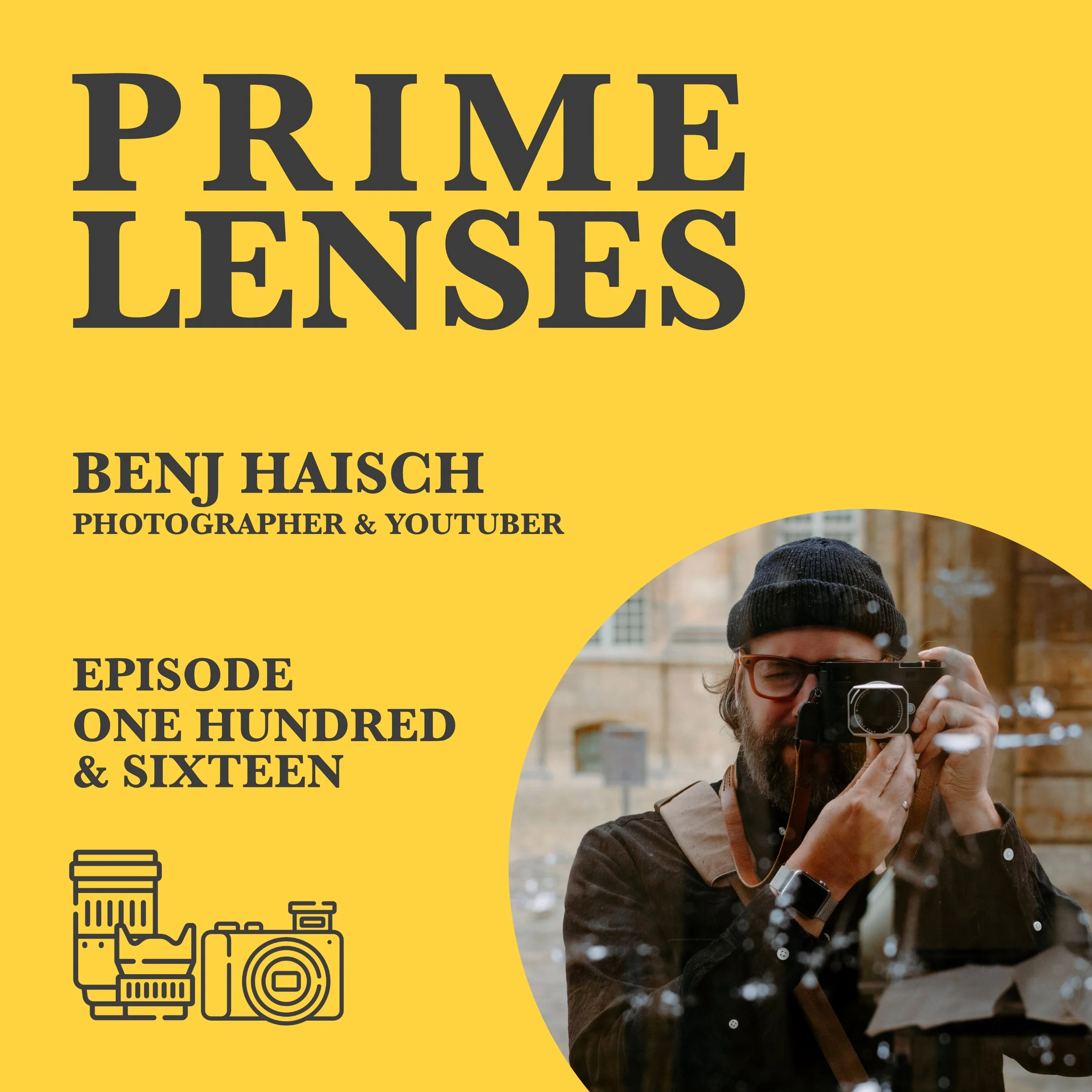


Benj Haisch is part of a proud tradition of guests who are musicians turned photographers/ YouTubers which nicely reinforces my personal biases when it comes to what genuinely constitutes creativity. Cutting his teeth photographing everything, with everything he’s a voice I trust in the photography space. He’s a warm, fun photographer and was a joy to speak with so I’ll get out of the way and let you enjoy our chat.
Sign up to the Prime Lenses newsletter for a mid-week treat.
Support the show on Patreon.
Episode Transcript:
Iain:
Thank you. The next step it's splendid to see you I've got so many things that i want to talk to you about because i feel like you're one of those lovely people to talk to who's a bit of the photography furniture you know you've been doing this for some time and i really trust your voice and rate your opinion on things So it's really lovely to kind of sit down. I was actually re-watching your Mandler video earlier today. Oh, interesting. You and Dave. Yeah, because as someone who shoots with the M system, we're going through this insane period right now where these things are coming out and they might be really good. But what you're doing, I think, that's different to a lot of people is you understand and go to the trouble of understanding things like the lens curvature and stuff like that. So I wanted to kind of, I know you've got a background in music and a background in, and musicians tend to be quite technical. So I thought it'd be good to set the scene for folks listening by saying a bit about how you landed on photography.
Benj Haisch:
Sure. Yeah. Yeah. So, uh, I mean, it's been a long journey for sure. Uh, I, I'm realizing that I'm almost exactly at my 19th year of doing this professionally. Yeah. You can, this is an audio podcast, but if you can see my beard there, you can see there's plenty of gray in it from all the years of doing weddings. Very distinguished. Very distinguished. Exactly. But yeah, my background's in music. And like many people, like we just mentioned Dave Herring, Dave and I just went on a trip together and we were talking about all of our musicianship backgrounds and things like that. And yeah, so like I started playing music when I was a kid and kind of just moved through a bunch of instruments as need would dictate. I started playing drums as like a middle school kid. So that was probably what 12 or 13 started playing drums. And then my best friend was a drummer and he was a much better musician than I was. And so I was like, oh, I can learn bass. That's only like one note at a time. And then I started playing in a band as a bass guitarist and a singer and then moved to electric guitar. And I've kind of just moved through all of the other instruments in that way. And I think that there's just there are so many parallels and so many current photographers have their background in music. And I think a lot of it, yeah, comes down to a lot of shared creativity and a lot of the way the brain works. A lot of us are also like have ADHD and other things that make that make the creative both the interest level in creative processes, like something that we can easily pick up quickly. and that kind of that barrier to entry for some people like myself at least it's the it's getting over that initial barrier that kind of moves you into something different and so then I had friends that were making music videos and things and my brother was really good at wakeboarding back in the day and so we would make like wakeboarding videos and I would make music videos for friends and then my kind of move into photography was just that I started traveling and then a friend of a friend of a friend kind of thing. Their sister's wedding photographer bailed on them like the Thursday before a Saturday wedding. And they were like, hey, you're the only person that we know that owns a camera. Could you maybe come do photos for us? And I said, no, I've never been to a wedding before. Don't don't make me do this. And they were like, literally anything's better than nothing. We'll pay you 500 bucks. And otherwise, we're going to go spend that money on buying a camera ourselves. And then we're going to have to do it. So literally just be the person there to click the button and then that's better than nothing. And so I did that and then I showed those photos and someone else saw that and offered me more money and then someone else saw the next photos and offered me more money and it just kind of spiraled into like, oh, cool. And so at the time I was actually playing music more of like a career thing. And then it kind of got to a point where it was like, all right, I have to kind of choose one or the other. And the music thing was really hard to make money in and the photography thing it was much easier to make money in at the time and probably still is to be fair. And so, but yeah, there's, there are so many similarities that I find between music and photography. And I talk a lot and teach a lot about like composition and framing and stuff. And one of the things that I've used as a tool for that is like a melody and a counter melody and how those things kind of like work and interwave and move between the two of them. And it's when you can really nail both those things that a photo works and, you know, a song works as well.
Iain:
I love that. And I love, I'm smiling like a loon because one of my pet theories on the show is that we put things into kind of creative, traditional creative buckets or not creative. And it's like, well, engineering and things like that, science, you know, scientific discoveries come through a leap of faith. Often engineering comes through clever problem solving. I think people are good at complex things and I think putting them in different buckets. So I love, it's why I kind of teed you off in that way because I've got a little bit of like confirmation bias that always feels good of course in the moment um but it's nice to hear that like these things were applicable across both I think it's why my common reference for this is is why athletes can sometimes easily move between sports you know sometimes there's a sport that they love a lot more than the one that they're actually really good at sure yeah yeah you know and I feel like you're a similar example of that I think there's a parallel universe where I'm making a music podcast and talking to Benj the musician instead of the photographer sure yeah yeah do you think part of your interest in it and then the way that you can deconstruct it led you quite naturally into the educational piece because you touched on that there as well that you've you've helped coach people and given you know mentorship and and and workshops and things was that kind of a very natural progression for you because some people feel it's quite hard to move into that space but I'm not, I don't get the impression you would have necessarily.
Benj Haisch:
Yeah. So I think that one of the things that the photography community in general can be super isolating, right? So like I, I sit in this little box in my backyard all day, every day. And I don't have coworkers. So, you know, I think, I think a lot of people that at least do this for a living will relate. And if you don't do this for a living, you do something else. It's something that, Hey, just a heads up. Like when you get something fun that happens or you achieve something or you book the client you really want or whatever. I can't just turn around to some other coworker in my space here and like high five them and go, hey, we did it. It's just like high five myself. I did it, I guess. No one cares. And so there's just like that bit of it. And so I think that early on, I realized like I have to be part of this community in a way that at least brings me some sort of sense of community. And so like early on, I was part of a bunch of Flickr groups. And even when like Facebook groups started, like I was pretty active in a lot of those Facebook groups and stuff and felt like especially early on, like in those like 2007 to 2010 or whatever, there was like a group of photographers that we're all kind of starting at the same time. We're all kind of like rising altogether. And so it was cool to go like, hey, this is my new thing. I just photographed this thing. Can you critique it? You know, and like I'm struggling with this thing. And so there was always like that sense of community. And I think because of that, I started just trying to like pour my information into people and vice versa. I would get that back from a lot of people. And then because of that, I started to get asked to speak at things. And I remember I turned down the first like four or five speaking engagements because they were like, I remember this is sorry you're going to get all my ADHD side notes but when I was graduating from high school one of the things you had to do to graduate from high school in my thing was that you had to give a 10 minute presentation just about yourself and what you want to do with your life. And I remember that was the most terrifying thing that I could possibly do was like, I have to go stand up there for 10 minutes and talk about myself. And that's just hilarious because now I make YouTube videos every single week where I'm talking to a camera basically about like what I learned or whatever. And then I've done tons of talks where I've talked for like over an hour, you know, and just talked about photography and whatever. But that was part of the reason why I was like, oh, that sounds terrifying. Getting up on a stage, not playing music, because like music is something I could hide behind. I have a guitar or I'm singing like there's something else. But the vulnerability of like getting up there and speaking about my work or something I'm trying to teach was scary. But yeah, because of that, I started to teach a lot. And so it was kind of like the combination of like knowing I needed some sense of community. and then that community sort of validating my ability to teach and things like that. And then it kind of spiraled into, oh, now I feel confident in this. Now I'm able to do this. Now people are seeing me at this conference speaking, and then they're inviting me to speak at some other thing. And I think because of that is kind of how everything rolled together.
Iain:
You've mentioned something a couple of times now. I'm just going to say, have you seen the documentary that was made about Paul McCartney's Lost Base? I don't know if it's crossed the pond. it's related because there's a bit so basically i mean i love The Beatles and The Beatles are incredible so of course it's great yep so basically his first bass guitar um was a german one he bought when they were in berlin that first time yeah yeah and it went missing he got a second hofner hefner hofner bass was yeah the hofner yeah the lefty old violin bass yep yeah yeah so he got a second one at some point and then switched to that because it was better made and a nicer sound or whatever. Got the other one resprayed and resorted at some point. Because it came back looking different. Was never as happy with it. And then at some point it disappeared. And there's this whole story about how it was in the back of a van one night in London and it got nicked. And they go on a journey to try and find it again. But in that, Paul McCartney talks about when he was growing up, he lost his mum when he was very young. And a guitar as an instrument, not only is music something that occupies your whole mind and so you're busy, you're engaged in something and it helps you move through some feelings and stuff but you're also holding something close to you which is just this wild yeah and i think i think when we're whether we're holding a camera or a guitar or something or the way a pen or a brush feels something in your hands i think as creative people when we when we find something that speaks to us like that using it just being near it gives us comfort yeah i think there's plenty of things that are like that
Benj Haisch:
Like, I mean, obviously we've touched on the music bit, but there's just other things that like, and I don't know what this is, but I've never, I've never been someone that like loves to go out dancing. Right.
Iain:
Like,
Benj Haisch:
but I, I go to weddings or a hat. I used to go to weddings every single weekend almost. And dancing is a big part of it. But if I have a camera in my hand, I'll get right in the middle of everything and dance it up with everybody. But it's like, you just, it's almost that like little thing. And this is like another little side tangent, but so many people have talked about how the camera is the thing that gives you the ticket to be in places, do things you wouldn't normally be able to do. And it's funny that the camera is almost the thing that gives me permission to do things that I wouldn't do and be places that I wouldn't be otherwise, which is obviously just an incredible thing.
Iain:
There's a darkroom near us in the Highlands that I've been using recently to develop film. And you book time, there's like a time slot system. And there's one of the guys who's a member at the darkroom who apparently only goes in on Friday nights. And he doesn't like going out dancing either, but his partner does. So she goes out with her mates for a few drinks. He goes to the darkroom and processes film and hangs out and does whatever. And then they go home together at the end of the night. Nice. Yeah, a little introvert-extrovert combo there. Yeah, it's sort of helping him at both ends. Because I'll bet the pictures he was taking on the camera, like you say, it gives you permission. but yeah so when you were kind of coming up you mentioned that time period 2007 10 11 kind of thing is that why your one of your first work courses then was that 5d because that was around
Benj Haisch:
that time when that camera blew our minds yeah yeah oh for sure yeah i i started with like a Rebel XTi it was like the um you know the the camera you could get at Costco in the state i think you guys have Costco, but yeah, it's like the big bulk store. You can, you know, buy a cheap camera there. So bought one of those. And then, um, yeah, that, that couple said like, Hey, we need you to do our wedding. And I went to the one wedding photographer I knew and was just like, Hey, what do I do? I have to do this. And they're like, make sure you have two of everything. And I was like, okay, cool. So I went out and bought like another, I bought a Canon 20 D and then I bought just another, like a lens for it and I think I had like three lenses and two cameras and ironically or perfectly for whatever uh you want to think of it as people were starting to walk down the aisle that rebel did it just stopped working inexplicably no idea so I just grabbed the other one and like had a different lens you know all that stuff but like the very first wedding I ever did within the first five minutes of a ceremony happening the thing that was like people are like oh it'll never happened to me like happened to me immediately. So I was incredibly thankful to have had multiple cameras because I think still a lot of people are like, I just need one. They're fine. It's technology. It's never going to break like woof. But yeah, and then and then so I did a few of those. And then I remember the 5D was like the thing. And it was the thing that like for me, at least if we're going to go off of musical references and things, it was like the jump between like a Squier strat and like an American standard Stratocaster or something like that, or like a cheap Epiphone and like a nice Gibson or whatever thing you want to think of. It was like the giant jump for me of like, oh, this looks way better. These files look way better. These are easier to edit. Like everything about it was just like a huge jump for me, at least visually. And it's still the camera that I still have one and I still think it's like I made a video a while back about how I think it's it's the greatest camera of all time obviously like it's 12 megapixels you can't really shoot above like 640 iso um there's plenty of issues with it the autofocus is slow but i could go out this weekend and make images I'm proud of with it um and i think the texture that you get out of it and everything is just incredible so yeah obviously a lot of nostalgia with it for me as well but yeah
Iain:
well it's funny you say it because I've said in the past about the 5d with a like a 50 1.8 is about the best deal in photography, right? If you're willing to carry it around, it's not small, but it's pretty bulletproof. And even though it's only a lower resolution camera, you'll still do great stuff with it. And actually this week I was, my 5D, I guess, would be like an A7 because that was when I started to seriously, so I had a D40, it was like my first Nikon that I adored. And then just before my son was born, I pitched to my wife that the A7 would be the last camera. because it's a 24 megapixel full frame you'd never need nothing yeah nothing's gonna beat this and and i was actually telling a friend of mine who wants to get into photography i was saying just you can get an A7 original body for about 300 pounds and get the the 35 Zeiss or the 55 18 and you will have a ball and those pictures initially because and I've purposely chosen primes it's like sure you will take three shots of that of your cat or whatever and think oh my gosh
Benj Haisch:
this is the most incredible thing yeah the jump between between like a phone especially and like a dedicated camera like a full frame dedicated camera um and there are something i haven't shot with the 35 but like that 55 1.8 from Zeiss like you know the Zeiss alpha combo it has some magic
Iain:
to it for sure it does it really does the 35 is one of my favorite lenses of all time and it's why i shoot with the uh the c biogon 35 f2 8 on my m all the time basically because like you I'm a 35 boy but growing up it was the it was a 35 to 8 on a point and shoot camera and then it was the 35 to 8 on the A7 and so it just became this natural progression that that to me is what a
Benj Haisch:
photograph looks like oh i mean yeah it works so well like obviously so many of the most famous images of all time are always on 35 and it's why like the x100 series is a 35 like i don't know it's a pretty well a 35 equivalent right you're gonna get someone mad at me in the in the comments here or something that's gonna be like well it's a 23 yeah if it's good enough for joel mywitz it's
Iain:
good enough for me and you yeah exactly where we're going um but yeah now it's cracking so so you're still how do you divide your time now then so you're basically your weddings your YouTube you're doing workshops you're heading to the desert with Dave yeah how do you like if if i met you at a wedding and said what do you do how do you answer that question yeah that's a good
Benj Haisch:
I think I've actually been asked that a lot lately uh because I've been you know just doing so many YouTube videos and yeah i went to nab last weekend or whatever last week um for like the big broadcasting convention thing. And it's it's a pretty close to being 5050 now between like doing actual like paid wedding work and paid work in general, whether that's like, you know, the occasional corporate client or whatever. And then just so it's a weird combination of like, yeah, I can tell people like I photograph things and I talk about cameras is kind of like, yes, right. Or I talk about photographing things is I guess a better a better way to put it. But yeah, it's a it's a kind of close 50 50. And I think a big part of that was when I was at my busiest doing wedding photography, I was gone almost every other weekend, like out of town, like I'm flying somewhere. I think I was doing like 40 some weddings a year. And 20 plus of those were like me getting on a plane to fly somewhere and being gone for four or five days, or three or four days. And my son is well, my oldest son is almost 10. He'll be 10 in like a week. And at that point I was just like I should probably not be gone every or like a lot of weekends of his summer and like you know uh so I think that I was already doing a little bit of speaking and teaching and I was starting to sell presets and things like that and I was kind of realizing oh there's another way that I can go about doing things that I can be a little closer to home and not be out and about doing things as much right so I think that's it's been a kind of a good thing to land on because I know a lot of friends of mine have just they've leaned so far into just doing like the influencer stuff right so they're just doing social media things or they're just teaching or they're just whatever um and then I've I just I guess I shouldn't spill this too much but I've guest spoken at a lot of their workshops and things and uh you know the people that are there they're they're trying to be full-time photographers they're making their living doing photography work and I've seen a lot of my friends get asked like oh so how do you book new clients how do you do this how do you do that and I know in my mind that no they don't actually take clients anymore they're only doing stuff for content and so they're giving these like answers that used to work for them five years ago or whatever when they used to do that and so all that to say I like to make sure that I'm keeping my feet in both worlds so that I still have if I'm going out and making a video that I'm talking about like why this lens or camera should be really good for wedding photography I go that's because not just of my background of knowledge of why this would be good it's because i actually went out and used this or I've used the previous model or whatever and I'm going to use the current model and this is why it is currently good and here's the issues that it currently solves and
Iain:
all that kind of stuff if that makes sense it does make sense and it totally explains what kind of we started which is why you know so much about and why you look into stuff like you're not just for content sticking the thing on a tripod and testing different apertures and different distances and things like that that's that's some of the stuff that i really appreciate and find interesting because it's helping make me better and helping me to understand like the way that you went into detail on the mandala I've not seen anyone else go to that level of detail you know a lot of people will get that lens try and shoot it infinity and be confused as did i shoot it wrong and there's no information there's no feedback on the m telling you what aperture you were at or how you'd focused it you don't get that metadata so it they'll just assume they did it wrong or it's vibes and they'll never really understand it and it's not rocket science but it needs demystifying yeah so i mean
Benj Haisch:
that is the weird i guess balance that i feel like I've been able to strike a bit as someone that like i appreciate the nerdy details of knowing what field curvature is in the first place and like but it's something that i had to learn along the way of like i remember i was doing a comparison in between two lenses and talking about why the bokeh seemed different on one lens versus another. It seemed to be more apparent. And someone in the comments was like, that's field curvature. And I was like, field curvature. Let's Google that. Oh, OK, that makes sense. I never really thought about how the plane of focus on a particular lens might change. I assumed they were all just flat because that's how we learn how depth of field works. Oh, it turns out some weird, you know, glass things. If you don't correct them, they'll curve the image. Oh, cool. And that makes more sense now. Um, and so I think that like part of the process for me is like, I, I, I like learning things like that. And then I like to hopefully be able to communicate stuff like that in a way that makes sense for people that don't already know what it is, because you come across, or at least I come across a lot of people that have a lot of technical knowledge, but not a lot of knowledge of the artistry of things that I might appreciate. And so I don't think I'm like crazy technical and I don't think I'm a crazy artistic brain, but I do think I have a decent balance of both that I find that I think that both kinds of people can relate to a little bit.
Iain:
I heard a lovely quote. It was Alan Shala said it on one of his videos recently, which was that amateurs worry about gear, pros worry about money and artists worry about light.
Benj Haisch:
Yeah, yeah. And I think what's funny is like, I'm like, oh yeah, I can, I kind of hit this weird balance between all three of those, you know? Like, and I think, I mean, even going back to the music stuff, like, I think that's why, uh, and maybe that's just an ADHD brain thing, but I think that's why I've bounced between instruments and I've bounced between camera systems and I've bounced between formats and I've bounced between digital and film. And like there's a part of it that's an easy way for me to get to an acceptable to mid level on just about anything that I like to try. But it's it is harder to push through that, you know, that plateau or that wall or whatever to get beyond that. And so that's why I like I'm a decent drummer. I'm not a great drummer. I'm a decent guitar player, decent bassist or whatever. But because I'm a decent amount of all those, I'm a really good musician and I'm a really good person to be in a band with. And in the same way, like I'm not the best at composition. I'm not the best at lighting. I'm not the best at capturing moments, but I'm pretty good at a lot of those things, which I think makes me a really well-rounded photographer. And I don't know every single thing about field curvature and about aperture and how lens elements work and all that kind of stuff. But I'd probably know more than the average person. I know how that affects things and whatnot. And so that makes me also like a decent reviewer in a way, I guess.
Iain:
Well, I wanted to ask you about the moving between systems, actually. So this is probably a good point to jump into that, because I, if you've listened before, you'll know I have a self-imposed one camera rule, which people like Dave find baffling. But it keeps me honest. And it's how I'm trying to achieve some level of mastery of something. How have you not, because, you know, asking for a friend, how have you not been distracted along the way? Or have you actually been distracted and gone down rabbit holes along the way? And that's turned out fine.
Benj Haisch:
Oh, for sure. I mean, I just published a YouTube video this week. This sounds like you set me up here to promote my own things. But I just made a YouTube video that I think it was called More Gear is Killing Your Creativity. And the whole premise of the thing was I brought a full like a three lens like a kit and a Hasselblad with a full like a zoom range uh to to our little road trip to Death Valley and stuff and I just found like oh my gosh it's just so it's having so many options is is gives you decision fatigue right um and so just like you're saying if you can just master one thing you'd go out and I think that the most creative I am is you know we talk about all the time but it's just like the force limitation is the thing that like promotes and prompts creativity. Sometimes I don't want to be forced to make creative decisions. Sometimes having a zoom lens is a great thing to have. And if I'm showing up to a corporate gig or even a wedding, sometimes like having a zoom lens and all those options can be great. But also it's one of the things that's distracting my creative brain because it's, you know, it's taking bandwidth to decide which focal length I'm going to use and where I'm going to do it. And I was kind of talking back and forth with a commenter on that video about how I actually, I never realized it, but when I'm shooting with Leica, I'm almost always using like a 28, a 35, or a 50. And if I'm shooting with two lenses, it's a 28 and a 50, and with one lens, it's a 35. And I've just used that system for like over a decade now. And so before I even pull the camera up to my face, I already know what a 28 millimeter is going to look like, right? Like you already know what a 35 million is going to look like. But I was realizing that, oh, yeah, when I pull a zoom lens up to my face, it's like the possibilities are still endless. I don't even know what I'm going to be doing. I'm zooming in between all these different focal lengths and stuff. And the end result can be great. Right. Like, but it's like I'm not pre making that decision when I'm bringing the camera to my face in the same way that I'm pre making that decision as I'm looking at the scene with a prime lens as I pull it up to my face. So it's just a completely different thing that can be helpful and useful. But I do find that it does absolutely hinder my creative process in that. That all, yeah, makes sense.
Iain:
So it does make sense because I think some of the time, well, the other camera I've used a lot is the GR3, which I adored because of that 28 millimeter and a bit like a Q. You can get really close to things. You can, the wide angle nature of the lens ceases to be a problem when you've got such close focus and you can do kind of a macro mode and things like that. You can kind of, you sort of get away with murder or something like that in a way that people don't necessarily appreciate when they say, oh, it's 28 mil lens. It's like, yes, but look, you can do all this. And I think the kind of the decision fatigue that you're talking about has to be counterbalanced. because the benefit of just doing this versus an internet that is telling you you need everything and there's people like us who get to play with things like I've just started getting stuff sent to me so I've added gfx 100 rf for the last couple of weeks just like Dave nice yeah and had loads of fun with that and it's thankfully gone in a pellet case and gone back home now but but it was fun to try and fun to do and so people see this stuff out in the world and go oh well actually i you know i need this and i was talking to a listener yesterday who was saying I'm not interested in the wide looks because my setup is complete he's like I'm not even i don't even feel the need to look at it and that's a lovely place to land that if you can you know if it's not your job and you're just
Benj Haisch:
enjoying it isn't it you can just land at something you know yeah and like i think that part of it is that like if you're interested in gear and you you get that little dopamine hit of like oh I'm gonna try this new thing i get to like you know play with this thing that i wouldn't have access to either. And that that is like the the give and take of doing this as a job, but then also doing this as a like or doing photography as a job, but also having access to all this extra stuff because I have a YouTube channel is like I have multiple times a month people wanting to send me new things to either keep or try out or whatever. And so then I have access to all this extra stuff that I wouldn't normally have access to, which can be fun. And it can also be like that creative limitation of, oh, now I'm gonna have to wrestle with this new piece of gear that I actually don't know really well. But I've been doing this so much that you could hand me anything at an actual paid gig, and I would still make work that was, you know, relevant and would work with my stuff. But it is the thing that like, I go through these giant stages of I just have way too much gear. Like, I just sold a bunch of 35 millimeter lenses because I realized I had, I think nine M mount 35 millimeter lenses just from like companies having sent them over the years and doing reviews and stuff and they were just you know just but it's just way too much stuff and i would keep them because in the back of my mind I'm like oh but like if i let's say i do another mandler video or something i want to have like all these other 35s to compare it to and I'm like no one actually cares about that really like you should just ditch stuff um so I'm in the middle of like i i do these like big give and takes of like i get way too much gear and then it overwhelms me and then i sell it down and then the stuff starts to accumulate again and then we sell it and you know just kind of how it has to go um but i will i will definitely say and this is going to be an admission of myself i i think I'm less creative right now than i was when i was just shooting a three lens setup with a couple like m's at weddings and stuff because now i have like the the Sony 28 to 70 f2 and it's Just like every time I show up, I'm like, why am I bringing anything else? But also then I'm only using that, you know? And so I just like that forced thing. And that's why like in the last video I made, we went out to the sand dunes in Death Valley. And I brought the 28 and the 50 for the Leica system because it wasn't windy and I wasn't going to get dust and sand and stuff into my camera, thankfully. But there was tons of times there was a guy that walked right past us that had like a 100 to 400 because he was going to do stuff and then other guy with the 70 to 200 another guy with all that stuff And there's part of me. I was like, oh man, it'd be really nice I should have at the hospital because then I could have zoomed in or cropped in more and all this stuff, but I was like no These are really fun and I have a 28 millimeter and 50 millimeter and these are kind of like my focal lengths and I'm gonna make really cool images and I might some of my favorite images of the whole trip were just of those and was because I I didn't have the option to do all the type stuff. I didn't have the option for all these other things. And so just having those two focal lengths and being able to kind of pre-see that because I've used it so much and before I even pull it to my face, just go boom, decision fatigue alleviated.
Iain:
Exactly. No, it's nice. And I think they're the pictures you made, right? There's this, we need to turn off the voice in our head that tells us some of the time that, I think you mentioned it in your video, like I'm not here for a client, I'm here for me. I can enjoy it. and the voice in the back of our head I've done it I've went to um went to the motor gp a couple of times uh in the netherlands with my brother birth you know significant birthdays and you go on a bit of a trip right and you have to kind of silence the part of your brain that's like right I've got to get coverage yeah yeah totally yeah like the photo you get is the photo you got that's why it's meaningful it's not I'm sorry to say no one at no one at the motorcycle news is going to tap me on the shoulder and go, Iain, it appears you've got an incredible photograph of Mark Marquez that nobody has quite taken before. Like, no. Yeah, there's 50. You just need to quiet that part of your mind and just enjoy it.
Benj Haisch:
Yeah, yeah, yeah. And yeah, there's plenty of times where like, I'll even see stuff that's like not even in my style or whatever. Like someone wanted to trade me like I was selling a piece of gear and someone was like, hey, do you want to trade for like the Sony 200 to 600 and none of my work is anywhere close to even 200 millimeters but i was like oh that could be fun I've never played with that before like blah blah but it was just like i don't know why like that it's it's the it's the combination of like the possibility of something new is kind of fun and exciting but also to bring it back to music it's like my goal as a musician is to like stay in the pocket right like I'm not trying to make waves and do something weird I'm trying to like serve the song trying to play with you know it's a it's also a fun dance with other musicians of like how do we work well together and all that stuff and like 200 plus millimeters is not me being in the pocket that's being being out of pocket to use a different kind of phrase but uses the same terminology um and it's like it would not serve my photography to use that it'd be a fun experiment but like i don't need to own a 200 to 600 right like that's just like moving well beyond something that's even close to necessary for me is that how we'll know that
Iain:
you've lost it that like we'll see you post the video on YouTube of the 200 to 600 and that's how we know that's your that's a kind of coded cry for help i think that would be a it would still be
Benj Haisch:
like a fun like experiment right i think experiments like that are fun of like okay i don't use these can that give you a creative uh process of going like how can i make work that feels like myself with the 600 mil like that'd be kind of a fun thing but yeah if i went out and bought one and you saw one in the background of my videos because i owned one you'd be like you're doing something weird or you're doing like a genre shift or something going on here but yeah well it's that or like the the shocked face YouTube thumbnail where you're doing like the click clickbaity thing I've told multiple people in my life if you ever see me do that face uh to try to gain clicks for a video then you have a permission to come and punch me in the face
Iain:
there was a podcast i used to listen to called Do By Friday and they had a different topic every week and they said you'll know when the podcast ending because the topic will be what's on your keyring and that's how that was how they were going to end the show they'd kind of they baked it in early on canonically they were like the show will end when we do the episode about your keyring there's no we've run out of ideas at that point yeah we're done oh my gosh yes yeah um so one of the things i also wanted to ask you about was last year i think it was but then what is time i think i saw you posting something on Threads where you'd got hold of some new crazy Sony and you were doing 120 frames a second full raw capture of a helicopter and a couple on a cliff edge. Like incredible pictures. That, I'm fascinated by what your thoughts are coming out of that. Because that capability existing seems insane to me now. And I wonder how, I know I could see that you used it, but a bit like 200 to 600. I don't know what it's for.
Benj Haisch:
That's absolutely a perfect little lead in and great timing on your part, which I'm not sure if that was on purpose or not. But I am currently have that camera for sale and it's one of those things that like it does too much. It does more than I need. It is. My only problem is because, yeah, that camera is the Sony A9 III A9 III, I guess for some people. And it'll do a burst mode up to 120 photos per second, full raw, global shutter, all this stuff. It's absurd. And I've really used it for like the party trick of it all. Like it works and it's fun. And every time I make an Instagram reel using it, like it always does well. And I've actually had clients be like, hey, we don't have a videographer. Can you just like capture just our first kiss or whatever, you know, using that mode because I've seen you do it. And I'm like, yeah, that's fine. I guess I could do that. But in retrospect, I'm like, can I just like video it on a different video camera or something? And so it has so many problem solving things, but they're all just beyond what I would need. And so I've realized like, and my Sony setup was like an A7R V, which has 60 megapixels. And then this a93 that has 24 megapixels. And it was just like, those things were messing with me. And so, but it was, it was totally and absolutely like out of pocket. That's not me staying in the pocket. That's me doing party tricks. And it's useful. And it's like a jack of all trades, master of all. But like it's just one of those things where I realize like I just have too much money tied up in this camera. That is just like beyond something like that is outside of my style, my realm, my type of thing. And the only reason I'm keeping around is like the what if scenario of like I might be in really bad lighting and have to use a flash for some reason at like, you know, one, two, three. thousandth of a second which that camera can do it without using high speed sync uh or just the party trick of doing 120 or even i think the videos that i posted most of them at 60 frames a second um which again is really cool but like none of that's necessary and it's just like it's totally outside of the things that i need for my own style and everything like that so it was definitely like a yeah i i don't i don't need this and i don't i used to use sports i used to like photograph the national football league and stuff and so like at the time i was like oh that'd be really fun like when i used to shoot for the Seattle Seahawks like incredible but i don't do that anymore so i don't need this um it was totally so yeah 100 was just like a um this would be fun and it is fun but i
Iain:
it's just not a necessity at all yeah it's not fun once your naz starts telling you it's running out of space which is what mine did this morning mine's waited to the weeks when i the fortnight where I've decided to start making occasional videos and it's like, boom, 4K videos a lot, man. Yeah.
Benj Haisch:
No, my bigger problem, yeah, is like, because those files are not nearly as bad as shooting one of the Hasselblads all day, which doesn't have a compressed raw mode. I think they're all like 238 megabytes a piece or something. And so if you're shooting that thing, that's where it's just like, oh, so four photos is a full gig? Cool, great. Yeah, that's the bad news. That's the bad news right there. yeah but yeah I have a few nasty units and storage is yeah the different issue but yeah but I mean back to the whole thing that's it's totally like a that's a version of me that caught into a this is useful this is cool this is fun but it's straying outside of you know I guess The Beatles used all sorts of weird and Indian instruments and things in times but that'd be a string and then abusing like synthesizers and weird stuff that's like beyond the genre you know even further out than
Iain:
they went yeah i think it feels like you're turning around to me at band practice going but what if we need the thereminian we've got to put it in the car yeah i don't think so yeah no i don't need a theremin yeah it's maybe slightly more useful than the theremin I'm being cruel i will get in trouble for my friend sam who works at Sony um it's a no it's incredible it's incredible
Benj Haisch:
And it's like it is a problem solving camera, right? Yeah. But it was like, is it solving a problem that I need to solve often? The answer was no. Yeah. And like, would I rather trade that for another A7 R five or the A7 five that just has better dynamic range? That's a problem I run into more in my work being outdoors on mountaintops and things is like making sure I'm getting all of my highlight detail than I am to like shoot at crazy fast shutter speeds and things like that. So it was like this was a camera that wasn't solving a problem I had. It solves a problem, but not one that I was having. And it was one of those things where like I could have that problem. And so it was nice to have, but it wasn't actually solving any problems, which is the thing that I usually do when I decide if I'm going to purchase gear or not is do I have a problem? Will this actually solve a problem that I'm currently having instead of an ambiguous problem that might occur at some point that I've never actually run into more than a
Iain:
couple times well you mentioned there exposing highlights obviously that made me think of film sure do you because you've got so much more highlight detail than that as I'm discovering as i get back into it and process you know film do you often shoot much film are you have you gone because Dave is a is a pusher with this stuff as well like i feel like all of you and people like scott are like like can be this nice circle of people reinforcing each other's habit in that
Benj Haisch:
direction as well yeah yeah i mean i used to shoot a ton of film um and I've actually done full multiple like full wedding days only on film too cool um which is also like a fun creative process uh in and of itself but yeah like film it just has so much more latitude and so one of the things that I've done for years is even if i don't shoot a ton of film because like some clients like specifically request it some clients just like don't care at all uh but usually even if I'm not doing a lot of it I'll bring at least a point and shoot or something and just shoot uh what I call like anchor images throughout the day so like oh here's here's what the ceremony looked like on a wide like a 28 mil focal length on film so okay so this is how portrait 400 or whatever you know uh ecta color 400 now uh it looks in this environment this is how film would have rendered this scene and so it can kind of help inform a little of my digital work to go oh so like the greens here, I remember them being a little bit warmer, but Portrait actually made them a little bit cooler than I remember them. Maybe we'll shift our digital stuff a little bit that way, or I'm having a trouble I'm having some like, I can't decide what on the skin tones here. Are we going to push more magenta or more like, you know, into the greens here? Oh, like Portrait rendered it like this way. Okay, cool. Yeah, I like how that worked. So it's either like a big combo where I'm shooting, you know, five to ten rolls at least, or usually I'll just at least do one set of anchor images essentially to go like, all right, cool, here's a few for the client that they can do some fun stuff with if they want, but it's more to go like, how do I help that inform a different version of my digital stuff and maybe help me shift a little bit more into something that keeps me in like a color palette that's going to be a little bit more sustainable and a little bit more timeless, as they say. Do you develop your own stuff or do you send it away? No, I don't develop my own stuff. It's been a long time since I've done that. And I have a combo. I will either send it to Indie Film Lab in Alabama, which is like across the country for me, because I've just used them for years and years and feel like they have a good version of what my stuff is supposed to look like. Or I have just like a local lab that I'll go drop it off, have them just develop it for me. And then I have, not that anybody else in this can see, but I have like self-scanning stuff that I've been scanning them myself with like negative lab uh pro and like the negative supply coast stuff and I've been doing it on the hustle blods so i have just like full 16 bit color at 100 megapixels uh and so you just have obviously even more flexibility with that kind of stuff so that's also been a fun little but it's obviously a lot more work than sending it out to a lab and having them just make all the decisions for you
Iain:
yes but i think it's nice is for for me the thing that I've been trying to un unlearn is we think the negative is kind of the thing right and we think that film makes all the decisions for us but actually I'm just doing black and white to start with and what I'm learning through that process is that if i develop a more neutral kind of flatter toned negative the negative isn't the end point the end point's the print so totally so actually I'm I'm i don't want to make all the decisions at the point of capture i want to make some decisions later so when i was photographing a friend's baby recently i have an r8 that i I'm using to kind of which oh it's gorgeous it's an absolute tank but it's yeah yeah oh for sure it's a great camera and that's uh some kent mere that i developed recently i sort of stumbled into not developing it for long enough but actually that was better because then i could yeah i could adjust it later on i got that flatter tone which was a thing i think i felt with the Fuji film as well was that the the black and white film simulation in that camera's neutral to the point of yeah you know because I'm coming from like as black and whites which are yeah opinionated and yeah yeah yeah opinionated is like the most politically correct term to use for that I'm i live in the uk it's the kind of thing we'd say it's very opinionated it's like it's like when people just for americans listening when a british person says something like it's quite good what they mean is that's awful like but americans hear that and they go oh it was quite good there was a qualifier really good yeah yeah there was the word quite there was the word good so i felt that was quite good british people don't mean that quite good means i hate it I'll burn it with fire um I'm on a mission to educate as well as yeah no i
Benj Haisch:
appreciate that because i would absolutely take that as a compliment and then just get absolutely
Iain:
worked no no no um i saw a thing today someone was um criticizing the king for speaking at this event recently because as we're recording the king is in america yeah and they they'd criticized him they were on british news yeah it's what it is man um he but they were criticizing the king and saying that he should stay in his lane and go back to kissing babies and the news presenters
Benj Haisch:
I saw that last night too yeah oh that's so dumb yeah they interviewed some yeah we don't have to get into politics yeah it's it's wild having the king in america right now he just like uh yeah went before congress and uh we had said some uh very opinionated things and it was fun
Iain:
yes yes appealing i think to better natures uh and for cooler heads yes which would be nice exactly um but yeah so an opinionated black and white file is kind of definitely what I'm used to and I'll live with the black and white jpegs out of my m all day long they're amazing but um but I'm learning with the with the negative like i can do more with it and i think I'll find the same thing when I go to then turn them into prints because one of the slightly romantic projects that I want to do is turn some of my friends' babies' pictures into these one-off. It's a one-of-a-kind, right? It's a one-of-a-kind. This is not a digital print. This is a next time I do it, it might look slightly different. You know, by the nature of the process, it will be different. Oh, yeah, absolutely. Yep. So,
Benj Haisch:
yeah. Oh, and that's the funny thing is like there's always these debates of like these film photography purists that are like, oh, you don't edit your scans. It's like, well, the scanner either made the decision for you automatically or someone at the button was hitting density, density, density, density and making that decision. And even if you're not doing that, you're developing and you're making your own prints in that way. Yeah. Like you've seen all like the contact sheets and the test prints of people that are talking about all the dodging and burning they're going to do. And like all those famous images of like Muhammad Ali's hand and all those things, all those decisions that people are making. And so there's just, it's, It's an art form and there's plenty of ways to go about doing it. And I think the elitist idea of like, this is the only way you can do it is always just silly to me.
Iain:
Yeah. I think max min maxing anything tends to be, you know, like my hair and your beard, there's gray and everything. And we just, we just need to leave it. Yeah, exactly. So we're recording like midweek, but like end of the week, you're going out with family and friends. What are you going to reach for? I saw the Death Valley video and really enjoyed that. coming off the back of that experience what are you reaching for for the bag like this is where
Benj Haisch:
you can surprise everyone and go it's an x-half no uh so i think so there's if I'm going out with like family or friends and it's not I'm not going to make images but i want to have take photos while I'm there uh that's historically been usually like the uh like the x100 series uh and it's it's it's And that I didn't have something like that before I had kids. But then as I had kids, I realized like, oh, I'm usually holding one of their hands or doing something. And like one hand of photography has become the thing that if I'm going out, I need something like that because I used to shoot with my M's. And as soon as they started getting big enough to move around and I had to start grabbing them and stuff like it became that I can't do that anymore. So the thing I've moved on to recently is actually the Sony RX1R III. So it's that small little point-and-shoot-y looking kind of camera, but its full frame has the same sensor as the A7R V, 35mm F2 Zeiss lens, but it has all of Sony's autofocus and stuff. And so it gives me some character that I like, but it still has the autofocus where I can just, like if my kid's doing something fun, I can just literally point it at them and know the autofocus is going to be great. And the files are going to be incredible, all that kind of stuff. It's not the most artistic of choices, right? But it's like the good compromise between having something that's interesting, also having a prime lens, also having something that's really small and compact. And I've loved the Ricohs and I've used those plenty and things like that. But this is just another thing to where it fits perfectly into my workflow because I usually use that camera. I can just toss a preset on there. It looks amazing right off the bat.
Iain:
It's the same sensor.
Benj Haisch:
And it's just the no thought camera for me. 35 is just a great focal length. I can literally point. It's like a point and shoot. So it's like a digital Contax T2 for me, basically. Yes.
Iain:
Yeah. But it also requires no compromise, right?
Benj Haisch:
Yes, exactly. Like it's absolutely overkill too. Like it's a $5,000 camera here in the States. And so it's definitely far beyond something that I could like necessarily recommend to most people in good conscience just because it's but I could say the same thing about a Leica Q series right so it's it's definitely like a photographer's personal camera kind of thing and for my specific use case it just ends up being super useful and I've never been disappointed with the images out of it all that kind of stuff where I've always liked the process of using the x100 cameras but they're always something that I was like I wish there was a little more depth i wish there was a more color fidelity i wish there's this right i think that they uh yeah despite its price and stuff the rx one are kind of solved a lot of those things for me
Iain:
yeah i mean the x106 is also i wish i could actually get one a lot of the time yeah
Benj Haisch:
geez yeah that's a wild a wild thing in and of itself for sure i was talking to you i remember
Iain:
when they came out um there and patch who used to be at the verge is a huge x100 fan and he ordered one within minutes of it going on pre-sale and i think it was over a year before he actually oh my gosh we were talking about it and he he loves that thing to death but he they made him
Benj Haisch:
wait for it you know that's crazy yeah i think i i because i i was in like the press briefings for it so i knew the moment it was gonna be live and everything like that like i knew and i woke up early to like pre-order one i still think it took me two months uh because it's just they're the popularity is just absolutely wild. Yeah. And I wonder, you know, you kind of wonder like, are they doing it on purpose? Are they trying to keep the hype train going and the scarcity mindset? Like, are they doing like a Rolex thing of, you know, like we have some, but you can't get one, you know, whatever.
Iain:
I don't know. Yeah. Well, do you know, on the subject very briefly of Rolex, because I also like to go off on tangents as well. There's an amazing podcast about the history of Rolex called Acquired. Oh yeah. Yeah. I've seen that. It's so good. They do these incredibly exhaustive histories they're about three hours long every episode and i listen to every second because they're brilliant yeah and um the the thing with the rolex thing is that they they just they're privately owned they don't have to tell anyone what they do but as best as anyone can tell they ship about a million watches a year or something and you go in the shop they have very few they they bought one of their suppliers they didn't even want retailers but one of their one of their retail partners was going to get bought was up for sale and so they just bought them stop to stop the information going out into the world yeah yeah sure and just fascinating company but the way that you can go into a shop they won't let you have one right there but they will call you back in a week because of course they have them that's how you ship watches a year and i feel like Fuji would definitely be selling one of these cameras if they could yeah and i think i think part
Benj Haisch:
of it to be and maybe this is insider knowledge i don't really know if I'm supposed to say this or not but i think that part of it was they were had to kind of cannibalize other cameras to make sure they had the sensors for the x100s and things like that too so i think that part of it was actually like the market chain you know chain of market whatever like actual product issues post-covid and and tariffs and things now and all sorts of regulatory things but yeah it continues valve
Iain:
launched the steam controller as part of that which is part of their new hardware lineup this week and when asked why this controller was coming out before everything else they just went it doesn't have ram in it so we can't do everything else right now because of the ram the world we live in there's never been a better time to hold on to the camera you own is what I'm saying yeah oh my gosh
Benj Haisch:
yeah I'm going to cannibalize my hostile lot cameras because they have a one one terabyte internal ssd in them yeah they're now worth a fortune they're not worth way more jeez i know all these yeah all the ssds are now four times as much it's absurd no thanks ai yeah thanks guys
Iain:
it's it's all really working out brilliantly whilst elon musk and sam altman throw poo at each other in court at the moment just it was literally it was literally like the prequel plot of dune
Benj Haisch:
was that like we let computers control everything and then we had to kill them all
Iain:
because no one's seen the matrix recently that's the problem yeah exactly right yeah geez yeah Well, we'll end on a happier note because I think this has been tremendous and I've loved talking to you. I'm so glad you're one of the people I like. When I started this, I had a list and I get to cross you off the list now, which is quite exciting.
Benj Haisch:
Well, I hope that I hope that we've we've gone to and fro among quite many different topics. So I hope that this was at least interesting to jump inside my brain for a little bit. It's been all over the place. I love it, though. Oh, it definitely was. For people listening, just in case they don't know you, where can they find? Sure. Yeah. Yeah. I guess I'll start that. My name is Bench Heish, which if you looked at it, you might not know. That's how you say it, I guess. And yeah, like you can look up. Yeah, my YouTube channel is where I spend a lot of time. I obviously have an Instagram account and things like that. And I'm assuming my name will be somewhere in the podcasting thing. So you won't have to figure out how to spell it. But yeah, those are the main two is probably like Instagram and YouTube.
Iain:
The super secret squirrel reason I ask people at the end of the episode to say how people find them is because sometimes I don't know how to pronounce all of their names.
Benj Haisch:
I mean, that's fair. I am maybe 10 percent of the time people say my last name correctly, or at least how we say it. So, yeah, it's like hello and then don't talk anymore. Hi. I really like that. We're good passive aggressive people, apparently.
Iain:
It's amazing. I get lane quite a lot. Americans in particular. Oh, sure. Yeah, yeah. Because it's the Scottish Iain with the extra I. And so, yeah, quite fun. A lot of conversations start that way. Like, we're just checking. Is it Iain? Is it Lane? Hi, Lane. Yeah. Becca Versace and I had sent messages back and forth for years, for literal years. Oh, wow. And then the first time we actually spoke like this, the first thing she said was, so it's Lane or Iain? Yeah. It's quite the discrepancy too. Yeah. Sheesh. That's funny. All right, well, listen, man, have an amazing rest of the day. Thank you so much for doing this. I really appreciate it.
Benj Haisch:
Same, absolutely. Thanks for having me.
More about this show:
A camera is just a tool but spend enough time with photographers and you’ll see them go misty eyed when they talk about their first camera or a small fast prime that they had in their youth. Prime Lenses is a series of interviews with photographers talking about their photography by way of three lenses that mean a lot to them. These can be interchangeable, attached to a camera, integrated into a gadget, I’m interested in the sometimes complex relationship we have with the tools we choose, why they can mean so much and how they make us feel.