
Episode 117 - Mattia Bidoli
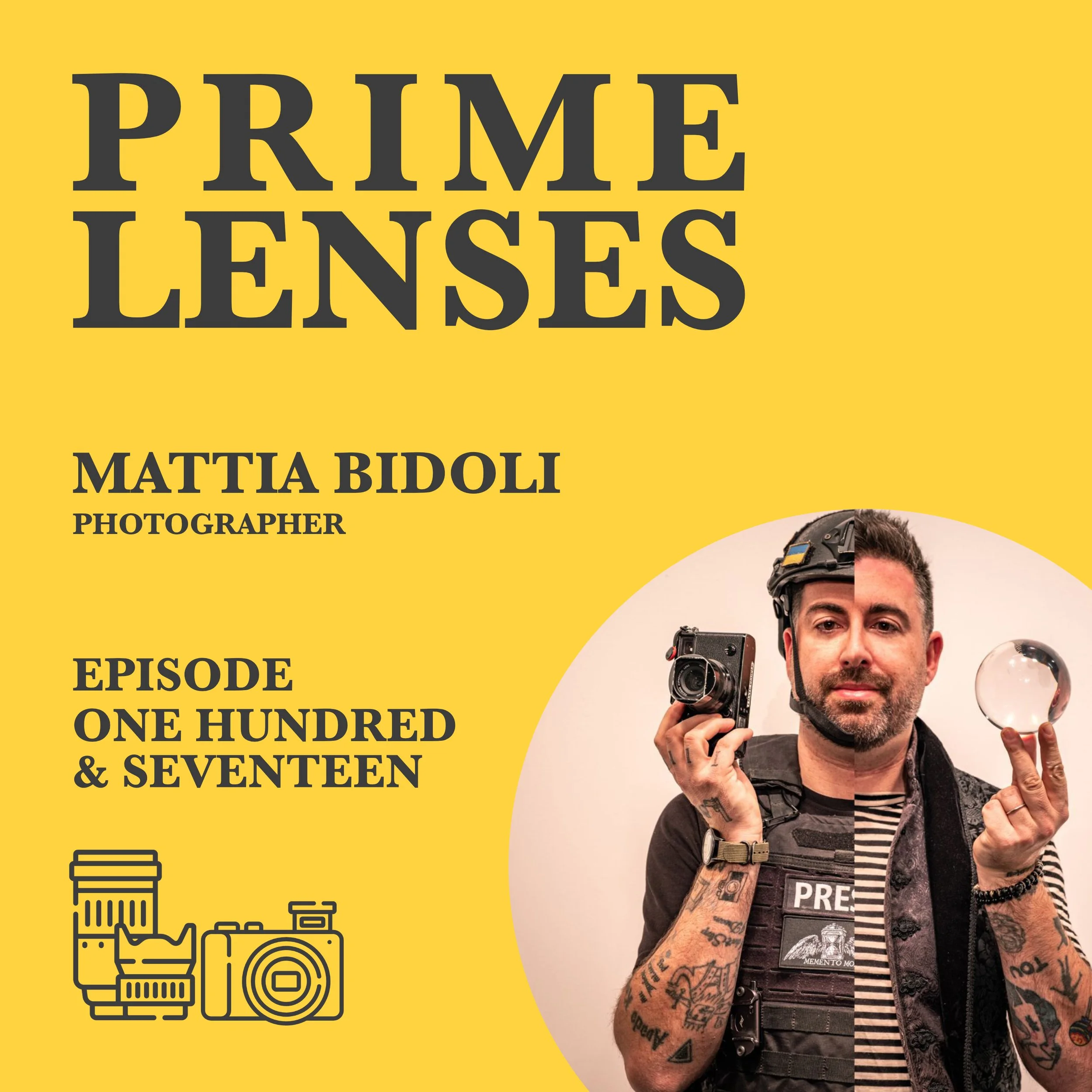


Mattia Bidoli is photographer and magician who has worked in some of the most dangerous places on the planet. His photography from places experiencing conflict like Ukraine and Gaza are sadly in demand in 2026. I met him at the Raw Photo Festival in May and he was kind enough to talk to me while we were there and give me a copy of his book which I devoured on the journey home. He’s a wonderful human being, great photographer and has very strong opinions about pizza.
Sign up to the Prime Lenses newsletter for a mid-week treat.
Support the show on Patreon.
Episode Transcript:
The next step:
Thank you.
Iain:
There we go, we're recording.
Mattia Bidoli:
And it's very cool that it's inside and I don't clip it here. It looks very professional.
Iain:
It's amazing. Well, the reason I do it like this, the reason I do it like this is that there is something nice about having the microphone facing the person, it sounds different rather than when it's here. When it's here, when you're wearing it like a lav, you can hear the voice, but you don't get some of the detail or texture of it, I think. So it is a texture thing. I'm kind of an audio person. Oh, okay. So this is why this is audio only by design, because it's in people's ears, and it's a very personal place to be allowed. So I want to try and make it sound as good.
Mattia Bidoli:
I like your attention to detail.
Iain:
Oh, thank you. It's a pleasure to meet someone who appreciates it. That's very good. Well, Mattia, it's lovely to talk to you. Do you mind if I just dive in? Oh, go for it. Is that great? So we met yesterday briefly after your talk, and it was fantastic, and everyone really enjoyed it. I think you had a room full of people eating out of your hand. But you didn't, it sounds like you've kind of had a complex relationship with photography. Yes. In terms of how much you love it and enjoy it and how you found it. So for people listening who didn't get to see your talk yesterday, can you give us a bit of your photography origin story?
Mattia Bidoli:
Okay, so I started to do photography very young, like with film cameras, but then I just put it in the drawer and that's all. And then I moved on to humanitarian work and working mostly in conflict areas or crisis scenarios. And then my photography come back. because at one point I was beginning only taking photos for me. And then when I started to work with the bigger agencies like United Nations and things like this, part of my job also become to document and do reports about this. And I realized, you know, it's a cliche to say that a picture is worth 10,000 words, but you choose the words. So I thought sometimes it was easier to explain with people with photos. But unlikely for me, I need to start to take photos of very horrible and uncomfortable things. Things that it's also difficult to take photos because you're entering in private moments, private life, moments where life is vulnerable. People are vulnerable. People are suffering. People are dying. And I start to have this huge conflict because sometimes I think, why am I taking these photos? Is this helping the person or it's my ego or is the ego or the NGO? So it's just this pure wiry means I'm being their voice. So a lot of time I have huge conflicts about this.
Iain:
For many people listening and for me as well, I often joke that I'm a tourist. I enjoy photography. I have a camera. I enjoy image making. But I don't have the kind of weight of what I'm making. I make the images and I enjoy them and I move on. And I wonder for you, presumably you started because you enjoyed image making and you enjoy the capture thing but how has it removed the enjoyment from it over time or has that changed that how do you are you able to appreciate and enjoy it still i enjoy when for
Mattia Bidoli:
example when i work with ngos and i see the the impact of the photos the way they are used like for fundraising for raise awareness for changing things and when i see the people that are in the photos or maybe not exactly the people that the the the environment that we are working they benefit at them so i think okay it's it's worth it yeah but also photography gives me access to very intimate moments especially when you spend a lot of time with them and and then when they give you the trust to take photos of very private intimate moments like you are one of them and you're not like it's just they are taking photos of my friends i want to say i think it's it's very beautiful and that healed me and like you say we are tourists yeah because we go in a country it's not our country, where there are already existing photographers. So, and like I told yesterday briefly, the story of Noor, this person that I met in Gaza. She's the press officer of Doctors Without Borders, and she helped heal a part of me through her photography. And so sometimes I'm very conflicted with what I have to take photos of, but then in a way or another life heals, or people, heals this part with this conflict that I have with photography sometimes.
Iain:
That was really interesting to me, actually, the way that yesterday when you were talking about understanding that the people in the area that you're visiting are completely capable of telling their own story. Yeah, absolutely. And I love the way that you've approached that differently. Could you talk a little bit about the way that you lived with them and lived with people in... Yeah,
Mattia Bidoli:
I think you referred to the refugee camps. Yes, yes, yes. So I was in Greece doing a project in a huge refugee camp and there was a huge crisis there. took fire was the refugee camp of Moria and the level of Lesbos and then I see photographers fleeing from all over the world because now it was cool to be there because it was in the news so everybody goes there and I get a little fed up and upset about this because also I saw there are more 200 organizations there are press from all over the world but the people after one week they're still living on the street so maybe something's not working yeah and I decided oh I need to go I was very burnt out about this and I said to an NGO I need to go somewhere else I don't think my presence here is needed, my work here is needed so I went to a smaller refugee camp in the middle of nothing where there was only 2,500 people and I say only in a sarcastic way of course and I wanted to make a project that I wanted to for a lot of time I want to do a photography class with women, only women from Muslim countries. And this place was perfect because they have a safe space where I already work, only for women. But I didn't want to make the cliche photos where then you print them, you put it in the wall and you say, oh, those photos are taken by refugees. And the photos maybe, normally they will be not good, but because they're taken by refugees, the people, oh, this is so deep. Oh, they are so resilient. I didn't want the people to, oh, those are made by refugees. They say, oh, those are beautiful photos. But this thing makes time and most important in its trust. Because when I went there, at the beginning it was very difficult because I'm still a white man with a camera in a Muslim world that I want to do something with women. And one of them, after we become very good friends, she told me, her name is Masume, she's Iranian-Afghani, and she told me, at the beginning I didn't like you because for me it was just another guy with a camera that comes here for a couple of days, acts like you are our friend, that he cares about us, takes the photos, then he goes back and he sells the photo, but nothing will change for us. So it is a time to destroy this cliche that we created, that also I created because I was like this before. All of us, we are guilty of this. And so not taking photos, but before taking from people to giving to people with presents, with words, listening to their story, asking questions, and not necessarily like, oh, I was difficult in your country, but what kind of music you listen? She told me, nobody asked me what music I listen. because for them was maybe for the people it was just a refugee and then when they asked me about photography I give them the camera and I start to teach them and the beginning was like just to take beautiful photos of themselves even with the phone because this is what they wanted because some of them there was teenagers like 17 18 and they wanted just to have a cool photo of them and then we move to later on to storytelling but the beginning was a lot of gaining trust and giving trust and it worked I was supposed to stay there three months and I lived with them for three years and the first time 10 months without taking a day off living with them in the refugee camp constantly day after day after day after but that also gave me access to very private intimate moment for example at home I have one of their burqa that they give me and it's the typical dress from Afghanistan and it's on my wall I have a matching tattoo of a camera with Masume so it was very what was amazing and I learned me so and he shaped me so much as a human and of course as a photographer but first as a human to have a deeper understanding of how we have been pursued what they think about us because people are polite you know people do not tell you uh fuck you in your face maybe they will say later when you leave but uh they will try to be polite because it's also
Iain:
in their culture yeah i think that what you're talking about is something we don't talk about enough in photography in general which is about slow work i was thinking about it on the on the way in today that time is i think really crucial and we we're in such a hurry all of the time now everything around us is just moving so quickly and i think what you're saying there about being with people for 10 months like just imagining that of like I'm living here I'm I'm adjusting my entire life i have a family oh yeah i have you have a partner you have like you have other commitments elsewhere in the world to spend 10 months there and to commit to the project because that's what you believe in and that's what that's what the work needs i think is crucial and also because
Mattia Bidoli:
I really care about them and I start to discover them not as refugees or human on the move but as humans. Then you start to care about them. You start to worry about them and so you want to be there. You want to spend time with them and also these things make sense because people unfold slowly. We expect that we go in a place and immediately they will show but now it takes time because um i tell always this for example because i live with them so much in every conflict zone that i realize you know when you have to flee your house you have to pull all your life in a backpack you know so what you bring with you it's already a choice and and we do like this all the time you know when we met someone or someone new someone we choose what to take out from our backpack to tell them right what this is what we are you know so i think that when somebody gives you a part of their self about their story for me they're giving you the most intimate and precious gift that we have our story our story is what defines us better than the clothes that we wear the car that we drive it's our story and as photographers when somebody gives this story to us they are giving us the most beautiful and important gift because also we don't know they don't know exactly what will happen then with these photos this photo can be on social media The photo can be in a newspaper, can be in a book. So a lot of things can happen. And when you work with Muslim women, these can have huge consequences to their life because their culture. I always say this, one of the girls, Farazana, she's from Kandahar in Afghanistan. When she started to come to the photography class, she was telling to her family, I'm going to English class. Because she was afraid what their family would think. Oh, she's going to photography, but it's forbidden. And the teacher is a guy. So when somebody gives, it's an honor and you have to treat it and respect it, but also you have to own it. You don't have to pretend that all people will just give me everything like this just because I'm a guy with a camera.
Iain:
I think that being a part of the community and blending it on, you know, let me say that another way. Yeah, it's right. But you became a part of that community for the time that you're there. and then presumably you're also involved in other work because you're you're you've worn many caps you're not just a photographer you've driven ambulances yeah i was part of the medical team
Mattia Bidoli:
I was delivering them aid and this of course giving me access to also to photograph very vulnerable things because there are people when people get sick or get injured or they fight and someone of them will get stabbed so you also know them clinically and you have the camera with you So sometimes you have also to start difficult because you can take photos of them in a vulnerable position. But also you know them and you know that these photos then can be used. So then also when you choose the photos, it becomes difficult because, oh, but I know this woman. And I remember once one woman was, you have some domestic violence, this 21 years old woman. And she come to me and she said, Mattia, I need to do a file to the police. what's going on for me but I need to take the photos of what he has done to me can you take the photos of what he has done to me so it was very intimate and very difficult because I'm still a man she's a woman from a Muslim country and I say yeah I can give this photo but these photos I will not use it because it's too much because like I said they give you you own it but you don't have to ruin it
Iain:
I think that that level of trust and you see it in all walks of photography is that people work with someone or they return to work with someone because of that trust, because it's the images you don't do anything with, I think, as much as, you know, the ones that you do.
Mattia Bidoli:
Exactly. There is a very famous poet in Italy from the region I was born. He said something very beautiful that shaped me a lot. It's very romantic in Italy. In English it sounds like from the truth, you have to smell it. You don't have to show everything. You have to smell it. You don't need to show everything in detail. leave them something to the imagination
Iain:
yeah, yeah, I like that
Mattia Bidoli:
I really like it too
Iain:
where out in Italy did you grow up?
Mattia Bidoli:
I grew up in Friuli, the Donbass of Italy we have our own flag, our own language and yeah it's cool
Iain:
very appropriate as well because here we are on an island which is Spanish but hasn't always been Spanish and has its own dialect and has its own culture
Mattia Bidoli:
it's a Mediterraneancy for centuries they fight and what is now this before was something else.
Iain:
Yeah, yeah. I think it's interesting. We have a similar thing in Scotland where the Orkney don't necessarily think of themselves as part of the rest of Scotland and Scotland is not...
Mattia Bidoli:
And you have your own money.
Iain:
Well, yes. Our own money
Mattia Bidoli:
has our own pictures on it.
Iain:
Yeah, no, it's very true.
Mattia Bidoli:
And sorry, but Scottish whiskey is superior to every other. Yes. I love, I like Scotches. It's the best. Whiskey, sorry. Caol Ila is my favorite.
Iain:
Oh, okay. Yeah, well, where we live, You'll have to come to Scotland sometime. Absolutely. We live about 45 minutes away from about seven or eight different distilleries. It's an amazing place to visit. Paradise. We just need to find a designated driver and then we can go and visit these places. That's wonderful. So when you were growing up then, was there photography? Was it much of a tradition in your family?
Mattia Bidoli:
No, but I journal since I'm seven. So I like to draw also my journals. And sometimes I was taking photos with my phone just for later on to be able to sketch what I saw. So let's say that the brain part of my storytelling, if you want to call it, was very developed through painting. And then I was in Syria once and I was with an NGO. There was a photographer and all your photos are very, because he showed me what I was doing. Photos are very cool, you should buy a camera. And then I slowly say, oh, but it's, I started, but because my purpose was to document what I was doing and also selfishly to show to my friends because sometimes the things that I saw was very difficult to put in words and say, yeah, this, this is what is happening. And yeah, that is how basically I started.
Iain:
I think that's one of the powerful things about photographs is that you can, if you record something in video, someone has to watch it. Or if it's audio, they have to listen to it. Yeah, exactly. Whereas a photograph does form an instant connection. If it's a good photo, you can see it straight away and sort of convey something. Presumably, you found when you were showing people those images that they were taken aback, I guess. Because I don't feel like what's actually happening in these places is necessarily really clear to us on the outside.
Mattia Bidoli:
For example, when I was in Gaza from 2024 to 2025, even now it was very difficult to put in photos and in words what I saw, because the level of destruction was so big that it was even difficult with cameras to show the scale of what was going on. And when I showed some photos to my friends and family, they said, "This is crazy. We don't believe that this is Planet Earth." and say, yeah, but this is exactly what is going on. And so, yeah.
Iain:
Yeah. How do you kind of carry it? Because it feels to me like you're doing an amazing thing. You're going and capturing these images. You're going into these places that are dangerous. You're coming out and telling the story of your experience. You're not taking anyone's story away from them as well. You're very cautious about that. You're very careful about it, mindful of it.
Mattia Bidoli:
but that's a lot for you to carry yeah about mindful it's thank you but because for me it's very important because i also learned this on the field because when you spend a lot of time there the people just become people become friends and family and so sometimes for example during when i was in Gaza i took the photo of the wedding of what is my Gaza with sister but i never published the photos because for me it was a such a personal private moment that I will fell that was not the right to to show these pictures because it was part of my family you know and I think imagine that it's like somebody took the photo very privately and they post it I will not feel comfort and also was not um was not needed yeah at the it's not it will not change nothing or make ethically so it's What is the point? I just post them for some likes on Instagram. Even if she never told me, don't post it, I will not feel okay to post it. And how I cope it? Well, I do therapy, of course. I started to do therapy after Iraq because the things that we, you know, sometimes as a photographer, we think that because we are hiding behind a sensor and a lens, We are not impacted by the things and we think, oh, no, when I take these photos, I'm completely detached. I'm professional. But the things that you saw, they have an impact on you. Everything. For example, let's say that you are a father, you know, and you see, you don't need to go to a war zone about this. If you see a car accident and there is a girl that looked like your daughter, you will be impacted. Sometimes we see things in the TV and we are impacted just because it reminds about something that we saw. We are impacted. that we are humans, we are sponges, we absorb things. And the problem of photography and the good thing that it frees things in time. So when you take a photo, you can relieve everything and because you was there, you can also hear the screaming, the smell, how you were sweating the war. So you relieve a lot of things. So it's not always easy. You take breaks sometimes. I do a lot of activity that I like. I take photos of boring things to compensate when I'm out. So when I'm out, I don't go to take photos of people jumping with the snowboard or other things. It can be clouds or whatever. It reminds me, when I wrote the book of Sir Don McCullin, it reminds me when he started to do photography of the fields and these things. "Oh, this is very good because you need to compensate." And I talked with friends, I explained that. I spoke with the people in the missions. So I do healthy things that makes me feel good because we are not super humans. We are not robots. We are not machos. Everything that we saw in life impact us. And part of doing our job better as a human is to realize these things and to heal ourselves. You cannot take care of the others. It doesn't take care of you. And I cannot give to someone else something that I don't have for me.
Iain:
Yeah. Do you see that there will be a finite amount of time that you do this kind of work? Even if you wanted to carry on, there might be a point where
Mattia Bidoli:
you know you just go i just i i can't do this anymore well uh if i lose a leg for example yes yeah yeah but there are photographers like uh that they lost some limbs and they continue um i don't know i i don't i don't i i don't know because life is about chapters you know sometimes what you are now is very different than what we are 10 years ago so maybe in 10 years from now I'll be interested in something completely different right the important thing for me It's what you do, you do it with love. I do this because I love it. If one day I'm not loving this anymore, I will do something else. Because otherwise you will also see the effect of what I'm doing. You can see when people, you know, when you go to a restaurant and there is the waiter that she doesn't like what you do, you can feel it, you can see it. So I think that if one day I wake up and I'm not loving, maybe because the burden is too much, too heavy, I will do something else. Maybe I will do photos of puppies, I don't know.
Iain:
Puppies sounds good. But with love, yeah. Yeah, yeah, yeah. Well, you already do chairs. Yeah, exactly. How do you kind of get these commissions? Because you've made a name for yourself and you've made photos around the world. There's a small list, I'm assuming, of people who do what you do.
Mattia Bidoli:
Yeah, also because I don't work with newspapers. I just work briefly with newspapers, but then a lot of people will hate me with this. But newspapers, they don't change things. I don't think that a photo on the front cover of the New York Times can change the things. can make maybe one on there is this beautiful quote from Marie Colvin a journalist from UK that she died in homes in Syria she said I wrote what I wrote because I hope that somebody reading the words she will start to care about this thing as much as I do and I still believe in a kind of a little bit like this but I prefer to work with NGOs because I can see the impact I know what they are doing they are more ethical so they don't chase the blood and the news so some of the NGOs, they contact me. Some of them I found them through what I love. Let's say for example, because I love to work in Ukraine and I love to do specific works in Ukraine. If I find out that there is an NGO that is doing something that I really care in the field, I contact them and say, "Oh, this is me. I already done this, this, this and this. I would love to come and join you and work you for some period of time." And our NGOs, they call, Mattia, we have this project now. I have something that they call me to do in Bolivia. Oh, we would like you to come. So it depends. It depends. Unlikely, we live in a world when there is a lot of bad things happening. So unlikely, there is also a lot of opportunities. Yeah.
Iain:
I'm glad that you're selective. Those kinds of groups, it feels like that you're trying to do the most good.
Mattia Bidoli:
Yeah. Yeah, also the organization they work with, I choose them carefully. Right. I like to, I see how they work, how they are on a personal level, how they communicate the things because I really like ethical things. I don't like organizations that take advantage of things or they change the stories on things like this. So I'm very selective of what I work because I learned this when I was in Greece, you know, because I was with an organization, but there was also other organizations in the camp. And now I see how I instrumentalize people that I live with them for three years. I feel very bad because I see the impact that these things have on the people. And so I'm very selective of who I work. And I don't feel the urge to, oh, my God, I've done this. Now I have to do the next story. Now I have to do the next thing. And, oh, my God, there is something there. We have to go there. No, I like to do long-term projects because, like I told you, you spend more time there. They know you. You trust them. They trust you. And you get the most result of it.
Iain:
Yeah. So when you kind of stand back from your career then, are you thinking about this as a body of work over time? It sounds like you're doing it on your terms, which is, I think, the best way to make things.
Mattia Bidoli:
Yes. Yes. For example, now I have a couple of projects going on in Ukraine. But now speaking with some people, they told me something so interesting. Let's say, oh, this is amazing. And they asked me, you want to come and take photos of us? Absolutely, yes. And now it comes up, but we didn't start to talk each other about talking about, oh, let's do a project. We were very interested in each other and then say, come and take photos. So sometimes the things come out normally, like having a conversation with someone that you met at the pub and something amazing comes out. Like when you're at school, you go into school the first day and then you start to spoke with some guys and some guys you will stay for a lifetime and others not. And the difficult part for me is when a project stops, because when you get so involved with people, you hang out with them. You want to go more and more and more. So it's very difficult to say when it stops. For example, my work in Ukraine is very difficult because it doesn't stop because it changed completely. I was now and the situation was different when I was in November. So the situation changed. So it's very difficult to say, oh, when the project is finished. It's finished when I decide it's finished. Sure.
Iain:
And then for you, is the end point, because I guess there's two parts to your work. A lot of people make photographic work and then the project comes to an end and the end point is, say, prints or a book or something like that. You also get to use your images, though, in real time, as well as have a future goal in mind. So do you start the projects with a long-term goal in mind or do you tend to start with, I'm just interested in this thing, let's go?
Mattia Bidoli:
It starts with I'm interested in these things because I think that the most beautiful things come when somebody is interested in something. You know, for example, I saw the photos of Christelle here and I find how she's done this about the alcohol they produce here. This is super interesting, but I'm not interested in this. So if I go to take the photos there, my photos will be shitty. I will never have the same result with her because she's involved in this. So first it comes, oh, I love this thing. I'm interested. For example, because of my education in EMT, emergency medical medicine, I, for example, last time in Ukraine, I spent one month with medical humans in the front line because I like these things. I'm generally interested in this. I'm interested not only in the actual, oh, let's see how to stop the bleed, but what the doctors do in the downtime. Because I've been there and I know that it's super difficult sometimes to stay eight hours in an ambulance. So I want to document also this part of the story, you know, because I love this part because I know how it feels. So it's first to start with what I like, what I'm interested into. But sometimes you don't know that you're interested in something until you find out. Because sometimes you have to go. You have to go and then, oh, this is amazing. This is a story I will never even tell because I didn't know that was existing. So some of when I work with NGOs, for example, the impact is immediate. Like for example, I go there and every day or every two or three days I prepare them a story or a post that they can use on social media to raise awareness. But also another special report, we have some photos that cannot go on social media that is for the back donors or other organizations that support them. So these photos will not be published but they will only send to specific people. When I was working in Gaza, some of the photos have been used by WHO, of course, in social media but also them for use for investigation so those photos are not used publicly but they still serve their their purpose yes or uh or some of them say oh this i have a good amount of work i can do a photography book and then use the the photography book to support the organization or we have done like exhibitions with the photos and then with the exhibition we buy the equipment to do them the new photography class doing new things. So there is always the goal at the end is that these photos have to produce something for the people that are taking the photos. That it's the ethically right thing. So they have to help these people. It can be through fundraising, can be through awareness, can be through collecting goods, but the goal is to... Otherwise I think I failed my purpose in being there. For me the purpose of cannot be the first page of New York Times. And I have huge respect for who does this, but it's not my path.
Iain:
There's a photographer I've had on the show before, a guy called Judah Passow. And he's American, but he lives in the UK now. He's lived there since the 70s. He photographed in Palestine and Gaza for decades, over about a 20-year period. And he did this book called Shattered Dreams, which was an amazing collection of images, actually. It's a really great book. I recommend it. But he said, when I spoke to him about that area that when he was photographing, because it was an age before social media, sometimes people would come to him, see he was a photographer, because he said back then we weren't targets. And people would come and they wanted him to tell their story. They wanted to use as a mechanism of getting a message out. Now that we're in an age of social media and a time when unfortunately photographers and journalists are being targeted in conflict in a way they never have been before. He said he used to be able to move back and forth seamlessly because he was recognized that like, okay, you're neutral. How do you, presumably you're not neutral anymore, you're at risk all the time. Do people still want you to come in or are they...
Mattia Bidoli:
It's a mix of things. For example, when I was in Gaza, a lot of people wanted and needed to speak. Also because it's our coping mechanism. When something bad happened to us, we want to speak with someone. We want somebody to listen to us. We want to feel less alone. And they have the perception that an Italian guy with a camera was more powerful than the Palestinian one because he had a bigger audience and things like this. I disagree on this, but it's a common belief. So a lot of times I have a situation when people were, I'm not even asking them, but they wanted the picture. They wanted to tell the stories and was very intense. was a lot of information going on because sometimes people like in Gaza they feel abandoned, they feel cut off of the world and they think oh maybe this I need the world to know what is going on to I don't want to be ignored I exist you know this is what is going on to us and on the other side for example in Ukraine in the front lines sometimes it's difficult because people are suspicious because for example when you work with some NGOs you have access privileged access to some areas but also that some people they don't want to talk or they because they are also very careful because they don't know what is going on also in a war when you publish something both sides see the material that you're pumping so you can also put people in dangerous or jeopardy i was with a military unit a medical unit and the doctor say you can take all the photos that you want but please don't show our faces because we are afraid that we can be recognized by the counterpart. Also, when you work in some places, your photos have to be checked by a press officer because maybe you take a photo of something and there is a building behind it, and the counterpart can recognize the building. By the building, they know where people are, where they're hiding, what they are doing. So yeah, you have to be very... Geolocalization, also things that you never... Last time, one of my photos was flagged. For me, this is a photo of a soldier, a medic, but he's still a soldier, and he was in the shelter underground at the entrance. There was nothing going on, but he was there because there was a missile alarm, so he was going to... and he was right there, and he was just reading the book next to the door. And for me, nothing was in it. It was, "Oh, look, this guy's reading the book in a shelter." And you can only see the entrance, and they flagged the photo, because for this photo, how the way they look, the shelf, they can find out where it is. And I say, this is absolutely crazy. Yeah, but this is what they do. So there are some people that are willing to talk your story, especially when you work with an NGO. For them, it's easier because they know they have a huge trust in NGOs. I have some friends that are journalists that for them is more difficult to get access to things because, oh, it's a newspaper. So they don't trust a lot. Also because this happened in Gaza and Ukraine as well. I mean, long term wars that are highly documented. I'm not talking about Sudan, but everybody knows what is going on in Ukraine. Everybody has seen pictures and videos of St. Boon Gaza. And people say, OK, you are still here telling our story after four years, but nothing has changed. So what's the point of telling the story? So people are also angry about this.
Iain:
Yeah, it is heartbreaking to know that it's still going on. And that's everyone's day to day. Again, we're here on an island enjoying ourselves. it's not actually that far away it's the same thing yeah but it's crazy because these are ongoing conflicts and we're we're more exposed to propaganda and generated stories well ai is just making it quicker isn't it really unfortunately and more difficult to recognize sometimes yes and i was going to ask how the burden is changing because you from a photographs you know things like the content credentials initiative i had a listener contact me about it recently i again as as someone who jokes that he's a tourist in terms of photography i don't have to worry about content credentials because it's it's you know it's like well i just made a picture of my family or whatever who cares right yeah but for you as someone who's in the field who might sometimes be accused of making something up or staging things or things are fake is it i don't think that these tools look to me like they're going to solve any problem particularly usefully, but I'm curious of the perspective of someone who has probably had to prove that an image is real.
Mattia Bidoli:
Yeah, happened also with Gaza because I was working for an NGO under the umbrella of a World Health Organization. When we sent some of the photos for investigation, they said this photo cannot be real, we want the raw file to check because they thought that the photo was manipulated, it was a photo of a starving child. and I can get it because the photo was when because I wrote the report this is the name of the children we have the concerns of the family this is the age of the children and they say this cannot be the age of the children and yeah and they wanted the raw photo yeah that's true go and check and have fun yeah but also sometimes for example with other NGOs still working in Middle East There was a photo of a hospital and people wrote something on the wall of the hospital that was very political and offensive. So then Gio asked me, "Can we please remove the words?" And I said, "Absolutely no." Because it's not okay. I get your point, but this is the reality. So there is a reason why these things are written there. So let's not remove. So the photo they have in the exhibition downstairs, there is this IDF troop transport. It was abandoned in Rafah and when I went there they draw a swastika on it and they wrote in Arabic "Jewish must die" and there are the kids playing on top. So I take the photo, but they couldn't use the photo because there was a swastika. And NGO is from Germany so they're very... Yes. Yeah, you know. So there are people that ask to change things, but I refuse to do this. Also because I think that when you put your hand in the dirty ones and your name got dirty with this, it's very difficult to remove the dirty from yourself. And also I think that the reality is strong enough and we don't need to fake it. I think that the stories are already horrible enough and hard enough. We don't need to create or fake something. But also I got, because you say propaganda, there is a lot of people that don't believe in counterparts. For example, talking about Russia propaganda can say that some of the photos and the things we produce are fake. But I don't think that sending them the raw file will convince them. Because if you think that there is something wrong in what you think. So I don't believe that nowadays we, even when Google search something, we don't search for the truth, we search for something that is on our side. Yeah, but it's a risk and it's real. But I'm not worried about it. I was talking also yesterday with Jorge, we talked about AI, we talked about later, that we're not worried about the AI in documentary work, because for now, at least, we don't know, maybe it's so fast in five years or something, but luckily we still have raw files. But till now I didn't see nothing produced by AI that was more horrible than reality. Also sometimes I get upset when I see people that post things about Gaza using AI, because they say, we have photos about reality, you don't need a fake photo done with AI or a cartoonized version of a mother holding the child. We have a mother with a name and so respect and use these things.
Iain:
Yes, no, I agree. And I think it's the powerful thing about photography is, you know, as you say, up until now, at least, you had to be there. You have to be there to catch the image. And it's what's compelling about your work and his work. And also like the work of Nick downstairs, where he's worked with people who are affected by climate change and photographed them in situ underwater. I think that's the powerful thing about being at an event like this is seeing the different ways that people.
Mattia Bidoli:
Absolutely.
Iain:
Effectively are doing the same sort of thing. Is that helping you as well? You were saying about like you do things to replenish yourself and to heal. Is an event like this one of those kind of healing activities? Absolutely.
Mattia Bidoli:
Absolutely. Because I think that we are photographers and we love what we do. Otherwise, we will not spend so much money on something. We are psychic. So I love to go do these things. Also to talk with people that doesn't do my kind of photography. Because my kind of photography is not more important or bigger than someone else. Because I don't think that it's defined by this. It's defined by the love that we put. You can take photos of doorknobs and do it with love. And this is more impactful than some shitty photos made in a war zone. I always use an example of my grandma. My grandma, she never left Italy in her life in 1994. She only traveled once to Tuscany, once in a lifetime. And she was a hairdresser. And still now she's the person that I saw. She's loving the most the job that she was doing. And I addressed her. So being here and sharing what I love with other people make me fall in love. When I see some, because sometimes when, you know, because you have to, when you do something for a lot of time, doesn't matter, sometimes you don't want to, you know. Maybe sometimes also, oh, going for a walk in your neighborhood with your camera, oh, I don't want, you know. I've done this already. But when you go in places like this see people in the other exhibitions. So you see the same world that you see but from a different point of view. And also you see that there are stories everywhere and there are important things. Because sometimes, and this happened to me when I went out from Gaza the first time, I didn't want to take photos because everything around me sounds mundane and meaningless. And I had a fight with my camera about that. And then I just see all of these people, they're able to take amazing photos in, not in a war zone, in a place that probably I will never go out and point in a camera. They're showing me the world that I know in a way that I don't know. And this is, for me, it's so rich and fulfilling. And then I have to meet people like you that I can see the eyes of how much you love it. Otherwise, you will not do this and travel with a backpack full of microphones around Europe. Yeah, yeah. Yeah, it's definitely important. Because, you know, I think the photography sometimes is a very lonely job. when you go around because when you go for a photo walk with other people you don't take photos you talk with people yeah so you don't come out with photos you come out with something bigger maybe better like experience and friendship and things like this and then you go on youtube and you watch reviews of cameras and things so it's a very lonely uh job i will say um but then when you go to these gatherings where you are not taking photos yeah i or you're just taking photos of each other and I think that you get the most value out of it and it recharges you to go back and do more. And maybe you see an exhibition and say, oh, if this guy's done this, maybe I can do this. Or maybe, yeah, you know, it's time for me to do that project or just, oh, I have to enjoy again. So 100%. Absolutely.
Iain:
Yeah. I'm feeling very like it's only been a day and a half. I'm just feeling like full of ideas and people I want to see. That's amazing. So good. It's the best part of being in something like this. Yeah. So where's next for you? Are you taking a break from this?
Mattia Bidoli:
No, I have to go back in Ukraine in June.
Iain:
Right.
Mattia Bidoli:
I have to continue the project because I'm following some evacuations in some areas. They're being evacuated for the last month, so I want to be there. There are a medical NGO that asked me to continue to do the project, and I want to follow a group of doctors from Europe. It is the first time that they go to the front line. So I want to take the photo from before, let's go to the front line, during, during, during, and when they come back, so to see the impact they can have on somebody that's never done something like this. But then I want to take a break from war zones and probably we'll go to Bolivia and another organization. Because like I said before, you have to remind that there are beautiful, interesting stories, not only in horrible places. There is beauty around us that sometimes we are just too busy. And you think, "Oh, I can only make good photos if they're bombing something." But no, because I always see this. A child smiling makes less noise than a bomb falling, but it's so much beautiful and so much worth it. So I think I will take a break until this December from War Zones and go to other places. But who never knows? Because I don't know what Trump will tweet tomorrow morning. So I was in Iraq doing something, and they started to attack the war, and I said, "Oh, I cannot believe it. I went here to don't be in a war zone, and now there are shahids falling down. It's unbelievable." Yeah, but I will always have to be something that has a social value. For me, it's very important.
Iain:
How many years have you been doing this now?
Mattia Bidoli:
Humanitarian for 18 years. Photography, I mean seriously, since 2019. So seven years. But very hardcore. So when I started, I never stopped.
Iain:
Do you think, because it feels from a news perspective, as a consumer of news and things in the world, like you just said there, that the level of crazy is increasing.
Mattia Bidoli:
I think we're just more aware.
Iain:
Right, okay.
Mattia Bidoli:
I think crazies has always been around. You know, we know that people are weird.
Iain:
Yeah.
Mattia Bidoli:
And people have very strong opinions about everything. But before, they're only talking in front of a pint at the pub. Now they can post it on social media. Right. So you don't need to go to the pub to listen to that. So I think crazy things are happening all the time. It's just you can stream them live in 4K with an iPhone. So we are just more aware. And we consume it more. So we can scroll it and see the word burning in front of us. They're in front of the phone. But I don't think it's crazier.
Iain:
No. I think the one thing we miss out on as well from a pub perspective actually is that the correcting mechanism of your friend going, stopping a dick. You know, like. Yeah, exactly. Because again, like if you're on your phone. Exactly. No one tells you no. I've noticed this just recently making stuff for YouTube for the first time. Podcast is lovely. Because if people want to be critical of what I'm doing or have opinions, they have to go to their, pick up their phone, unlock it, go to an email client, type it. By the time they've done a few of those steps, they're probably like, ah, forget it. But with YouTube, the comments are right there. And it's a tap. And a friend of mine who also makes comments, I was getting my first kind of taste of slightly mean or negative comments for the first time. And he said, oh, no, they never reply. They just turn up, shit, and leave. Which is just like, was a lovely way of putting it. And so I think if you're trapped in your own bubble and it's too easy to kind of give in to the worst instinct somehow.
Mattia Bidoli:
And you feel also protected because you don't have to confront physically and you don't have to see it, watch in the eyes the person.
Iain:
Yeah, no.
Mattia Bidoli:
Absolutely. It's madness.
Iain:
But yeah. Well, I think what you're doing is incredible and inspiring. Oh, thank you. And I, ordinarily when I speak to someone whose work I like, I hope that they get to carry on doing it forever. I don't know whether to wish that for you, honestly, because I don't know whether that's the best of you.
Mattia Bidoli:
In a school, they asked me a beautiful question about this. They said, what is your dream? Yeah. And it was very young people and this girl, She wants to, I feel so sorry for her. She wants to become a world photographer, you know? Wow. And you cannot say to her, don't do it, because it's stupid. But also, it's very difficult because it's young age. Everything that you can say can have a huge impact on you. So what is your dream? Where do you want to go? I wish that I don't have to go in these places.
Iain:
Yeah.
Mattia Bidoli:
Because when you know the stories behind the photos, when you know the people, when I have friends that died, I have I lost friends colleagues and and you think that you always think like a car accident that always happened to the others. But this can also happen to me many times. I've been so close to that everything finished. And I really for example wondering yeah I really wish to go back to Gaza but without the war. to see my friends and not go out and don't be afraid of the sky and make only stupid photos in front of the beach. But at the same time I know that I have some values in life and a moral compass that drives me to go to these places. Because I'm a humanitarian so I have access to specific things that normally are more difficult to get or you cannot get. And also I want to continue to this as long as possible. As I say, until I love it. The day that I don't love it, I mean, over a bakery, who knows?
Iain:
Yeah, I look forward to buying your loaf of bread. The best loaf in Italy. The best bread. Like you said, with pizza yesterday.
Mattia Bidoli:
There is no pizza outside of Italy. There is only bread with toppings.
Iain:
I make pizza every Friday for my family. Sourdough. And I have an Italian friend who's a photographer as well, Davide. I send him pictures of my pizza every week for like vetting. I think what I'm looking for is approval.
Mattia Bidoli:
My wife needs to come and check because it's a bold statement to say in Italian that you make pizza, you know?
Iain:
Well, I'm trying. I'm trying. So yeah, we're redoing the kitchen at the moment. I'm getting a proving draw. Okay, okay. This is the best thing. Okay,
Mattia Bidoli:
okay.
Iain:
You know, like my kids, my kids won't eat other pizzas now. They will only eat mine.
Mattia Bidoli:
So it must be good, must be good. I hope so. But do you deep fry the pizza?
Iain:
No, my countrymen do. Okay, yeah, yeah. I'm aware of that. Yeah, yeah. Outside of Glasgow. Yeah, we're sorry for what we did to you. It's okay. There's a lot of Italians in Glasgow. They let it, they just let it go. They let it walk on by.
Mattia Bidoli:
Yeah, I was expecting way more rioters when they find out about a deep fried pizza, honestly.
Iain:
Yeah, I think there's a few, a friend of mine used to work at an Italian cafe in Glasgow and the guy that ran the place, he shrugged a lot. He was not happy about it, but he just let it go.
Mattia Bidoli:
Okay, fair enough. Cool.
Iain:
Well, thank you so much, man. I really appreciate this.
Mattia Bidoli:
Appreciate you too. We'll see you next time. Thank you. The next step