Episode 102 - Hannah Rheaume
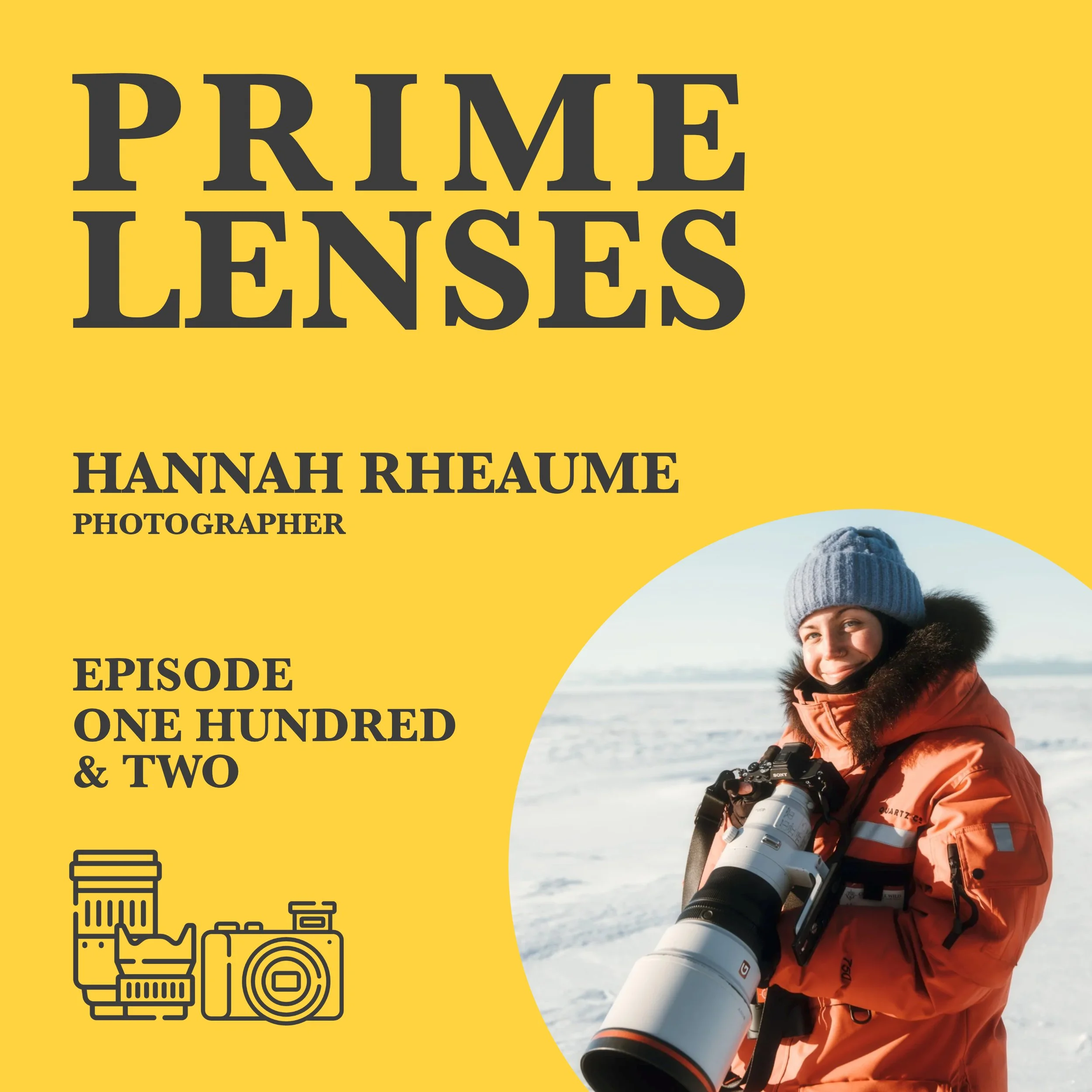


Hannah Rheaume is an American photographer who more than anything feels a kinship to animals, and photographing open spaces. She took a chance on an Instagram contest having never left the US before, she won, and fast forward to now she is professionally photographing and leading workshops. She has travelled in her work too from the US and Canada to places like India, Morocco, Taiwan and hopefully at some point in the future, Scotland.
Sign up to the Prime Lenses newsletter for a mid-week treat.
Support the show on Patreon.
Episode Transcript:
Iain
Hello, welcome to Prime Lenses. I'm Iain. This week, my guest is Hannah Rayo, an American photographer who, more than anything else, I think feels a kinship to animals and wide open spaces. She took a chance on an Instagram contest, having never left the US before, won that contest, and fast forward to now, she's a professional photographer, leading workshops and helping people to understand our natural world. She's travelled all over the world in her work as well, from the US and Canada to places like India, Morocco, Taiwan, and hopefully at some point in the future, Scotland. Hannah was a fab guest. I think you're going to really enjoy hearing her story. Here's Hannah. how on earth are you how was christmas and new year it was all good I was back in maine to see
Hannah Rheaume
My family so it was really nice to see them we had a very similar kind of well we had a very quiet one
Iain
Which was really nice last year we had so many family coming in that it was we were turning the house over like it was an airbnb at points like just people were coming and then you'd flip the house and get things ready and then coming again so this year was the opposite this year was just my wife's parents uh for the big day and then the rest of the time it was kind of just us
Hannah Rheaume
And tooling around so yeah that's awesome remind me where you're based up in the highlands in scotland okay oh nice I've never been it is very high on my list yes yeah no wolves but the landscape is ready for it you know that's okay yeah I know yeah that's a whole other conversation for sure
Iain
Put it on your list like it's yeah yeah you'd love it especially someone who loves the outdoors
Hannah Rheaume
Yeah I have friends that have gone and I've always dreamed about going so one day I know I'll make it
Iain
There well a life lived with a camera in your hands increases the chances significantly of ending up
Hannah Rheaume
Been landscape like this for sure most definitely yeah it's good well have you had a chance to
Iain
Listen to anything do you know the kind of format that what I'm going to run through before I kind of dive in yeah yeah yeah great oh good do you like it is it all right oh yeah so I actually I
Hannah Rheaume
Have this microphone because I used to actually have a podcast um it was called women and the wilderness uh it was basically just having it was it stemmed from uh covid 2020 and stemmed from a place where I very much just was going from full-time travel to then like having absolutely no outlet for myself and turned to the outdoors. And so it kind of stemmed this idea of starting a podcast and it went for, I did a three or four seasons and then, and photography took over, travel happened again. And I just couldn't justify spending all that time on a podcast. So.
Iain
I increasingly feel that as I age, that there's not, if I'm going to do something really well, it's the ron swanson quote from like pucks and wreck of like you got a whole ass one thing rather than half ass a couple of things and yeah I'm increasingly feeling like I was thinking about it literally before you joined the call that just you've got to there's going to be a moment where I stop paying attention to certain things because I want to pay attention to other things more and I feel like that's where I should spend my time and I think you're absolutely like whereas I've landed on the audio on the podcast side you've landed on the photography side yeah
Hannah Rheaume
It's interesting. I just I feel like there's always so much work to be done. And the things I care about and telling these stories is so important. And it's like, sometimes I get ahead of myself and thinking I'm like, I'm more than one person. But like, I'm only one person. So you can only do so much. But yeah. So that's probably a good place to start. Then we can talk about
Iain
The thing that you are now confident having tried a couple of things that is your is your passion. Where does photography come from come from for you? Is it a family thing? Was it friends? Was it just you know studying thing like how did the camera end up in your hands in the first place
Hannah Rheaume
Yeah kind of a winding road of ending up with a camera in my hands I took a black and white photography class in high school and was actually just talking to my mom um over the holidays and she was like Hannah you never actually really liked that class and I was like really I have different memories of that class which I find very interesting um but yeah it was a black and white photography class and um we were in the dark room developing our prints and things like that and kind of lost sight of photography. You know, my mom always had a camera and I always just kind of watched her and observed. I don't think I ever thought anything of it for myself. And then fast forward a couple of years, well, quite a few years actually after I had graduated college and I had studied communications and was working in public relations and was really looking for this creative outlet. I'm a very passion driven individual. And if I'm not happy with what I'm doing, then I think that takes over every mental space in my brain. And so picked up a camera and ended up entering an Instagram contest. And that Instagram contest was to travel to Hong Kong and Thailand of all places with a complete stranger. So I entered that on a whim. I had already been kind of taking photos around Maine where I lived at the time and just, you know, documenting day-to-day things and entered it on a whim and thought nothing of it. Well, I ended up winning the contest and that was my first time outside of the United States where I'm based. And so that was a really interesting experience. Talk about culture shock and also just what a slap in the face of how big our world truly is because I had never even traveled to Canada before. I think the furthest I had gone was Alaska at that time. And so I'd never really experienced other cultures or other ways of life. And that was so impactful in my early 20s. And so after that trip, I knew I just needed to figure out how to make that happen, but also how to have purpose within storytelling. And it was a kind of long and winding road of kind of getting to the person that I am today and lots of trial and error, trying many different styles of photography, photographing different subjects. And finally, I've landed in a place with telling the stories of animals. And I really,
Iain
Really love it. People listening should take a minute whilst we're talking and go and have a look at your images because they are spectacular. Oh, thank you. Yeah. You're clearly, you feel a kinship to the animals you're photographing and want to convey their story. And I know from reading your blog post as well, how informed you are as well in terms of what's going on and the conservation of animals and spaces. Is that the life's mission now you think and photography is a way of
Hannah Rheaume
Communicating that? Yeah, definitely. I think everyone has their individual strong suits, right? Some are biologists, others are scientists. I'm a storyteller. And I have really realized that over the past few years of this is my, my zone of genius, we can call it. And it's only been since I'd say like 2020, that I've really felt this kinship that you mentioned to nature into the animals. And, you know, it was seeing a wild wolf for the first time that really like woke me up to how wild the wilderness truly can be if we allow it to be that. And being a voice for these animals that don't have a voice or don't have a seat at the table is really at the core of kind of why I
Iain
Love to tell their stories. In the UK, we've got this tradition with people like David Attenborough and lots of the BBC has spent my entire lifetime with whole groups of people out in the middle of nowhere filming everything, you know, and then using cornflakes to simulate the sound of polar bears walking on snow, all that sort of cool stuff. Is there much of a tradition of that in the US? Because when I've come to the US, it's really hard as an outsider to get a sense of the media landscape. And that's also changed massively in the last decade. But for you growing up, Was there like a document for us with four channels growing up? Everybody watched the latest BBC wildlife thing because it was on at eight o'clock at night on a Tuesday or whatever it was. And everyone just watched it. But I don't know if it was the same for you and if you had the same access to the same monoculture.
Hannah Rheaume
Yeah, definitely. I'd say similar in some ways. We had National Geographic, right? That's kind of what I grew up on and flipping through their magazines. And I'll never forget, I had watched a documentary about Machu Picchu. And it just, I remember being a child and just being absolutely mind blown about the mystery of this place. And that turns out I ended up going a few years ago and I've now been twice. And it's just a really wild, full circle moment to sit here and think about the young girl that I was seeing all these places on TV. And now with the camera in my hands, I'm able to at least try and tell the stories of these places and animals. And when you go to somewhere like that, are you able to give yourself kind of
Iain
Permission to enjoy it as well? Because a place like that has been so widely documented. To some extent, you feel like you've seen it before you get there because just the pictures are everywhere. But I'm just wondering, I've never been to a place probably as photographed as that, with the exception of cities and stuff like that, which I don't think are quite the same thing. Did you feel that you could enjoy being there and make your own and tell your own version of that? Or is it hard because you kind of know what you're seeing before you arrive?
Hannah Rheaume
Yeah, I mean, it's something I struggle with in terms of storytelling, right? Like we, I think as individuals want to tell a unique story based on our own perspectives. And having gone to a place that's been documented millions of times, right? Of course, like I've seen the photos before. It's honestly what drew me to that place. And then reading about the history and learning from my guide, I became enamored with it even more. So I definitely think it's hard to kind of find your own angle of a place. But that's the beauty of, you know, being a storyteller is sometimes you don't know until you get there what what your photo will look like and things like that or what the story exactly is that you're going to tell. And I've hiked Inca Trail to Machu Picchu and I hiked the Salkantay track to technically to Aguas Calientes and then you take a bus up to Machu Picchu. Yeah, so I've been twice now and within the span of a year. And the difference in both of those experiences is pretty crazy to reflect on just from a visual perspective, let alone like how much you change in a year, right? But the second year I went, I was definitely more confident in my ability to, you know, tell the story of this place in my own unique way. I do a lot of slow shutter photography as well and find that motion can really add something to kind of a still place. I also think photographing places in those like realms where all those people are. So you're standing on the edge looking at Machu Picchu, but you're behind a wall of people, which I think is really interesting. And it's the same for critters too. When I go to Yellowstone, it's documenting that human landscape too, just as much as it is about documenting the animal itself. because they exist in this landscape too. Like we have created the monster of Machu Picchu, for example, right? Like, and so has the Nat Geos of the world. And so it's just interesting to kind of like reflect on, it's not always about like the perfect shot with no people in it, right? Sometimes that's not the whole story.
Iain
That's really interesting. I've seen some really good stuff on a similar sort of way of looking at things. In the Louvre in France, where they've got the photo, sorry, the painting of the Mona Lisa. and all the people in front of you that you have to get to if you want to see that picture on the wall. And I've seen some really great photos which are not even of the painting. The painting is out of focus in the background and the focus of the story is the number of smartphones being held up.
Hannah Rheaume
Which is just, it's kind of just as interesting in a way.
Iain
Yeah, it's so funny the idea that you would need to take a picture of the Mona Lisa. I think there's enough. We've got that one covered. Yes. At least it didn't get stolen this time, which was, you know.
Hannah Rheaume
Yeah, that's a good thing.
Iain
I need to look up on that story to see whether they actually got all that stuff back.
Hannah Rheaume
Yeah, I'm not sure, actually. I don't know how it ended up. I also don't know, like, were those people caught? Are they making a documentary about it?
Iain
What's going on? Well, it's got to be on a whiteboard at Netflix headquarters, right? Oh, for sure. It's on the kind of, there'll be a whiteboard somewhere, and next to it, I hope it says, kind of, documentary stroke fiction question mark, like, you know, or drama question mark. Because it would be so good. It would be. I feel like five years from now, we're going to see, you know, Chris Hemsworth doing a French accent. For sure. Leaping out of a window and sliding down the slide. Definitely. That's really good. You were mentioning your motion stuff there as well. And a bunch of your photos, when I was looking at your portfolio, there's a lot of very traditionally still subjects that you've got some motion, as well as the animals that are moving and you convey a bit of that. It's really nice kind of circular sort of there's a there's a real I'm trying to think of the right word. It's effort or work. It's like it's clearly not accidental. It's clearly you're painting with light. How did that come about? Because it's for me as a tourist, right, enjoying photography and speaking to photographers. I'm in my F8, F11 phase right now. So I'm very kind of, you know, dollar store Ansel Adams at the moment. like that's how I see myself but so when I saw some motion stuff it really stopped me in my tracks I was like oh that's really interesting did that come about through happy accidents are you a kind of um what's the word uh experimental do you experiment in your work do you give yourself space to that I was just curious as to how you arrived at that yeah I think I do definitely give
Hannah Rheaume
Myself to experiment especially as I've grown as a visual storyteller photographer whatever you want to call me. I also do shoot video. And so finding this like blend of the movement of a moment, but also being able to not make it so obscure that the person doesn't know what they're looking at. So it's like this fine balance. And wolves, for example, are these creatures that are constantly in motion, right? And they are one of the main things that I photograph and my favorite thing that I photograph. And so to kind of tell that story through still imagery without having to rely on video was kind of like an aha moment for me. And I think being creative and giving yourself room to experiment as a photographer is important because otherwise we get pretty stagnant. And I think there are so many photos in the world of wolves, for example. And there's so many sharp, perfect portraits. And those, I think, serve a purpose. And there are very talented photographers that have taken photos of that and they're beautiful. But I think to just focus on one singular image style would be kind of like a disservice to storytelling as a whole, right, of that individual animal. And of course, like no one photo is going to be all encompassing of an entire species, right? But I think we always try our best to tell those stories. And so, yeah, catching animals in motion is so much fun and so tricky because talking about apertures, you got to make sure it's kind of in the right place where you're still being able to get some sharpness of that image and you need to keep your shutter slow, but not too fast. So you
Iain
Can get that motion blur. So presumably, you can't ask them to do it again. But that's the other thing for me. Exactly. You're you know, it's happening once in front of you. Yes. So when I
Hannah Rheaume
Talk about also taking video, so I'm this person, I'm, I'm a very hybrid shooter, I do shoot a lot of video. Photography is my main thing. And so trying to marry the two together, I feel like I said, like the motion blur imagery really kind of marries those two together. But to your point, you get maybe like one six hundredth of a second with an animal in that exact position. And so that's easier to nail than when you're trying to nail a sharp image at say one 15th of a second. And so you can't ask them to do it again. So it's a risk. Every time I do slow shutter photography, I'm like, okay, let's hope this works out. This pays off. This is encompassing of this experience. It does the animal justice and it tells the story I want it to, right? There's like so many levels and layers of storytelling that I think of. And it's through conversations like this that I'm able to realize the like gymnastics I'm doing in my brain when I'm pressing the shutters. So yeah, it's definitely a little bit nerve wracking. And I've looked at the back of the camera and I've seen shit. Like I've seen photos that didn't turn out that I thought were going to be killer and they just weren't. But that's the risk of all of it, right? I've taken photos at F11 and for some reason the autofocus misses and it focuses on a shrub next door or it focuses just on the tip of the nose. And so that's just, you know, I've heard so many stories of other photographers experiencing the same thing. And yeah, it's just a risk, but it's one I'm willing to take because I think it's a very cool way of being able to tell those animal stories, even places too. I do a lot of slow shutter photography for landscape as well.
Iain
How much access do you get? Because the way you've written about the wolves and especially like your conservation piece that you wrote on the blog not that long ago. It sounds like you're very close to, because I'm imagining that, you know, one cannot simply wander up to a group, like to a place where wolves are necessarily. Like, you know, some of these places are A, very hard to get to. And B, I'm guessing that the people who look after these regions are going to be like, what are you doing? Why are you here? Like, you're disturbing them. Like, we have it near where I live. This is the most Scottish and British thing, but it's hilarious. Capa Kailies. After this, look up a Capa Kailie. It's like a really massive Aggie turkey. Like this thing, they've got very sharp beaks. Like they will mess you up. Like they're not pleased to see you a lot of the time. And quite often we'll be walking in the trails near the woods where we are. And it's like something out of a cliche of a Scottish TV show or something. But there's signs warning you of highland cows that are roaming and capricaylies. And if the capricaylies are nesting because they nest on the ground, they get very protective.
Hannah Rheaume
You better watch out.
Iain
Yeah, yeah, yeah. They will mess you up in a way that other animals might just leave you alone, just like whatever. But yeah, so how do you kind of get to go back and to get because the great work comes from repeat visits, and maybe they start to recognize you in time as well and know that you're not a threat. So I was just curious, like, what the shape of something like you saying, I'm going to be there for a few days, or you know, what that what a project and a shoot looks like.
Hannah Rheaume
Yeah. Wow. That's a very, again, layered subject, right? So I think what's unique about the United States and wolves specifically is that they can be hunted in some states. And so with access to wolves in a place like Yellowstone, there's a lot of concern for habituation and a lot, I wouldn't say a lot, but many of the animals have become habituated to humans. And so surrounding the area of Yellowstone, if those wolves were to leave the park in the winter, they potentially could be hunted and killed. And so it's always a concern and that's always top of mind is like animal first, right? Especially for these large predators that are sentient and just charismatic and just derive so much human emotion, whether it's on one end or the other. And so keeping that top of mind, we never want to be too close to these animals. I think it's so important to obviously keep a safe distance, let alone they're wild animals, right? They are 80 to 115 pounds and they have the ability to hurt somebody just as grizzly bears or black bears do. And so from that perspective, of course, we don't want to be around a wild animal at too close of range. And same goes for the same reason of habituation. We don't want these animals to necessarily associate us with safety and then they leave the park and they associate hunters with safety and then they're killed because they thought they were okay. So it's definitely very nuanced there. And in terms of we'll use Yellowstone as an example, it's a very interesting place. It's grown a lot over the last few years, especially since COVID, just in terms of people wanting access to wild spaces and wild animals. It's one of the only places in the lower 48 where you have access to be able to see wolves and grizzly bears. And so it's, of course, a novel experience for so many people. And really, when I entered the scene there, I don't think I understood the impact that the place would have on me and seeing those animals. And this was quite a few years ago now, but it's just interesting to reflect back on that part of my kind of like photography journey and see where I've grown and how I've become friends with a lot of people that live and work in the park or around the park. And so I've met a lot of wonderful people that have helped me with access and learning and just understanding the lay of the land. And I'm always constantly learning still, even though I'm basically a regular there. Like you always are learning. And I think that's one of the key things too in wildlife photography specifically. It's just always being open to the changes in the landscape, especially as it relates to wolves, where they're a basically political pawn in many ways.
Iain
Can you talk a little bit about that? Because I think for listeners outside the US, and also maybe in the US, might not be paying attention to kind of how the environment is being used as a political football. In a way that really surprised me that that was happening.
Hannah Rheaume
Yeah. Again, I'm no expert on all things. My zone of genius is really with wolves in the West and basically the U.S. as a whole. And so I'll speak on that from that perspective. And I think our natural resources here in the U.S. have always been kind of under watchful eye in many ways. You have the people that really care about the landscape and the animals. You have the people that are kind of middle of the road. And then you have the folks that extract things out of it as if it's just a resource. No other intrinsic value. And I work really hard to share my stories in a way that will help benefit these places and these animals. And so when we're speaking about wolves specifically, they are currently on the endangered species list here in the United States, which protects animals from being able to be hunted and it's supposed to help bolster their populations. A very elementary level of description of what the USA is. But then you have some states that are able to manage wolf populations on their own. So that's the Northern Rockies, which is Montana, Wyoming, and Idaho. And then elsewhere in the US, they are protected. There's a lot of nuance there in terms of reasons and things like that. So I won't get into the nitty gritty there. But in the Northern Rockies, you are able to hunt wolves. And so when I'm talking about this boundary, this invisible boundary around Yellowstone, it is really important to really pay attention to your impact on how you're influencing the wolves behavior and habituation and patterns in which they associate being okay with humans. And so, yeah, I think a lot of my work, I definitely strive to talk about that human-wolf conflict or the human-wolf relationship even, because if you read anything about indigenous cultures here in the U.S., it's obvious that they viewed these animals almost as kin in a way, not to say they never hunted and killed wolves, But there is more of a reverence there than a hatred toward the animal. And so it's just it's a really interesting long history here in the States where they were essentially extirpated in 1926, which means they were removed from all of the Mountain West of the U.S. with the last remaining population being in the Great Lakes. And so when an animal is extirpated, it then goes through a reintroduction process if this animal is to ever be back on the landscape. And that's what we saw happen in 1995 in Yellowstone. And that's one of the reasons why we're able to see them today is because of that reintroduction. And obviously a hotbed for politics. It was a federal program with states buy-in. And so we're seeing a lot of similar stuff happen in the Colorado wolf reintroduction as well right now. And so it's just, you know, there's a lot of human emotion that plays within caring for these animals and stewarding the landscape that they live on. And it's something I struggle with as an individual trying to wrap my head around both sides because I really do try to see kind of like the middle ground there. Like what is the way through so that everyone, including the animals and the environment, can kind of thrive, right?
Iain
Would you ever want to kind of do a series of photography that sort of covered the human aspect of it as well and like did a documentary story around that aspect of it? Because that's a tricky needle to thread as well.
Hannah Rheaume
Yeah it definitely is it's actually kind of like what I envision in this moment in time like what my life's work will be will kind of be documenting the animals and the human conflict and I think a lot of that human side is very important to share those images and tell those stories just as much as it is to get those beautiful photos of the wolves you know I love nothing more than being in the presence even if they're a mile away with these wolves even if I'm looking at them through a tiny scope, but also you're standing there in Yellowstone specifically on the side of the road with, we'll say 15 other people, all of which are enamored by these wolves that are a mile away. And then you have the exact opposite end of the spectrum of those individuals that are out in the woods hunting them. And I think it's a fascinating play on human psychology and kind of how we view the wolf and what the wolf means to society here in America. And so, yeah, I think like my life's work, I aim to help contribute to that story in a positive way. I mean, that's always the hope,
Iain
Right? It's funny, it's on a silly level, we saw Zootopia 2 at the weekend, a fine movie. But one of the storylines in that is around the fact that how easy it was to scapegoat snakes and make them seem worse than they are. And it's just the way you're talking there is just so interesting. It's so easy for a wolf to be a wolf in sheep's clothing, or it's a bad, you know, it's immediately, And it's like, these things are just, they're just animals living the way that they live. They never chose.
Hannah Rheaume
If you take our human like psyche out of this or our own opinions, like they're, they're really just animals living on an increasingly human dominated landscape that are just trying to survive as they have for thousands of years. And I understand the landscape looks very different than it did a thousand years ago. I'm, I'm very aware of that. but I see a way forward where there is some sort of coexistence, I guess you could say. And even if you look in traditional media, as you're saying, like in Zootopia, there's other films that have recently been released specifically featuring wolves. And it's like the wolves are always depicted as like these bloodthirsty killers that are hunting you down and circling you and they're going to kill you. And it's just not the case. And it's just this perpetuation of narratives that we see in the media. And you have unsuspecting people just watching this that have never seen a wolf, that have never been exposed to wolves. But that's their first interaction with what it might be like to be with a wolf, right? And so, of course, people are going to be afraid. And so, yeah, just interesting.
Iain
It's just funny the way that we do, even in a silly way. And it's worth discussing, I think, because although it's a silly example, it's something that just sits there in our, like, I love spiders. I think they're amazing creatures. People are terrified of spiders and most of them haven't really had an interaction. They've never even been near a dangerous spider or understood why it might be dangerous versus, you know, we're very lucky to live in places where most of this, I mean, certainly in the UK, like if a spider bites you, like you're fine. Like we've got nothing left in the country that can really hurt you. Like stay away, stay away from the capicales. You'll be fine. You know, there's nothing, there's nothing dangerous left on this tiny island that will seriously hurt you like you know sheep's gonna make a funny noise at you but it but it does mean that we we sort of we don't understand it a friend of mine talked about this once he was a coach and he used to talk about like his fear of spiders and he's a big lad and he played rugby right and he's a big dude and he had to get his grandmother to remove a spider for him once because he was so terrified of it and here's this woman in her 80s has to remove the spider whilst the like you know big rugby player in his 20s he's got a towel wrapped around him he's too scared because there's a
Hannah Rheaume
Spider in the bathroom it really is so interesting and I mean I'd be the first to admit like I'm afraid of spiders but like I don't know why right and so it's like what what is this like conditioning that we've experienced to be afraid of the things that we don't understand right it's I don't know it's such an interesting psychological thing I think as humans because we have the ability to form these thoughts and have these thoughts about thoughts so it's just
Iain
Interesting well he picked it up he traced it back he told this story he used to tell the story because he was a coach for people he was helping he was using it as an example to help kind of identify when we're fearful of something or when we don't do something because we're worried about the outcome or whatever and he traced it back to when he was a kid he was uh like you know maybe eight or nine they went to like a zoo and they're in a place where they've got the spiders and various like insects and someone the person running the thing says you know would anyone like to hold it and and he remembers distinctly kind of everyone stepped back and so that group kind of thing of oh well everyone else is scared or worried so I should be too this kind of instinctive thing and that actually what he needed to do and years later he you know went somewhere specifically right so someone would put a spider in his hand quite a big furry one right so he would like address this that he felt was unfounded and it turned out was and he's fine. And he can now deal with spiders in his house a bit more. But that is a silly example of, I think, the importance of the work that people like you do, where this is something that people aren't even necessarily thinking about. They're looking at images of wolves or looking at images of animals in their natural habitat. They don't even necessarily know what preconceptions they're bringing. And that's why I think the work people like you do, although, you know, that's a silly example. It's so powerful and so important to demystify our natural world. So we understand what we're doing to it, what the consequences of that can be, and what's important to look after, you know? Yeah, thank you. I appreciate that.
Hannah Rheaume
Demystifying is a great way of putting it. I think, yeah, I think a lot of it does definitely strive to kind of demystify or at least give them a leg up and maybe someone's perspective will change or maybe somebody will see an image of one of my wolf photos and it'll be the first wolf photo they see and it'll influence how they feel yeah that's always the hope for sure yeah definitely
Iain
Well that's a lot of wildlife stuff like it's worth asking as well because you've done a lot of you do tours and you take people around is that to kind of educate or is that more photographic
Hannah Rheaume
Is that the the kind of aim of those sorts of things I think it's a bit of both um definitely love sharing places I love with like-minded people. I think that's really important. And I also think it's really impactful in shaping people's perceptions of the natural world. Like I hosted a Yellowstone trip last year. It was a women's photography focused trip. And we spent four days, five nights or five, yeah, something like that. We spent a few days in Yellowstone together and we ended up just having really vulnerable conversations about our thoughts and feelings of the natural world and what's happening and just really trying to understand through communication with one another in conversation of like, what is happening right now? And it was interesting listening to everyone's perspectives and things like that. And everyone comes with either biases or they come with opinions or they come with how they've been raised, right? But we all come together and just conversate. And I think it's so cool. And especially to be able to create space for women in the photography world. I think it's really important and really special to be able to have a safe space and just, yeah, just be. And so I definitely would love to do more of those. Nothing on the docket for this year yet, but it could change.
Iain
Well, this is when you announce your Scotland workshop. Right, oh yes. That's how we make this happen, right?
Hannah Rheaume
It's perfect, yes.
Iain
Yeah, I mean, we can probably find you squirrels and some deer they're not quite as exciting but you know they're very fluffy and
Hannah Rheaume
Very cute they are and we're one of the last places with the red ones left oh really yeah the
Iain
Gray ones if I'm getting my natural history correct and I'll have to bing myself in the episode and correct it if I'm wrong but I think gray squirrels came over one of the places they came from was North America I think when boats came back and also from parts of Europe and Basically, the grey squirrels for us are much larger and stronger animals and they've pushed the reds out. And so that's moved north. And there's a bit of a kind of fuzzy line as you come into Scotland where reds are kind of managing to kind of hold their own. And up in the north as well, where it's colder and it's more sparsely populated, so there's less food for them. So the greys tend to stick to towns because they've adapted very well, much like rats and pigeons and some other. know like they've adapted really well to the urban environment and so actually they'll stick around there and stay around like culture uh not culture yeah so they're going to the theater uh heavily populated areas um I'd love it if they were going to the cinema that'd be amazing um yeah but uh yeah so we've got a load of reds up near us and there's actually there's an active kind of um move to like log when you see them log sightings see where they are so that we can understand what their movements are and what their patterns of where they live and where they're breeding and stuff like that which is super cool so when you get a few days with people in a workshop environment like that and and building those connections and building those relationships there's a there's a nice thing that happens I think when a group of people are together for an extended period of time more so than just getting together for an afternoon and then all going home have you observed that that kind of like if people are beginning to open up over a few days like I imagine it's quite a intense but really nourishing experience for everyone yeah no definitely and so base camp for
Hannah Rheaume
We'll use the yellowstone trip base camp for the yellowstone trip was a hotel in um gardner so it's one of the gateway communities outside the park and um we had double occupancy which was the option for people to room together and what I've noticed is our days from experience on my own personal side of things is days in the park are very long and very tiring. And a lot of people actually do like to go back to their rooms to kind of like regroup, decompress away and just like be quiet and just kind of reflective on their own experience. And so I offer either double occupancy or you can also do single if that's what you prefer. So yeah, when we're in the car for like in the summertime, it doesn't get dark until about 9 30 so we're out there all day from sunup to sundown and I think it's funny you get into a groove of like being able to just have conversations with people pick up where you left off the day before and at the end of the trip I've always noticed we kind of leave more like family in a way we go our separate ways but after trips we always keep in touch and still talk and I have some of the gals that reach out with questions about whether it's cameras or hey did you see this wolf thing or whatever it might be so it's a really special
Iain
I guess camaraderie you can call it yeah that's lovely I imagine that throughout your career your phone is going to be filled with whatsapp groups for different trips that then you know some will
Hannah Rheaume
Come back around and some will cross definitely yeah yes absolutely that's really nice so when I
Iain
Looked at your portfolio of work obviously the the wildlife stuff stood out but I was interested by one set in your portfolio that was in BC in Canada and they were black and white instead of color like almost exclusively black and white if I'm remembering correctly and they had a very different look and different feel and I did want to ask about how you like do you switch a lot between color and black and white like I've talked a lot about it on the podcast there's a Joel Mayowitz book called A Question of Colour, which I love. And I read it nearly two years ago. And the effect it had on me instantly, because it was about him choosing between black and white and colour and have basically in the 60s and 70s had like two cameras, and was literally shooting almost the same scene twice to see which one he liked to kind of decide where to land. And these days in a digital world, we don't really, it's not a choice you necessarily have to make even in the moment. But those images stood out to me as it felt like you did. It felt like you were consciously picking monochrome versus color. And so I just wondered how they came about, what the story was maybe there, if you could share that.
Hannah Rheaume
Yeah, I mean, sometimes it definitely is intentional. I think I so much look at scenes, obviously, with my two eyes, with the color that I can see as, you know, as natural as it can be. And so it's always a challenge to kind of look at it as light, right? Like how can I look at a place simply as it's just being light when I have so much going on, especially in a place like the photos that you're talking about? And so when I was kind of like post-processing those images, I remember having the conscious thought of like, hmm, what does this look like in black and white? And I did it. And I was like, that is exactly what I need it to be. And there's, for me, it's less of like a technical look of light and more of like, what is that ask of the viewer. And so when you remove light, or when you remove the color, can it still emulate an emotional response? Or can it still require an emotional response from the person that's looking at it? Does their mind wonder? Like, oh, I wonder what that will look like in color. But those set of photos specifically was pretty intentional to, after seeing that first image that I edited to be monochrome, it definitely continued down with the path. And I've edited them both ways. I've edited them in color and in black and white, and I do prefer them in black and white. And a lot of my wildlife photography too, I tend to edit in black and white. And I don't know specifically what it is about a more monochromatic look, but to me, it feels less distracting and you're able to pick up on, for animals, for example, the emotion, or like you're able to kind of quiet the noise of what color can bring and I think it's a really
Iain
Cool tool to have kind of like in your toolbox right and we're not sacrificing anything which I think is the nice thing like yeah you know you can always go back to it do you keep your raws and keep all that stuff oh yeah revisit it yeah absolutely and it's just it's interesting
Hannah Rheaume
Yeah because it's like it's again goes back to experimenting and giving yourself permission to experiment and I don't know, push the envelope a little bit. And yeah, sometimes when I'm post processing and editing and the photos don't, don't look the best in black and white and it really does need color to sing. But the more I use black and white as a tool, the more I notice you really don't need color to tell a story. And there's a book by Ragnar Axelson called Arctic Heroes. He's a super talented photographer. And this book in particular is about the sled dogs and life of these animals. And so it's just really interesting. All his work is in black and white. And yeah, it's a it's a it's nice to be able to reflect and look at other people's work, too, and help that inform like my decisions of why I'm choosing black and white or or just kind of understanding light in general, you know.
Iain
That's a nice way onto something I wanted to ask you about as well. Like, how's the photo book collection? Like is Ragnar one of your go-tos? I was in Iceland last year. You literally, you go in cafes and hotels in Iceland, in Reykjavik, and his pictures are either on the walls or they've got the books, you know, in the foyers. They're very proud of him. Quite right, too. He's on my get list.
Hannah Rheaume
That's awesome. Yeah. Oh, I'm sure you will. Yeah, my photo book collection, I read a lot. I read photo books, but I also read like other normal standard books without photos. I don't know. I'm losing the word nonfiction. Maybe that's the word I'm looking for fiction. Books. Books. I read normal books too.
Iain
That's such an saying. It's like someone who's slightly mad. I read normal books as well. I look at things with my eyes.
Hannah Rheaume
It's fine. Exactly. But yeah, I make it a point to read, yeah, photo books and regular books as well. I think too, what's interesting about regular books is I find myself painting the pictures in my head of what these places or experiences might have looked like. And so being able to pick up a photo book, it's special to read the words of the experience and then see the photo. It's very rewarding as a reader. It not only helps me shape kind of how I approach shooting in the field, especially animals or landscapes. I learn a lot about places I've never been. There's so much more to photo books than just skimming through and looking at the pretty photos. If you really sit there and get technical about it, you can take a lot away from somebody's body of work like that. And I always say I'm forever learning and every new photo book is like kind of a step in that direction. I recently, it's getting
Iain
A bit out of hand on the shelves that you can't see. It's the side of me, like the photo book thing is starting to be a problem because you look at them and you don't, you know, I look for used copies when I can. I go on eBay and go on Amazon and you're like, you just look at it and go, that's only 20 books. And then before you know it, you've bought three or four in a month and you're like,
Hannah Rheaume
Okay, I need to slow down. Yeah, absolutely. We have a used bookstore and I almost exclusively try to purchase all my books there. And I always go in and I'm like, okay, do you have any wolf books? And then I usually like clear them out of all their wolf books, whether they're regular novels or photo books as well. So yeah, I'm all for the used book train for sure.
Iain
There's an amazing one. The biggest town near us is a town called Inverness up on the north. Well, it's not the north north coast, but it's kind of there's a little bit of coastline in the middle. I'm always amazed that there's more above Inverness, which is just like I think of it as the top. And then I get there and I'm like, no, this isn't even close. But it's in an old converted church. And so it's just this incredible interior and just there's just books everywhere. It's just it's like something out of a movie. That sounds like my dream. Yeah. I'll send you a link to it afterwards. Seriously, we're going to manifest your trip to Scotland. I would love this. And you can go to the bookstore.
Hannah Rheaume
Yes. Oh my gosh, that sounds wonderful.
Iain
Yeah. Wonderful place to visit. That's really, really good. I ordered one yesterday. It's a photographer called Platon. He's a portrait photographer. Well, I don't know if you know him, but yeah, his stuff's really cool. And I found one of his books. So yeah, that's in the post somewhere now.
Hannah Rheaume
Yeah. And it's interesting you say that. Like I definitely gravitate more towards like animal photo books and photographers that photograph wildlife. But there is so much to learn from, say, a portrait photo book or a street photography photo book when we're talking about like using color black and white or using light. Like even though it's street photography doesn't mean I can't apply it to wildlife photography in a way. You know what I mean? So, yeah, I'm always open to any sort of like photo book recommendations for sure.
Iain
Well, you're on my list now. I will send you. But on a similar kick, we in the UK, we have like a wildlife photographer of the year exhibition every year in London. Is there a similar kind of national thing in the US every year that you can also like go and just absorb?
Hannah Rheaume
Yeah. Is the wildlife photographer of the year, is that the Natural History Museum?
Iain
Yes.
Hannah Rheaume
So that's actually quite popular here among wildlife photographers as well. I know a lot that enter. And so in terms of similarities here in the US, not that I can think of, not yet, not off the top of my head, I'm sure there are some and I'm probably blanking, but nothing that are quite as high up as the Natural History Museum Wildlife Photographer of the Year.
Iain
There's an Australian one as well. When I was in Australia last year, and my Aussie listeners, I have a few. I met some of them. It's quite nice. But shout out to Tom and Peter. But yeah, they have an equivalent. And that was an amazing exhibition last year. The book of that exhibit is fantastic. There's some incredible work in there. And what's lovely is it's not just Australian photographers. There's a lot of Australian photographers in there. But there's, again, it's like people from all over the world contributing to that one, which is really, really good. I think about maybe a decade ago, maybe a little bit more, what is time? There was controversy about a wolf photo winning the UK Wildlife Photographer of the Year because they'd not quite tamed the wolf, but it was familiar enough with them. It was a photo you may have seen of like a, it's a flash photo. The wolf is jumping over a gate.
Hannah Rheaume
Oh.
Iain
And there was kind of controversy because it won, but some folks were critical of the relationship the photographer had with the animal or maybe it was fed by people and those people had allowed them to get close to it because it was, you know, it was like shooting a portrait at sort of a 50 mil kind of distance, you know?
Hannah Rheaume
Yeah. Oh, that's really interesting. I'm going to make a note to look into that because now my curiosities are going.
Iain
Yeah, yeah. The problem was it's like headlines these days love controversy.
Hannah Rheaume
Oh, I know.
Iain
There's no follow up.
Hannah Rheaume
Yeah.
Iain
So you're just like.
Hannah Rheaume
You read the article and then you're left with what the article stated.
Iain
Yeah. It's like area man says, that's my wolf. And then you go, well, I don't know what happened. Yeah. Like there's no there's no follow up. I need I need Jerry's final thought to tell me what happened at the end.
Hannah Rheaume
Please interview him.
Iain
Yeah. Yeah. Yeah. I need to know. Yes. There we go. You're helping with future episodes. I'm just going to write down what happened to the wolf. Yeah. Yeah. Who knows? We will find out. It's probably worth talking about as well. And I like to share this out loud on episodes if I can. Libraries are also an incredible resource for these sorts of things because photo books are so expensive and huge. You don't necessarily need to fill your house with them as well. Libraries can get these things delivered and shipped around. I don't take enough advantage of that, I must admit.
Hannah Rheaume
Neither do I. I think that's because I love owning them. I love being surrounded by stories that I've been told, even if I haven't opened their pages in a year. There's something like about that, that I find magical. And I feel like it's good for my own creative juices to be around those stories, even if I'm not actually reading them. And I'm also like, I'm a book reader. Like I need the physical book. I don't read on a Kindle. I don't listen to audio books. I read and I'm very traditional in that way. And I mean, photo books, you wouldn't listen to an audio book though. Right. So that's a little different, but yeah. I love the idea of a photo book, audio book. It would be kind of cool. Like, how would we do that, though? Would we? Yeah. Like, I'm not sure. I'm not sure you describe the photo or I know some audio books have the ability to have photos on there as well. I'm not sure. Do you know what you're sparking? Because
Iain
This is proudly audio only, like by design, like I'm leaning very heavily into the audio aspect. And I think it works for a number of levels. It works for guests. It works for me when I'm editing, which is really nice makes life a lot easier you know from working with video how much harder life becomes when you're capturing an image 24 times a second yeah suddenly you're like oh no now and if someone moves slightly or whatever so there's all of that but it's also it that's an interesting challenge I wonder whether you could do something with getting multiple people to describe the image or getting just something like that that would turn it into an adventure or have like an
Hannah Rheaume
Like an accompanying set of photos or something like that, that would come with it, with the audio book. I don't know.
Iain
Yeah. Oh, you've got me thinking. Yeah. Yeah. This is really, really good. Photo audio book. This is fantastic. Hannah, you'll have to come back because you'll just give me loads of ideas. Perfect. Give me an episode to put out and ideas for future things. How brilliant.
Hannah Rheaume
Awesome.
Iain
Yeah. Cool. So what does 2026 look like? We're talking in January. This will go out February kind of time by the time, you know, rolls around. What's the year look like for you? Do you know? Because a lot of people I speak to a bit like you, it's seasonal. So you kind of know, well, I'm going to be here for these kinds of things. There's probably images you want to get. You know, you kind of know the flow of the seasons. You've been doing this for a few years. Is it mapped out?
Hannah Rheaume
Yeah, so sort of. In February, I head to Yellowstone. I'll be there for a huge chunk of that month. And then I'll come home. I'm based in Washington state. And so I'll return home to Washington state and I will then go back to, I'm so excited for this trip. Oh my gosh. I'm going back to Churchill area of Manitoba, Canada. I went there, oh gosh, in November. And I was looking for what they call cloud wolves. And so I was at a remote wilderness lodge looking for wolves. And we didn't see any wolves, but we did see so many polar bears. I couldn't even believe it. And if we're amounting any sort of consolation prize, the polar bears are incredibly – Yeah, I still – Even though I didn't see wolves and wolves were the objective, you almost didn't need to because that was just such a surreal experience being alongside those big bears. So I'm going back there to hopefully see the wolves this time though. So I'll be there in March. And then in the spring, I will go back to Yellowstone as well. it's baby season in the springtime. So you've got elk calves and wolf pups and bear cubs, and it's just, it's so green. The landscape there is beautiful as well. And then middle of the year is kind of up in the air. I'm kind of planning it out right now as I speak. And towards the end of the year, oh, actually I did forget one trip in the spring. I will be going to North Carolina to hopefully see the red wolves, which are critically endangered. There's less than 30 in the wild. so hopefully we'll go there to see them and then fast forward to November which is my next kind of solidified trip I'm going to India so it'll be my fourth time to India but this time I'll probably head a bit further north I'm gonna go hopefully see some tigers but also see some wolves as well there's a lot of like human wolf conflict happening and a lot of loss of habitat for those wolves as well so I'm really looking forward to kind of getting lay of the land and seeing what it's like over there too so some some trips are planned other trips are kind of like up in the
Iain
Air so those are my solid plans right now that sounds amazing what a full packed year that
Hannah Rheaume
Sounds brilliant yeah it's it's going to be very wolfy which I'm very much looking forward to that's the t-shirt yeah I know it's going to be wolfy it's like my whole yeah that's my whole
Iain
Persona right there. I love it. And when you're traveling with all that gear, like are you a quite a paired back gear? I mean, there's going to be a load of gear because you need redundancy, you need spares of things, you need spares of that. But are you kind of like, I need this zoom and this zoom and that's kind of it? Or do you kind of, are you an all eventualities kind of
Hannah Rheaume
Shooter? Yeah, usually. So when weight limits like are not a thing, like I'm not worried about weight limits. I will bring, I have a 200 to 600 Sony lens. I love a zoom because it's super versatile and depending on where these animals are, depending on the type of photo you are trying to capture, I think a zoom is super helpful to really tell that all encompassing story, especially when we're incorporating a landscape and an animal. And then I have a really great relationship with the folks over at Sony. And so sometimes they lend me some of their long prime lenses. And so I love to use the 600 f4 and their 400 to eight um those are my absolute favorite lenses to shoot on they're stunning the the images they make are beautiful well they don't make the images but they help me make the images right so it goes a long way um and then on top of that I will do a 24 to 70 as well and a 100 to 400. So it's kind of like getting my bases covered from 24 to 100, right? With a 24 to 70 and my 100 to 400. Or if I have the opportunity to use a 70 to 200. So it kind of just depends on the trip. If there's weight limits, if there are, then obviously I got to pare that down. If there's not, then yeah, I'll throw the kitchen sink. I like to be prepared. I like to have everything I might need. I have been in situations where I'm like, oh, damn, I wish I had that lens. And so I also shoot on two bodies now. So yeah. So it's a lot of logistic planning, just thinking about this and talking to you about it. I'm like, oh gosh, I have to do this in about
Iain
A few days. I've got to figure it out. Sorry, it's spare memory card city. It's all this stuff. Yeah.
Hannah Rheaume
So, oh yeah. Not to mention the memory cards on top of like that. And then like the hard drives and being able to store and back up all of that data. And yeah, it's a whole thing. So yeah, I use a variety of lenses and usually they get the job done and I don't feel like I'm missing out.
Iain
You see, it's stark contrast to my world where I'm like, where's my M? It's around here somewhere, it's just over there. But I'm a prime lenses, like an M shooter. So I'm very completely different, like zoom, I don't have zooms. I don't know, it's all manual focus and stuff like that. So it's a very different world.
Hannah Rheaume
It's so interesting, though, because they both tell a story. It's just kind of like what your preference is and what you're shooting. And it's like taste. You prefer that? I prefer this?
Iain
Like, we all get the job done? Exactly. Well, I shot with an A7. When the A7 first came out, the first A7, I have a friend, shout out to Sam, who works at Sony. He's been there for years. And I got that first A7 and it was only when I got the 35 prime, the Zeiss, the F2.8. I love that lens. It's so tiny and it's just really beautiful image rendering on. It's lovely. And Alice and I took it when she was pregnant with my first son. We went to Boston. She was out there for work and I went to join for the trip and stuff. And so we got amazing images there. And so I really fell in love with that focal length and that camera whilst I was out there on that trip. And it's an amazing camera. Like if anyone's got a Sony, like an A7, it's just like incredible. I nearly called them entry level, but they're so capable now. They're really not. Like you can do work with them. Just incredible cameras. And so, yeah, I carried that thing around for years. I had it for about 10 years before I moved over. And the only reason I moved over is because I just fell in love with the way the M works. And so there's just a, it's a way of operating and a tool that I enjoy using. But I will send you after this, it's quite funny. I have, it's so stupid, I have an adapter for an R lens that was made in the late 70s. And it's a double prime set. It sits next to me in this ridiculous case. It's 560 mil or 400. And you swap out. It's basically a telescope with a very long tube that then attaches to your camera. And I have to adapt it to put it onto my camera now with like a silly adapter. And that's what I use to photograph like the woodpeckers in the garden and squirrels and stuff. But it doesn't operate by twisting it. And it's not autofocus. You squeeze a trigger on it like a gun. So you squeeze it to adjust the focus. And all of it was designed so that when you used a film camera back in the day with a special add-on that would do auto-advance the film. It was for Leica's R series cameras for people doing sports photography. So you basically, I can never take this to a sporting event because I'll be like escorted out because it looks like a gun.
Hannah Rheaume
Yeah.
Iain
But you have a trigger and you even have like a shoulder stock that you can kind of push into to give yourself stability so that you could shoot at like F11, F32 or whatever on this 560 millimeter lens and photograph whatever you were photographing back in.
Hannah Rheaume
Oh my gosh.
Iain
Like 1979 or whatever. I love that you have that. Well, it was for sale on a camera shop down south, had it for sale. And they discounted it by like 75, 80% or something two Christmases ago. And so it was one of those ones where I just, I have to know, right? Like I have to know. And I'll send you the pictures afterwards. They're interesting because they have this, the best as I can describe it is they look like photographs of wildlife, but from the 70s and 80s. The coatings on the lens. Yeah, just lend it that kind of look.
Hannah Rheaume
And it's interesting because sometimes I edit and I'm like, oh, maybe I can try and make this look infrared or like I can maybe try and make this look like it's from the 70s or the 60s or maybe I can try and make it look like film. But you never really can get it to look exactly like it. And so that's an interesting way of being able to kind of achieve a similar look through using like an older lens. I have a couple of more vintage style lenses. I should probably use them more.
Iain
It sounds fun until you have to deal with the practical reality of like this thing is only sharp in the middle yeah right and things like that it works as long as your subject stays put yeah or is doing something that lends itself to it but a bit like you were saying to go kind of full circle sometimes the moment happens it doesn't quite come together the way you wanted to like you were a fraction late or they're just at the edge of something or the light isn't quite there but it would have worked if it had been lighter or darker whatever so it's it's kind of one of those things but I have to, I get it out usually when it's snowing and there's an abundance of light reflecting everywhere. And so I kind of lean into situations that work for the, for the compromises you're having to make. So yeah, super fun though. That's awesome. Yeah. I think it's
Hannah Rheaume
Being of prime lenses, like I said, I, yeah, I shoot on the 400 and the 600 are the primes that I mostly shoot on for like wildlife stuff but I have the Petzville 55 1.7 art lens and that's a really fun lens because it creates a different kind of bokeh and so it's more swirling in the background and that is very very for very specific things and I obviously it's only 55 so you're not shooting much wildlife with it but landscapes and any other like still subjects portraits it's super
Iain
Fun to use. Which is how I found you. That's the lens that it's funny. We've gone this whole time.
Hannah Rheaume
Yeah. We haven't even mentioned it. Yeah. That lens is super fun. Have you shot on one before?
Iain
No, but I'm very tempted to kind of add one to the arsenal because for my, the things I like to make images of, and I want, I have a documentary project in mind that I want to put together and I want to do some as much in camera as I can and and and lend things a look and the the subjects that I want to shoot are involved in a very technical modern world and I want to kind of bring them back into a kind of more human and and depict them in a different way it would be it would make a lot of sense to photograph kind of very technical people in a very stark sort of cover of Wired magazine, kind of very crisp, clean, kind of flash lit, strobe lit kind of way. But actually, I want to do something a bit different where there's a bit of that vintage ness and little bit of texture and grain to it, you know.
Hannah Rheaume
That's awesome. Super unique. Well, that's the lens for you then.
Iain
Yes. Yes, indeed. Marvelous. Well, Hannah, this was so much fun. I love that you sent me an email over Christmas from an airplane. We're like, yes, let's do this thing. That'll be really great. for people listening who don't know your work where can they find more Hannah yeah um thanks
Hannah Rheaume
For having me on first of all super excited to get that email and I'm glad we found some time to make this work um to see more of my work um I post a lot on Instagram and my handle is Hannah Raeum and it's um H-A-N-N-A-H-R-H-E-A-U-M-E I'm sure you will link that in the show notes we'll link it in
Iain
Show notes but it's a it's a shortcoming of the format I'm sorry and then um on my website I
Hannah Rheaume
Update my portfolio and I write some stories on there as well and that's hannah's camera.com
Iain
I love that url it's very good oh thank you every so often you come across a url and you're like
Hannah Rheaume
I know that's excellent it took me a long time to land on that let me tell you there were many iterations in my notes section or my notes app on my phone and so many names went through and I landed
Iain
On that one. It was simple. It's very good. I came across something recently on threads. They may even be a listener to the show, but their threads handle, and I've congratulated on this repeatedly, is polycamorous. That's awesome. So good. I love that. So good. Yeah. Well done. Yeah. Game respects game in that one. Well, thank you so much. Have a wonderful rest of the day. That was a lovely chat.
Hannah Rheaume
Yeah. Thank you as well. I really appreciate you having me on.
Iain
Well a huge thank you once again to hannah for taking part that was a lovely one that one and I hope that we have an excuse to get her over to scotland sometime she can photograph the wild haggis live they're real guys they're here seriously anyway if you enjoyed that and you're new here don't forget you can like and subscribe wherever you get your podcasts. That's Apple Podcasts, Spotify, YouTube Music, Amazon Music, all those lovely places. Please do go listen, subscribe, leave us a review, leave us loads of stars. All of that helps new people to find the show as well. You can also support the show by backing us on Patreon or by visiting the merch store. We've got umbrellas and pin badges and cups and bundles of all of those things together. Feel free to avail yourself of that and I will shove it in the post and get it over to you. And actually on that subject, if you find that your country isn't listed or we can't ship to you, hit me up, DM me and I will adjust the shipping rates. I've just got to manually choose a lot of that stuff. So I haven't put worldwide shipping in yet because I don't want to overcharge or undercharge or get that horribly wrong. I'm quite new to the e-commerce thing. But yeah, so with all that said, have a fantastic week and we'll see you back here next week for another guest. Thanks so much for listening. Bye.
More about this show:
A camera is just a tool but spend enough time with photographers and you’ll see them go misty eyed when they talk about their first camera or a small fast prime that they had in their youth. Prime Lenses is a series of interviews with photographers talking about their photography by way of three lenses that mean a lot to them. These can be interchangeable, attached to a camera, integrated into a gadget, I’m interested in the sometimes complex relationship we have with the tools we choose, why they can mean so much and how they make us feel.