
Episode 105 - Joe Cornish
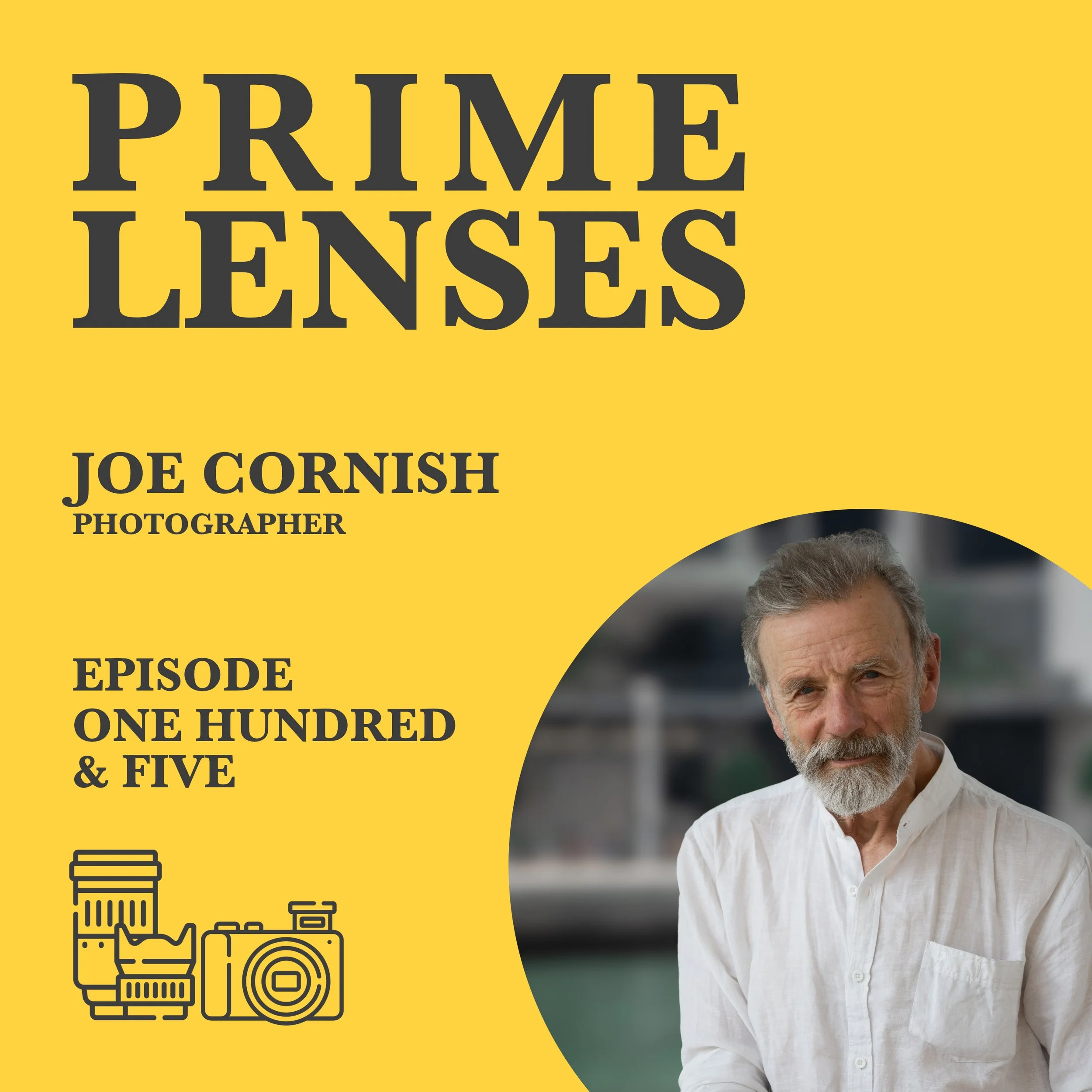


Joe Cornish is a landscape photographer and true lover of lenses. Perhaps a little more shy in his younger years than now, you’ll hear him discuss how he came to photography. You’ll also hear some sounds in the background, the occasional kettle and the sounds of tea making. Like last week’s episode with Nina, that’s what it’s like recording on the road and I think it adds if I’m honest :) Joe has an exhibition on at the moment along with another former guest Simon Baxter. You can find out more about the exhibition on the link below.
Simon and Joe exhibition on until the end of March.
Sign up to the Prime Lenses newsletter for a mid-week treat.
Support the show on Patreon.
Episode Transcript:
Iain:
Hello, welcome to Prime Lenses. I'm Iain. This week, part two of my On The Road series that I recorded when I was travelling earlier this year. My guest today is Joe Cornish. Joe is a landscape photographer who's been photographing since the early 80s and has made a name for himself just making these incredible images. If you mention Joe's photos to anyone in North Yorkshire they'll know exactly who you're talking about. The town where I live and the surrounding towns and villages, Joe's images are everywhere. They're in hotels, they're in cafes, doctor's surgeries, the lot. I love his photographs, I love the way that he captures the natural world and you'll hear in our conversation he clearly really loves that and feels a responsibility to show people the world that we're so fortunate to live in. As I say, this was recorded on location. Joe was very kind and let me come to his house to record. And so also the conversation is punctuated a little bit by the occasional sound of cups of tea. But I think that just adds to it. It's why I like recording on location. It gives things a different feel. And it's really nice to be with someone in the room when you're having a chat. Joe was fantastic company. I hope you enjoy this conversation between me and Joe Cornish. I do like to just dive in but yeah it's lovely to have a coffee it's lovely to see you it's lovely
Joe Cornish:
to to meet you and um yeah really looking forward to to chatting I missed you when you were up at Ford's not that long ago oh good old Ford's that's the as Alistair says it's the ultimate photographer's toy shop isn't it it really is yeah I've been doing some stuff with them because I met
Iain:
Steve at the Leica event last year. So he and I both. When you spot another person with a camera in Vanessa Airport, you're sort of like, okay. And you're both going to... When we both realised we were both going to Schiphol and then we were both at the same gate again, I was like, okay. So we've heard a little chat. So it was really nice. But I've been doing some stuff with them. And it's really funny. John up there posts, does a lot of their social media posting things. And we're always trying to come up with interesting things to post. we put a lot of thought into posting, kind of really trying to post like interesting things that are attractive or whatever. We posted a picture of you with, who was it you were with?
Joe Cornish:
I was with Mark Littlejohn.
Iain:
Yes, with Mark Littlejohn, that's right. He didn't even put your names on it and it got thousands and thousands of views. And so he and I always joke about like, I can put all this effort and thought into like, oh, we could do this, we could do that. And then we just post two blokes in a shop. It just does really well. We're like, I don't know. He posted some fungus on a lens yesterday. I can't understand the internet.
Joe Cornish:
That's weird. Well, lens is, I mean, I guess that's at least one of the things that's bound to come up today. And it just seems, it's so much fun when you're my age anyway, to look back because everything's changed so much. You know, remember, probably remember the very first, the very first lens I had would have been a 50mm f1.8 from around 1976, I think. And that ended up in a harbour. Yeah. Oh, no. When I dropped my camera. But yeah, over the years, I've just owned 100, and probably hundreds of lenses. I hate to admit it in a way. But I find them absolutely fascinating part of photography. I mean, they are literally the kind of eyes with which we see the world, aren't they? Yeah.
Iain:
Yeah. Yeah. I mean, I've had previous guests and I kind of like this analogy that refers to them like brushes. and sometimes it's about it's about the brush that you want to use in the moment and the kind of the result that you'll get from it and I think that's where a lot of the that's why these conversations are so good because I think a lot of the conversation around things is around the new thing and why it's better and why it's faster and why it's sharper but I think it's about understanding what it will do for you isn't it more so it really really is and and then it also
Joe Cornish:
of course depends on your agenda you know because there are some photographers who want a really really soft rendering don't need detail uh and you know there are others who who want the highest contrast brightest sharpest everything um and yeah you know it is of course there's a lot of variations around those areas as well but I mean I do have an agenda and the agenda is that nature comes first so that's my that is my agenda as a as a artist as a photographer is is to is to document the world in all its beauty and to have it be as real as possible so that that on the face of it implies you need a very sharp lens and of course that that's true but a really good lens is more than just sharp because there's plenty of sharp lenses that aren't very nice um and so the ability of the or the ability of the lens to get out of the way is actually really important so I would say the best lenses are ones that you don't actually see for me if that makes sense yeah they don't have a style right they don't have a look but they just they just do the job without and get out of your way and you never have to worry about them or think oh am I going to worry about some ghastly aberrations or will they be too soft in the corners or um or is the bokeh nervous or all those sorts of things so yeah they don't necessarily have to be the sharpest in terms of highest resolution because those other qualities are equally important the ability to just render
Iain:
the scene completely neutrally right yeah I was just gonna ask the word neutral was in my head do you like to capture in a very neutral way and then adjust exactly right yeah so I I suppose it
Joe Cornish:
is important that the lens uh I mean large format suits me in lots of ways partly because the the lens is a big image circle yeah it's actually when you're in the middle of working with the middle of the image circle most of the time it is a as it were a flat rendering of of the space uh in terms of the way that detail is rendered and so on and you don't get uncomfortable distortions or whatnot so but saying that you know sometimes I do push lenses to the limit and I find myself right at the edge of the lens especially if I'm side-to-side stitching right with a medium format technical camera for example or offsetting the lens because I'm using perspective control so all those things can happen and of course you know there are times when you do get darkening vignetting for example but that that's really an issue for me actually right I in fact um you know to return to the issue of editing I quite often use vignetting I quite like the effects of it but in a way that's uh any large old large photographer would tell you that most lenses that were either standard or wide all vignetted in the past. But they've vignetted really, really gradually. So they did so in a very organic fashion. And in a way, the word organic is quite a good overarching description of what I'm looking for from a lens and from the process. So, you know, high resolution sensor also allows you to render a scene more organically, more like film. Yes. I mean, really. Yeah. I mean, you can emulate film by introducing additional noise if you want to make it look like grain. I mean, there's so... Digital photography is amazing like that. There's just so much control. But you do need to know why you're doing things. Otherwise, I think it can be a bit all over the place. Yeah.
Iain:
Well, I think I look back being much earlier in my photography. We talked about it a little bit before I was recording about you know taking photos in places and sort of wishing wishing I could go back you know the MotoGP was an example but you don't know what you don't know sometimes and I think sometimes when you look back it's nice to have a body of work to look back over and see how your style has changed or adapted presumably for you there's a big step change when the move to digital comes and that's
Joe Cornish:
maybe a big moment oh Iain I can tell you that's a real can of worms for me I've been writing about actually um and it it's a fascinating for me it's fascinating because it's my career my my life so I'm interested in it whether anyone else is I don't know but you could you can if you if you go back to say 1985 uh it's the beginning of my career effectively so you know 41 years ago I was an assistant before that I took pictures of course but um by then by 85 I'd started to work as a freelance photographer um and in many respects there's a the the kind of stylistic elements aren't that different the way that I see but uh there comes a point where uh I'm trying to uh well yes digital I mean really the there's a there's a number of of important changes I suppose so very briefly I started shooting 35 millimeter like everyone uh even by the time I was at the end my student days I actually started shooting tuna cauldron. I become interested in the idea of image quality and the differences that that bigger bit of film gave you. And so and then bit by bit I started using a 5x4 in the studio but I was very very reluctant to use it outdoors because of the feeling from my point of view that I would lose spontaneity. And so in terms of that, I actually didn't switch to shooting large format until 1997. Oh, wow. So I'd already had established a kind of career path as a photographer there, and I was shooting medium format, two and a quarter square, six by 12. Yeah. Not 617, but sort of semi-panoramic. And then finally, I think I realized that if I was going to take the next step, And actually, strangely enough, it was the coming of digital that prompted that step because I realized that it was coming. This was the end of the 90s. I wanted to kind of swim in the opposite direction. I actually felt that it might help give me more of a kind of exclusive, not exclusive, there were plenty of other photographers shooting 5.4, but they were kind of elite, really, because it's expensive and whatnot. And that's when I did start shooting 5.4, And I shot exclusively with that format for 11 years. Wow. And it was incredibly important to me. My identity as a photographer was really established then. But it was only building on what I already did because composition and lighting were fundamental, of course. And shooting with a large camera, it really reinforces those elements. Partly through the cost, the fact that you see the image upside down on the glass screen is really really important um anyway so then uh I there were several reasons why 90 what was it 2008 became the year that I changed yeah um I I suppose that I I felt I had to adopt digital because of the pressures from clients and from workshop um clients as well who almost all of whom by then were starting to use digital I realized I needed to learn it and also I could see some of the advantages however the following five years proved very very difficult right very difficult indeed and and I I almost gave up uh on a couple of occasions so instead of just going 35 millimeter which is probably would have been more sensible um I decided to get phase one back oh wow and a technical camera yeah so I actually initially used my phase one back on the ebony my my wooden uh 554 camera however wooden cameras and are not ideal platforms for for digital and they certainly weren't then because there was no live view on the backs which meant that you had to do everything using a ground glass screen I really don't know if people will be able to relate to this but it was and screens were tiny course they were much smaller than 5.4 because the format of the of the back was actually less than 6.45 yeah not dissimilar to say Fuji or Hasselblad today yeah but I persevered because I felt it was right and the image quality of the files was very very good colors were a bit mixed at times but they were sharp and whatnot and um so that anyway came a day um when I I shot a picture in colorado it's 2013 having been shooting for five years and I when I played the image back to myself on my laptop I was a broad obviously at the time um I actually I started choking up because I realized that I I fall I fell in love with this picture I was really happy with it was great but I realized I hadn't fallen in love with a picture for five years oh it'd take me that long yeah to in a way come to terms with the gear using the gear and um there was so much friction in the process yeah you know there were lots of cables the focusing was difficult the visualization was more difficult the playback of the uh wasn't very good um that's improved enormously because ironically now in uh 2026 I'm using a backup actually had since 2018 it's a phase one iq4 150 and it's got fabulous live view um you don't need to worry about any cables you just use the electronic shutter and and it's I won't say it's dead easy to use that would be that would be wrong because it's still on a technical camera yeah but the the fact is it's if I had that from the off it would have been a much much more straightforward transition as it was it was really difficult so yeah I look so if we were looking at the body of my work over over a career there's a kind of five-year hiatus yes in it and it from 2008 to about 2013 2014 and and after that there's a there's it there is also a distinct color change by the way and of course that comes with uh going from shooting transparency film which was expected because that's how publishers wanted to receive the images and then it was really up to them to do the scanning and do the repro and then bit by bit what happened through the 20 well through the early 2000s is photographers were expected to do their own scanning yeah and so on so that was a big learning curve as well um but the big change was going to a raw file right so and why well because the as I I'd never really thought of it before you shot transparencies you knew there was an alternative which was negative color negative but color neg wasn't really practical for repro unless you were always making prints and there was no need to do that because I could I could shoot a good color transparency it was more cost effective and I got pretty good results with it on the whole but um what I hadn't really understood is that film itself is the signature of the photograph in a way along with the photographer it sets a it sets a sort of style it has a rendering a tone a color value and so on raw files don't have that so the raw file uh you know was this new mountain to climb in a way but the great thing about it was that it enabled me to really question what my work was about and why I why I'd used a particular type of approach in the past when I was really looking for a subtler kind of image making I think a lot of my work from the 90s and 2000s it's quite punchy quite rich colors and I like the composition still when I look back I find that when I when I scan my old pictures I'm quite often having to knock back the color right so that it becomes more believable right because a lot of it is not that believable in as I realize now and the beauty of the raw file is that you have not quite infinite control but you have a huge amount of control hue saturation and luminance of individual color channels as well as the you know the overall tonal rendering the luminosity the emotion the emotional kind of resonance of the image and all of that it makes for a much for me it's become much more immersive as a way of working to to shoot digitally I'm sad to say that because I know people feel as some people feel it's a bit of a betrayal um to you know the traditions of photography but the reality is that you know technology doesn't stand still and I actually see digital photography especially if it's combined with digital printing as much more craft based than film photography film photography is more transactional in a way for me you know you had to know what you were doing you had to be able to exposed the film correctly but you were often sacrificing shadow or highlight detail yeah depending on on the kind of environment that you were in and now you can you have a lot more freedom um in terms of what you will shoot that's not to say that I'll just shoot anything the light still very very important of course uh and composition but the um the way that the file is interpreted is
Iain:
a lot more varied yes yeah you can get away with murder with a with a raw in the way that you just can't I've recently been shooting film again because I want to learn or relearn to develop my own negatives and and so I've got a 35 mil camera in my bag and and the the useful thing that film is doing for me is making me pause before I press the button because there is more of a cost associated and it is slower yeah and I'm you know I'm gonna so I'm not just rattling off shots in the way that I might do with digital and then give yourself something to deal with later but for you I guess part of that learning as well because I've noticed it retraining my brain I came up through digital so for people listening who maybe weren't using cameras back say in the mid 2000s and beyond like the early digital for me it's always been that there's more detail in shadows I don't really remember a time I didn't shoot raw because I could my first dslr even shot was a nikon d40 that shot raw file so I was shooting for highlights and reclaiming shadow detail pretty much from the jump and whilst the technology's improved like you know take the computer that's in front of you if you're listening to this near a computer and make it about a third as quick and at least half as heavy again and that's kind of the computers that we were using to edit raw files but you know you you would press a button and wait for the thing to finish doing its thing so we've come an incredibly long way to be able to like the latitude that we have now but it was a big change for me when I went back to film to kind of retrain my brain that actually there's more detail here in the highlights and I should be overexposing not underexposing and things presumably that was all those kinds of things were the things that you were figuring out over that five-year period that's well that they were some of the things for sure
Joe Cornish:
um yeah absolutely I was also learning stitching and and printing digitally and so on so there was but yes how to how to manage highlights and shadows and just wrestling with the camera frankly was a lot of the the problem and also those earlier backs were nowhere near as good as the backs today so you know there were ccd sensors and they they did give good color and of course the lens is actually remarkably almost the same yes um you know and that's I mean if we were to return to that topic at some point it'll be interesting to talk about through but um yeah it just just in terms of trying to sort of how how this all works the the it's very interesting and I applaud you for for using film because I actually think everybody every photographer needs to have an understanding of where we came from and what the advantages of of and there are some advantages in film of course um but mainly there to just the fact that you're you're as it were outsourcing a lot of the interpretation to the film yeah what uh probably slightly less so with color and egg than with color transparency but color the trouble with color and egg is is you know it's a complex staged process you know you you have a you have a piece of film that doesn't look like anything you'd recognize that that has to then be inverted and then it has to be heavily converted if you're doing it digitally and that requires quite a lot of understanding of color and tone to do that well if it's a transparency that's a different story because of course it comes out looking like what you saw yeah except that it's on the whole very contrasty yeah and that's the thing that most people really struggle with inevitably unless you're shooting a low contrast subject in which case it can be really good yeah um and actually I you know thinking uh back to the the uh mid-2000s um although all the 90s I should say uh well actually no it would have been the mid-2000s you know a lot of stylistically uh my friend david ward who uh inevitably comes up in conversation because he and I have done so much together over the years um he developed a style that was really around shooting in quite flat light shooting on a high contrast transparency film fuji velvia yeah um and his pictures are amazing I mean and he also struggled a little bit with his transition to digital he now shoots digital and his pictures are even more amazing yeah now that he's kind of gripped the the metal and how to how to manage the files uh but yes he also found it difficult to change and you know to to understand the difference and you know there's the elements of using a smaller format course focused differentiation is different we used to shoot most of the time I say we but anybody was shooting large format would typically shoot at f22 would be like their widest aperture right yeah and and when you look at those images now transparencies and or negatives if you If you look at them with a powerful loop or what we would call 100% today, they're all soft. They all have diffraction. Now they're nicely soft and very often with a little bit of selective sharpening, they'll come up looking quite crisp. And they print fine to almost any size because actually it isn't about that 100% viewing a print. That's one of the problems with our photography. We see things rendered one-to-one on screen. And if they look good, they're happy days. But actually, a picture could be a great picture and it's not that sharp.
Iain:
And that's really the...
Joe Cornish:
It's one thing that I think we do obsess about. I do myself. You don't obsess about it too much at fine detail. But of course, it's reassuring to know that you have got really good detail. But actually, the most important thing is, is it a good photograph?
Iain:
yeah does it work yeah yeah yeah I'm glad that you have a good friend called david ward I also have a very good friend called david ward I feel like everyone should have a good friend just seems like a solid you know like in a world of multiverses like every galaxy we go to but there's a good but you're absolutely right there I think about the detail and the kind of the what's important because I think the the current conversation often about photography like if if you were starting today if someone's interested in the hobby I think it's it's unavoidable that eventually you end up probably fairly quickly people telling you why this one what is good and that good is somehow associated with technical stuff and I I hear it a lot when I listen to or watch youtube folks that I know who do a lot of good work reviewing things right like they get the cameras in and they're like well this is this and it doesn't do this and I wished it had open gate and I think about a lot of these new technologies especially things like in video like open gate where the entire sensor is being captured yeah and I can appreciate someone who makes video for a living going will the extra latitude be handy potentially but just frame it because like every every I've always said this to people you probably occupy a similar place with your friends when people want to buy a camera they come to me and they say friends say you know what which one should I get? And I always remind them initially, I'm like, well, every photo you've ever seen that you admired was made using something probably less good than what you are about to buy. Technically, right? Like, you think about when I, you know, amazing photos. I was talking yesterday with Nina Davidson about the Magnum book of all the contact sheets that you can get. And it's like, you think about the photos that were made, like, you know, the one I really love of Muhammad Ali's fist up close that I think was shot on an M3. And, you know, way back when and it's an incredible photo yeah and if you got a loop out and looked at that I'll bet there's bits of that that aren't tack sharp or perfect or whatever yeah but it doesn't matter because it conveys this incredible thing or or you know portraits and stuff so I think it's important for us to kind of not overanalyze because you can get lost when you said about enjoying that editing process now and that living with your image and living within it for a bit longer it's quite beguiling to get stuck in that edit process isn't it and it is and and you have to be mindful of
Joe Cornish:
that um yeah if I give you another example of a black and white picture I have a portrait of my mom I did when I was a probably still a student and um she left us a couple of years ago uh and so it was very important for me to be able to go back through my archive of family pictures and found this picture of my mom at this sort of height of her kind of um you know middle years And I think it's a brilliant portrait. But we used it at a funeral and so on. And everybody, you know, raves about it. But I can see that it's actually slightly out of focus on her eyes. And I was thinking, well, how did that happen? And of course, loads of my pictures from that era are not that sharp. Because there was no eye detect or pupil detect, autofocus or anything like that. It was shot with a Hasselblad manually. and you know it's just concentrating on the moment not on whether I need to come forward back a tiny bit or you know any of those things does it matter no it doesn't matter no it's totally irrelevant but it was it just struck me it's been quite funny and in a way it speaks to what what you're you're
Iain:
talking about now yeah I've been messing around with this film camera I got this leica cm and it's an uh it's a kind of last hurrah point and shoot leica 35 mil and it has manual and auto and what's funny is I'm working out at the moment whether it has an autofocus problem because picked it up from the guys up up at ford's and because you don't see them very often they didn't make very many of them so and it's I love an underdog so if it's weird if it's weird it immediately jumps to the top of my list and uh they they said to me it has a tendency to back focus and the more time I'm spending with it and the more images I put through it I don't think I think it's just 2006 autofocus you know I just think it's not very good. You know, I think it's point and shoot era autofocus and they're all fairly...
Joe Cornish:
I remember the very first autofocus cameras. There were, I think it was Minolta who were the first to actually solve the problem of having a whole system, autofocus system. But before that, Nikon actually had these two lenses that were autofocus lenses he could use on it. And I think the autofocus control was actually on the lens itself. You had to press a button and it went... we took about three seconds to rack between focus points but um and yeah so yeah it was funny because that was a period when uh technology this is in the 1980s when technology was you know we thought that was incredibly advanced to have autofocus but it was everything was so slow in terms of advances compared to what it is today you know cameras would have um life cycles of at least 10 years so nikon the first nikon f I think came out in 59 and then in 69 you got the nikon f2 and then in 79 you got the nikon f3 yeah and so on and that's that we always sort of assume that that's roughly how it would work and there's nothing wrong with the original nikon f it was just a bit more basic yeah um than than the later models but you know still work fine you can still put film in them you can still shoot and you still can of course yeah um but that's one of the great things about about really well-made film camera like a nikon canon whatever of the day is that they still work today yeah um so long as the shutters haven't seized up um and you can still
Iain:
make lovely photos with them yeah I you see a lot of m3s and a lot of them like m cameras just running around and stuff so yeah I think more power to them if they're still useful the amount of people listening to this you probably started with an a1 that was a hand-me-down or something
Joe Cornish:
like that oh I remember that camera I remember that the in fact I remember that because it came out a year before the canon a1 this is really geeky yeah I love it it's great 1970s I think it was probably 78 when the canon a1 came out it was considered enormous revolution because it could do both shutter and aperture priority automatic what about that yeah um I mean it seems that you it was all manual focus lenses and everything but it was yeah and it was this is ridiculous but the selling price was 300 pounds it was considered a lot because similar cameras would have been you know 150 200 um and then it was selling on the black market for 600 pounds wow there was so so much demand to have this revolutionary camera yeah that changed fairly
Iain:
quickly but um you can imagine it just seems so funny now looking back the x100 of its day yeah pretty much yeah that's yeah that's a very fair comparison yeah yeah those cameras are great they do very well well talking a little bit about nerdiness I'll steer us down that road so you mentioned earlier about the lenses and and to kind of wanting to kind of touch on how they've not they've not changed but have changed yeah I shoot when I shoot with my arm I shoot with a lens that the design is off you know probably from like the late 70s sure and it's not and like you say it still works it still lets light in it still renders a really pleasing image yeah over time you've presumably adapted gear and changed gear and you know bought and sold but what have you what's your perspective on that change over time is it that it was a solved problem quite some time ago
Joe Cornish:
it's so it's incredibly complex and I'm sure that there are I mean I think briefly resolution is a sort of fundamental question with lenses and you know even in the days of film you know a lens that had a high modulation transfer function was considered a better lens than one that didn't but the reality was that with large format film there was a there was a figure attached to it once So the MTF for large format film only needed to be four. Right. As opposed to 85, or something's what we say now, for it to be able to produce a reasonably sharp looking picture. Yeah. Now, I'm not quite sure where that comes from, and I've never really studied optics in a great deal of detail. But I think the ability to render fine detail is the underlying question. And there have been great lenses throughout history. Well, let's say at least since 1900. that were based on the sort of symmetrical designs. They could have been a four element, they could have been a six element, the so-called TESA four element. There was even three element lenses that had been made up until very recently, tri-autar type designs. It still produced a nice image, but probably slightly less sharp. I honestly don't really know. When I was shooting Nitro, it was always said that processed lenses were the sharpest lenses. process lenses were mainly four elements only but they were optimized for uh probably a reproduction scale of one to five or something like that so they were they were used for for copying flat artwork um and they were very good and they were a lot of people use them for landscape yeah and they were fine but they wouldn't be considered fine now because they probably wouldn't be considered sharp enough or high contrast enough um six element lenses were the kind of the standard really they became the standard so all 50 millimeter lenses of the 70s and 80s were six element symmetrical designs yeah um what we call planar planar um or simmer syrenar if you're large format uh and they still um the best ones of those still are amazingly good and I I use a 105 millimeter nickel w and a 150 millimeter serenar s with my phase one iq4 150 back which is 150 megapixels and they still produce good images now there are modern designs that produce slightly more micro contrast but I mean honestly for the extra size and weight and so on that these you know fancy new lenses are it's really immaterial in a print so I'm not bothered with those at the wide angle side of things it's a little bit different right so um In wide-angle photography, with large format, there have been brilliant wide-angle lenses, and I've used a lot of them. So, for example, at one point when I was shooting 5x4, I'd carry a 58, a 72, a 90, a 110, and a 120 with me. That's ridiculous, of course. And if I was climbing a mountain, I wouldn't have carried them all, but I was taking the 90 in all probability, which is a really good all-rounder. Those are mostly 8-element lenses. They're mostly symmetrical designs. They had short back focus, whereas today most wide-angle lenses that are high quality have telecentric constructions, which helps to collimate the light. So they're much more complicated, usually at least 11 or 12-element. and the rear group is just designed to make the light rays more parallel. And most photographers of my age know perfectly well that wide-angle lenses are a lot longer than they used to be when we were young. And that's because of this collimation of light. So I hope that's off interest anybody who's interested in wide-angle lens design. The other thing is that the modern lenses are super sharp. They have amazing coatings. So, for example, with the Phase 1, I have a 35, a 40, and a 50 as wide-angle options. And they're all amazing. The 40 and the 50 also have quite large image circles so that you can use large offsets with a technical camera. They're made by Rodenstock, and they're the only ones now. They're the only manufacturer, which is kind of sad for those of us who use that system because it feels as if, well, A, there's no competition, and B, they're never going to get any better. Do they need to be any better? No, not really. But it's a much different field than being in the world of 35mm where there's so much competition and there's all these wacky exotic lenses appearing from time to time.
Iain:
It's a shame when we potentially lose a skill set as well because the thing is something stops being developed and it's not because it's not good. Have you come across the project to bring back the WideLux camera that's happening? Oh, right. Yes, I did hear about that. So it's some people who've been on the show who are making that again and the factory burned down in Japan in like the early 2000s, I think. Right. And when they were sending technical details back and people would ask questions, they would get pieces, put them on a photocopier, photocopy them, label the photocopy and then kind of send that or fax that. So there's really not a lot of documentation left for understanding. So they've really had to basically take as good an example as they can and disassemble it.
Joe Cornish:
Reverse engineer.
Iain:
And then basically reverse engineer this thing because there's no other way to figure it out. Fascinating. It's amazing, isn't it?
Joe Cornish:
Yeah, it really is. I suppose a lot of things die off over time, technologies. And there is a, it feels to me like it's a major challenge facing us all as AI becomes more and more pervasive, that we can kind of depend on AI to provide solutions for absolutely everything. And there's a risk that we, you know, I'm not sure that this is a worry, but hopefully it won't turn out to be a thing that people will lose skills because they become essentially, well, what's the point when AI can do it for me?
Iain:
Yeah, I think the danger for me, I have two thoughts on that. One is that I worry about a two-tier system existing. Because especially in music, I was listening to something the other day, a podcast series called Switched on Pop. They talk about music and music production. And in Nashville, where there's a very big business in writing and pitching new country and western songs, and traditionally you would get in a studio, you'd have session musicians, session singers, things like that. So these aren't the people who are going to sing the final thing, but they're going to help you pitch the song to whoever's people. And you would get these people together in a studio, you'd record demos of tracks, and then you'd send those off. You can now generate really convincing demos in seconds. With AI. Yes. And so it's cutting out this whole group of people who had jobs and things like that. So it's partly the skill from a production standpoint of getting people in a room, recording it well, giving it a feel, giving it a tone. Like you're saying with the lenses, recording it with these types of microphones, it's going to sound like this in this space. All of that will happen later on down the line once an artist gets hold of it. But you're cutting out a whole step in that serendipity of people meeting and sharing ideas and maybe the next big band. I think that's my worry is that actually that goes away.
Joe Cornish:
Yes.
Iain:
And then also, what if it's cheaper to subscribe to Spotify for just generated music versus real music? And then access to art is gated by money. Like, that's my worry.
Joe Cornish:
That is a big worry. And session musicians particularly often went on to become stars in their own right. Yes. You know, it's a step. Yeah. I think, you know, music will carry on, of course. And because of live music, fortunately, performance is going to be the key. for musicians to make a living is that ability to be able to get up and play on stage live because people will always want that I'm sure um no no question but yeah in the meantime there's a revolution under underway as you say yeah uh in terms of the recording industry and it's difficult to I mean that pandora's box has been open oh yeah it's not going to close now so you know how musicians and especially aspiring young musicians navigate that it's going to be a big challenge
Iain:
for them yeah it's it's coming for us in in photography as well I guess with with things like you know there's efforts to do things like content credentials and try and show that something is a real image and was made in a real place that that and that's another fascinating point to me I
Joe Cornish:
mean there's so much kind of cheating going on in competitions in particular in uh you know and ai can do so much it can do so and it's becoming more and more convincing that will you know perhaps at the moment still photographic imagery looks a little bit uncanny when it's AI generated but it's surely only a matter of time um so for you know an old timer like me um it's frustrating but at the same time I sort of feel that it's AI doesn't make any difference to my life in the sense that I still want to go out and photograph that that is what I love to do uh that's what I identify with and I see many people use photography as a as it's their hobby it's their it's their passion or it's their you know you could say it's their therapy uh for many and so um I can I can see my role as a workshop leader has sort of subtly changed over time it's not just about helping people take better pictures it's about actually just just being able to feel reconnected to the natural world that's perhaps more important than photography itself because I think that's the fundamental challenge that faces humanity today anyway um is our relationship with nature I was
Iain:
bound to bring it back to that eventually yeah good good well I was going to ask about it yeah because you've been quite outspoken and and you know about about the natural world my sister is a founder member of extinction rebellion so we've spent a lot of time talking about that sort of stuff yeah she's much cooler than me she's kind of a big deal well she's a true heroic activist I
Joe Cornish:
couldn't do that probably because I have too much self-doubt I actually think that um you know I I know how I feel and what I think but I don't know whether it's true does that make sense so yeah because of that I can't I I wouldn't feel comfortable in an activist role um but but as as to what I feel and I also feel very very much that it's it's not that I want to blame anybody about this yeah I don't. I just, what I really want to do is be able to say, well, you know, we have challenges going forward and there are ways perhaps that we should be thinking differently. You know, most of all, I think it's to work with the ebb and flow of the natural world rather than against it all the time or exploiting it. And to remember that every action has consequences and so many of those consequences have been unexpected and unwanted ones. I mean, the fossil fuel question is really complicated because, you know, we all benefit hugely from them. You know, I know I do. All that traveling I've done over the years. But I'm very conscious of the fact that the, you know, emissions from fossil fuels are the thing that is most likely to cause us or our children and grandchildren long-term problems. You know, as the world heats up and we're already seeing this sort of cycles of flooding and drought across the world. I'm seeing flooding here at the moment, which is of historic proportions. You know, we've never seen anything quite like it before. Yes, there's always been weather events, but you're becoming more and more frequent. So that's one thing. And somebody who loves nature as much as I do, then the loss of diversity is also a worry. On the other hand, I feel more hopeful about that because I think there's a lot of awareness of that. And there's a lot of work being done to manage, let's call it the living world rather than ecosystems, which is a bit of a technical term, you know, in a way that's more benign. And the UK, you know, is a little bit of a leader in that area. But then we have an incredibly low base that we're coming from because our biodiversity in the UK is awful because we've dominated the landscape for so long here. but there is hope and there are ways that things could get better into the future. And I'm hoping that it's really, you know, it's a cultural thing. You know, think on continents. Every major continent in the world, there are apex predators, bears and wolves and tigers and lions and so on. And these, the locals live with them, you know, whether it's in Italy, America, you know, or Uganda. And they, you know, they learn to live with them and accept them. We don't have them in the UK, so we can't imagine what it would be like now to live with wolves or lynx or bears. But we could.
Iain:
Yeah.
Joe Cornish:
We could. It's really just a question of will. And if we were to have apex predators, I think we would see actually significant improvements in ecosystem quality and health, particularly in Scotland. Yeah. you know, where deer are, you know, poor old deer, they're a problem because there are too many of them. Yeah. So good example.
Iain:
Yeah. We have deer visitors in the garden all the time. Which is lovely.
Joe Cornish:
Yeah, it's really nice. Yeah. And it's wonderful seeing animals like that, you know, wild animals in a natural environment, you know, but an excess of them makes it very difficult for, you know, for trees particularly to recover, to get that wild balance. We've seen examples around the world, like the Yellowstone example, where wolves are reintroduced. What a remarkable improvement it's made on the functioning of the Yellowstone ecosystem. Yeah. So, you know, there are good news stories around. And it's just, it's trying to develop stories. In fact, my other kind of agenda here is trying to develop a hopeful agenda around beauty and the beauty of the experience of nature. And that that is a way where we can all unite in a common cause. Because there's far too much division and dispute going on. And while it's important to debate, we also need to learn to tolerate differences of view. And there's not much of that at the moment. Tolerance, I mean.
Iain:
Yes. No, exactly. I mean, it's plenty of difference of view. That seems to be for sure. Just for new listeners as well, I'd like to mention previous guest about two episodes back will be a photographer named Hannah from the US who photographs the wolves in Yellowstone. So I've just recently spoken with her. So this, as we're speaking, it hasn't gone out yet. But it will have done by the time yours goes out. Oh, fantastic. I recall her. She's a great guest. She's worth a listen. So yeah. Lovely. So your love of the natural world and photography, if you were making photos at home and you were taking portraits of family members and things like that, was there a moment when you went, it's the outdoors, it's the outside world, suddenly something clicks? Or were you photographing lots of things? How did you land on?
Joe Cornish:
That's a really interesting question to me because I'm still trying to work it out. But I think the reality is that When I was young and Some extent is still true. I was very very shy very shy boy, but yeah, it was a real I would like to have disappeared a lot of the time I don't and that one of the reasons I love photography so much is I'm behind the camera, right? So I and it's like it's like a defense for me in a way so I When I was a kid I love playing outside Lots of tree climbing and all sorts of stuff. You're not allowed to do nowadays um and uh you know we we weren't exactly feral but we were given a lot of rope as kids so I was very comfortable in the outdoors and when I first started using a camera the first thing I pointed my my camera at were trees and that's literally true if I I can still find my first rolls of film somewhere out there in the studio um which and it's nearly all trees pictures of trees shapes of trees you know and and their their patterns and so on and twigs and branches and whatnot so um but the the reason fundamentally was I felt comfortable I didn't feel judged I didn't feel um threatened or um emotionally kind of challenged by by nature it was indifferent to me so I was able to be part of it yeah if that makes sense and that that never really changed I think my confidence is a result of my photography so I'm able to talk to you comfortably and I can stand up in a room 300 people and talk to them if I have to um I mean it's not something comes naturally but I can do it because I I don't think about me I'm thinking about photography and about the natural world and so that's that's been that's given me the kind of platform to I suppose um a form of fulfillment and I feel I have a role in a job in that sense. But yes, the process itself, you could say, is because I lacked so much self-confidence that it was nature that was my safe place, as I see it now. And I'm still, I think, hardwired as an introvert, really, but I still sometimes find, if I'm walking down a street in the village, see somebody coming on the other side I'm more likely to cross the road so that I don't have to say hello which is terrible um I mean I don't always do that but uh you know that that's my that's what I feel is an instinctive thing for me um whereas you know many of many of my friends are the opposite and I find also that when I work as a workshop leader in when I I much prefer to work with someone else right and I like playing the kind of what's the word um like the uh well the second in command yes yeah uh rather than the leader role and I feel that many of my friends so I leave with a very charismatic right um brilliant all brilliant very much cleverer than me but I have a role to play I make them look good that's how I like to think so I'm not sure if that's how they see it but yeah um so yeah so to return to the main theme here um as as I realized that uh of course when you do photography as a young photographer you're trying everything I did lots of portraits lots of interiors exteriors and when I was a travel photographer photograph buildings and markets and um all sorts of different things but landscape was always my greatest joy yeah and and the biggest challenge and and funnily enough you know I mentioned trees um a few minutes ago and and trees and woodland have become absolutely the core of my practice now so if I have a day when I've got time I'll go to local woods almost any time of year yeah and and photograph and that's just practice is keeping in touch with my my process um and I love doing it funnily enough when I shot transparency film I tended to avoid woodland and there's a simple reason for that it's contrast yeah and it was so difficult to control the contrast except in very rare circumstances very misty conditions perhaps it would be fine but they are rare um you know we're the best will in the world they're finding just those right conditions I mean I do go out into the woods when it's misty but the beauty of shooting digitally is that you have this incredible control over the tonal values so you can you can render render them where you want them to be the highlights and the shadows and so and also control excessive greens which is a big problem in color photography so all of which um has made has allowed me to in a way return to my
Iain:
roots yeah so yeah yeah I living as I do in surrounded by trees uh I sympathize I I make so many pictures now of trees and I often joke it's because I'm too cowardly to be a street
Joe Cornish:
photographer and the tree never says no well there you go that probably I mean I and by the way on that note because I I totally agree with that um when I when I was you know starting out don mccullum was the big name in photography you know he was a great hero of of our era um of course there were other brilliant war photographers as well so I should say that but you know if you think of what what he was doing you know in a way we all wanted to be like him but the fact is I realized right from the outset that I a wasn't anywhere near brave enough to go to a war zone and also I felt slightly uncomfortable about the idea of as it were building a career on seeing other people suffer that wasn't what I wanted to do yeah um so and and I I think for me the nature because it fundamentally it's fairly indifferent yes it does what it does and that it was the ideal subject for me and also because it's so infinitely varied in terms of color texture tone pattern and so on and so that became a a form of um of mission in a way and even when I was still a student my my final degree show which is all black and white not all but mainly black and white photos are patterns of sand and rock and trees. Right. So.
Iain:
Yeah. Love of texture and shape and light. Like the. Exactly. Yeah. Basic stuff. That's wonderful. Well, we should also mention just briefly, a friend of the show, Simon Baxter, who put us in touch and is also out in the woods making photos of trees and things like that. Probably doing it right now. I hope so. I hope he and Meg are out there and he's listening to this. Exactly. It'd be really nice. But yeah, it was good of him to put us in touch.
Joe Cornish:
Yeah, thanks for Simon. Yes, and on that note, he and I still got a show on at Nunnington Hall at the moment. I'm not sure when this goes out whether it'll still be on because it finished at the end of March. Okay. But yeah, so if anybody happens to be in the area, I'd encourage them to go. Yeah, we've had a lot of fun working together and I love working with other photographers. Yeah. I actually think that photography is such a brilliant field to be in because, you know, as in all human life is here. photographers of every type every personality type uh and you know over the years I've been lucky enough to meet lots and lots of photographers and you know what one of the things that strikes me about photographers is how smart they are um I wouldn't put myself in that category particularly but I'm always fascinated by the insights that you get from from photographers what how they see the world uh and and what what drives them I think that you know it should be said that one of the things that we um we probably take for granted too much is what an amazing way of life it is yes uh to have this it's a real real gift you know and if you think uh fundamentally back to um our dim and distant ancestors that they I mean let's let's return to the pre-agrarian era so let's say more than 12 000 years ago our ancestors and one of those so many of them would have been largely hunter-gatherers and the hunter-gathering is really what photographers do in many ways so we have this deep connection in time with our ancestral past I think we don't hunt and kill animals or gather fruit what we're doing though is the skills are fundamentally very much the same the ability to observe to understand all the subtleties of what's going on with the weather So it's like being a tracker in a way. But instead of dragging a dead animal back with us, we come back with some images instead.
Iain:
I love that. That's fantastic. Well, that is an amazing note to end on. For people listening who don't know Joe, where can they find more Joe?
Joe Cornish:
I do have a website, which is run for me by colleagues. So I'm very grateful for that because I can't do anything on the internet. I don't do social media, but apparently they do have an Instagram site. for me as well um which they also run I I can't take responsibility well I should take responsibility for it but I'm grateful that um that they're doing that I'm really too old to be doing that sort of thing but uh but yes so that's that's one way there's the show at nunnington um where else I
Iain:
I mean I think that's it really for now yeah fabulous joe thank you so much thanks ian been a
Joe Cornish:
been a pleasure
Iain:
Well a big thank you once again to Joe for being on the show and for letting me come to his house and disrupt his morning it was lovely wasn't it? He's an encyclopedia when it comes to that transition from film to digital and it was lovely to hear how honest he was about struggling with that transition as well and now being on the other side of it and really enjoying it but that it took some time to get there. That's good. If you enjoyed it, don't forget that you can like and subscribe to the show wherever you get your podcasts. That's Apple Podcasts, Spotify, YouTube Music, Amazon Music, all those lovely places. Please do feel inclined to hit us with a review and some stars. Let me know what you like. Let me know what you don't like. My DMs and emails are open and it's always lovely to hear from listeners. You can support the show directly on patreon.com and also via the merch store that's on primelensespodcast.com. There's links to all of those sorts of things in the show notes as well. Right, get out into the landscape, photograph some trees, do some stuff, be inspired by Joe. Hope you have a wonderful week and we'll see you again next time.
More about this show:
A camera is just a tool but spend enough time with photographers and you’ll see them go misty eyed when they talk about their first camera or a small fast prime that they had in their youth. Prime Lenses is a series of interviews with photographers talking about their photography by way of three lenses that mean a lot to them. These can be interchangeable, attached to a camera, integrated into a gadget, I’m interested in the sometimes complex relationship we have with the tools we choose, why they can mean so much and how they make us feel.