Episode 126 - Kit Young
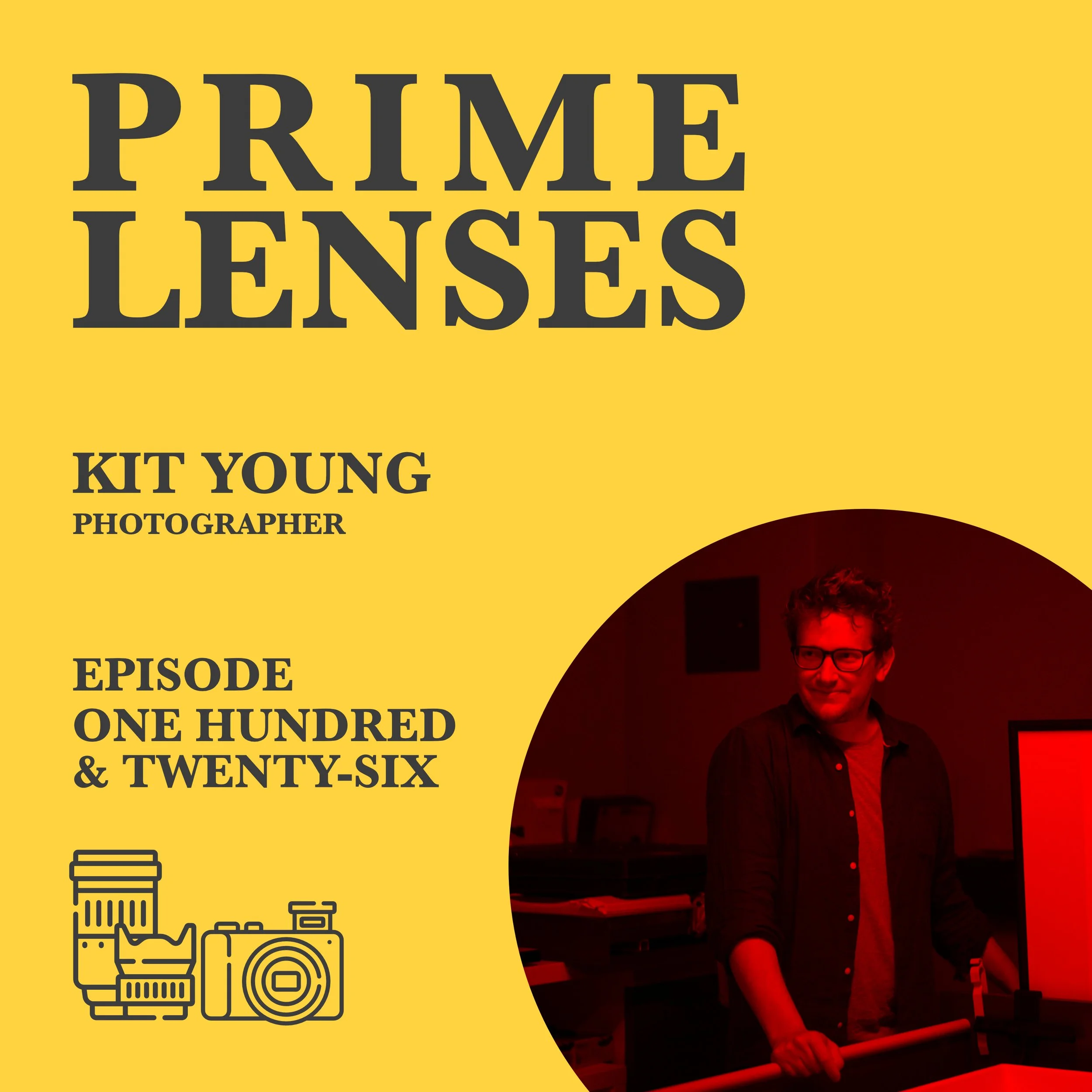


Kit Young is a British analogue photographer and printer. In an age where film is a niche choice and many folks who do shoot it send their film to someone else to process and scan, Kit handles the whole process himself, making his photos, developing the film and then making the prints in a darkroom. As a result his images stand out to me and have a very specific look.
Support the show on Patreon.
Episode Transcript:
Kit Young
Oftentimes, I've found anyway, which is quite the quite nice thing with having a few lenses in the cupboard, is that if I get a bit stuck, I just put something random on and go and make some work. And yeah, something, something will happen eventually. Well, that's the idea. Whether it does it is another thing, as always.
Iain
Hello, welcome to Prime Lenses. I'm Iain. This week on the show, my guest is Kit Young. In a world where many of us who shoot film either develop that ourselves and scan it digitally or give it to a lab to do both parts for us, Kit is the full analogue process. So that means capturing images on his film, developing it himself, and then using those negatives to make enlargements and proper analogue prints. Is it a labour of love and time-consuming? says during the episode almost certainly it's crazy amount of work but it does mean that his images have a really particular style and look so i really wanted to sit down with kit and talk to him just returning from Germany where some of his work has been exhibited i was really pleased to get to sit down with him for a little while and chat about his process and why he does what he does oh and one more thing during the conversation he mentions a particular type of bird sound that is really unusual you will hear that bird sound, I've added it to the mix, so do not adjust your set when you get to that part.
Kit Young
Well, it's good to see you. You're a real person. No, I'm joking.
Iain
I am! That's the start of the podcast.
Kit Young
It's always funny. This kind of social media stuff, it's funny, isn't it? I think I wrongly just presume everybody's a robot.
Iain
And then I kind of meet them and I think oh it's nice. My version of that Alice and I were joking about this last night because we're going to potentially meet up with a friend who's coming over from the States later in the year and she was like how old are they and I was like I don't know because I just assume everyone's our age but like I'm nearly 47 so I shouldn't do that to people that's not fair. Like they've got their whole lives ahead of them and I'm there going yeah he's probably in his mid-40s and they're like 29. I'm really bad I'm really bad I can't I can't gauge age at all, it's terrible. But unfortunately my wife is better. I make it easy, see, because I've got the grey, the free highlights. So I just make it nice and easy for people to tell. Well, you've got some years on it. You're looking very cool, yeah. Oh, thank you. I've always enjoyed my greys. They came in early and so I've just kind of leaned into them, really. Embraced it. Yeah, definitely. Yeah, yeah, yeah. Last few years has been the time when it shifted and you see your reflection in a window, but you catch it out the corner of your eye and you think it's someone else and because you still mentally have a picture of yourself with dark hair and then i yeah so there was a period yeah there was a period of adjustment where i would think a gray haired gentleman was walking towards me as i approached a reflective surface and then realized it's me um that was odd yeah it's ages ages but a number as they say thank you i like to think so that's that's the plan but yeah also we should say I should say before we get going happy birthday for tomorrow because I saw your email today yes thank you very much I thought I'd invite some people into my dark room for yeah for a few was it 15 seconds I think is that what I'm allowed to do or what I did but anyway yes yeah yeah thank you very much yeah yeah well it's nice to see the dark room process because I think that the the exciting thing about talking to you is that I speak to a lot of people who photograph using film and then they go and get it developed somewhere else, maybe not by them. They maybe don't process it or scan it themselves. And then they get back what they get back. But there is this nostalgia around film, which is, I think, not the whole process. And I really like the way you describe yourself as a photographer and printer. And you understand. And it's not like you're mad and you're self-identifying as an Epson. You see yourself as a producer of analog images, which are unique. And so I think that's a really interesting place to start.
Kit Young
How did you approach this in a way that is so much fuller I suppose yeah I'd probably start by saying the people who send their film off to be developed scanned and then they work on a computer are probably more sane than I am which is you know sure is probably a wise move it does take a lot of the stress out of it and it probably adds a bit more enjoyment in a way but yeah I've because I just got back from Munich opening a show there and I was talking to loads of people. As you do, you sort of same questions are asked and you kind of think about things. But I have slowly realized that, yeah, the way I do it is not conceived as kind of normal these days. I think once upon a time it was the only way to do it. You know, there's a magical thing called, you know, digital photography, which sidesteps a lot of those issues. and a lot of the work, a lot of the expense. But we can talk more about this later on. But I basically, I think I'm most interested in the moment. Well, obviously I have to take the picture. I can't deny that myself, that kind of role in the whole process. But I think that the bit that interests me is kind of the gap or the space between after that picture's taken and then the actual making. the print, and this is something I kept telling people in Germany, in Munich, every photograph I see of my work is always on silver gelatin paper. I don't scan anything, which is kind of a nightmare for galleries, for publishers, for anyone who's trying to work quickly and, you know, carefully. Literally, everything I do has to pass by in a larger with the light going down and then the sheets of paper which I have to physically create the image using my hands which these days is kind of you know why would you do that but there's something in that process in that gap I said that space between the taking and the making where something happens I've flippantly called it darkroom magic in the past I don't know if that's the right term but there's something there which I don't understand and that's what keeps me Yeah, it keeps me going, basically. It keeps me working. But your images are different looking as well as a result, which I think is also powerful. Yeah, I think that is, a lot of that is kind of locked up in the materials I use. So obviously, we all know film and developers. You know, when you're using a certain film and a certain developer, you're kind of taking the image in a direction. But then, I mean, there's only so much you can do at that point. I say to people, you know, it doesn't really matter what film or what developer, and people go, you know, it doesn't matter what film or what developer.
But it's more the darkroom work afterwards. Hands, lights, contrast grades, timings in baths. In my case as well, I also had some selenium at the end, which kind of gives the blacks a bit more of a punch. So yeah, it's kind of, it's a very, I say it's a hands-on process. Let's put it that way. Yeah, but I think that craftsmanship is the thing that's so interesting to me.
Iain
Because as we're speaking on Monday, I'm speaking to a guy called Ian Bogost, I think is his surname, who's written a book about the small things in life, enjoying the tactility of things, enjoying, you know, like everything is so frictionless and so easy in the modern world. And so enjoying the feeling of a coffee cup or in my case, in a photography case, part of the reason I love my M is because I like holding the thing. I like the way it feels. and I like the way that the paint is rubbing off on the bits that I handle all the time. It's those things that speak to me to the point where I am reading his book on an old iPad mini, not a newer one, because I don't like the way it feels. The old one went to my son and I just don't like the way the new one feels that I bought four years ago and the square sides and everything. And for me, the tactility is gone, the joy is gone. And so I've swapped back and I've got the older one and he's got a newer, he's done very well out of it.
Kit Young
But it is one of those things where actually embracing that joy. So I'm curious as to when you say it's very hands-on, I think there is something that speaks to us with using our hands for more of a process. Yeah, I think so. And I, you know, we all know the modern world now where constantly attached and bombarded and, you know, it's hard to switch off. I mean, going into a dark room, it's very nice. It's dark, it's red, maybe some music playing.
But yeah, I was talking to people in Munich about this. It sounds like it's quite a meditative thing. I said, well, yeah, it is actually. I mean, also it can be a stressful place if you're trying to get prints ready for shows and stuff. But I think, yeah, I don't think I do it. How can I put this? I don't think I do it to escape the modern world. I think I do it because it's for that result. And the most important thing being the actual print.
I think I can touch you know which which does go back to what you've just said actually um I well I tell you the story now I have a good friend and he uh lent me uh like a monochrome uh for a month and he said kit try this it's brilliant you know be just like your lycra m7 uh but you don't have all the expensive film development you know you can spend more time with your family etc so you know on paper seemed really good and I used it for a month I think I shot like 380, 400 frames with it, put all my lenses on. So it really was like using my M7. And I was actually really quite shocked that I thought it was going to feel like a digital experience. And it didn't, honestly, didn't. It felt like it. For me, apart from the fact that I couldn't wind the film on and change the film, which can have its inconvenience, but it also can have its benefits changing film. It kind of gives you a split second to stop and think about what you're doing.
So yeah, anyway, I used it. I gave it back to him and said, thank you. And he thought, yeah, you know, yeah, that's great. I've sort of converted. And then he rang me up and he said, Kit, you left all the, you know, left all the images on the SD card. Did you download them? You know, what are you doing with it? And I said, oh, no, no, no, I didn't download them because I can't take them into the darkroom. And that's kind of, it was one of those moments where, you know, the picture taken part is, But for me, yeah, it's this process of being in the dark with chemicals and paper, which I think that's where the attraction lies. And I think the object as well, as I said, everyone who's seen a silver gelatin print kind of knows what I'm talking about. There's something about it. There's some kind of magic. Well, magic. I think we can say magic. No, that's the thing. I don't think it is because I think there is a parallel universe.
Iain
Somewhere where I'm doing a podcast about painting and you're talking about painting. You know? I think there's a... Or you're a carpenter or something. I think this is one of my grand theories of the show a little bit when I talk to people is that being a creative person or being a great sports person or something like that, I'm not sure all of these things are that different. And I think when I talk to creative people, it's quite fun. Like Alan Schaller, for example, did a lot of music and then is an excellent photographer.
And I think it's because in part he has approached it like a musician where he taught himself to do, you know, to look at something and go, that's 1.2 meters. And, you know, he trained himself to know how to focus without really even having to look, right? That is applying a musician's practice to, you know, the rest of us when it gets dark, sit at home and go, well, there's nothing I can photograph now. I'll have to wait until tomorrow. And Alan was like, I know what I can do. I can do this. And that helps elevate him in certain regards.
Kit Young
And I think what you're talking about, I wonder if it, to some extent, would be almost too easy for you shooting digital now, in a way. Yeah. And I, you know, I can't really use Photoshop. Right. I mean, I can sort of, you know, crop my print, move the sliders for the, for the levels. I mean, just basically get it to look sort of, it looks nowhere near like the print, but it's sort of, you know, similar. But that, it doesn't, I kind of like the not knowing I think like the unexpected the unknown is another thing we can talk about but I yeah I was saying in Munich I don't know how many people walked out the gallery after I said it but talking to a group and I said yeah this idea of like pre-visualization I do not agree I don't I just don't think it's possible I think it's right it's impossible basically so I think as a photographer you're sort of yeah you're sort of casting a line but you never know if you're going to get a bite uh i at least yeah any any of the pictures if i ever i take a picture i think oh yes decisive moment i've got that in the you know on film amazing uh i'll develop the role of film i'll hold it up check it and i'll just make the contact sheet make a make a test print but it's always rubbish yeah i don't know why it's kind of it's the ones i don't remember taking they're the ones that interest me whether that's just the way
Iain
My brain works but yeah there's that kind of distance that lots of people talk about with film from shooting to developing to making the context etc that also I think is yeah is important working quickly is not my goal no but I think you can miss it can't you you can miss you know Joel Meyerowitz is off re-releasing or releasing work that 30 40 years ago he sort of passed over and actually some of it's really interesting
Kit Young
Yeah, I've set up a newsletter to go out in a couple of weeks, and it's work that I shot in Paris literally a decade ago, which I printed a month back. Also in Munich at the show there, a lot of the work is of New York, which is my honeymoon with my wife. We went there. I might have snuck a couple of cameras in a bag. I didn't take any film and a couple of lenses. And as soon as we got there, I went straight to B&H. And I went to the guy at the counter and I said, 80 rolls of film, please. And he came back and he only bought eight. And I said, no, no, 80. I said, I'm here for five days. I need more than eight rolls. And he was kind of like, 80 rolls. So anyway, I did shoot the 80 rolls in the five days on my honeymoon. I don't know how, but I did. And that also, that work I made in 2016 when I got back.
I then sort of I showed some people it and stuff but then recently I thought you know I can actually take these negatives now with all the time that's passed and the experience etc and actually do a real job of them so I reprinted it all so I mean in a way that work was made in 2016 like you could say I made some proof prints I've kept them because I thought maybe one day it'd be quite nice to have a room somewhere where you can see the one I made as soon as I got back and then with time the ones that I'm now exhibiting and selling and stuff. But yeah, so that I say to people that took me 10 years to print that work, which is part of the problem of, you know, a skill we're using our hands. I'm far from being the best printer on earth, but I'm always every session learning something, you know, and it's just gaining this. But it's, you know, digital photography is the same in this regard. You know, you're always learning stuff.
It's identical really the two things I think they're slightly different things but I think they achieve the same goal if you know what I mean
Iain
Yeah well the approach the thing you're describing sounds a lot like making a podcast where every episode I'm learning something different because it's I'm about to release episode 125 right and it's the same with you know your roles of film you've got there quicker because I'm only releasing one a week but the principle is the same I think which is that every time you do something you either do it better than last time or more comfortably or quicker or something happens sometimes happy accidents or you you know you do something and then you're like oh that's interesting it didn't come out quite right you know yeah that's why these conversations i think are so powerful right no no i think you spot up i just this kind of uh this this notion of a photographer being like an all-knowing god-like presence with you know who takes 100 amazing photos i just i don't buy it i think that we're all we're all scrabbling around trying to find something
Kit Young
Oh yeah. But yeah, it's interesting. I mean, you know, talking of contact sheets, I can have contact sheets where I, well, in fact, let's start with the walks I do.
I can walk around Paris and it's happened numerous times for 10, 12 hours, quite literally, obviously stopping every now and again, because that's a long time to do it. And I actually don't take a picture. And then, you know, maybe at midnight, there's a, there's a print in the show at, in Munich.
Now I just took this, this picture. And it's like one of my most sold prints. It's been exhibited in America and Europe. And it's just fascinating. You know, you have no control over these things. But then equally looking at contact sheets, you can have, you can pick nothing for a whole contact sheet. Then suddenly you can pull a contact sheet up. There might be one or two, and then you can pull another one up. And there could be like 15 or 20 frames which I print. and then go into exhibitions, go into booklets, whatever. But it just fascinates me how it's never... People say, what's your hit rate? And I say, I'd rather not talk about that because I shoot a lot of rubbish to get just something decent. But I think this is the case of most people like this. I think it's the way. But yeah, this idea of pre-visualization I struggle with. And I'm now speaking up about it. I think before I just shut up and kept it to myself.
Iain
But I want people to know, you know, when you're stood there, you don't always know. And certainly I don't when I'm taking a picture. It's a bit of a lottery. Do you keep notes while you're doing it as well? Because I've done some stuff where when I've dabbled in film and I've been getting back into it this year, and I had a camera with a focusing fault. So I was taking notes as I was making the pictures of like what I'd used and what my settings were. So when the image came in, I could look at it.
And that actually was a practice that has proven to be quite useful. And I've kept up, you know, for just now I'm using a camera that's got, you know, my R8's got a great reliable meter in it, works brilliant, it's built like a tank. But I still do that because actually it's really useful. Do you do anything like that with yours? It's like the EXIF data, isn't it? Yes. It can be quite interesting. Yeah, I was telling some people last week about my trip to Scotland.
Kit Young
And how I think I literally had 20, I might have told them 30 kilos, but maybe that's just, you know, artistic license and telling my story. But I think there was 25 kilos of gear literally on my back in these two big bags. And somebody rightly said, you know, but you can only use one camera at a time. Why are you taking all that stuff with you? And I think this is, to answer your question, on the actual roles of film, on the leader, I use a permanent marker and I write down the lens, the camera, the film I'm less bothered about because I'm basically always using the same film and I know my recipes and stuff but the gear part interests me because if I have a camera with a, you know, in the landscape you point the camera at the sun and you can, with a Leica anyway you can get sort of holes in the shutter cloth and then it's just ruined. Or not, maybe it could make some great photos, who knows. But I like to sort of keep track of what I've So I do carry a lot of, I mean, if somebody could have taken a picture of me walking across Rannoch Moor with literally five Leicas around my neck, all with different lenses on, a bag of film. Did I have a tripod? I might have done because it was like five in the morning. It doesn't look, it looks strange, you know. Obviously working in cities, I try to, I don't want to be seen. I also know in the landscape there's generally nobody about. Yes. So nobody looks. But,
Iain
Yeah, I like to keep notes on the individual canisters. Then when I've developed the film, hang it up to dry, I can read those notes. And I transfer them to the negative sheet then, if you see what I'm saying. Yeah, yeah, yeah. No, I totally do. And because it is, I, the digital equivalent of that is that when I shoot with a lot of M lenses that I've got, they're not coded for the body. So the camera doesn't know. So the camera, so for example, my beloved Biogon C35 I love that I'm making a little documentary about with Zeiss. That lens I've got a little marking kit so I've marked it up like it's a 35 but the body thinks it's a 35 f2 and then I go in and use a little tool afterwards to modify the EXIF data so I know it's that lens and I even put the serial number in in case I ever get another copy and then I've got two and then I know which one I was using for what just you know in case yeah I don't know but I'm building up that library of data as well and it means especially with that lens because I talk about it so much on the show. Anytime it gets mentioned online I am summoned like some terrible genie. People tag me now on Reddit and threads and things like that. They go, you should talk to Iain Farrell about this. And I jump in and it means I can really quickly bring up images I've made with it to say, look, I do think there's something special about it. I do think it works. It's the equivalent of that, I suppose. Incidentally, Rannoch Moor, I've been across Rannoch Moor, Alice's folks live around there. I've done the Buachaille dash.
Kit Young
Oh, right. You go across the moor, up the Buachaille, come back down and go back across. That was a long day, but it was good. Yeah. Yeah. I wouldn't want to do out of 25 kilos of limping gear. No, I didn't. Yes. Crucially, I did not do that. Is that where your photo of the deer with the mountain and hill in the background then was? Yeah. That unfortunately has a less dramatic story. There's the car park there at the Kingshouse. Yes. And it's quite funny. I've shown it to a few people. when I've been at openings and stuff. But I was there with a friend from Glasgow and he's got this photo of me. I was petrified of approaching that deer because I think I was using a 35mm. Wow, you were close. So he actually took a picture of me taking the picture. So it's really quite funny. I kind of look like this really scared British guy. But my photo looks like this powerful encounter with nature. I mean, it was, but also I was I feared it was going to just maul me and take me off into the black quarry somewhere you know but it just so happens around that car park there's a load of deer and they're just waiting for you know peanut butter sandwiches and McDonald's wrappers I don't think but yeah so it was it was it was fun but it was just one of those it was one I'd arrived in Scotland when I when I when we went there and it just for me that was like the the start of my trip yeah so it was um yeah it's a special
Iain
Special Place. Although, yeah, the back, the kind of behind-the-scenes photo and the story make it seem less grand. Yeah, but that's, I think that's the magic of this. I've shot, I've photographed a deer on the other side of the moor at Rannoch Station because quite often, they're quite often just milling about and they're fairly tame. Although, they're not tame, but they're not particularly frightened of people. And so you can get quite close to a deer. And I think I've photographed them with like a 50.
Kit Young
You know, not too far away, but not, you know, you can get fairly close. Yeah, yeah, yeah. Yeah, yeah, no, no. I had an experience afterwards, actually, and this kind of, I guess this might have reset my memory a bit until my friend showed me the behind-the-seed boat and then it all came flooding back. But I was out on the Isle of Skye and I generally wake up when it's dark, when I'm doing these trips because I want to sort of get going and, you know, start walking. I want to be in darkness. I quite like it.
I went outside and there were these birds drumming. I don't know if you've ever heard a snipe drum, but it's a very weird noise if you've never heard it before. It kind of sounds like a UFO. So that kind of intrigued me. And then I woke up really excited the next day thinking, oh, they're going to do it again. I went out of the cottage I was in, into darkness on the Isle of Skye.
And I was kind of walking with my cameras and I just, you know, when you kind of feel there's something around you and you kind of could get this, you know, you think it's a ghost or, you know, something's following you or whatever. I had that feeling and then I kind of, you know, focused on my surroundings and I realized I was surrounded by sort of 10 or 12 of these massive deer. I was kind of walking with them. It was really weird. Yeah, no, it was really odd.
So I've sort of tried to infuse that with the memory of Glencoe, but unsuccessfully with his behind-the-scenes photo. And now I've just told the world as well. I feel like if you tell the stories enough, I was like Stan Lee used to do this thing about the origin of Spider-Man where he'd say, I've told this story so many times it might be true. And I feel like that's... Yeah, I think with time, yeah, I'll just modify it a bit and mould it into the right kind of shape. Yeah.
Iain
Well, on the subject of Scotland, it's one of your things on your website. You've got a bunch of projects and some of them still say work in progress on them. And that was one of the things I wanted to ask you about is if you're not going in with a very strict, here's what I'm going for, I need this many. If you're taking like 300-nod shots a day using a quick back of a fag packet bit of maths from like shooting film in New York, when do you know when your project is done? Do you know?
Kit Young
Do you just find a point when you're like, this I'm now full? We have to be careful with words here. Project is not a good word. I mean, it is, after the fact, but I think I went to Scotland with all this stuff, but I didn't know I was going to make anything, if you know what I mean. I just go there with the hope, which is a good way to work, but you can also come home with nothing. I've come home from Munich with no No film, not one shot. But yeah, Scotland, I was working, walking 12 hours a day, nonstop, changing locations, trying to sort things out. And it was quite funny at the time. On Instagram, I was just sort of taking pictures at the end of the day of the film I'd shot next to the cameras. And I think a few people, the first time, they go, oh, that's great. And then after sort of, was it six days I was there? They were just like, what are you doing?
Some days it was like 15 rolls, 25 rolls. But yeah, I didn't know I was going to do it. Anyway, I came home. I couldn't really remember anything about the trip. I actually hated it when I was on my last day. I just wanted to get... I said, I'm done with this. This is nonsense. It's too much work. People think walking around with a camera, but when you're concentrating and you're trying to also lose yourself because I don't want to think too much about what I'm doing, which is probably why I shoot so much rubbish. If I was a bit more strict with things, it would be less of a problem. So I got home, made the contact sheets, and this is how I generally work, just putting lines on the interesting frames. Then I leave them for a week or two, do it again. And over time, I've got these contact sheets with these one diagonal line on it, you see. Then I'll start printing a few things, generally like the ones that I go, wow, this is amazing.
I make those prints and then generally they get taught. Well, I never really throw anything away at this point, but they're the prints afterwards. I kind of think they're not interesting. Actually, it's the frames I find later on, which really kind of stick out. But anyway, after I've got this line like this on the contact sheet, when I've made the print, there's a line that goes like that. So kind of an X on the contact sheet when I've made the print.
And I was doing this anyway, like two years, I could probably go back in there now and pick another one out and start making a print. But then obviously from getting from that first version, as I call it, like the first draft to then there could be sort of 10 different versions till I get to the final one where I'm happy and I think, you know, this is where I want it. That can take, yeah, it can take two years or in some case. I mean, there's certainly a print in Munich which took me, a long time to make. I think I said two years actually. I had all these different versions. This is kind of the printer. The photographer is kind of spontaneous, just walking, snapping away willy-nilly. I often tell this story as well. The printer is more like this kind of mastermind of trying to find the photograph and how can I generally take this overexposed, badly framed shot that this photographer who has no care in the world, It was just snapped away. And how can it be sort of crafted? And I tell people in Munich, I tell people in Wetzlar as well, an artist taught there, I said that the two, the photographer and the printer, they're not friends. Right. They don't like each other because it's kind of, yes, it's trying to, I see it as two separate steps basically. But it's, yeah, from a trip, you know, I'll get the, I think from Scotland there could be, I shot 180 rolls of film in the six days. I think there could be, it's hard to say exactly, but I would say between 200 and 250 final prints. So there's enough to fill a number of galleries. I mean, the galleries wouldn't want them all, but the stack of work is there. But certainly when I left Norfolk, I had no idea I was going to come back with all this stuff, which is nice. And I guess it has sort of, you could say it's turned into to a project, but I try not to use the word because I don't want to stress myself out too much. And, you know, I hope to make it back up there because it's just an amazing place. Yeah. Not that I want to split you into too many personalities, but is there then an editor as well or a curator who is then receiving that work? Yeah. Yeah. In my case, I'm very fortunate. I have. So I work with galleries in America. Main gallery in America is in Tulsa. The Hulett Collection. in Tulsa, Oklahoma. And I can generally send Michael there, the gallery owner, a load of work and he has a very good eye and I trust him and he can sort of say yes, no, yes, no. Obviously, if I send the same collection of photographs to another gallery, they don't always pick the same ones. So there is kind of a, yeah, there's something there which comes from. But I like to get an outsider's view on that. work certainly obviously if it's exhibited it's not me saying this is what I'm exhibiting you're putting this on your gallery wall that's that's really not how it works it has to be a two-way thing you know yeah and obviously for books when I self-publish but also working with publishers you need that input you know I I think it's important I I kind of focus on this kind of series-based concept of photography which which I enjoy because I can sequence the work which works for me. It's not about putting a masterpiece, a masterpiece, a masterpiece, a masterpiece. It's more like trying to write a sentence or a poem. You need full stops, you need commas, you need capital letters, you need all these literary devices. You need them in photography. You can't just put... Well, you can, I suppose, if you're a master of photography and you can have a book of masterpiece. But I'm more interested and creating a feeling.
For me, I think that's what photography is. I mean, it's certainly what I was sort of taught in France when I was sort of getting to grips with it all, is this idea of photography being like an evocation of something. It's not the thing.
Right. It's an evocation of the thing, which probably sounds more French than it needs to, but I do truly believe in that. And I think that this is where the darkroom work comes in.
Iain
It's trying to take this blueprint of the negative and trying to push it to an extreme, to push it in a certain direction. Yeah, I think. Look, it's all work in progress. The nice thing about doing this, and I want to make the show for 20 years, is that I will have people come back, hopefully. And then you can go, you know, and then hopefully people go, that thing I said, nonsense. Nonsense. Yeah, rubbish. It was actually this all. along and then five years later it'll be something else so I think that that is the other part of this I suppose is that it's like you've alluded to with your work where you've come back to it a decade later and you're making different versions of the same thing which I just that's brilliant to revisit it and to go back to the beginning every time yeah and I do I have this kind of I can't remember if I said it in a in a Leica I think there's a Leica blog coming out soon but I
Kit Young
I often have this kind of, I often say when I'm in the darkroom, maybe it's just kind of, yeah, this split sort of photographer and printer, but I often kind of see negatives. I think, wow, I can't believe I saw that. Like, I don't remember, I kind of remember being there, but I can't believe I pressed the button then, you know? Yeah. Which, yeah, I guess that, yeah, I try and, yeah, it's a funny, it's a funny feeling. But yeah, I think that's, yeah.
Iain
It is important to have this notion of, yeah, was that me? I think, like I said, if I get this feeling of having nailed something, it invariably just goes to pieces. I have definitely had those moments where I felt like an edgy motherfucker, like pressing the button. I'm like, yeah, I got this. And then you get home and like you say, it's just not because I try not to look when I'm doing it because I want to stay present. And so I'm trying to use things that I try to do. the system, I'm trusting the machine I'm using, I'm trusting my eye, but that also means that because I'm not trying not to look at the back of the thing every five minutes, that if you missed it, you missed it. But I think that's fine because most of us aren't doing this either, you know, I'm not shooting a celebrity where that's got to be the cover of the magazine. Of course, I wouldn't do it like that if I was doing that. That's not, because that's a different thing. But if you're trying to capture things that you encounter, And in my case, a lot of my personal photography is family photography. And I'm a tourist. I talk to photographers. I'm not a photographer. Like it's a, there's a distinction there. That's why, that's part of the reason I think I can do this. So in that regard, it doesn't matter if I missed it. Kids will do a wheelie another day. You know, like it's, I don't need that. But I do. I have the, I have the exact same approach. I, I mean, this, I said this in Munich and the kind of, it was an artist talk and kind of some people went, oh, you know,
Kit Young
I rarely carry a camera. I rarely carry a camera. You hear people say you must take it everywhere, which I get. I think probably I used to when I lived in Paris. where a lot of the photographs that are now being exhibited are Paris ones and had I not had the camera with me maybe I wouldn't have made the shot but I wouldn't have made the shot but I have the same approach too if I miss something or I don't have my camera I just say you know what it's fine yeah I'm owed a few masterpieces so the photography gods will one day deliver well I think it's you know you could meet Paul McCartney out having his lunch he doesn't have a guitar on the back of his seat does he like I think there comes a point yes take a camera everywhere with you when you're starting like I've got friends I always encourage them to get a camera that they'll use. Oh yeah. That they can put in a bag. But there also comes a point when you've been doing this for a certain amount of time. I don't want to, you know, like you don't have to take, there comes a point where you don't have to have it with you all the time. And if it's going to get stressed. Yeah, it's like thinking about the camera, you know, and all this stuff. I can't be too flippant about the taking the photo part. Like it's very important. But I think my brain now is at a point where, you know, I don't know how many rolls of film I've shot. I think the, I think my, yeah, Michael, When Tulsa's worked out, I have, he worked out how many contacts, I know it's a lot because I can see it, but he worked out and he was like, that's crazy. But I think, yeah, with time, these things just, it just becomes like part of you. And you, you know, you work instinctually, don't you? I think. Yeah. I mean, give me a camera I don't know. I'll get there. But I mean, the thing is with the, yeah, with the Leikers, they're all pretty much the same thing. Some have light meters, some don't. Yeah, some are quirky, some aren't. But I mean, they're all the same. They work. The thing people don't talk about so often is kind of the brain operating, which sometimes falters. But anyway, that's another story.
Iain
Yeah. Do you, when you're using your M though, because I feel like anytime I use anything else, I'm so used to driving something so basic, if you like, that if I get into anything else, then I'm like, oh, wow, this actually, this is easy. And I don't know if it's good for me because I feel like the challenge keeps me sharper. You know, I have to focus this thing. It's a bit like a motorbike. A motorbike doesn't do anything without someone on it. And I feel like a manual focus camera is like that. Yeah. So the first time I ever looked through a Leica, it was a friend of mine. Now, sadly passed away, but we were in Norwich Market near the county hall and he sort of handed it to me. He said, look at this kit.
Kit Young
And I kind of just looked through it and I just went, wow. I think I said to him, it's like looking through it. It's like being in a tank. I think that was my comment at the time. It was like this lens sticking out of it and I could sort of see everything. People walking into these like frame lines floating there. And I just thought this is like, because I was used to looking in a tunnel and I still do sometimes for some things because I can't do it on an M using a 600mm lens or longer is just not doable.
But I then sort of had this experience. I thought, oh, I really would like to try this. You know, it's actually quite nice watching stuff come in. It feels more like you're in control of, you know, where you're pointing the camera and stuff. And so I went to a shop and I said, look, I was looking at this, my friend, you know, and he's got this Leica and he went, oh, yeah, yeah. And he said, well, yeah, we'll try this. And he sort of flogged me a, I can't remember the exact model. It was a Voigtländer.
Bessa, something or other, film camera. And he just put this 50mm Russian lens on it. And I kind of used it. And I was like, well, I can see these frame lines. But I think these lenses, they vary a lot from copy to copy. So any straight line was kind of wonky in the one I had. There are people out there who swear by them, and I'm not going to counter that here. I just think the one I had was dodgy.
And also taking the picture on the Voigtländer. Sorry for anyone listening who likes Voigtländer. I don't hate it or anything. It's just I was used to this very quiet shutter of this M2. And this Voigtländer was, it seemed really loud in comparison. So I sort of went back. I said, look, this is not quite right. And the guy in the camera shop in Norwich said, oh, I'm glad you noticed that. Right, here's a Leica M3 and an Elmar. And it was in amazing condition. I wish I could hold it up now and show it to you still in the same condition. I can't because I've knackered.
I mean it still works fine but it's been through the wars. It was quite a late one and I think I paid 450 quid for it with the lens. Wow with the lens wow. Yeah and that I kind of say to people that's when things really went a bit wrong because then I just had this obsession with this because I mean they're amazing cameras and that Elmar lens to talk of a lens that I don't really use it very often anymore but that was the one that really got me started.
Yeah, it was all downhill from there. Or uphill, I don't know. Yeah, it all went wrong anyway. And then, you know, I was shooting one roll of film a month. And then, yeah, I was buying three, four hundred rolls a year. Some years I've shot. Yeah, it all went wrong after having this Leica anyway. So they're expensive cameras in more than one way. Yeah. Just so I can calibrate the maths.
Are you shooting 24 exposure rolls or 36? 36, but I'm squeezing about 39 frames off a roll. Okay. Because that's the great thing with the Leica. People don't really talk about it, but if you load it in a certain way, you can get more. Yeah. As long as you close the back and sort of, you know, do the test with the tension rewind knob thing to make sure it's all locked in, you can start shooting at frame. Yeah. Before frame zero. Right. Actually, I think. and then you can keep going yeah yeah nice so it's it's economical yes well which is not a phrase people use in relation to like it very often no certainly not trikes film i don't know how much it is a role these days i have i have a way of doing it and people over the years have sort of commented on the the silliness of it but it's worked for me i i generally buy sort of four or five hundred rolls put them in a cupboard and then i forget A, how much they cost me so I can sort of just get on with the work. I think if I was buying them weekly, I'd be sort of going on my word. It's just crazy. But every time I do this order, I mean, the prices, yeah. It's crazy. When I was living in Paris, I was paying €2.10 for a roll of Tri-X. Right. Which is about, at the time, was about £1.70 or something. It must be, I don't know, it must be 15 or 16 quid now. Yeah, I was just thinking.
Yeah, I had these big shopping bags and I'd sort of get on the Metro with 400 rolls of film and yeah, the good old days. That's a golden era. Have you not considered, I was going to say have you not considered Ilford, but I suppose they're still not cheap. Ilford, yeah, no, sorry, I use mainly, when I was in Paris, it was mainly Tri-X and T-Max 400, which I like to push to 1600. I can't remember the developer I was using at the time. It was a Tetenal, Is it Tetenal Ultrafin Plus? Anyway, the aim of the game was to try and get the T-Max to sort of appear. There was this film around when I first got into it all and it then disappeared that was called Fuji Neopan 1600. I don't know, I might have probably bought and shot like 40 rolls of that and they sort of said that's the end of that. So you kind of think, this is like, this happened a lot since I started.
I haven't been doing it forever. These products then always disappear so I was trying to replicate that but then coming back to England not being in Paris, living in Norfolk I started working more with landscape and I was using a lot of Ilford HP5 and FP4 again which I would, the FP4 I quite like to push it, rate it at sort of 60 and push it to 250 and then develop it. I mean, you get very dense negatives, but there's a gorgeous grain to the images. There's also a few prints in Munich now which were made with pushed HP5. But I mean, these days, generally, I try to just... Like Scotland is all Tri-X. Yeah, New York in 2016 was all Tri-X. So I don't want to... I can use whatever.
And I think in an exhibition, if you put Tri-X next to it, it's fine. It all looks good. But I think if you would ask me my favourite film, I probably would say Tri-X. Yeah. Which Ilford won't be happy about, but it's the truth. The heart wants what the heart wants, man. Yeah, exactly. You know, I, like I sent me an SP, no, SLP, sorry, to try recently with the new SL3. And everyone on the internet is falling over themselves.
Iain
To say how good that camera is and I just didn't work for me at all I mean it's brilliant right it works perfectly does everything as advertised there is nothing wrong with the camera I just really didn't like it I just didn't get on with it and so there's not a lot to say it's like well that's not the camera's fault and if someone shoots I was talking to Jason Roman about it and he was like I can't imagine shooting with anything else and I was like well I can unfortunately and so it's just
Kit Young
It's amazing isn't it Everyone seems to have their preferences. I think some, certainly with gear, some things reach this cult status because X person uses it or whatever. I think at the end of the day we all have our own preferences, don't we?
I think when you peel the layers back. In fact, you asked me to think of three lenses. It's actually a question I was in Munich, my favourite, obviously being in the Leica gallery with the shop, the store just next to it. So probably my favourite, well favourite, yeah, let's start with that maybe, my favourite focal length is a 50. So I think I have maybe seven different 50mm lenses, which is excessive. I haven't necessarily bought them, some have been given to me, etc. But yeah, my So my favourite 50, the one I would probably, if I had to just choose one, it would be it, is the Summilux Aspheric, but not the close focus new one. It was sort of the, yeah, 2000s, is it? Yeah. Yeah, something like that. I think I might have bought it in, I can't remember when I bought mine, a while ago. Anyway, that's the lens. If somebody just said tape, obviously I'd rather carry 25 kilos. Of course.
Of course. And then three lenses you don't even take out the bag, you know, just to teach yourself a lesson. Exactly. But I think a 50 in a city is perfect. And in the landscape is also, you know, I could work with that forevermore. I think I'd be happy. Yeah. But there's this thing as well of sticking different lenses on cameras and then you sort of do stuff and then you think, wow, that's actually really good. I wouldn't have done that if I hadn't have stuck that lens on there and tried that.
And I think with rangefinders, well, certainly shooting analog, I have no idea what it's going to look like. I have no idea if I've hit the focus. There's quite a few of my photographs where I've focused the camera, often in cities, and I've then taken the shot and I look on the contact sheet and I'm actually in between focusing the camera and taking the shot, just like whack the lens and knock the focus off.
Right. Taking the shot anyway, but it turns out that it's a shot which works. Which again is this kind of, yeah, embracing the unexpected, the unknown and all that. But yeah, knocking the lens is quite easy with an MI. So yeah, that 50mm somewhere looks, if you knock that, you can get some brilliant results from it, for sure. I shoot a lot 35mm and I've found that in Europe that works.
Iain
And in America, it doesn't. Right. And the first time I went to the States, I decided, or with my M, I decided I would take it and I would just take my beloved 35 because who needs more than 35? Immediately, everything is so far away and everything is so big that you just had too much, there was too much city and the streets were so wide. Whereas in Europe, that was kind of the perfect,
Kit Young
The reality of the space meant that it worked. Yeah, yeah, yeah. It's very interesting. I did a project in Chicago in 20, I think it was 2023. I had to stay in the loop of Chicago, which is a district in the center. There was a photographer in sort of the 80s who did this, so I can't really take credit for being original here, but I like this concept of, I mean, I've done it. in various places, but I also wanted to see what the loop looked like now as well. So there's Ray Metzker did a similar thing early on in his career. And I was just amazed. I mean, one side of the loop would have, I was walking with another photographer at the time, would have this corner of light. I think we worked out, because I was there for three days shooting this book I ended up making, but it had light on it for like 30 minutes, and then it was gone.
That was it. And then it was like literally, it was like doing night photography. Yeah. Because of all these buildings, you know. And I mean, I've been to New York and I definitely in New York, you know, I had the same, I think I took a 35 minute. I didn't even put it on the camera. Maybe one night shot I did it on a, over the East River with this person close to me. But otherwise, yeah, I was just shooting 50 and 90 because I just, I felt everything was just massive and everything's far away. Yeah, it's interesting that.
But then, yeah, I think in Paris, a 50 is perfect, you know. Or even 35, yeah, I guess you could, 28, I've always struggled with 28, I don't know why. Landscape is doable, but cities, not so much. But that's just, that's probably just me. But I kind of get that. In New York, a 35, or in America, a 35 would be just insane. It's like having a 15 mil on your camera. Yeah, exactly. I was in San Francisco, and it just didn't,
Iain
It just didn't work at all. And when I went in to see, shout out to Wayne, in the Leica store in San Fran, he, I said I was a 35 person. And he just looked at me in a way that was like, but why? Like he couldn't, you know, because the M is also built really for the 50. Like the way the frame line works, the way that, the thing that everyone talks about where you can see the outside of the frame and the inside of the frame, that doesn't work as well on a 35. And on a 28, you're right up against it.
Kit Young
The edges of the window. So it's quite hard to live with. But yeah, it was just funny. He just looked like confused at me. Yeah, spot the foreigner. Yeah. Yeah. Well, I was trying to sell him on the virtues of European cities. Right. Okay. Yeah. Yeah. He'll come over to Europe with his like 135 mother. Why not do it with himself? Yeah. You don't. Yeah. You see, you don't need it. You don't need it. Actually, I have on the subject of lenses.
Iain
I have it right here. I have my 100 APO, but it's an R lens. Oh, wow. This mounted on an M or on a modern digital M where you can actually see what you're focusing. Holy moly. Because it's macro and like standard. Wow. So, oh mate, this lens is something else. Yeah, that I'd like to try that one. You can pass it to me through the screen. Yeah, just through the camera. Yeah, there we go. There we go.
Kit Young
Yeah, well, actually, I bought the APO thing. Well, a few people said to me, oh, it's kind of a digital thing. You know, you don't need an APO lens. So I kind of avoided them. I think Leica UK sent me a 50mm f2 APO. And I loved it. But for me, it just wasn't my summer looks is just my favorite. Why? I don't know. It just is. But before I went to Scotland, I bought myself a couple of lenses just for the I bought the 35 Summilux Aspheric, but quite an old one with a big plastic hood with a triangle cut in the corner. So that was the one I took the picture of the deer with. But the other lens I bought was a 75mm f2 APO lens. And I didn't use it before. I literally just went there and snapped away, not knowing what was happening. but it's yeah a lot of the prints i'm i'm then made and you know share with people etc through exhibitions that were used were made with that lens um and i mean so yeah 50 75 there's not a huge difference but in the landscape i i sort of was talking to a friend about this i have a noctilux as well which is yeah wow it's crazy lens i i can't i i don't like using it because it just scares me um it's kind of like a big boy's lens i think you need to know what you're doing with I have no idea. But this 75 is kind of a similar result with the separation. Especially with landscape work. It works really, really well. So that might be my second lens. But yes, APO lenses, I'm now sort of semi-converted. I also have 135. Is it 3.5? Yeah. I think there was a 3.4 and an F4 that was later. Yeah, 3.4.
3.4. That as well is just brilliant. Again, for landscape work, yeah, far beyond my capabilities, I'm sure, but it's fantastic. So I have to, yeah, APO lenses. Yes. I now sort of, yeah, I'm kicking myself for being a bit negative at the beginning, but anyway, yeah, I really enjoy them. Former guest of the show, Mynxii White, when she was starting to take photography seriously, asked a friend of hers because she was getting a bit of,
Iain
People were being a bit dismissive of her as a photographer and so she wants to a friend she just in a moment of weakness she was just like right what lens do i need to get that when i walk in the room everyone will shut up and they were like oh it's the it's the nocti so she just got a nocti and then she walked and she learned to use it really well and everyone shuts up now because she's like yeah everyone runs out everyone runs out the back door when they see one of those well it's because if you can focus one of those things then you know one question i have for you and then i will let you get on with life the 3514 because I have a 35-1.4. It is, not to trigger you a Voigtländer, used to belong to Tiffany Roubert, if you know her, she's a French. Yeah, yeah, yeah. It's Tiffany's old lens. Okay. And it's wonderful. But I was curious because I don't have any lenses that go that fast. And so I was curious as to what I could do at 35 with a rangefinder with that kind of separation and that kind of speed. Yeah, yeah, yeah. It's beautiful for black and white.
Are there any things that you would say I'm missing? Because for me, I like portraiture with a bit of space around it. So the thing that people do with Leica Q's, where they have a really fast lens, but it's wide. And so you sort of make a portrait of someone with a bit of background separation, but a lot of the scene. Is there something that you find that you use that for? Or do you actually just like it stopped down? And is it the rendering in general?
Kit Young
Well, actually, I was using the Noctilux in London with my friend Pete Gardner. I've walked around London with him loads of times over the years. And I think on one walk, I just took this Noctilux. I thought, you know, just use it. And I think I had like FP4 in there. But it so transpired at the end of this day, walking together and I developed the film that I was just shooting at F60.
So I said, actually, this is actually pretty good at F16. I mean, it's a complete waste of a lens. That just avoided all problems. I think the Summilux, I used to push film a lot and I'd try not to anymore. I'd just try and have it all the same, just make developing easier. But that just gives me a bit more flexibility. When it starts getting dark, I just open it up or find a rock to lean on or whatever.
So I don't know. I think, yeah, I'm not very good at guessing the results of these things. Yeah, I think not seeing what I'm doing is kind of where the magic is. Yes. But a lot of these lend to sort of F4, F5.6, you know, sweet spots for sure with making urban, well, and landscape work too, actually. The stuff with the Voigtländer that I've really enjoyed shooting, and I sent a print to a friend of mine actually recently, Tom, going to Australia.
Iain
I shot it on a very grey day up near Loch Ness and there was some landscape there it was fantastic and shot a bunch of stuff up there and it just looked magic in black and white and it just made some really great black and white high contrast your mate with the mono would have loved it and that was like because I've been waiting Tom sent me a print years ago and I've been waiting to make a print that was sort of very Scotland to send him
Kit Young
That sounds like it's up there. Yeah, it was great. I think it's brilliant though, you know, this kind of, yeah, using gear and sometimes these shots we take and then suddenly this lens or this, in my case, the cameras are pretty much the same thing, but the lens kind of, yeah, it's like I would never sell this lens. It makes amazing work. I had a friend in my My mentor in Paris, Gerard, once lent me a pre-aspherical Summilux 35mm f/1.4 [name as heard — please verify]. I'm trying to think what it is. I can't really remember because I've only used it this once. But I went out and I just shot all this work with it for a day or two days. We were walking around Paris together. And now a lot of those images are what I exhibit when I show Paris work. So for me, this lens, it's not mine. It was literally borrowed off a friend. But for me, it's just kind of like it's legendary. this legendary lens which I never owned and I sort of said to him never sell it if you sell it tell me I'll buy it off you but it was just yeah it's amazing I kind of anyone who has that lens now I go oh that's you know yeah that's a really good lens but it's just down to experience I think yes yeah and and also an element of the stars aligning sometimes for the work oh yeah for the work to happen you know like it's I have to remind myself sometimes I put my 50 I've
Iain
Because I'm such a 35 boy. I put my 50 on sometimes and I pick it up and I'm like, oh, I wish this was my 35. It's like, stop being stupid. That is also an incredible lens that people will give their back teeth for. It's why I turn up here most weeks and talk about my one camera rule because if I was to turn up here every week, Kit, and go, I shoot with an M11 and need all these other things, a lot of people listening would be like, shut up. You have this one amazing camera, just go and use it.
Kit Young
Yeah. But in the case of that pre-aspherical Summilux, it's a lens I used once. I made all these photographs which people are buying and exhibiting them.
I didn't know what I was doing with it. It was a complete fluke. I couldn't think, oh, if I do this here, it will do this to this.
No, it was just willy-nilly. But I think oftentimes I've found anyway, which is quite a nice thing with having a few lenses, in the cupboard is that if I get a bit stuck I just put something random on and go make some work and yeah something something will happen eventually you know where it's uh well that's the the the idea whether it does it is another thing as always that is the quote that is the bit that will be that that will be the trailer brilliant oh dear well with that I will let you get on with your life but for people listening who maybe don't know Kit Young I would suggest my website so www.kityoung.co.uk I'm also on Instagram kityoung all lowercase 135 in the number format you can also check out at the minute the Leica Munich if you're Leica Gallery in Munich if you're there there's some work on and if you're in Wetzlar I also have a print on show in Wetzlar as well until September. And Munich's running until October. So if you're in Germany at the minute, it's a good time to see the actual physical prints. Oh, amazing. Yeah. I'm hoping to get over there. I'm hoping to catch up with the Silvergrain Classics folks. Oh, brilliant. Yeah. So I will have an excuse to be not far from Wetzlar. So if I'm there in time, I'll go and see it. Fantastic. Yeah. Cool. Well, thank you so much, mate. I really enjoyed that. That was brilliant. No, thank you ever so much.
I appreciate your time and asking me to appear which is a great honour. Thank you.
Iain
A very big thank you to Kit for being on the show. It's always nice to actually talk to someone properly when you've been chatting back and forth on this messenger and sort of, you know, missing each other. Ships in the night for so long.
But he was fantastic company, and I really, really hope that I can encourage him back onto the show at some point in the future. If you enjoyed that and you're new, don't forget that you can like and subscribe to the show wherever you get your podcasts. That's Apple Podcasts, Spotify, YouTube Music, Amazon Music, all those usual places. Please do feel free to leave us a review or a star rating, and my DMs are open, and as I say most weeks, hearing from all of you is absolutely the best bit. Although I will say to you, to people who are as fun as kids, is also really good as well. Shh, don't tie them. Right, well, head to the website, have a look at the merch store, subscribe to the podcast and listen to some back issues. Back issues? Previous episodes. Let's go with that. This outro has run its course. Have an amazing week, everyone, and I will see you next time. Bye for now.