
Appreciating the Small Stuff with Ian Bogost
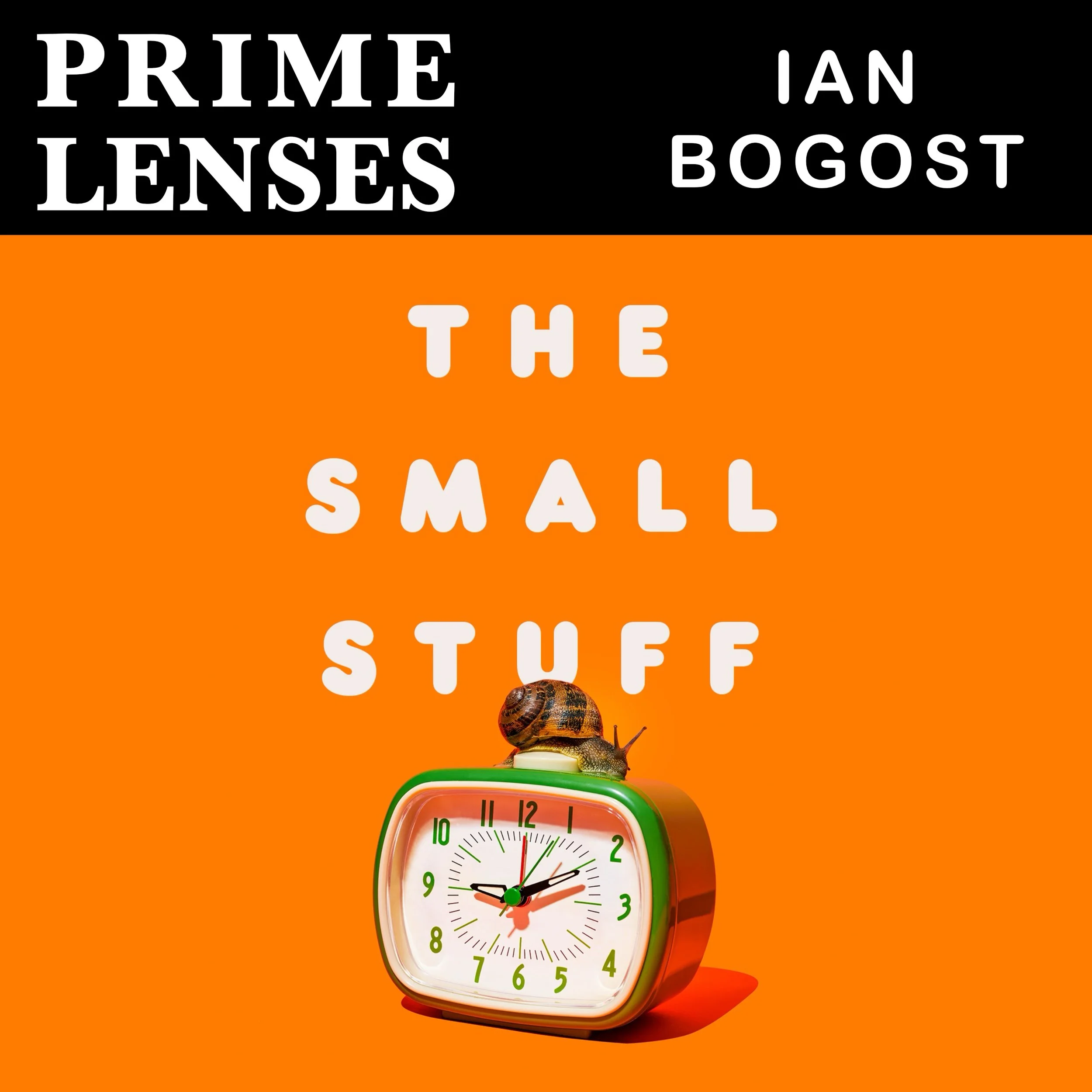


People often say “It’s the little things”, but what does that mean? Ian Bogost has written a book on this subject called The Small Stuff, and in it he describes the gratification that we can all get from paying attention to the small things that happen around us every day. The way a camera feels in the hand, the texture of our clothing, the difference in taste of a soda drunk from a can instead of a plastic bottle. All of these things can be savoured and make our lives a far richer tapestry than it might otherwise be.
I am sold and hope you will be too after you enjoy this conversation. And go pick up a copy of the book, I did and it was very much worth it.
Support the show on Patreon.
Episode Transcript
Iain
It's fantastic to sit down and talk to you. There's a lot I think I want to cover. There's also a lovely overlap because I used to work in video games. So when I got to the part in the book where you were talking about not wanting to play Minecraft, you know, you're the wild thing. Well, I do because I used to play, I remember, Pikmin 3. So my role, I would say, was kind of production adjacent. And Pikmin 3, especially with the Wii tablet and everything, super stressed me out when I realized I was playing project manager. the video game. Right. When it's like, send these people over here. Yeah. And you end up doing your job with this thing you're supposed to be enjoying. Yeah. No, I couldn't do it. I mean, I will occasionally play, but yeah. Anything that feels work-like, I don't want any part of it. Just got to do something completely different. Yeah, yeah, totally. And what was wonderful, I think, was as I was reading the book, and I read a digital copy of it, I was telling another guest about this in a previous episode, but I swapped iPads.
So we had two iPads in the house and one was the older style one with the rounded back and one was the newer style one with the slab sides which I've never really liked and so I just swapped to the old one because it was nicer to read on and it's nicer to hold. So my son has had an upgrade and I've got his old one as a result. Yeah sometimes you just have to listen to that to your body telling you what it wants. Yes and I think it's what you were saying about the relationship. I think if I can start by asking like what the what's your lift pitch for the book. Because I heard you interviewed and was like, I have to talk to Ian about this because I think it relates to creativity and making things.
Ian Bogost
I think the top line idea of the book is that there is a flavor of contentment that we've been missing and that we've underestimated its importance and have sidelined and tried to move past. And I named that kind of contentment gratification. And it's different from happiness and it's different from satisfaction. It's all about. your body's ability and delight in connecting to the physical world. And that's like not just important but like really, really deeply meaningful and has a lot to offer. Ordinary life. And it's easy. It's free. You don't have to work that hard at it. You can add it to your life without really changing your life. And it's not your fault that you feel it less, that you feel sort of less connected to the world that a lot of technological, and bureaucratic and social and economic changes kind of thrust it upon us but we can still rediscover it.
Iain
And I think the reason I jumped at trying to get you onto the show is because I think when we're photographers, we are making a choice often to use a tool which in a lot of people's view is quite an archaic thing to use now because people sort of ask me all the time, why don't you just use your phone? And I think your book and what you've noticed and other books, I love that you reference Shop Class as Soulcraft because I love that book. I think that's really great. Yeah. And, you know, the people that you talk to in the book, I think you're providing a framework to understand what we're maybe feeling but can't articulate. Yeah, that's right. I don't talk about photography in the book. I do talk about manual transmission cars. I talk about espresso machines, both things I love.
Ian Bogost
But I've been a, you know, not professional, an amateur, serious amateur photographer for many decades. And so I get it. I think I have a, I have an intuitive understanding of the experience of equipment. But in much the way that another kind of specialized piece of apparatus, like an espresso machine or an automobile works, a piece of photographic equipment is delightful because it allows you to feel connected to this thing that is like an extension of your It's got specificity. And having a shutter button and an aperture dial gives you a sense of particular control, which a smartphone screen does not. And I think the thing, you know, everyone knows like what equipment they like to use to get an outcome. But an additional, I don't know, like kind of gift I would offer your listeners is that it doesn't matter if you get the outcome. Just the feeling of a knurled knob under your fingers is glorious. and is enough. It doesn't have to do anything more than feel that way under your fingers.
Iain
The quote I sort of circled early on was that the work isn't the key, the attention is.
Ian Bogost
Yeah, and it's, I've been really struggling with kind of situating my thinking inside of other kinds of popular conceptions of what makes your life good. And you mentioned attention, you used this word attention, which is one that sometimes people do or people talk about how noticing things, Lately, people have been talking about friction and adding friction back into their lives. And photography is one example of a thing where film photography is kind of becoming popular. Maybe not popular, but people are picking it up again as a way of, quote unquote, adding friction to your creative life. And I'm not sure that any of those are exactly what I have in mind. The way I've been trying to think about it is that it's more like acceptance.
This experience of gratification is like acceptance. The world is constantly delivering these little sensory enchantments to you. And all you have to do is take them. You don't even really have to notice them because it doesn't happen in your brain. It happens in your body and with your senses. And so those are some kind of strange and subtle experiences. But I notice them a lot. I've been working on this for a while.
But just that sense of manipulating an apparatus, you're holding in your hands, you feel the heft of your equipment, or you spin a dial, or you sort of, you're not even using it. You're just kind of, it's like petting a dog, you know? And that's delightful too. And that's a way that you kind of develop kinship with things, even inanimate things.
Iain
And I really like that notion as well of thinking about developing relationships with things. Because I think, again, as people who use certain things, whether you write or whether you draw or paint or whatever, whatever you like to make in the world. Right.
That, I think, is an important part that's often, it's, well, in cameras, it's sometimes thrown to the side as well, right? Oh, gear doesn't matter. But it does.
Ian Bogost
Oh, that's right. Yeah, it does. I mean, obviously it matters because without the apparatus, you can't make the image.
But there is a sense that, I don't know, I think, you know, it's like any hobby where there's equipment. People become overly obsessed with, you know, getting the latest and greatest or having high prestige apparatuses or spending a lot of money or whatever the case might be. And, you know, it's right to kind of back off that and say, no, it's about, it's a tool that's used to produce art. And that's true. But it's also a tool that's used to interact with the tool. And, you know, acknowledging, I mean, it seems obvious, like, of course, it is.
But we forget sometimes that that's part of the reason why we engage, especially stuff that you use for work or, you know, or use for serious craft that you have to be friendly with. It has to be a friend. It has to be a companion, not just in order for you to produce results with it, but for you to kind of tolerate and deepen your day-to-day moment-to-moment relationship with it.
There's nothing wrong with that. Yeah, so I think in general with photography or with other kinds of equipment, maybe we overstepped, we moved too far into the it's just a tool kind of mentality. And it's worth acknowledging that no, like just using the tool as an object is also a part of the reason that we do it or a part of the opportunity to live a delightful life amid the tools of your craft.
Iain
I think for listeners listening to this right now who've not read the book, and I urge them to do it because I really enjoyed it. It was really good. I wonder how you encourage people when you meet someone at a party or when you you know when they've got no context and like oh what are you doing how do you onboard them to the notion of this so
Ian Bogost
There's a concept in the book that I've named dematerialization which is sort of a big name for all of the ways that we got disconnected from the physical world so sometimes I'll just say you know I'll cite one of those examples and it depends on the context and I try to tune it a little bit to who I'm speaking with and why and so you know for a photography audience, I might say, exactly what you already did, which is, well, you have this smartphone that's great for taking pictures and it's with you all the time. But, you know, it doesn't have that sense of tactility that a traditional camera with a lens and an aperture ring and a shutter button does. And so photography has been sort of dematerialized in that way. And you know intuitively, if you're a photographer, that some of the delight of operating the equipment is lost. But in other contexts, there's usually, I mean, there's always some that we encounter together just by virtue of living in the world. Sometimes it's the sensors on washroom faucets that I'll use in this example where you used to turn the knobs and maybe you didn't feel like you wanted to or needed to or maybe you were even like, I don't want to touch the germy knob in the public bathroom. But there's a loss that comes with not having the opportunity to do so. Or doors and doorknobs that move automatically or elevator or lift buttons. that you don't touch as buttons anymore because there's a touch screen that automatically routes the machinery. The manual transmission car is a favorite example of mine because that's one that's kind of on the wane. Whatever pens and writing implements, people love those. Sometimes I'll just pick a prop. There's always a prop in any context. I've got my water bottle here and it jingles with the ice that's inside it against the walls.
So I'll just look for an example of what I call gratification of this sensory enchantment that comes with contact with the world and that's the way I explain the core idea of the book that that's harder to find than it once was. It's deeply meaningful. You deserve it and you can have it every moment of every day because you live every moment of every day in your body in the world.
Iain
What I've really loved about discovering this now is that it's also in a year when, and I think a few people are doing this, you see this kind of need to pick up tactile things again. So people are trying to move away from smartphones and flip phones are a thing. Yeah, there's like a nostalgia. Yeah, yeah. I've stopped writing on an iPad and I started picking up some fountain pens and they make a nice sound and you love the tactility and the feel of it. So I think, yeah, like I said earlier, your kind of book, I think, something that a bunch of us have been feeling.
Ian Bogost
Yeah, I think that's right. It's in the air and there's a strong yearning to reclaim some of this feeling of dematerialization. I do, I'm not advocating for going back in time as if we could. I'm not, I think, nostalgia is dangerous. I think pegging this solution to the loss of gratification to kind of so-called analog culture, like, oh, I'll write longhand or, you know, I'll shoot film again or whatever the case might be. It's not that it's bad. It's rather that that's more a way of showing yourself the problem than really solving it fully. Because no matter what you do, you cannot live your sensory life in part. You can't live it in one sort of little tiny corner of your life, which might mean writing with a fountain pen occasionally when it's convenient or it might mean, It might mean picking up a new kind of device, a cassette player, a CD player, a vinyl record player, a piece of photographic equipment, any kind of manual device that you could otherwise automate, but that is something of a relic. I just worry about seeing that as the answer. It's rather a way of seeing the problem. And then the opportunity is that your senses are always something you exercise every morning. and so they're available to you all the time so that that sort of nostalgic analog culture temptation or kind of first look that's great and then from it i hope people will learn that they're they're living their sensory lives all the time and it's it's available to them much more broadly so So like I'm sitting here at my desk in my home office and I have this walnut desk that has a certain smoothness to it and density and it's smooth in front of me where the oils of my hands have sort of rubbed against it over months and years. And sometimes I just feel that and it just grounds me. I'm here and I'm here with this object and then it goes away again as I stop touching it and something else, you know, you know enters the picture it might be the can of soda that I'm drinking it might be the textured case of the back of my smartphone that I can pick up or the smooth glass of its of its surface it might be the kind of rubbery feeling of my mouse a sound I hear outside I may need to adjust my chair and I sort of feel the armrests of it click into place and that's happening to you literally all the time you know so learning to kind of plug back into that and knowing that it's like a current it's like a stream that's always running and you can always dip your toe back in and then come out again that's so freeing it's just been such an enormously freeing and liberating idea for me i think if i can chuck on the end of that
Iain
As well something i noticed when i stopped working for a company and started working with myself and doing this last year was that you you have to get out of the mindset of being on someone else's time And so every going to make a coffee, every quick something feels like you're cheating because it's your time. It's all your time, right? Exactly. When you open yourself up to experiences in the way that you're describing, the other thing that happens, like when I started writing in a notebook instead of on an iPad, what happened was sometimes the notebook's in another room. So you come through, you sit down, you're like, I need to look at that list I made earlier.
And so you get up and you walk through to the kitchen. This is exactly what I'm talking about. It's like the Kurt Vonnegut thing about going out for an envelope.
Because then you meet people or you see something. Or in my case, my wife and I work from home. I'll bump into Alice and we'll have a little chat.
And that interaction is so enriching. And you would have missed it.
Ian Bogost
You would have missed it. And the more you do it, the more it gives back in exactly that way. And, you know, it's not about recovery.
It's more about just kind of fully being in the world. And some days, you know, you're working at your desk and you're at your computer all day and then you have this sort of yearning. You feel like you need something else and it's your body telling you, just give me some different sensory experience for a moment. Maybe you go outside and you feel the sun on your face or the breeze in your hair or the dirt crunch under the particular shoes that you're wearing that day. And that is sometimes enough to quench that thirst in the moment. It's not always about, I need to change my life. I think this happens to people where they get slightly dissatisfied or they feel like something's wrong. And they immediately go to the biggest possible problem and the biggest possible solution. Maybe I'm married to the wrong person. Maybe I'm living the wrong life. I have the wrong job or the wrong career. I live in the wrong place. It's this sort of immediate extremism. when maybe you just need a marginally different sensory experience for a minute. And then that refreshes you and you sort of get back to it. And the more that you accept, again, this is why I think acceptance is the right verb for it.
The more you accept those offerings, then the easier it is to accept more of them because they can be small. They can be tiny. And they can have outsized payloads of delight that they deliver.
Iain
Yeah, and as you talk about in the book as well, the big stuff doesn't come along all the time.
Ian Bogost
It's actually quite rare. It's quite rare. The kinds of things that people think of as the most meaningful moments or aspects of their lives, which might mean a graduation or a big event, getting married, having a child, getting a promotion, going on a big vacation, they're important.
And they do define you in many ways, but they're scarce. How many jobs and career changes and spouses and so on children does one have over one's life? You can maybe count those kind of big moments on both hands. And that's great. But what about all the rest? What about every moment in between? If those moments don't bear meaning, then you're missing out. You're in some very literal way not living your life. Or if you look past them. I just need to get through this. I don't need an envelope. or a pencil to do it. I need to get on to the project that's at hand, the task at hand. You've missed the opportunity to live your life. What a shame. And it's always right there for you. All those experiences, it's the thing of just touching grass, isn't it? Like just get outside and basically... Yeah, people say that now, don't they? It's funny because it's such an internet saying. And sometimes I think that people... Like they mean to mean it, What they mean instead is like log off or something or like I am on the internet, you know? But I literally mean touch grass, you know, like just and for no end, not because it's going to like make you different or even that it's going to ground you literally probably will ground you. But just, oh, the softness or the texture of the grass and its greenness and its wetness in the morning or its dryness in the afternoon or the length of it as it tickles your palm.
That's what I mean. Not the abstract sort of notion of touch, you know, don't really touch grass, but just get off your phone. No, I mean, actually touch it, right? And that is, it's so easy to do, but it feels so hard for some reason, or it feels like it's worthless. Like, why would I bother? But no, then when he says you, you know, it's delightful because you feel delight. Certainly an underlying thing, a theme that I took from this experience was that,
Iain
This is also a little bit of the antidote to hustle culture and a little bit what we were saying before about it's your time.
Ian Bogost
It's your time. Anything that you're doing is a thing that you're doing. I mean, it's tautological. But you are present in your body every moment of every day, which means every moment has the capacity to deliver a little bit of small stuff gratification. Like right now, as I'm speaking to you, I have this sort of textured lounge wear shirt. It's like summer now. So I wear these resort wear garments. and it's got a texture to it and I didn't plan to touch it. I'm just gesturing as we're speaking and I feel it and that's delightful. And it's strange to talk about a little bit. It's strange to admit it feels like that's weird. Like what's that guy doing? He's touching his shirt or what have you. But it's not weird at all. And part of embracing gratification is recognizing that it's absolutely and totally normal. I mean if you'll indulge a kind of photography experience, example. You know when you're just holding your kit and you're sort of spinning a focus knob or an aperture ring, you're just fiddling, right? And that's not weird at all. That's just, oh, I have this apparatus that I'm not using it in any way. I'm simply engaging with it because it's delightful to do. It's that but everywhere. It's always there.
Iain
I really like that and I think my camera is brassed off and rubbed off in all the places where I hold it all the time so you can you can see it and that's kind of in some quarters that's a mark of you know there are many like this but this one's mine. Yes yeah I love that example of brassing because you know on the one hand it may show that you're you know you're serious you actually use your equipment but also just seeing the just seeing the sort of brassed edge where it was once painted black and you just looking at it even.
Ian Bogost
It's delightful. Not because it connects you to your work with the equipment, which of course it does, but just, oh, there's a little bit of color showing through. I didn't see it quite that way yesterday. It's just, it's amazing. It's like looking at a familiar face and feeling comfort and recognizing it again, but like seeing someone's eyes in a different light and their particular greenness or blueness is visible and you just accept the delight of seeing that.
Iain
And then you move on with your life. The first time I saw it, I was delighted and immediately ran over to Alice and was like, look, you can see on the edge. And it was on the ISO dial on the edge. Right, right. Really pleased because it just, I carried it everywhere. And I was sad when I upgraded from one to another that the old one rubbed off on my jacket in a different way and the new ones made it up. Right, right. That gives you a new opportunity, I suppose. And yeah, so I had to kind of start again, but I didn't know how it was going to age because it was a new material.
Ian Bogost
And it's like you know so it's funny how these things they're the same but different and they move through your life and they have different meanings to you and yeah one of the things anyone who works with any kind of equipment you know day in and day out there's a sense that you sort of meld with it that you enter a sort of flow state and you know how you're using it and i don't know that i believe that that's always fully true i mean certainly you become familiar with it but there's always this like kind of tension or friction between you and the stuff that you use. And you feel that when you put it down and pick it up again or when you get a new piece of equipment and it sort of reveals itself to you. But we got ourselves into a mindset where we started to believe that transparency and that everything should vanish into the background. And that a good piece of equipment, no matter what it's for, a blender or a camera, is good if you don't notice it. But that's like bananas, actually.
What you want is to notice it, but not to make a big deal out of the noticing. It's like there it is. There everything is. Here's my keyboard. Here's my water bottle. Here's my camera. Here's my automobile. Here's the door to my house. Here are the pants on my body. Trousers, I guess I should say. We're international. Okay, good. All of those things are, you know, they're entering and exiting our sort of apperception all all the time. And with each of them is this very small opportunity to just sense something and then to move along from it. But you don't want transparency or you don't want your world to vanish away from it. You want to be in it and engaged with it as much as possible, which doesn't require any work on your part other than the work you're already putting into doing whatever it is that you're doing.
And you can pick up this extra little thing of noticing along the way, which just gives you this extra little. It's like that's a thing that that's there too. It's so comforting. And, and, and sometimes we do seek comfort in it. Like, you know, you're, you're, you sort of withdraw from whatever, whatever your surroundings are into the pencil you're holding or, or into the piece of photographic equipment you're carrying. And then you re-engage. It's like a way of taking a breath, a little island of, of private.
And then it doesn't feel so strange. But sometimes it does feel very odd. And some of the work of reclaiming gratification is just when you feel that sense of oddity or embarrassment or weirdness or like, I hope someone doesn't see me doing this, that's a good sign that you're on the right track.
And if you lean into that, just lengthen or extend that experience, linger in it just a little longer than feels reasonable, then it sort of releases this gratifying payload. And also talking about it like we're doing now, I mean, I don't think any photographer needs someone to tell them that they like the clicky sound of the aperture ring on their lens. But yet saying so out loud allows me to say something and you to go, yes, of course.
And that acknowledgement normalizes it. It makes it normal. It makes it reasonable. And now you can say the same thing about the feeling of your refrigerator door gasket opening and closing or the particularities of a piece of cutlery or the doorknob that you use to go in and out of your office and the way that it jiggles under your hand or whatever it is that you encounter next. They all share that kind of property. It's not like reserved for, for expensive equipment or for specialized equipment or for a particular work-related task. It's everywhere.
Iain
It's funny because I've got myself into trouble with photographers in the past by saying things to them like, well, sometimes we just all like clicking the button, don't we? Yeah. It just feels nice to press the shutter button.
But it does. It does. But sometimes people look at you like you're mad.
Yeah. You're missing out.
Ian Bogost
Well, and I do think it's interesting, I mean, for amateur photographers or for ordinary folks who don't even think of themselves as photographers, It's been such a gift to have these smartphones where you have a camera with you all the time and some of what I think folks are missing isn't photography if they remember having a camera but it's just pressing a button to make an action happen in a way and I mean I've struggled with this myself as I said an on and off serious photographer is what I'm looking for to buy a new kit again because I sold mine, you know, and years ago, whatever. Or is it just the sense of tactility of that particular kind of button pressiness that a shutter button feels like? And, you know, thinking through that, it does make you sound a little crazy. But negotiating between those different, it's like having a yearning for a particular kind of food. Like, what am I in the mood for right now? Like, what do I feel like eating? It's that kind of a sense, that's that kind of an idea, but for your senses.
And I think having a varied diet, a sensory diet, is really good. And knowing that, well, sometimes on a given day I might just want to press the shutter button because it's delightful. Like that's one day. And then another day that's not as important to you even though it's an apparatus that you use all the time. It's almost like the way that your body tells your brain what it needs physically.
Iain
You know, you have a hankering for like fresh food because you haven't had any greens for a while. It's kind of like that but with your fingertips and your ears. I wonder as well as we, as the world has dematerialized, we just got a battery backup for the house. Yeah. And that is completely automated to the point where I can state a couple of loose preferences and then it just goes off and does its own thing. Right.
Ian Bogost
How do you think about a context where even software is further dematerializing? I don't even, I'm just extending your metaphor. I don't even. No, no, no, right. Yeah. I think that our lives have become easier through automation of various kinds. They've often, if not most of the time, become better on the whole by means of it. But we have started to miss out on, again, it's this idea of like a diversity. of experiences. So, you know, I have these automated light switches that turn my exterior lights on at dusk and turn them off at dawn. And thank goodness, because some of them are in the basement. And when I first got the house, I had to go all the way down to the basement and turn them on every night and turn them off every morning. And sometimes I thought about the previous owners of my house, which was built in 1909. And they owned the place for like 50 years.
And I'm like, how did they do it? How did they go downstairs every day and turn them off? And then other times I think, oh, well, what a delight to go down the stairs and into the coolness of the basement and to press the switches. So it's a give and take. It's like some days you want a certain kind of automation and other times you don't. And I think being open, not so much to changing your mind, but just sort of to understanding that we're not trying to remove as much of that experience.
We're not trying to make as much of that experience inaccessible as possible. What we're doing is sort of negotiating between different sensory preferences all the time. One of my neighbors down the block has one of those robot lawnmowers. And, you know, I see it sometimes when I'm out for a walk and I think, well, I mean, it's cute and delightful to watch, but I really love mowing the lawn. I would miss it if it were gone.
And then sometimes he's out there with his mower mowing the lawn. And maybe it's because the robot has to be recharged. But maybe it's just because, oh, today's a day when I want to mow the lawn. So we don't have to make these all or nothing decisions all the time, right? There's usually ways that we can engage with the world without giving everything up. And just giving something up for a moment doesn't mean giving it up forever. We have become extremists about everything these days. and it's all or nothing. But it doesn't need to be. And so, you know, some days you pick up a smartphone to get a task done and other times you do it longhand with your pen and paper or your fountain pen. And it's not about how righteous you are or are not in so doing, right? It's, well, today you're living a slightly different sensory life. And you're still touching the screen. It's still delightful. Yeah. I have had that conversation with parents. I've got two kids.
Iain
Sure. One's 12 and One's 8. And you hear sometimes parents sort of bemoaning and yearning a little bit for the pastor and talking about like kids spending time with computers. But the thing is, to some extent, that's the medium. You know, like even if I.
Ian Bogost
Yeah, that's how we live in the present, right?
Iain
Right. Yeah. Yeah. And there's joy to be found there in, you know, buttons and hinges.
Ian Bogost
There's joy to be found there. And remember that we've been through this with with every major medium. I mean, when I grew up, it was television.
You know, we weren't supposed to be watching television all the time. If you go all the way back to when the novel was new, there was a moral panic in the Victorian era about reading novels, you know, because it was a waste of time and you were, you know, fantasizing about a different life and it was impious and it was tempting. You know, and now, of course, all the parents want is I'll put down the phone and, you know, put it on the iPad and read a book instead, you know. So we are always anxious about novelty.
But we also always must live in the present and into the future. We must socialize into the moment in which we were born and persist. So there's a bit of a folly to thinking, well, I'll give this up or I'll sort of, you know, even resist it. Which also doesn't mean that you should spend every minute of your day on your iPad, right? Of course not.
So it's funny to me that we think it's so hard to manage that process. Like, oh, I just am so, I'm on my phone all the time. I wish I weren't. Are you really like, you know, when you're in the loo or when you're cooking dinner or when you're driving your car or when you're on the train and holding the handrail or when you're walking up the steps or when you're doing all of these other things, you're not on your phone. What about all that? Does that not matter? And it does. It's just that that stuff doesn't feel real anymore. for some reason. It doesn't feel like it can bear meaning.
Iain
And I think it comes back to that thing I liked at the beginning about attention. The activity you're engaged in determines.
Ian Bogost
Yes.
Iain
It matters.
Ian Bogost
And some of this is about, some of the feeling of reclaiming gratification is about having enough openness and curiosity that anything whatsoever might deliver the goods. and that you are not closing down your sensory life in advance. And that sometimes just means picking something up and holding it and turning it over in your hand and putting it back down again. That is sometimes enough. Or smelling a scent when it arrives because you can't help yourself but do so because you're smelling it. It doesn't even have to be pleasant. The idea of pleasure is often at the heart of gratification but not always.
Sometimes just, you know, if you kind of feel an odd sensation or it's particularly cold and that's uncomfortable or you taste or smell something that you marginally dislike, but you're still engaging the world through your senses. And then soon enough that ends and a new opportunity arrives. So it's just like fully living, but not worrying about missing out either because there's such an enormous surplus of gratifying experience.
Iain
That you can never really miss out. Did you see the YouTube ASMR massive takedown thing that has happened? I did. I did see it. Yeah, I did. It's a real shame because these are people who have, I think, understood some of what you're talking about. They have. Yeah. Yeah. I mean, I have a whole chapter about ASMR in the book, but partly because I think that these creators and the people who watch these videos of like folks like, you know, folding towels and tapping bottles and whatever. Yeah.
Ian Bogost
They have discovered something true about the sensory world at a level that others have not. And this takedown you're referring to, which is that YouTube is always very concerned about anything that seems like even marginally sexual. And there's something sensual about ASMR, but also some of these creators are actually providing sensual services on other platforms too.
We're very confused about our, and very guilty about our senses. You know, anything that involves the body, there's a lot of shame around, and there's a lot of confusion about. And it can be easy to think, it's that extremism business again. It's like, if I'm feeling something, and it feels good that it must be sexual, right? Or indulgent in some other way. Like, it's sinful, right? Instead of it just being, oh, like, this is my body, to the world.
So it's a very complicated matter, this recent event. And I have been following it closely for that reason. But living in our bodies isn't something, especially in the West, we just have a lot of shame about it.
And I think one solution to that shame is not, it's not in just normalizing the way that we relate to one another as it relates to sin. It's more just also about just feeling more confident in every sensory experience. In the small things of just tapping the shampoo bottle you're holding or feeling your fingernails itch against the metal of a coated surface or whatever the case might be.
Folding the towels and feeling their softness. Those kinds of things that ASMR creators have highlighted. Doing more of that will make us less weird and less shameful in our bodily life more broadly.
Iain
Yeah, I think if we could just allow people to make it okay to sit and go, I really love this thing because I love holding it.
Ian Bogost
Yeah, that's it. Like that's delightful. And then that's it.
That's sort of full stop the end. And there's nothing more to say about it. It's not that, oh, and it justifies the hobby that I have or the job that I've undertaken or it gets me further down the road of this big goal or this accomplishment.
Iain
No, it's just lovely. That's a nice way to just reference one of you. You did very kindly give me a list of lenses that you liked. I did. And although this is not one of those episodes, but I love that you have that Nokton 35. I have that lens too, the Voigtländer. Yeah, I love that. I love that lens. It's so small. There's a lot of reasons I put that on my list. One is that I think it was the optic that taught me that you didn't have to spend a lot of money
Ian Bogost
To get interesting, high quality lenses. And it's so small, but it felt so good to use. It has that sort of tapered look. I don't have it anymore. I miss it. You know how when you miss a piece of equipment? That's such an interesting experience. And you have that sort of hole. And it's a tactile, like a sensory hole. Oh, just when that was in my life and I could hold it and it had the right heft, but it wasn't too heavy.
Iain
But I could still feel it. Yeah, really delightful little piece. I was using it yesterday. And it's my my copy belonged to a friend before it belonged to me. Oh, even better. She was selling it. And I sort of just went, well, I think, you know, because I didn't have any lenses that fast. So it goes down to 1.4 and 1.4, right? Didn't have anything as quick as that. And so the combination of it having previously belonged to Tiffany and me wanting to try. Oh, that's lovely. My focal lens. So I went, yeah, OK, well, we'll do.
Ian Bogost
That. I agree with you completely. The aperture ring on it with two blades, it doesn't just have a little nub, it's got something on either side. Right, you sort of hold it with two fingers almost and there's a sense of control but also a sense that that's the way it should be held. It's almost, I mean it is intimate like we were just talking about. It's almost like with your spouse or your partner you would touch their face in a way that wouldn't be appropriate to touch someone else's. And that feeling of contact with that aperture control on the Nokton was very much something. I mean, I still have a muscle memory of it. And those are the things that you, those kinds of contacts, they linger so long, long past the time that you're using the apparatus or even in my case that I've owned it. It didn't hurt that it produced delightful images, but that wasn't really why I loved it.
Iain
And I suspect it's not why you miss it.
Ian Bogost
No, no, very much not. Yeah.
Iain
The thing I'm realizing as we're speaking is that the things when I do feel that I miss something like I've sold a lens or whatever, it's the quality of holding it. It's the quality of holding it. Yeah.
It's not even necessarily using it because I talk every week on the show almost about, you know, I shoot with this M. It's a lot of people's dream camera. I would be a dick if I turned up every week and went, well, of course I have several. I could use it. Like, no, that's my camera, right? That's the one I have. And I keep myself honest by only having the one because I don't think it's reasonable to have such an amazing camera and then go, oh, but I want to use this one when I'm on a walk. So I keep that. But I do miss, like, my Ricoh GR, for example, because it was so tiny and it was amazing to hold and it just, again, made incredible things. But it's the thing. Yeah, you know, it's funny. I tried one again. I picked up the new GR IV, and I thought, oh, this is a
Ian Bogost
This is what I'm missing. Because I sold all my Leica equipment a bunch of years ago. But there were aspects of it that were tactically delightful. The heft of it, the make of it, it feels solid in the hand. But then the act of digitally programming everything again and sort of moving through the menus, which you have to do on that app. It wasn't so much that I wasn't willing or that I couldn't get good images out of it. It was that, oh, this kind of scrolly feeling, this kind of software scrolly, That's actually not what I wanted more of in my life. So I ended up sending it back. I remain on this kind of quest to find the right match between equipment and output or outcomes. And it's harder when you're not using it professionally, when it's just a thing in your life that you could take or leave. And there are fewer options now, partly because of smartphones.
It's harder to get equipment. It's more expensive. And that's a shame. It's a shame that there's not more variety, more tactile or physical variety in the equipment that's out there. Because the GR is kind of all alone in that space, which is too bad. I wish there were 10 different options. But I really don't miss the heft of my M day to day either. And so that knockdown made it to this clunky, expensive body that I didn't really want to have on me.
That's not something I miss exactly. And I think that negotiation, that sort of, well, it's not just what am I after in terms of producing a result. What am I after moment to moment with a piece of apparatus in my life? That's so central to, I mean, it's not just central to purchasing decisions, central to identity, to your experience of, you know, whether it's your hobby or your profession of what you're, of what you're doing. So the examples like the Nokton that stand out where they just felt really resilient in the face of that kind of usage, that kind of sensory usage. I just really appreciate the opportunity to reflect on that in my life through your invitation because it's not a subject I normally get to think through.
Iain
Oh, there you go. Brilliant. Well, I'm glad that as part of all of this talking about your work, there's a little uniqueness, something new.
Ian Bogost
Yeah, yeah. And I'll have to think about what I, you know, now I'm like, maybe I need to get that knocked on back. Of course, then I'd need a body to put it on again. Yeah, well, and then before you know it, you're down the rabbit hole of people on Reddit arguing over whether the base plate going from the M11 is the right thing to do. There is a lot of discourse out there. And it's easy to get lost in the discourse rather than just enjoying the experience. Yeah, pick up a thing and use it. A funny thing, actually, Leica sent out, a questionnaire to people last year, no, earlier this year, about whether or not you would want a base plate again on a camera, and then furthermore, whether or not you would pay extra for one. So if they were to produce two bodies, one with a base plate, and I think it's interesting because it's sort of, to go full circle, it's kind of, it's all that you're talking about. A base plate on a digital camera where you've already removed it. Yeah, it never made sense. No, I mean, it's fine for removing the battery. It's digital. Yeah, you sort of feel, it's like the M10D had a film advance lever on it that did nothing it was i remember my um my son uh recently got i mean he got he got the equipment bug and he got an m6 he hasn't he has an m11 too i don't know he's really he's really kind of gotten m-pilled since i've uh stopped and i had forgotten how good the m6 feels compared to the digital ms i mean it is it is a it is a just a It feels like it should be identical in their feeling. We know that the digital ends are thicker a bit, but that slight thickness, that slightly increased thickness makes an outsized difference. This is a company that makes very high precision equipment, and I don't know how they're communicating with themselves or with their customers anymore, but some of the issues are like, they're weirder. They're weirder than just German engineering would allow allow solutions for because it's about a vibe and about a sort of sensation and those extra two millimeters or the superfluousness of having the base plate is like oh no that's that was what connected me to this ritual experience like the like the film advance like the fake film advance lever so yeah all that stuff's in all that stuff's in play it's real it's real it's like I have a as a guy I talked to a food scientist in the book and uh He has this amazing thing he said. I'm not going to remember it precisely, but it's like, you know, when you taste something and you wonder, well, did it really taste that way? It's like, well, all taste happens in your head in the end. So if you sense that it did, then it did. It mattered. It matters. And it's like that with the stupid base plate too. It matters because you feel that it matters. Yeah. Yeah. Until it doesn't. Until it doesn't. And then other things can matter too, you know. Oh, amazing.
Iain
I think I could probably go down rabbit holes with you all day long. I'd love it, but I suspect the Diet Coke on your desk will be warming and we can't have that. That's right. I'll dig into that. All right. Well, it was great to talk.
Ian Bogost
Thanks so much for the invitation. I really enjoyed it.