Episode 129 - Natasa Leoni
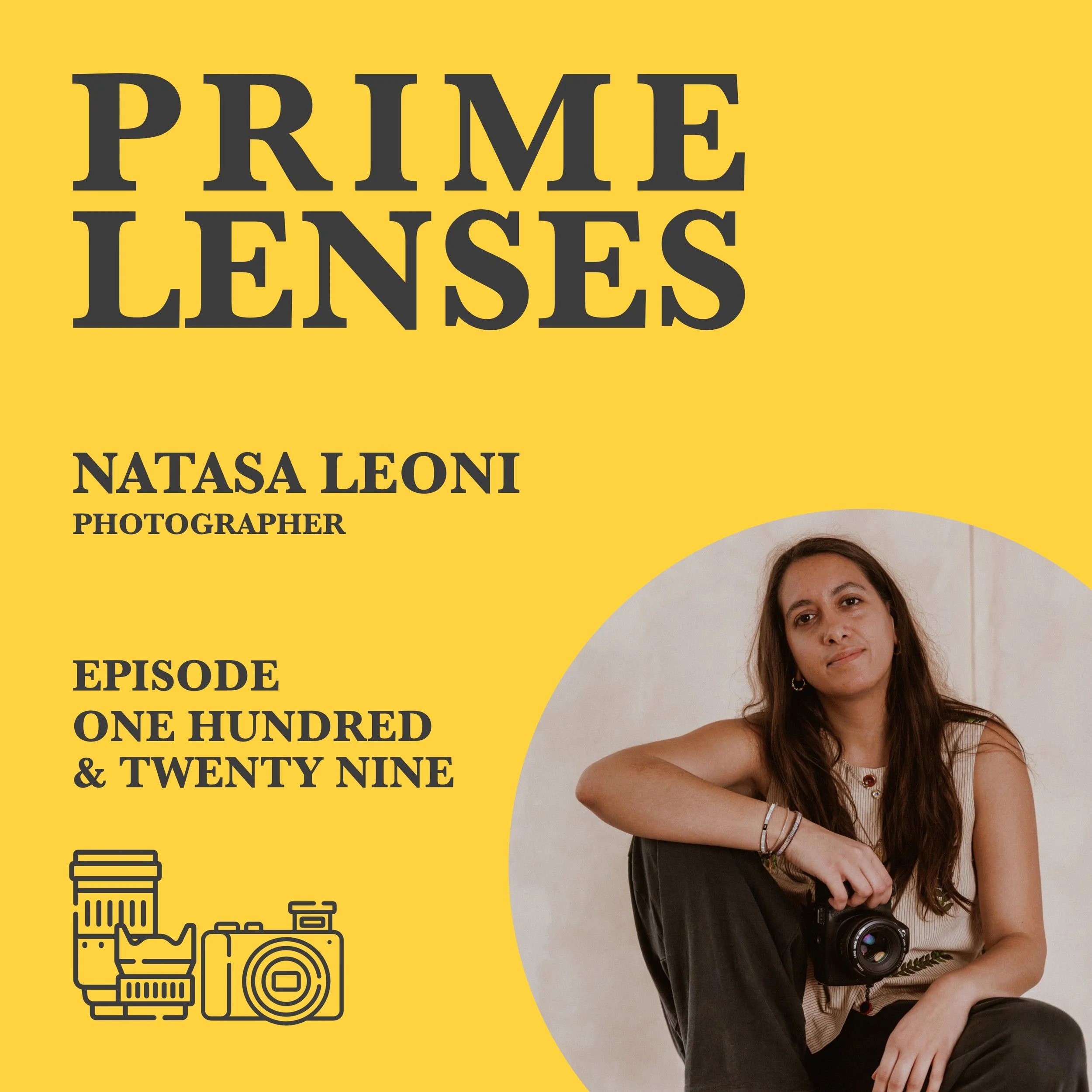


Natasa Leoni is a photographer based in the UK who in addition to commercial work photographs causes she cares about in relation to climate and social change.
Support the show on Patreon.
Episode Transcript:
Iain:
I'm using a mic so I'm hoping the sound will be better just because my I tested my headphones earlier and this sounded clearer so it does sounds really nice yeah you sound good yeah yeah you're you're a proper creator in the 21st century when you're holding a road mic in front of your face I hate it I just have nowhere to really clip it to
Natasa:
So it's like
Iain:
No, that's right. Look, we can do it like subway tapes. I'll get in really close to my mic and you can get it. It'll be really good. It'll be great.
Cool. Well, as you know, because I just get going, but it's wonderful to see you. It's taken us a little while to kind of finally get together and talk.
Your photography kind of seems to span a bunch of genres. And there is kind of like a more commercial side and then a sort of more, I would say it seems personal to me it seems that the work is meaningful to you and matters and it's images that you think I think you need to make so I'm curious for kind of if you can tell us a bit about where we find Natasa the photographer now and kind of maybe where you came from and that's kind of a nice way in
Natasa:
Yeah, it's been a journey. I'm sure many artists and photographers kind of evolve many times throughout their career and their life. For me, it started at a super young age. My dad is and was back then a huge, and working photographer at some stages in his life too. So we actually had a dark room in our house. So from kids, we, our dad taught us how to develop everything. So the love of photography started pretty early on, I would say. And then a huge gap, but, you know, kind of just taking photos of friends like you do when you're a teenager, nothing super serious. And then eventually after university, I didn't study photography but after university I realized that is 100% where I want to take my life and my career so I became a working photographer actually probably when I was backpacking and I ended up landing in Australia for two years so I worked with the tourism board there and then I realized that oh actually this this can be a career that I pursue I think you kind of have this well I definitely did had an idea that I'm artists and photographers can't do it full time there always has to be something supplementing um your income and all of that kind of stuff but yeah I quickly realized that that's not true and that's a myth and I've been a working photographer for 10 years so earning a living from photography but a photographer as a passion or at heart for my whole life probably.
Iain:
When I was preparing for this and looking at some of your work, you've got photos from New Zealand around 2010 and van life and stuff like that. Was that on the cusp of kind of that transition?
Natasa:
Yeah, it was. I think when you're younger and you're backpacking, you've finished university, everything kind of serious has been left behind and you've got this space to explore and play. And I think also back then my where I was in terms of I guess my political education wasn't where it's at now so it felt more I just felt a bit free I I guess in a way was a bit more selfish so I was just exploring everything and anything so van life as everyone does in Australia it kind of started there and then I got a that was one of the first jobs I did out there so I got a a brand deal with a camper van company this is also kind of when instagram was only just starting for a lot of people so we were creating content for their their social media which was all really new so it it felt really playful and yeah and then when we came back to the uk we tried to convert our own van during lockdown because we'd actually we went to new zealand when as we landed the What was it called? Lockdown, that's the word. The lockdown actually got announced. So we were in a van with no signal. And then we went into a town and the radio was playing and we heard that everyone was being repatriated on this final flight. So we were like, oh no, we've got to make it to the airport. So it cut our van time in New Zealand short. But when we got back, we got a van and started to convert it. But life got in the way and it's still,
Iain:
Sitting Park Converted Outside. Yeah, it felt very playful in terms of life and my photography. The reason I ask about that, because I think when I look at the stuff that looks newer and then look back at some of those things, you can see a through line. I really love that about photography is when you can see someone's style like starting to emerge. And there's just certain there's compositional, I guess, and tonal in terms of colour use and things like that, tonal things that feel familiar.
And I just wondered, I guess, if that was you start to see something in your images and start to like them, which I think for a lot of artists and creative people feels like a guilty thing. You feel, I don't know whether it's a British stroke, you know, countries of the empire like Australia and so on. But there's a very kind of, oh, no, I can't possibly, you know, and that feeling you have to. And even when you're young and confident and have all that like unearned confidence that we did in our 20s, like that moment of still can feel like that.
A little bit awkward and I like to talk to people about like recognising that I guess in what you made and what was it that kind of stood out to you
Natasa:
No I think I can do this in terms of photography or my style specifically well a bit of both maybe I do think it was just my age I think I was a bit naive in a good way to the world and so I was like oh I can do anything you know I've like I said earlier like I've finished uni I've gone to the other side of the world. Why not follow a passion as well and make it a career? And then I will admit back then when I had a lot more time, I spent a lot of time on my editing style. So I think I spent two days during a rainy season literally glued to Lightroom trying to figure out how I see the world and how I can then show everybody else through editing because I'd never, really nailed it before or felt like I nailed it. So yeah, I think that's where you're seeing like a development of style, but it took me really long to think that I was actually proud of what I was putting out there. And even I think because my style is quite strong in a way, or I think it's quite recognisable. Yeah, it's got a bit of a vibe to it, but it means that I I also have gone through love-hate relationships with it too. So sometimes I think, oh, I wish I had those two days again where I could sit on Lightroom and just play and find a new style. But then I always go back to that and I think, okay, I actually do like it.
Iain:
I think it is a tricky thing. I think, you know, even, you know, Bryan Adams gets tired of doing Summer of '69. Like, you know, whatever you, however you've made yourself successful, I think sooner or later. I have it a little bit with the show actually, because I started with that notion of, of three lenses and then sometimes we cover it and sometimes we don't and it's all meanders around and I do occasionally get messages from listeners if we go through a long spell where we don't talk about any lenses they're like could we just you know can you just play the hits and then and then we go back around and I think that earns you the right you know to like to play a little bit yeah do you you don't so you don't have two days to sit down with Lightroom but when you're working do you still build in a little bit of room for playfulness into the work that you're making as well maybe not so much with the activism
Natasa:
Yeah. You know, I try to do a bit of a personal project once a year so that that is my time to play. So it's nothing to do with anything. That's kind of the point. Well, sometimes it is, but a lot of the time it will be, I did a few years of a project called Women Unite. So I just invited women and non-binary folk to meet.
At a spot that I would put out there in Brighton or in Sussex and whoever wanted to show up can show up and then we would just kind of have this play on the beach and photograph and that was that was definitely a really playful project and there was no end goal which is quite nice because that allows lots of space to do whatever you want because no one you're not there's no pressure to show anybody the work and I did get
Iain:
A little bit of time to play with the editing style with those so a few of them I edited in more of like a filmy look which is really not where I tend to go like really up to the grain and took the blacks up and all of that kind of thing so yeah I do I try to do a personal project once a year for that reason. You mentioned film there it's something I'm I'm touching on with photographers more and more as I think film enjoys this resurgence I don't know that I really have an for film in that I didn't really discover photography through film photography I'm kind of enjoying it and discovering it later and I don't think Polaroids count I think they're something different but for you was it you mentioned your dad was a photographer and there was always photographic stuff around the house so presumably you just came up very close to film and that dark room and enlargement print process so you do have that kind of thing in you I guess yeah I love film I do I use film now as again it's more for me so I don't ever
Natasa:
I think there's something important to keep one thing sacred and that for me is my film camera and I used to do something where I'd put a film in and leave it in for a year so I would be really mindful of what I was taking pictures of and then when I got it developed it would be a surprise because obviously you forget what one photo you took in January when you're getting it developed in December. But I have stopped doing that because I'm finding myself picking up the film camera a lot more than just, you know, 26 times a year or however big the film is. So I take it with me on some assignments and I'll just photograph things that are just for me. And again, like the client will probably never see that, but it's moments that are those in-betweens that I really want for me. So that's where I'm starting. To pick it up a lot more and the i've tried to develop my own that it's quite hard to find studios here in brighton where you can but um the smell of the dark room is something that it kind of flashes past me sometimes and i'm like oh my gosh it smells like home yes you just find yourself walking into a Snappy Snaps going i'm just gonna stand here for a minute yeah just gonna get my fix if that's all right there's a dark room i'm a member of up here up in inverness
Iain:
And I'm going on Thursday because I've got three roles that I need to develop. I've been shooting a lot. So I need to, but I'm only doing black and white at the moment.
I'm not developing my own colour yet. Shout out to my friend Jess, who's been on the show. She develops her own colour and she seems to have an amazing process and just has it down.
And like, that's her happy place. The notion of like the temperature control and everything across different chemical baths. I'm just not ready for that.
Natasa:
Yeah. Yeah. Colour is a whole other thing.
I mainly do black and white when it comes to film as well. I have dabbled in colour, but yeah, it's so hard. So shout out to Jess as well. Yeah, yeah, yeah. What's your little film shooter you're using? It's an AE-1, a Canon AE-1. I was going to guess it was an AE-1. I'm dedicated to Canon with everything. So even that, but that was one of my first cameras. So yeah, I still have her tucked away, which is great. But that's the wonderful thing because they still work. You know, there's no reason.
Iain:
And not to if they still work like I've got an old a film camera an R8 a Leica and then I've just I'll show you this because it's fun I've been like 72 hours into having this thing but this is an R9 right Leica but that's the digital back oh right so so basically where the film door was the film door comes off and it's replaced by a 10 megapixel digital module and a massive battery that goes in the bottom oh my goodness that's 21 years old yeah really cool Really weird kind of tangent that they went off where they developed this digital back for a camera. So it's a lot like shooting a film camera. In fact, you should hear this because it's great. The shutter sound is amazing because it's a film camera. So the mechanics of everything has to wind the thing on. Otherwise, it can't make another picture. Right. Oh, wow. Oh, my gosh. Right. Ready? Oh, that's it.
That is amazing. Isn't it good? That is so cool. I sent a video of it to a friend of mine the other day and they replied going, not to be inappropriate, Ian, that is the hottest shutter sound I've ever heard. Agree. No, it's really good. And it's one of those situations where I thought I would buy it and I want to make a video about it, about the history of it and how it happened. So I thought I'll buy one and then I'll sell it. And it was 35 miles away from me and it was a good price.
And everything. I was like, yeah, and I can justify it because I'm going to sell it. And the first time I pressed the shutter, I was like, I'm going to have to have a conversation with Alice at some point. I can see where this is going. This is going to be here forever. It might be. They only made 2000 of them. Like there's not that many in the world. Yeah, it's a nuts thing to exist. And they took them years. They announced it in like 2003 and it didn't come out until 2005. Like it was a difficult project. Oh my gosh. Well, you have to keep it then. Do you know what? That's what Misan Harriman said. I messaged Misan Harriman when I got it because I was like, you're a fellow nerd, you'll appreciate this. And he replied immediately saying, never sell it. So I might have to say what Misan Harriman said. And then I might have to message him and go, have you got a couch I can sleep on? Bad influences. Indeed. Indeed. Well, as we mentioned Misan Harriman, that's probably an excuse to talk about the activism photography you've done. So there's a lot of wedding and commercial and kind of like you mentioned, you've come up a little bit through brand work. So there's that kind of like, you've got that dialed in.
What then attracts you to photographing things like XR and the Black Lives Matter movement and things? I mean, there was a definite moment. I think we were fortunate, especially if you live like down the southeast and around London, that moment five, six years ago when just a lot of things seemed to happen and people needed to make their voices heard. And I think we all felt we wanted to be involved in some way. But talk to me about why you went, yes, and I'm going to take my
Natasa:
So it probably starts pre my existence, to be honest. So my dad is a refugee from Cyprus. So he fled in 1974 when he was 14 to the UK. And we grew up not only developing film photography, but we grew up with stories of his experience and his life as our bedtime stories. So we always We're hearing about how he fled when the soldiers knocked on the door, all of that kind of stuff. So it's always been deeply embedded in me about where I'm from, my heritage, I'm very rooted in that. So I think it's always been there and my journey into activism is a bit more straightforward, I think, in that it's part of my history and my blood and sort of my, yeah, my dad's, through my dad's stories.
But I think I can't actually remember which year it was. There was some riots happening in Brixton and I grew up near there. So I think I just must have heard about it. And I grabbed my little brother and my camera. I don't know what compelled me to take the camera, but I just did. And I said, we've got to go. It's down the road. We need to support people and see what's going on. And I started photographing that. And I did get, I guess shouted at oh I don't really know people just were not really super keen on me being there and it kind of made me realize that when you're an outsider popping in that is not good journalism and that's not how I ever wanted to work again so I kind of recognize that you need if you're truly passionate about something you also need to prove it to others, especially when it comes to this kind of work and not just you. So I tried to look for groups and I found Extinction Rebellion. I actually literally stumbled across them. I had just been photographing something in central London and I was walking to the station because the buses had been cancelled and there was this tiny group, I think of about probably no more than 24 people with the logo, just walking down the street.
And I just said, oh, what are you guys protesting? They're like, we're on our way to parliament to protest for, well, against climate change and pro-climate justice. We're called Extinction Rebellion. And that was my first realisation that there's other people out there that form these groups that fight for things that I also care about. So I joined my local Extinction Rebellion group.
In Brighton. And it wasn't until a bit later down the line that I started taking my camera. So it was all, it was again, that kind of thing of like earning the trust of people and also proving that I'd be there with or without camera. I think that's a really important thing. I'm definitely an activist first and then the photography is something that I can just kind of donate to the movement or be there to archive for future generations. So yeah, it was,
Iain:
I think that was kind of a couple of moments that were little light bulbs for me to yeah to follow what I actually care about and that photography could be a tool to to boost the movement. I really like what you were saying as well about being there with or without the camera I think that's that's crucial because then you start to earn the right I used to make pictures when I worked in video games and I'd be around the studio running around And I didn't have a camera with me right from the start. But gradually people are like, oh, it's just Ian just always has a camera and they trust you. And I think that's it's it's about kind of being allowed to be there. But also in your images, I think there's also a real deep interest in people. And they're not everybody sees people walking down the streets with placards and is immediately interested in them. And do you think that that's a is that sounds like that's always been there with wanting to go to the riot?
And what you know like you're just interested in people and how they're getting along
Natasa:
Yeah i'm i'm super fascinated by human stories and I just love that anybody you speak to has something to say and if you give them space to say it the passion really comes out and I love discovering that about people I recently did an assignment in kenya this is a bit of a But anyway, we'll get to the point. I did an assignment in Kenya and when I got back, everyone was asking what animals I saw and all of this stuff. And as amazing as all of that was, of course, I was, you know, I love animals. I love landscape. But I was like, but the people that I spoke to, there was this person who does this. And it was just those connections. I was, that's what I always come back with is the human stories. I, yeah, I think it's really, really nice to give people space and a platform and everything to really share how they got to where they're at. I mean, you know, that's what you do.
Iain:
Well, yes. And I think that's the thing. Alice always makes fun of me a little bit because she's like, won't you one day just run out of people to talk to?
I'm like, I don't. That's like saying, won't they run out of stories to write? Like, well, we haven't yet, you know, and I think I think there's there's power in one of the most powerful things about these conversations, I think, because a lot of the people listening like me, I put myself in this bracket as well, we photograph for fun. It's something we're passionate about and we love and we see the power of it, but it's not our jobs necessarily. So if we can bridge the gap or a perceived gap where you're like, well, you know, but I couldn't possibly talk to them and actually realize that they're going through a lot of the same thought processes and their motivations are a lot of the time the same as yours, that there's the reason they started. I think that there's real power in that and sharing those stories.
So that's why it's lovely to kind of sit down and why I don't think I'll ever run out of people. I hope not. I love listening to the podcast. So there we go. That's that's clip. That's all we need. Thanks. I just need someone to validate me. It seems like you're very established in knowing kind of who you are creatively as well. Like sometimes I talk to people and it feels like well, no. Okay. So you make a face. Maybe not. But you feel very and together about your practice, even if you're giving yourself flexibility and know that you'll grow and develop.
You seem very comfortable as an artist. Has that always been the case?
Natasa:
That is such a big compliment because I do not feel that. Well, sometimes I do. And then most of the time I have imposter syndrome.
And I think that's just when you're a creative, you and your that's your job as well. What you love is you're also your income, you put your whole self into the work. And then when it's quite vulnerable, then you send the work off. And then you if you hear nothing, you're like, Oh, my goodness, I'm never going to work again. I'm the worst photographer. But I think, yeah, it's quite nice to hear that, to be honest.
I think it's important sometimes to step back and think about what I've actually done and accomplished but I don't do that nearly enough or at all so it's nice to hear it from someone else
Iain:
Well to me as a as a person who doesn't know you well and coming into it fresh you do seem to have a style and it's nicely established and there's a kind of a sort of consistency of perspective I guess that that comes across which means that the work feels cohesive and then it's not an accident that like other people notice that and recognize it and share your work and you know that's how I came across you was you know Misan Harriman but it's he won't be alone in being the kind of person who just spots that that's someone with something to say and they're saying it and they're doing it in a in a consistent way as you kind of progress through this career and kind of move through through various stages of life what is it that keeps you I really fancy a stint in investment banking. What is it that keeps you when there are the times when you're not feeling as confident?
Natasa:
That's a good question. I think as much as I have the moments where I'm so unsure of myself, I also have moments where I'll be walking to a photo shoot and I think My bag's heavy, you know, my back's a bit aching and I'm like, but I'm carrying my passion on my back and I'm going to a job where I'm being paid and this is my life. And in the grand scheme of what I could be doing, this is pretty cool and amazing. And yeah, I get moments even, you know, on kind of smaller local photo shoots where I might be photographing a brand at sunset.
On Brighton Beach and it's the most stunning pink sky and I just think this is my job I'm out here in the fresh air with interacting with people who are super interesting you know meeting people all the time which really gives me life is just constantly being around new people learning about them and I just think oh my goodness I can't I can't ever see me doing anything else so I have to make this work and I think that's what kind of keeps me going. Even just talking of Misan Harriman and the photo that he shared and that's how you discovered my work but even that at that protest it was a good example I suppose of this but I was so not picking up my camera as much as I normally would I was on the front lines we were being pepper sprayed by police I was helping people pouring milk in people's eyes I really really thought I I hadn't picked up my camera that much and there was a lot of kind of personal stake in the game with that particular demo as well so I was really not constant you know the camera was sort of just hanging off my shoulder and afterwards I do get this a lot but people will text me or message me and say oh I can't wait to see your pictures or did you get any good shots and I said oh you know I really don't think I did and a friend of mine Megan, she said, look, I think you should just post something because for Brighton, it was such a pivotal moment. It was an anti-fascist march. And it was, it was incredible that out the turnout. So it was amazing. There were 4000 of us. So, you know, pretty, that is huge for Brighton. And she said, just post something. It's a moment in history. So I just kind of flippantly posted that post. And it just, and I am proud of that photo, don't get me wrong. But at the time, I was like oh I didn't get any good photos you know I'm I didn't take as many as normal I was really in my own head about it and it wasn't until she said that and I just put it out and then it kind of got so much attention and kind of was it's a it's a photo that does sum up that whole march and I just couldn't believe that I'd gone home and said oh I didn't get any good shots or you know I wasn't I was just so with my city that I thought I hadn't really picked up the camera.
Iain:
Well, it's interesting you say about the not feeling you got something. So as this, when this episode airs, a couple of weeks previous will be Rachael Talabat's episode. And in the conversation she and I had, she talked about the other side where I was joking about sometimes you pick up the camera and you, you, you know, you get the photo and you feel, in the moment when you capture something you're like I'm an edgy motherfucker I definitely got this I'm the greatest photographer and then you get home and you feel like your pictures suck and we were talking about getting distance from the work and she said something really interesting which I thought was I'd never thought of this before and she went well the problem is if you've had a great time doing something then when you come home and look at the pictures nothing that you're about to look at can compete with how you felt feeling really good in the moment and I wonder whether your experience in the midst of the something that's very heightened. You're trying to keep everyone safe. You're focused on what a big moment this is for the town. On all the things that you do, it's a culmination of a bunch of things. You maybe came out of that feeling emotionally drained and you're slightly lower and therefore you feel like, well, there's no way that anything came out of an experience that's left me feeling like this that was good. And yet your instincts kicked in. You knew something in you knew to make those images and capture those scenes. And actually, it turns out you are really good at this.
Natasa:
Because you've done your 10,000 hours. And then, you know, something great is there. It's just really interesting how in the space of a couple of conversations, we're talking about the same, I think we're talking about the same thing, but just from completely different ends of the spectrum. Yeah, that's so true. Yeah. Cause we all felt totally knackered after. So yeah, you're right. I probably just came home with that energy and just carried it through and thought, yeah, there's nothing there. And also that's not really, in my head, I was like, oh, that's not really what I was there for. And then, yeah.
Iain:
You're right. And then you look at it and you're like, oh, okay, actually. Yeah. There's the shot. We need that distance. I think one of the reasons that why shooting film is good or turning the screen off on the back of your camera sometimes can keep you from overthinking it in the moment. Because otherwise you get on the train on the way home or something and you start self-editing. And then before you know it, get rid of the blurry ones, by all means. But if you get into that mode a bit too much, you're constantly looking and you're not enjoying any of it then.
Natasa:
Yeah, I did a workshop actually last year with a photographer called Pietz. He's from Amsterdam. And he asked us all to, he set us an assignment that would eventually be, well, I guess you could choose, but ideally in colour. But he asked us all to turn our screens to black and white. So we were totally shooting just by looking at shadow and light. And for me, it was so alien. Like you say, like turning the back of the screen off and all of that kind of stuff.
It's not how I'm used to doing it. And suddenly, I just felt like my camera was not a part of me anymore. And I didn't know what I was doing. And it really worked. It made me see things totally differently. And then when we went back to edit with him, you could easily see what was going to work, what wasn't going to work. And it was really a good experiment just to work in a different way than you usually would.
Iain:
I do really love workshop experiences when you're with a group you get a little cohort together and a little band and then you've got the whatsapp group afterwards you know kind of like trade stuff we did for the podcast did a photo walk week a couple of weeks ago now where a group of us all got together and we're making pictures every day and I sent out a silly little video and podcast every day to remind you to pick up your camera and go out and I think stuff like that can be really good because it just breaks you out of the routine and gets you to do something.
Natasa:
Something a little bit different. Yeah, totally. I mean, this is going to sound a bit criminal what I'm about to say, but I was feeling a bit stuck and I wasn't doing any personal projects and all of that kind of stuff. So I bought the worst thing. I bought one of those Oreo lenses that have been advertised on Instagram. And I thought if I'm photographing with still on my mirrorless, but just with a lens that is, you can't focus, you can't do anything.
Iain:
It might just help me play again. It was that idea of trying to play a little bit. And admittedly, I haven't actually taken it out yet, but the idea is there. I've gotten to the point of checking out with one of those about four times before I think, what am I doing? Like I have, I have terrible cameras. You know, I could, I could just do this. And I, what I try and do, and I'm breaking my own rule a little bit by having this other camera that I'm using at the moment, because I tend to try and do one, camera and not do more things but trying to use that my just my camera as as if it's a point and shoot and take the point I've even been shooting just jpegs recently just choose set it to vivid have it just as a jpeg and then you just you just grab the thing run around and what what you get is what you get because that stops you overthinking as well you know and stops you getting in your own head about it do you feel like though that you'll get used to that and then
Natasa:
You'll start overthinking that so then you'll have to change something else
Iain:
Oh maybe entirely possibly you just you need you need to kind of mix something up a little bit just to make it you know like i've been experimenting with the structure of the show a little bit and just like sticking different bits at the beginning and I think you're just because you've just got to even when you've established something you've got to kind of do something to kind of keep it growing and keep it progressing I think yeah you know keep it interesting yeah
Natasa:
Yeah, and evolve because then you also are evolving as a person and the more people you speak to, you're learning more and having different conversations. So then naturally the podcast will also evolve with that.
Iain:
Yeah, but I think it was back to what you were saying at the start about style, right? You've established a style. I can see a through line in your images, but like you were also saying, your newer, your more recent work leans into kind of a, you know, it's a slightly cleaner, you're not, you know, that's why the the film thing is so fun because if you go to the extreme ends then you find actually what works in the middle usually but like if you can just go right I'm just you know like Peter McKinnon did shot for a year on film but that was his only like he just shot film for a whole year and that's you know for a guy who's made his YouTube career shooting canon stuff that's bananas but he did it to get good at something new and to learn something and Yeah, I think it's been really good for him. So I feel like there's value in kind of picking stuff like that up, you know.
Natasa:
It's kind of interesting, isn't it, how creatives and artists always look for evolution in themselves or like look for growth. Like I think, well, talking for myself and not for everybody, but I always feel like I'm never just like plateauing and happy. I'm like, okay, I'm really happy that I got that job or I'm so proud of that work, but what's next? And then you don't really, Well, that's me anyway. I don't really savor the moment or yeah, kind of going back to what I said before, I don't really look back on what I've done.
I'm always looking for growth and what do I want next for myself and push myself more and more and you don't. Yeah. It's interesting that it sounds like from the conversations you've had on your podcast and from what you just said that all artists are kind of like, okay, well, I'm so used to this. How can I make myself uncomfortable, which makes me then learn and grow?
Iain:
It's really interesting. Yeah, I think so. I think it's a universal, it's a fairly universal thing. Like I think if you were to write a character in a TV show or in a book who's an artist who's constantly like wrestling with this, I think everyone would nod along. I think that's the kind of the test. Yeah. You know, can you find this character in fiction? But I also think, you know, because if you work for yourself or if you have this kind of, you know, no one's sitting down with you for like a mid-year review and go, how are you feeling about?
So you have to kind of do that for yourself a little bit. And I think the two parts of that are you have to nudge yourself in the right direction if you feel like you're getting complacent. But you also need to be kind to yourself about but you've also got stuff that you need to do.
And there's a bunch of photographers I speak to. Irene Yee was on recently who she does climbing photography and stuff like awesome photos. But she now does work during the week, 9 to 5 effectively, to kind of just give herself a foundation. And then that means that she can put that down guilt-free. Because when you're creative, like anyone who runs her own business listens to this knows, you don't work less when you run your own business. You just work all the time. Because it's in your head.
Natasa:
Yeah, exactly. And even when you go for a break, so if you go on holiday or wherever, well, I'm always looking, you know, you don't switch off. You don't. It's part of the package. It is. Well, and also, especially if your hobby or your passion became your work, then you're not going to go on holiday without a camera. Yes, exactly. Yeah, exactly. Everywhere you go, you're like, I could compose that. I could frame that. Or, you know, even if it's just a photo of you,
Iain:
Lunch. You're like, well, how would I put the most pleasing background into this? You know, I do it with, I was taking pictures. One of my sons wants to sell, he's got a little camera. He wants to sell his camera on eBay. He thinks it will sell instantly for thousands and then he will buy a better camera. It's going to be a learning, when you're eight, you know, that's how it works. But even making pictures of the camera to sell it, like in the kitchen, I'm trying to get good light. And I'm trying to, because I'm selling a photographic tool to someone who also appreciates photographic Yeah, you need to get the studio set up out. Reflectors. Don't do anything by halves. No, no, exactly. Yeah, get some samples. Like we were trying to take some sample pictures with it yesterday, but the light was dreadful. And so he woke up this morning and was like, are we going to sell the thing? I was like, well, it depends. I've got to get the sample shots and the light's got to be decent. See some blue sky. So by the time we've finished, maybe, maybe it'll be time.
Natasa:
That's so cute.
Iain:
Yeah, bless him. He's very excited. He's decided he wants an interchangeable lens camera. He saw like a Nikon D5000 or something in the window of a shop at the weekend. And now he's like, that's the future dad. Oh, wow. Yeah. Right. We'll see. I don't know whether he's going to stick with it. He's very flighty when he's eight. But I just, I'm definitely going to be the dad who puts a camera in his hand and just sees what happens. I'll send you after this, actually. He's done, he's got an instant camera in Instax. Oh, yeah.
And made the most incredible selfie. Oh, wow. It's brilliant. It's him and his brother and my wife. And just three of them in a row. And it's terribly composed and out of focus. And it's the most perfect photo you've ever seen. Oh, I'd love to see that. I honestly love imperfect photos. I think everyone, well, I'm, again, this might be criminal to say, but I don't believe that things have to be in focus or things need to be in focus.
Natasa:
To be sharp. Sometimes I think the best pictures are the ones that are a little bit off because that's just real life. You don't always see things clearly and it's nice to have that in a photo.
Iain:
And I think we need that. That's why it's so good to show stuff to kids sometimes and just let them because they don't know the rules and then you see something in it, you know.
Natasa:
Well, my dad put a camera in my hand and this is what happened. So
Iain:
Photos of like me and Claire dad loved photography and but he was also he'd read the back of the box so when they had the little pictures on the back of film boxes and stuff which had like the diagrams with like the sun behind the people and just so you had a it's like sun behind the photographer and so dad followed those rules the sunny 16 rule religiously and so our childhood photos are filled with pictures of me and family squinting because dad has followed the rules like to the letter of of the sun had to be behind him and you have to basically be staring into the sun so he gets a correct exposure. It's very funny. As long as the exposure is okay, it doesn't matter what anyone looks like. The pictures did always come out, in fairness. I can't criticise him too heavily. Oh my gosh. From past to future, what kind of future plans for you in terms of are you leaning more into the documentary work?
Do you want to do more commercial? Presumably weddings are a staple. I love your wedding photos. I think they're really beautiful. Oh, thanks. It's not always something you can say a wedding photography. Sometimes it can be a bit stagey and a bit, you know, like stand there and look like you're in love. Yeah. It's very natural. Try your best. Yeah. Yeah. I don't do weddings that much. Actually, I do. I give myself one a month for the busy season. So,
Natasa:
Because I enjoy them and I learn a lot from weddings. Yeah. So my main source of income with photography is more kind of commercial and brand photography and I work with a lot of smaller brands as well so that will probably continue. I have some really amazing clients who I've worked with for years and years and years and I still enjoy that work so I definitely keep them.
But yeah, I'm definitely leaning towards documentary photography and doing a lot more of that. So just I have been pitching to more people that are kind of that style. I've been pitching to a lot of charities who work in the social impact space. That's really where my heart is and my passion is. So I really want to support charities and NGOs who have that as their focus and help them with campaigns and social content and all of that stuff, fundraisers.
So yeah, that's kind of where I'm going. I obviously still do protest photography. I love being in that kind of energy and feeling like in years and generations to come, someone might look back at my photo and be like, wow, they really cared about us and our lives. And I really find that quite powerful.
And yeah, so that's, yeah, I mean, I kind of going in that direction.
Iain:
Yeah, I like the idea that I think it's important. And there's value in people being there to bear witness. And it is a different, it is a different thing to folks just waving around a phone. It's a very, just because there is a device everyone has with them all the time that can capture an image doesn't mean that they're, it's being captured in the same way.
So from a historian's standpoint, I think we need people there who are there wanting to document and wanting to capture the moment and convey how something felt as opposed to just a series of Google phones have now got this new feature where you can just wave the camera around sort of in general for a few minutes and it will decide what is a good frame and what makes a good video and things like that. And that just sounds crap to me.
Natasa:
Yeah, that doesn't sound great.
Iain:
No, and I feel like it's just going to lead to a lot of people walking around with their phone on a selfie stick and hoping for the best. And you will have a record at the end of it, and I'm sure it will do a vaguely competent job of making something that you want to post on Instagram. But I don't think it's historical record. I think it's, you know, if any, it might be a reference for a future movie. But apart from that, you know, oh, look at the things people are wearing. Look at the cars, you know? Yeah, yeah, yeah. That feels like all it's good for.
Natasa:
Yeah, it doesn't sound great. Also, I think in protest spaces, it's also nice because a lot of the images are obviously a bit documentary style, so you're not necessarily interacting with people. You're just, well, yeah, you're making images of what's going on. But the ones where I have people posed and it's more portrait style, I always have a conversation with people afterwards.
Or before and see why they're there, explain who I am. And, you know, there's that also human connection. I think people need that and crave that. And just waving a phone around and hoping something happens isn't anywhere near human connection. Sounds, yeah, a bit scary. It's something, there's a journalist I like, a guy called Nilay Patel, who's the editor-in-chief at The Verge. And he talks about it being software brain. That the problem with all of these companies is they're infected.
Iain:
By software brain. So if you can build, and it's very clever engineering, don't get me wrong, like if you can build software that can look at video footage, pick out frames that kind of meet some sort of characteristic based on other images that has been trained on, like these are quote unquote good images, I can sort of see that like that's a really interesting technical problem to solve. And it's probably adjacent to the kind of technology that like looks at x-rays and looks at scans, you know, these are useful things.
There are useful applications for this stuff, for sure. Like, look at images that humans don't have capacity to look at all of them anymore. Like, brilliant. And I can see that you would make a sideways leap to how do we commercialize this product. But one, I don't think something like that is ever going to... I can't see how I would teach someone to use that, like to want to use it. And then also, what's the point? You're just creating gigabytes and gigabytes of video and footage that then flies around.
It has to be processed and you have to do something with it and that's where I come back to I want to give that job to a person with eyes and a brain and a personality and a perspective because the thing that we keep touching on is the reason you're interesting to talk to is because you've got a perspective
Natasa:
Yeah with my weddings again it's not my main source of income but I use an editor a human editor and I've taught her my style and she edits for me because I just don't have time unfortunately to do that kind of you know huge albums but I remember going to a wedding show I was invited by a location and I'd never done one before so I thought okay why not and I got chatting to the other photographers there and they were asking my editing process and I said oh you know I do the culling and then my editor I work with her and they said oh you're one of those ethical photographers and I said what do you mean and they said well we just use AI and I said well the fact that you think me using humans is ethical you obviously are assuming what you're doing is unethical I don't know why you would sort of promote that it was so strange and they said oh why use a human if you can just run it through AI and I said because I'm an artist and I want to give another artist some work And also, I like having a conversation with her about things. I just found it so weird. I just backed away slowly. I was like... Yeah. Imagine saying the quiet part out loud so much like that. It's like walking up to someone and going, oh, you're one of those non-murderers. Yeah. Oh, you're an ethical human, are you? Don't kill anyone, right? Okay. That's bananas. I know. But you touched on something really important there as well, which I think is...
Iain:
Is how do people learn in a world where so many things are being taken away by software and I think having working with someone because whether or not your editor aspires you know whether they just are like I'm an editor through and through or whether they just aspire to be a photographer and part of what they're doing is learning through looking at your images and then gradually and then they give opportunities to people you know it's it's it's such an important part of being an artist and being a creative person is I find a lot of really great people I talk to who are very giving of their time and skills and like they want to teach you how they do something so that you can take that and then you can progress because they find great joy in seeing you moving forwards and so yeah I'm thrilled that you're one of those ethical photographers that sounds great I'm so glad and sounds like you've not gone back to a wedding show in a while
Natasa:
No no no or if I do I won't speak to anyone I think there's something nice about not gatekeeping and I'm really open if someone asks me something about my work I'm not afraid to share because I think there's so much space for everybody and no one's going to see the world in the same way as me anyway so what there's nothing to hide you know it's it's weird when people are very closed about their method or even talking about rates and there's so many kind of taboo subjects and I just think that may as well just talk about it because then it becomes a bit more standardized in the industry and there's more artists in the world and we definitely need that.
Iain:
And we need collective bargaining power stroke capability. It's one of the things that people don't talk about a lot but if you look at the platforms like YouTube and Instagram things they're all designed with a focus on individuals because if the biggest people on that platform got together and actually worked together that would present them with a problem. You know, right now they have this nice thing where every day tens of thousands of people provide them with content for free.
And if those people could work together and go, actually, we want a minimum rate and actually you should do it like this. And actually you can do that. Otherwise, we'll just go.
And it's like that would present huge problems. I think it's really powerful to make sure that like, no, we're all in this together. There's room for everyone, you know?
Natasa:
Yeah. It's the same with activism. It's like if you look at yourself and you're just looking within and like, oh, well, my what about my life? And you're very insular then your that change will never ever happen and there's such strength in all of us and collective power and saying well we can all come together and and do this so I think that kind of leads nicely back into activism for sure well I have loved this this has been a fantastic one i'm really glad that we finally got together and were able to kind of sit down and do stuff yeah yeah like we'll do it um and if I have a project I want to get off the ground that has
Iain:
There's a video games conference in Brighton every year. So next time I'm down, I will say hello. Oh my goodness. Definitely. Do you like coffee? I do. I've been supping one through the entire conversation. There's some great coffee shops here. So I will treat you to a coffee when you're next here. Yeah, amazing. Yeah, I want to come down. I haven't been down to Brighton for ages. And I've always liked wandering along the beach and go to the aquarium and stuff like that. So it was always a good time down in Brighton way. Oh, you're always welcome.
Natasa:
Oh, thank you. Well, to people listening who maybe don't know your work, where should they go and find a bit more Natasa? So I'm only on Instagram. I'm not on any other social media at the moment. It's Natasa Leoni and Natasa is N-A-T-A-S-A. So Natasa without the H, which I say more often than I'd like to admit. And on my Instagram page, there's also a link to a personal project that I've been working on for about five years. It's called In Limbo.
So you can click through to that page on there and read about all of that stuff. And then my website, which is not up to date, is natasaleoni.com, but I will update it.
Iain:
Well, you've got a couple of weeks before this goes out. So you've got some time. You can sneak some updates in beforehand.
Natasa:
I'll add it to the list.
Iain:
Yes. It's so often a catalyst when I speak to people, they're like, oh, don't look at the website. Like everyone has one and nobody updates it. They're like, yeah, don't. Oh, gosh. I know. I was thinking of having a substack and then I just thought, I don't know if I'm going to stick to it, but I like the idea of it. So watch this space. Do you know, actually, as you're Brighton-based, do you know Kevin Meredith? Have you seen his work at all? Lomokev. No. So, hang on. I'll have to write that down. Lomokev did a thing, did a book years ago called Hot Shots and... Oh, wow.
With those LCA Lomo cameras. Oh, yeah. The 35mm awful point and shoot things. And this is 2008 kind of period. Very sort of flicker and early Instagram and things. And I don't know if he's still shooting, actually, because I met him a couple of times. Excuse me, I worked at Moo.com. Oh, right. And I met him a few times. I was like employee number nine or something at Moo.
Yeah, it was fun. It was a good time. Silicon Roundabout, that whole weird period of, you know, Last.fm and Moo and all these. It's all old internet now. But yeah, so Lomokev's stuff was good because he used to photograph swimmers. Oh, amazing. Oh, I'll have to look him up. Yeah, he used to do, and he did this book about taking photos. But like there was, I don't know if that'll get. Oh, wow. Yeah. That was like down on Brighton and he always used Brighton Beach and he always used to, there was a guy with a beard.
Who used to feature in Lomokev's photos a lot from sea swimming. That's not good. There we go. Man with beard. Is that in the snow? Yeah. Oh my goodness. So. That's so cool. It wasn't a beard, it was a tash, but there he was. That dude. That's so cool. It's a great shot. And he would just be in the sea with his Lomo doing stuff. I'll invite him along then. Yeah.
I need to find Kev see if he's still doing stuff anyway I have a podcast to finish um but yes I'll let you get back on with your life but thank you so much for sitting down for an hour I love that it was really good a really good one feels like there's so much to say it's like hard to hone in on anything but hopefully that was okay imposter syndrome coming in yeah no you were good what I tend to find is that the the ones where I'm in the moment a bit and I'm coming in a bit hot I'm worried that I've maybe not structured it very well. Like when you listen back, actually, it's a nice conversation and there's a through line and it'll all work out.
Natasa:
Yeah. Oh my goodness. Oh, thank you so much. Thanks for asking me to be on it as well. Such an honor.
Oh, it's a pleasure. And I'm so glad I discovered your podcast because I literally listen to it religiously now, like on, because I have a regular client in London on Wednesdays. So I, in my, I leave at 6am. So it's in the car on there.
And I'm like, this is a good way to start my day. So yeah, I feel really happy to be on it, but also to have discovered your podcast.
Iain:
Yay. Oh, that's really good. Thank you. I'm glad. Oh, yeah. Amazing.